100. Eight Men Out

Eight Men Out is John Sayles’ take on the story of the 1919 Chicago White Sox – one of the greatest teams of baseball ever assembled – until they weren’t. It’s the all-too-true and sad story of a team, slighted by their benefactors, who decide their only way to get the pay they desire is to throw the World Series. Boxing and Gangster movies would have you believe that throwing games has been a constant practice in the world of sports, but in 1919 in America’s Pastime, it was unheard of.

Eight Men Out is also the ultimate “Oh, that guy’s in this?” movie. Some household names, like John Cusack and Charlie Sheen, as well as David Strathairn (practically in every John Sayles movie as well as Edward R. Morrow in Good Night, and Good Luck), D.B. Sweeney (Dish Boggott in Lonesome Dove and Travis Walton in Fire in the Sky), Don Harvey (bit roles in The Untouchables, Die Hard 2 and brief stint on General Hospital), Michael Rooker (McMasters in Tombstone, Yondu in Guardians of the Galaxy and Merle in The Walking Dead), Perry Lang (Jacob’s Ladder and Cattle Annie and Little Britches), James Read (North and South, Days of Our Lives, Charmed), Gordon Clapp (that guy from NYPD Blue), Bill Irwin (CSI, Northern Exposure), and Jace Alexander (…you know what, let’s not talk about him) round out the players. Richard Edson (Desperately Seeking Susan, Platoon, Good Morning, Vietnam), Christopher Lloyd (Great Scott! Do you really need his filmography?), Kevin Tighe (Emergency!), and Michael Lerner (the guy who thought it was a smart idea to have a pitch meeting for a children’s book on Christmas Eve in Elf) are the seedy gangsters and former ballplayers who claim a big payday if the boys throw the games. The floor walker from Cool Hand Luke and Fraser’s dad play the owner and manager of the team respectively. I guess you didn’t need to know all of that, but I think it’s fun.

Writer/Director John Sayles started off working under Roger Corman, a director who worked mostly outside of the studio system, except for a string of highly successful Edgar Allen Poe adaptations. For context of how important that is, here’s a list of filmmakers who were mentored under Roger Corman: Joe Dante, Peter Bogdanovich, Jonathan Demme, Ron Howard, Martin Scorsese, Francis Ford Coppola, and James Cameron. Impressive, innit? Sayles followed Corman’s way of self-financing his projects by writing genre scripts and using the paydays to fund his passions. So, the same guy who wrote and directed this movie, Passion Fish, Matewan, and Lone Star, also wrote a bunch of schlocky 80s creature features such as Piranha, Alligator and The Howling. The history lesson isn’t really necessary, but I’d always rather give my readers too much information rather than not enough. And I think John Sayles is an interesting director. Back to the movie.

After winning the American League pennant, the 1919 Chicago White Sox feel they are owed compensation, but the money-grubbing team owner, Comiskey, thinks they should be content with flat champagne. Seeds of discontent sow within the team, and that’s when wolves in former-baseball-player’s clothing swoop in and present an offer: lose the World Series on purpose and you’ll make more money than if you win. More powerful gangsters get involved, and it seems like a done deal. Some of the players, when faced with the proposition, balk at the notion and prefer the feeling of winning and playing your best, but others are all too eager to get what they think they should have already gotten from Comiskey. The de facto leader of the team, pitcher Eddie Cicotte, is on the fence at first, and goes to Comiskey to address a previous agreement that if Cicotte won 30 games in the regular season, he would receive a $10,000 bonus. Comiskey informs Cicotte that he only won 29 games and staunchly refuses. Equally motivated by revenge and a desire to provide for his family, Cicotte joins the conspiracy to throw the World Series.

Rumors float around as the Series begins, and with the White Sox’s initial performance against the Cincinnati Reds, it’s seemingly confirmed. The team manager, Kid Gleason, refuses to believe his players are cheating. Those who aren’t cheating are frustrated and fighting with those that are. Tensions and dangers mount as the gangsters start making threats against the players’ families. It’s really not a good time to be a White Sox fan…or player. After the Series ends, it only gets worse for the conspirators when a couple of journalists do enough digging to find evidence of their cheating. The players go trial, and despite being found not guilty, they are barred from Major League baseball forever.

Most sports movies are triumphant, feel-good experiences. Rocky goes toe-to-toe with Apollo Creed. Rudy plays a game for Notre Dame. Happy Gilmore saves his grandmother’s house. Kevin Costner gets to play catch with his dead dad. People remember the Titans. You get the idea. It’s much rarer to see a sports movie with a melancholic ending. These guys never got to play in the Majors again. One of the more innocent-but-still-not-totally-innocent-because-he-should-have-brought-the-conspiracy-to-someone’s-attention-if-he-knew-about-it players, Buck Weaver (John Cusack), sits at a minor league game, watching an incognito “Shoeless” Joe Jackson hit a home run and reminiscing on what could have been. It’s the what-ifs that make the story so interesting. What if Buck had said something about the conspiracy? What if Cicotte hadn’t chosen revenge? What if Kenesaw Mountain Landis (we really should bring back “mountain” as a middle name) had stood by the jury’s verdict or shone leniency? What if the conspirators had just said “no”? What if the players had just been compensated fairly in the first place?

Because of that approach, the film goes beyond the sport to shine a light on the unfair balance between those who did the work and those who reaped the benefits. And it was genuinely unfair. This was a long time before baseball players saw multimillion-dollar contracts. Owners were able to keep most of the earnings while maintaining low salaries for the players. Now, the film may not be 100% fair in it’s leaning towards the players. There are some things that we genuinely can’t be sure of. Was Buck Weaver as innocent as he claimed? Was Eddie Cicotte so concerned with money strictly for the sake of his family? Was the illiterate Joe Jackson really tricked into signing a confession of wrongdoing? These motivations, portrayed as black and white, are a lot grayer when looking at the real history. But in the end, it’s just a movie. And Eight Men Out is a fascinating one, to be sure.

Bonus Review: Matewan
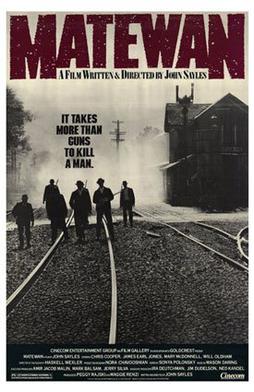
Eight Men Out was released in 1988. The year before, John Sayles released another historical drama called Matewan, named after the West Virginian town where the story takes place. In 1920, coal miners in Matewan go on strike against the Stone Mountain Coal Company after wage cuts. A man named Joe Kenehan (the woefully neglected and underrated Chris Cooper in his film debut) comes to town to encourage the miners to unionize. Soon after, two men from the Baldwin-Felts Detective Agency arrive on a tip from a spy for the company within the town and attempt to frighten the strikers. When the townspeople refuse to leave, the detectives have to bring in backup. It culminates in what is known as the Battle of Matewan – a shootout between the coal miners and detectives working for the coal company.

Matewan is like Christmas – green and reds everywhere. The color grading of the film stock strengthens the greens of the trees and grass of Appalachia. It’s beautiful to look at, and rightfully received an Oscar nomination for Cinematography. The union organizer, Joe, is labeled by the detectives as a “red” – a Communist. Chris Cooper does a wonderful job for not only his first film role, but as the lead. He’s backed up by strong performances from David Strathairn and James Earl Jones.

I love the open-ended view of the politics in the film. Not everyone will agree with the pro-union message of the movie, but it does go out of it’s way to show that both sides escalate the tension and do more harm than good (the miner-supporting town sheriff starts the gunfight in the film, though in real life, no account of who fired first is made). Political messaging isn’t always the best reason for watching movies, however. Sayles’ historical dramas are informative replications of rarely-discussed events in American history. That alone makes them worth watching. Matewan makes a great double-feature with Eight Men Out mostly just to see more of Sayles’ filmography, but there’s a lot to say for the similarities between them in theme, in time period, and in actors (four of the actors are in both films). Both movies are timeless tales of timely situations.

Guess Who’s Back? Back Again.

Yikes. It’s been months. Look, let’s just cut to the Chase. I’ve got several legitimate excuses as to why I dropped off the face of the Earth for a bit, but who wants to hear that? Instead of boring you with a “life update”, I intend to just apologize for my absence, go ahead and apologize for my future absence, and explain what I’m going to be doing in between those.

First, I sincerely apologize for my lack of posts these past few months. I know it’s what most of you live for and I’m sorry I’ve deprived you of random lists of movies that have some vague thematic connection between them or reviews of movies you weren’t going to see in theaters anyways because either you had no interest or it’ll be available on streaming eventually. All I can say is that I intend to do better – nay, to be better – but I can only do so much. I’ve already alluded to the fact that I will be going on hiatus in the near future, so what else is there to say? Hopefully, this isn’t the last series of posts I will be making on this website, and maybe one day I’ll pick up the laptop again, dust it off, and return with great indifference as if I was never gone. But we’ll see. On to the important stuff…

In my circle of friends, I’m known as “the movie guy” – a badge I wear with great pride. I have no problem with having forsaken genuine education like math and science, not to mention basic life skills like how to do my taxes or talk to people, and replacing them with random movie factoids that will get me nowhere in life let alone with most acquaintances. And so, because of this label and notoriety, I get a surprising amount of requests for movie recommendations. If those who ask don’t have a specific idea in mind of what they’re interested in, I typically just pull from my favorites and throw one out there. However, I’ve never on this blog really addressed what my favorite movies are. I have reviewed some and even more have made a list of some kind, but I haven’t outright said, “these are a few of my favorite things.”

So, with my remaining few months of freedom (sounds ominous, don’t it?), I intend to run the gamut and run the gauntlet of movie recommendations by serving up reviews for my Top 100 Movies. To up the ante even more, I intend to include a mini review with each one of a similar or companion film if you want to explore a little more or have yourself a double feature. That means 200 movies in total. Which also means at least one review per day. Woof.

Anyway, we’ll see how this goes. I don’t know when I’ll start, but each review will be numbered, so you’ll know it when you see it. And hopefully, I will not completely flake on this.

Shutter Island

Martin Scorsese, in a near 30-film career, has hardly spent any of that filmography on film noir. He’s certainly championed the movement, specifically mentioning films such as Out of the Past, Nightmare Alley, and Leave Her to Heaven in interviews as prime examples of what noir can do, and many of his films dance around noir motifs (much like the films of the Coen Brothers), but the only full-fledged neo-noirs Scorsese has made are Taxi Driver and Shutter Island. To compare, that’s less than his number of gangster/crime dramas (duh), spiritual films, period pieces, biopics, female-led films and on par with his number of romance dramas, remakes of other films, and comedies. So, when Scorsese divulges into the world of film noir, it’s best to take notice.

Shutter Island may not belong in the zeitgeist of the time it was released like Taxi Driver, Goodfellas or The Wolf of Wall Street, and it may not be the laud of film bros like Raging Bull, Casino or The Departed, but it deserves a place in the discussion of Scorsese’s oeuvre if only for its unashamed adoration for the films and genres that inspired it. Pulling from both Jacques Tourneur and Alfred Hitchcock, Shutter Island twists and turns and nearly terrifies from the beginning all the way to its depressing conclusion.

Leonardo DiCaprio, in his fourth collaboration with Scorsese, plays Deputy Marshal Edward Daniels, but he goes by “Teddy”. He arrives on Shutter Island with his new partner, Chuck (Mark Ruffalo), hot on the trail of known arsonist Andrew Laeddis. Teddy is determined to find Laeddis, convinced he killed Teddy’s wife, but finds the staff at Shutter Island to be uncooperative in his investigation, particularly Dr. Cawley (Sir Ben Kingsley), the head psychiatrist. As Teddy uncovers more about the mysteries of Shutter Island, he also uncovers the ‘truths and lies’ of his own past. That’s the most I can say about the plot without giving too much away, so you’re on your own as far as that goes.

Criticism of Shutter Island tends to focus on the heavily leanings into genre tropes and the over-the-top story, and while these things may be true, they’re certainly not criticisms – they’re assets. DiCaprio’s manic performance fits Teddy better than his period-accurate pants in the flashback scenes. Ruffalo, Kingsley, as well as Michelle Williams and Max von Sydow are all in top form. The atmosphere of the film is dark and brooding. Cloudy skies, rain and hurricane winds convey the external mood and the internal despair. The film practically begs for a lightning strike when the lighthouse on the island is in full view. Shutter Island may be unapologetically genre filmmaking and not as highbrow as it wants to be or Scorsese is typically associated with, but the intrigue that peppers the entire length of the film and the thought-provoking ending make it an enthralling experience.

Night of the Comet

The entire world watches and waits to see a comet pass across the sky that hasn’t been seen from Earth since the age of the dinosaurs. Something once-in-several-lifetimes like this deserves some serious attention, so comet watch parties overtake the evening’s festivities. There’s just one problem: the comet turns those who witness it to dust, or worse, they turn into zombies that will soon become dust. Lucky for sisters, Reggie and Sam, as well as a few other characters we meet along the way, they miss the event. The world they wake up to is a post-apocalyptic dust bowl where the only sound is a prerecorded radio show coming in over the air waves.

Night of the Comet is hardly a zombie movie. As a matter of fact, it is hardly an apocalypse movie. Really, what Night of the Comet is, is a conspiracy movie. A group of scientists who knew about the effects of the coming comet hid themselves to survive the night, but one idiot scientist left the air vent open and the comet dust came in and infected them all. In a desperate attempt to give themselves more time to discover a cure for the comet’s effects, they are killing innocent survivors to harvest their untainted blood. It’s up to Reggie and Sam to stop them before they kill all the remaining survivors.

The synopsis may not make it clear, but Night of the Comet, more than anything else, is a comedy. Reggie and Sam are Valley Girl types thrust into a zombie-infested world, and the movie plays it smart by playing it straight. This is a real apocalypse these girls are experiencing, but even if you can take the girl out of the Valley, you can’t take the Valley out of the girl. Despite their circumstances, Reggie and Sam keep their priorities straight. Their focus is on dating and shopping. Reggie and a boy named Hector end up connecting as they thwart the evil scientists, but who is there for Sam to date if everyone else is dead? And though they go shopping for guns to defend themselves with, they also make sure to give their wardrobe some attention. After all, this is prime time for a new fashion trend.

The movie is action-packed with interesting set pieces and a surprisingly satisfying visual style. Some of the set design is outdated (the radio station the girls meet Hector looks like the 1980s got food poisoning and vomited neon), but that adds to the fun, right? Perhaps, that’s why the movie has seemingly gained a cult following. That nostalgia for the 80s that’s crept into modern Horror properties needs to have a point of reference, after all. The film also follows a rising 80s trend of strong female protagonists, but Reggie seems to never get lumped in with Ripley and Sarah Connor on the lists nerds make to justify their hatred of the latest Star Wars heroine and Sam never truly gets the credit she deserves as the inspiration for Buffy, the Vampire Slayer. Some films just can’t escape their B-movie standing, I guess.

The film is far from perfect, however. The editing lacks a rhythm to it and some scenes last longer than they need to, the actors outside of Reggie (Catherine Mary Stewart, who also starred that same year in The Last Starfighter and was on Days of Our Lives the year before that) are wooden and directionless throughout most of the movie, and some decisions are outright head-scratching (the whole DMK resolution feels tacked on because the writer thought it was way more important than it was). While it has its flaws, there’s enough about Night of the Comet to enjoy a movie night and makes you wish stores like Blockbuster were still a thing. It’s a perfect October rental.

It Came from Outer Space

When I think of the slew of 1950’s Sci-Fi movies that were released on shoe-string budgets, a few things come to mind. Terrible acting, ridiculous special effects, and the most basic plots known to man. It Came from Outer Space is no exception to these things, but with one interesting twist. What if the aliens aren’t here to destroy or enslave us?

John Putman and his fiancee, Ellen Fields are out stargazing one night when John notices something shooting across the skyline from his telescope, watching it crash off in the distance. The two go investigate and, just before it sinks beneath the dirt of a landfill, John sees a spaceship. John tries to convince the town of what he saw, but no one believes him until the sheriff starts to notice some people going missing and returning with a strange air about them. The sheriff decides they have to kill the aliens before they themselves are killed, but John believes a peaceful solution can be reached. He discovers that the aliens aren’t killing anyone, they’re merely shapeshifting into humans they see in order to get ahold of supplies they need to repair their busted ship. Once they have all the parts they need, they will get out of Earth’s hair. It’s up to John to keep the sheriff and his posse from getting to the aliens before they can leave.

Most of the time, these Sci-Fi movies from the 50s are reactions to the Red Scare. The aliens are malicious and vindictive and out to conquer our planet, just like the Soviets. However, this movie, based on a treatment from one of the greatest Sci-Fi authors, Ray Bradbury, depicts the aliens as sympathetic. Not necessarily human, but deserving of a chance for peace. Just that tiny change elevates the movie above many of its peers. It still has the cheesy special effects, but they’re more subdued and used sparingly. It’s not like there’s a giant lobster off in the distance, ready to attack.

Credit can be given to the film’s director, Jack Arnold, for the intelligence behind the camera. Arnold’s other credits include Tarantula, Creature from the Black Lagoon, The Mouse That Roared, and a personal favorite, The Incredible Shrinking Man – all much smarter than their contemporaries. It will still make you laugh when you aren’t supposed to, but It Came from Outer Space is an enjoyable Sci-Fi romp, worth a look during the month of Halloween.

Bubba Ho-Tep

It’s October – spooky month – and that means I plan to focus my reviews on the Horror genre. I’m not really a fan of Horror movies, so I’m probably rather unqualified to do this, but what can I do? I gots to review. There are some great Horror films out there, don’t get me wrong, but the majority of them are too indulgent on what gets audiences – jump scares, gore – to the point where their stories are diluted.

This is my first foray into reviewing Horror, and I thought I should start with one of the oddest films I’ve seen in the genre. Bubba Ho-Tep.

The one-line pitch for this movie is as follows: A geriatric Elvis (still alive and hiding as an impersonator of himself) and a black man who is convinced he’s John F. Kennedy have to save their nursing home from a southern Mummy. Think about that for a second, reread it if you have to. Come on, you know you want to see it.

Maybe it’s because of that crazy hook that the movie felt more disappointing while watching it. It had so much going for it, in theory. I love the totally bonkers premise. I love Bruce Campbell and Ossie Davis (Elvis and JFK respectively). I honestly love the soundtrack. But when it comes down to it, Bubba Ho-Tep is not a good movie. Not even in the campy-sorta way. I’m sure this comes as a shock to all of you.

The biggest issue with the movie is a subplot explaining how Elvis came to impersonate himself and why he has another name, Sebastian Haff. It takes up way too much time and derails the pacing of the movie, all for a joke that needed maybe two sentences to set up. While watching these scenes, I contemplated what could have made them seem necessary to the filmmakers. Really, what I suspect it is, is there isn’t enough story involving the mummy to warrant a full-length movie, so they had to pad the runtime with this backstory. We don’t even get a backstory for JFK’s transformation to a Black man, which would have been much more interesting.

I also don’t care for the director, Don Coscarelli. Other films to his credit are the Phantasm movies and The Beastmaster. If you’ve seen those movies, surely you understand what I’m getting at. Coscarelli is good with minimal budgets, but he’s less consistent with pacing and editing. It makes his films hard to watch and Bubba Ho-Tep is no exception to those tendencies.

A scene where a lady is confronted by a scarab and the last 15-20 minutes (the confrontation with Bubba Ho-Tep) are quite well-done and enjoyable, especially seeing Campbell’s Elvis coming to JFK’s rescue in a motorized wheelchair, but it’s not enough to rescue the film. If you’re a fan of schlock or enjoy watching bad movies for the irony, maybe give Bubba Ho-Tep a try. I’m sure some of you will find something in the movie to latch onto. Otherwise, you’re better off watching something – anything – else. In fact, you’re probably better off not watching anything at all.

Dumb Money

Dumb Money is a simple movie. The good guys are good because they’re poor, and the bad guys are bad because they’re rich. There’s no room for any depth of character, in fact, any personality at all is a deterrent. Paul Dano, the main reason I was willing to see this movie, plays Keith Gill, a struggling financial analyst who spends most of his time streaming to YouTube and posting on Reddit. He and his wife have a young baby and little money to their names. He spends what little they have on GameStop stock.

Gill’s not necessarily unlikeable, but the only reasons we’re given to care about him are the baby and his financial situation, presented at face value. His brother, Kevin (Pete Davidson in his most Pete Davidson role yet), is completely unlikeable. He’s a jerk to his brother and eats the food that he delivers via DoorDash. He’s a stoner that lives with his parents. I think we’re supposed to like him because of these qualities, but he’s about as tolerable as scraping your bum with a cheese grater.

Keith Gill has something on his side, though: internet culture. He’s a frequent YouTuber, posting livestreams of his financial data, making arguments for why GameStop is a slept-on stock, and he’s also a frequent poster on the subreddit r/WallStreetBets. Because of his wise business sense and his dank memes, he cultivates a massive following, successfully convincing others to buy up GameStop stock simply because he “likes the stock”.

GameStop stock skyrockets as a result, and everyone holding on to their stocks instead of selling it produces a short squeeze on the hedge funds that were short selling the stock, causing some ridiculously rich men to lose a lot of money. When they notice the holes in their pockets, they do everything they can to cut off the tap. The poor nurses and college kids, as well as Keith Gill, watch in horror as the evil rich men switch the rules of the game, causing riotous behavior, such as an increase in TikTok videos. In the end, Congress gets involved and those evil rich men embarrass themselves with having to answer for their actions in a hearing. I think this is supposed to be a victory for the good guys, but I’m not sure. Also, Keith Gill is now a multimillionaire, so I think I’m supposed to hate him too now?

Dumb Money has a very specific audience. It’s a film for the younger generations who believe memes are the pinnacle of comedy, and assume anyone who is wealthier than a broke college student is a bad person. And this is my biggest problem with the movie: it makes me defend the rich guys. People who commit shady business practices (legal or otherwise) where they step on those less fortunate to deepen their pockets are bad people, but they’re not cartoon villains. There’s always a chance for redemption or at least nuance to their character. For instance, did you know that Gabe Plotkin (played by Seth Rogan trying his hardest not to Seth Rogan all over the place), despite bleeding money from the short squeeze, took money from his own compensation to provide his staff with their annual bonuses and continued to donate to Jewish veterans? If your entire knowledge of these events is this movie or Reddit, then you certainly wouldn’t.

On top of its cardboard characterization, the movie is also almost completely tensionless and forgettable. Like most anything you find in the theater, Dumb Money can be an entertaining way to waste a couple of hours, but if you’re looking for something good or fulfilling, or even something more akin to The Social Network, my advice is to look elsewhere.

The Innocent

What if Brian DePalma tried to make a family dramady…and was French? That’s 2022’s The Innocents. It’s equal parts comedy, romance and heist. It has moments where it’s totally grounded, and others where it’s off-the-walls.

Sylvie, who teaches prison inmates theater, falls in love with one of her students, a convict named Michel. She drags her son, Abel, to the prison for their wedding ceremony. Abel is understandably hesitant, especially considering his mother has a history of being romantically involved with prison inmates. Once Michel is out of prison, much of the early film is him trying to connect with Abel, while Abel resists and instead tails Michel, with the help of his best friend, Clemence, convinced he’s setting up another robbery. Classic setup for one of those “we’ve got to learn to get along”-type movies.

Where the film goes off the rails (in a good way) is when Abel’s suspicions prove correct. Michel, fresh out of prison, called in a favor from one of his former buddies to secure a building so he and Sylvie can open up a flower shop with no rent attached. The problem, now, is Michel can’t get something for nothing, and now has to pay for the shop by robbing a semi carrying crates and crates of caviar in order to flip them for a profit. Michel scopes it out and its seems like a perfect setup – the driver stops at the same roadside bar at the same point in his deliveries and always orders the same meal and dessert. After timing the rest stop multiple times, Michel has it down to a science on when and how to extract the caviar. The only problem is that he needs to stall the driver for about 10-15 minutes to ensure a clean getaway, so he asks Abel’s help for a little father/son bonding. When Clemence calls him a chicken for not doing anything exciting in his life after the tragic death of his wife, Abel agrees.

Clemence gets roped in as well, and she and Abel take a crash course in acting, courtesy of Michel, in order to learn how to play a fighting couple convincingly. Once they add a little bit of true life to their performance, they’re ready to go. The heist nearly goes off without a hitch, but is busted by the double-cross of Michel’s work associate. A mad-cap escape sees Abel rush Michel to the hospital and Clemence makes off with the goods. Once things settle down, Abel, in order to prove himself to Michel, Clemence, and, well, himself, goes to make the deal for the caviar. It’s a setup, and Abel is arrested. Michel and Sylvie are no longer on speaking terms for roping Abel into his schemes, but things are looking up. Abel moves past the feeling of self-loathing over his wife’s death and confesses his love to Clemence. They are married in a scene mirroring his mother’s wedding at the beginning of the film.

The Innocent is a good film. Cute, surprisingly tender, and funnier than it probably should be. But the convoluted plot weighs it down, and it doesn’t have enough room to breathe. Really, I think it just tries to do too much, to the point where the ending feels lacking. I wanted more. I wanted crazier. And the ending, while acceptably silly, is just too mild for my tastes. There’s a nod to the DePalma influence in the use of split-screen for a scene, but it doesn’t add much to the scene, and in fact detracts from its focus a bit, and then it never shows up again, so I’m left wondering what was the point. If you can handle subtitles and have some time on your hands, The Innocent is short and charming, and different enough to hold your attention.

Alice Doesn’t Live Here Anymore

At the time of my writing this, Martin Scorsese’s latest picture, Killers of the Flower Moon, is roughly three months away from release. Early buzz for the film ranges from “Scorsese’s masterpiece” to “a fantastic film, if a little too long”. Between the collaborations (Scorsese, De Niro and DiCaprio, not to mention Lily Gladstone), and my own personal interest in the story (I read the book, I’m from Oklahoma, and I have an unhealthy obsession with Native American history and culture), it’s preemptively my most-anticipated release of the year. What better time, then, to take a deep dive into Scorsese’s hefty filmography? This is an odd starting point, considering what Scorsese’s famous for, but it was available on The Criterion Channel for the month of July. So, here it is: Alice Doesn’t Live Here Anymore.

Martin Scorsese’s fourth feature film puts the director into uncharted waters of his oeuvre: the romantic comedy. Apparently, this film wasn’t even on Scorsese’s radar at the time. Ellen Burstyn, who plays the titular Alice, and won an Academy Award for Best Actress to show for it, received a copy of the script from her agent after being tasked with finding a complicated woman for her to play. After reading the script, she went on the hunt for a young, visionary director to helm it. It was Scorsese’s previous film, Mean Streets, that was garnering all the buzz at the time, and after viewing a screening, Burstyn decided he was the man for the job. Warner Brothers agreed, and so began Scorsese’s journey into major studio filmmaking.

Alice is a stay-at-home mom caught between her needy and verbally abusive husband and her preteen boy who is discovering that “brat” is a viable personality. Alice doesn’t have to keep the peace very long when her husband dies in a work-related accident. His death, however, leaves Alice and her son without any prospects or security, so they hit the road, heading towards California, so she can realize her dream of being a singer – a dream that was completely derailed by married life.

Her financial straits demand they stop in Phoenix to earn enough money to make the rest of their trip. Initially, she can only get work as a waitress, but through her determination, she is able to secure a job as a lounge singer. She captures the heart of the young cowboy, Ben (played by a young Harvey Keitel), and he sweeps her up into a whirlwind romance that is going great until she discovers he’s also abusive. Oh, and also, he’s married. Yikes! In the middle of a confrontation between her, Ben, and Ben’s wife, Alice decides it’s time to continue to Monterey. They get as far as Tucson before they are forced to stop again.

In Tucson, Alice gains employment as a waitress at Mel’s diner, working alongside the outspoken, headstrong Flo, and timid-to-the-point-of-collapse Vera. The chaos in the diner leads to some of the funniest scenes in the film, especially when Vera’s involved. Alice also meets a divorced rancher, David (Kris Kristofferson), and they fall in love. “Oh, sweet mystery of life, at last I’ve found you!” It’s days of wine and roses until David finally does the seemingly unforgiveable: he spanks Alice’s son. Trust me, over the course of the movie, I spent more time with Alice’s son than David did, and he’s lucky a spanking is all he got. When he runs away after his reprimanding, Alice frantically searches all of Tucson for him, determined to find him and get him to Monterey. However, when she finds her son, they have a heart-to-heart, and Alice realizes that she’s happy in Tucson with David, and so is her son, so they make the decision to stay.

The script and Burstyn’s feminist take on the character makes Scorsese an interesting choice when considering modern criticism of his filmography (i.e. the sidelining of his female characters). I suspect her decision to choose a man over her dreams won’t sit as well with the most recent wave of feminists as maybe it did in the 70s. However, I think one of the things this movie does well is show growth in Alice’s character. At the beginning, she doesn’t have a choice in the direction of her own life, or at least she doesn’t believe she does, but at the end of the film, it’s completely her decision to stay or go. The other thing this movie does well is lean into the shmaltzy look and feel of older soap operas and 1940s melodramas. It gives the movie character and a charm that it’s mostly lacking.

This brings me to my biggest criticism of the film: it’s surprisingly bland. Without its color and occasional cutesy attitude, I doubt I would have made it to the end. Ellen Burstyn does great, but it’s far from her best performance (I suspect the Academy gave her the award for this film because they realized their mistake in not giving it to her for The Exorcist), and with the exception of Flo and Vera, all the other actors are wooden. I’ve never considered Kris Kristofferson a good actor and he doesn’t change my mind here. The kid is the most frustrating part of the entire film, though that may not be the actor’s fault. The character is insufferable, and I have never wished for a worse end to a kid in a movie since Mildred Pierce.

In the end, the movie is passable, and cute enough to give a look if you have the time, but don’t go out of your way to make time for it unless you’re doing a Scorsese marathon like I am. Mean Streets was a glimpse of what Scorsese could become, but Alice Doesn’t Live Here Anymore is someone else’s movie tossed into his lap.

Gran Turismo: Based On A True Story

Did you know this movie is based on a true story? I was unsure how to address the title of my review because all of the posters for this movie say “GRAN TURISMO” in big white or black letters across the top, and in much smaller letters, somewhere below that, it says “Based on a True Story”. Like it’s a tagline or an afterthought. But when I went to purchase my ticket, it lists the title as “Gran Turismo: Based on a True Story”, as if that were the full title. They really want you to know that this movie is (somewhat) based on a true story, and who can fault them for that? It’s an excellent piece of marketing. I wish other movies were that forthright with their origins. Titanic: Inspired by True Events. Schindler’s List: Based on a Book Based on a True Story. Braveheart: Total Male Fantasy, but William Wallace was a Real Guy.

This movie was fine, and more like the kind of “fine” your significant other is when you ask them how they’re doing, knowing full well they’re not doing “fine”, than actually fine. Which is a bummer, because the fact that this film is “Based on a True Story” makes it such an interesting idea for a film. The basics, for those not in-the-know, is a young man who is really good and obsessed with the Gran Turismo video game series, gets the opportunity to put his gaming skills to the test by becoming a real racecar driver, through a training academy set up by Nissan and PlayStation. It’s the story of a group of outsiders that have to prove they belong in a world where no one wants them. The premise is fine – actually fine – but that’s the best it can do.

There are some positives to be sure. The movie editing is tight and quick, all gas and no breaks, which keeps the movie exciting and suspenseful. I was certainly on the edge of my seat the whole time. It felt like a rollercoaster or like a game of Gran Turismo (I can only presume, since I’m not really a fan of racing games – not even Mario Kart), but at the very end, as I was walking out to my car, I wondered how I could have spent the entire movie so enthralled and yet walk away so nonchalant. Then, it dawned on me that I didn’t care how the movie turned out, I didn’t care about the characters, and it merely gave me an adrenaline rush. So, I guess I got my money’s worth.

It’s a struggle when talking about film sometimes, because film is sometimes highly artistic, and sometimes it’s solely mindless entertainment. I love a good rollercoaster, but the thrill is certainly a fleeting one. Likewise, Gran Turismo: Based on a True Story is fun and exciting, but it’s not going to linger with you unless you buy another ticket. But I’m digressing.

Some of the acting performances are worth mentioning. David Harbour, of Stranger Things fame, remains the highlight of anything he’s in. He plays Jack Salter – a former racer who lost his mojo and now works as a lowly mechanic until he gets roped into teaching these gamer losers how to be winners. And while we’ve seen his type of character thousands of times, Harbour ignites in every scene he’s in. Djimon Hounsou, who plays Steve Mardenborough, does the best with what he’s given, playing another stereotype – the father to our main character, Jann (it’s a soft “J”), who just doesn’t believe his son’s silly dreams until a tearful reunion makes him see the light. And then, there’s Orlando Bloom. Orlando Bloom is…there. In the movie. Seriously, what happened to that guy? I guess I just don’t love him if he’s not defying physics as an elf archer or the dull pirate of a two-pirate crew.

The two biggest things I have against Gran Turismo: Based on a True Story, are our main character and an emotional detour or pit stop that’s supposed to set up and lead into a triumphant final race. Whatever you want to call it, it pumps the breaks on the whole thing.

*Spoilers beyond this point. If you don’t want to be spoiled, scroll down to where you see a message similar to this.*

Okay, so everything is going great for Jann. He’s got his racing license, he’s coming up fourth and fifth place in races consistently, and he’s looking to get onto the victory podium. And then, suddenly, in the middle of a race, his car goes over a hill and gets too much air, causing him to flip the car and go crashing through the track and into some spectators. One of them dies, and Jann is informed of this when he wakes up from his mini coma. Realizing what has happened, he is understandably sad, and he may never race again. Racing is dangerous, after all.

My problem with this portion of the movie is two-fold. One, it’s so out-of-nowhere. Jann is cruising down the track, making a name for himself, and then boom! People die! And you know you should be sad because the music that plays in the background is sad. If you’ve been enjoying the movie so far, you’re going to get whiplash. And maybe you can say that’s the intention of the filmmakers, but I don’t think it is, at least not entirely. My second problem is that this crisis is completely unnecessary to the film. It adds a bit of internal conflict for Jann (which doesn’t work, and I’ll get to that in a minute), that’s resolved five minutes later. The movie had enough conflict to keep people engaged without the crash. You get the sense that the filmmakers felt they had to include it just because it was such a tragic accident that really happened. They rush through it, telling Jann and the audience that it was a freak accident and no one’s fault (again, this is Sony and Nissan making this movie about Sony and Nissan), and there’s no real closure. It just goes away as quickly and jarringly as it came.

*Spoilers over with. You may continue.*

My other main gripe with this movie is our main character, Jann. First of all, I don’t think the actor, Archie Madekwe, is particularly good. Granted, he seems fairly new, and maybe he’ll keep growing and improving. However, I really feel like he was fighting a losing battle in this movie. Jann is a real person, and so Archie has to pass for someone you can easily find videos online to compare to, but the filmmakers also want you to see yourself as Jann. He’s a self-insert for all the gamers and dreamers out there, and so it becomes difficult to give Jann any personality. The most we get is his love of Kenny G and Enya, and that he’s sad when tragedy strikes, but he appears sad most of the time, so it’s hard to tell the difference. This idea of the main character as a stand-in for the viewer seems to be a newer trend in movies, and it really has its origins in video games, so it kind of makes sense here, but it gets in the way of storytelling and character development, causing both to suffer.

In the end, Gran Turismo: Based on a True Story does most of what it sets out to accomplish. And again, it is a white-knuckle thrill ride for the majority of its 2 hour and 15 minute runtime. It’s an enjoyable way to spend an afternoon. But that’s all it is. Don’t let that “based on a true story” moniker rev you up too much. If you do, you’re likely to crash and burn.

Rating: 4/10