71. Three Amigos

It’s amazing that this is the only film that Steve Martin, Martin Short and Chevy Chase all worked on together. Though, perhaps, based on the reported attitude of Chase and the continued friendship of Martin and Short (if you’re not watching Only Murders in the Building, you should be), we can assume what went on behind the scenes. Three Amigos also has the great distinction of being Randy Newman’s (“Short People”, “I Love L.A.”, Toy Story music) sole screenwriting credit. Go figure.

El Guapo and his Mexican gang terrorize the village of Santa Poco. The village leader’s daughter, Carmen, travels to surrounding villages in search of someone who can protect Santa Poco. She stops inside a church where they are showing a silent film starring the Three Amigos – Lucky Day, Dusty Bottoms, and Ned Nederlander. Thinking they’re real heroes, Carmen sends them a heavily-edited telegram asking for their help. The Amigos are fired and kicked off the studio lot from where they made their hit movies when they receive the telegram. Thinking it’s a celebrity appearance to their Mexican fanbase, the Amigos sneak back into the lot to get their costumes. In Mexico, they meet with Carmen and the village welcomes them with open arms. The next day, some of El Guapo’s men ride in and the Amigos put on a stunt show as a display of scaring the men off. Confused, the men go back to El Guapo to tell them what they’ve seen. The next day El Guapo returns with his posse and during another stunt show, shoots Lucky. Now that the Amigos realize they are in very real danger, they whimper and beg for their lives. El Guapo lets them live since he only kills men, but he sets fire to Santa Poco and kidnaps Carmen. The Amigos decide to be real heroes for once and go after them. They infiltrate El Guapo’s hideout during his 40th birthday party and leave with Carmen, knowing the posse is right on their trail. They return to Santa Poco and encourage the villagers to recreate the ending of The Magnificent Seven, complete with coordinated costumes.

This film could have looked very different from the finished product. For one thing, this wasn’t John Landis’ Final Cut of the film. The studio edited heavily while he was on trial for an accidental death from his segment on Twilight Zone: The Movie. Also, originally, Steven Spielberg was set to direct (if you’ve seen 1941, you know what a mistake it would have been to let that man do a comedy). The trio was also originally going to be Steve Martin, Dan Aykroyd and John Belushi. Then it switched to Steve Martin, Bill Murray and Robin Williams. I’m gonna level with you, as much as I like some of these names, I don’t think I could have stomached the movie with some of them attached. So, thank goodness for circumstance, I guess.

Three Amigos is hilarious from the situations to the dialogue to the homages to other Westerns. Of course, the fact that Martin, Short and Chase are naturally funny helps the movie out a lot. The best scenes in the film involve original songs also written by Randy Newman – the “My Little Buttercup” bar scene surrounded by tough hombres, and the singing-cowboy-around-the-campfire, “Blue Shadows on the Trail”, complete with horse accompaniment are a riot.

Bonus Review: The Jerk
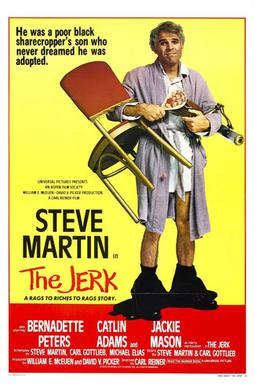
Another Steve Martin classic. This time under the direction of Carl Reiner (actor, director, creator of The Dick Van Dyke Show and one half of the 2000 Year Old Man). The Jerk is Martin’s first starring role after writing for the Smothers Brothers and beginning a career in stand-up. In fact, Martin wrote the treatment for The Jerk around some of his routine – starting with a one-line gag: “It wasn’t always easy for me; I was born a poor black child.” And that’s exactly how the movie starts.

Navin grows up with his family of Black sharecroppers in Mississippi, and he doesn’t realize he’s adopted until he finds he can dance in rhythm to music that could be on the Lawrence Welk Show, when he couldn’t dance to the Negro Spirituals his family sang. He decides he’s going to see the great, wide world. He gets a job at a gas station and ends up destroying a church when he tries to detain a couple of guys he recognizes as trying to steal from him. Another customer’s glasses break, and Navin makes a brace for them so the man can still see. A man randomly picks Navin’s name out of the phone book and decides to kill him. He shoots at Navin while he’s on the job from a distance with a rifle. He misses each time and instead shoots holes into the stacked cans of gas. Navin runs away and joins a carnival as a weight guesser. There, he is swept up by a motorcyclist into a one-sided relationship. He falls in love with a girl named Marie, and they have the happiest time together, but she leaves him claiming he cannot be financially stable working at a carnival. Meanwhile, the glasses he fixed became the prototype of an invention called the “Opti-Grab”. Navin is given his share of the profits and is able to send his family money as well as convince Marie to marry him. They buy a mansion and are overrun with possessions, but then Navin is hit with a lawsuit claiming the Opti-Grab leaves people permanently cross-eyed. He loses the suit and goes broke. He ends up homeless in an alley until his family and Marie find him and bring him home.

The Jerk is very episodic and some of the scenes barely string together, but it’s still good fun. Some of the lines are so quotable (“That man hates these cans!”) and some of the visual gags come out of nowhere that the surprise alone is enough to put you in stitches (hitching a ride with a man who only takes him a block, or Marie pulling out a flugelhorn during their duet on the beach). Honestly, trying to make logical sense of the film will only lead to headaches and frustration. It’s a relentless frenzy of goofy jokes, but that’s why it’s worth watching.
72. Pan’s Labyrinth

Let’s be honest, film bros. Guillermo Del Toro is very hit or miss, and he hasn’t had a good movie since Crimson Peak, and he hasn’t had a great movie since Pan’s Labyrinth. Pan’s Labyrinth is a horrific fairy tale set just after the Spanish Civil War and follows a little girl, Ofelia, as she acclimates to her new stepfather who happens to be one of the biggest jerks ever put to film.

Ofelia and her pregnant mother, Carmen, travel to be with Ofelia’s new stepfather, Captain Vidal, where he is posted as he hunts down rebels against Falangism. One night, Ofelia sees a stick insect in her room. Thinking it’s a fairy, she lets the insect lead her to a stone labyrinth in the woods. However, she is stopped by Mercedes, Vidal’s housekeeper who financially supports her brother, Pedro, and the other rebels. Later that evening, the insect returns and transforms into a fairy, once again leading Ofelia to the labyrinth. This time, she meets a faun who believes her to be the reincarnated Princess Moanna. Princess Moanna was the daughter of the king of the underworld who went to the surface world, became mortal and died. The king built these labyrinths across the world to acts as portals because he believes the spirit of the princess will one day return.

The faun tells Ofelia that she must complete three tasks in order to become immortal and return to her real father in the underworld. She completes the first task easily enough, but for the second one, she is instructed to not touch anything that belongs to the Pale Man, a child-eating monster, but she eats two grapes, which wakes the Pale Man up and he chases after her. She narrowly escapes, but the faun is furious with her disobedience. After this, Ofelia witnesses Vidal killing and torturing rebels. Her mother also dies during childbirth. The faun tells Ofelia that the third task is to bring her newborn brother to the labyrinth. She sneaks off with the baby as the rebels attack Vidal’s camp. The faun tells her to spill some of her brother’s blood to complete the task but Ofelia refuses. Vidal appears, takes his son, and shoots Ofelia. He is killed by the rebels shortly after and the boy is given to Mercedes to raise. Ofelia’s own blood spills onto the threshold of the portal and she appears before the king of the underworld who greets her cheerfully, claiming that her willingness to spill her own blood instead of her brother’s is what completed the third task. The faun greets her happily and Ofelia is offered a seat next to the queen, her mother.

The movie is left to interpretation. Was Ofelia really the spirit of the princess, or did she just die and dream this on her way out? I guess since her dad is supposedly king of the underworld, it could be both. Either way, I appreciate the simultaneous use of fairy tales as life lesson and coping mechanism. In the same way that mythology works, fairy tales have the ability to express deep truths and also offer explanations for the inexplicable. As far as Pan’s Labyrinth is concerned, it’s genuine approach to death and life’s unfairness, as well as the institutions that make it unfair, keep it weighted down and makes it hit closer to home for all of us.

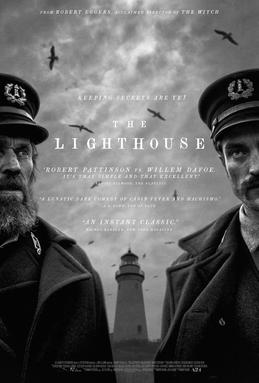
Bonus Review: The Lighthouse

Inspired by an unfinished story by Edgar Allen Poe and a myth about the mysterious deaths of a couple of lighthouse wickies in Wales, The Lighthouse follows two wickies as they spend their time in isolation. Over the course of the film, the two slowly descend into drunken madness. That descent ramps up ever more when Robert Pattinson’s Ephraim kills a one-eyed seagull, something that Willem Dafoe’s Thomas superstitiously warns him against doing. This film is filmed in black and white and contains frequent use of period-accurate maritime dialogue, which gives it a greater sense of historical and mythological presence. Robert Eggers’ previous film, The Witch, also notoriously keeps its depiction accurate to the period in which it is based, making Eggers an interesting new-ish director to watch.

The Lighthouse is immersive in a way that very few movies made today are. Movies that come out these days are looking for the latest and greatest technology to tell their stories, but The Lighthouse uses old technology – filmed on old cameras and outdated film stock – and tells a confined story that requires very little in the ways of set design. The surrealist nature of the increasing hallucinations isn’t even that out of place, though instead of a bullet-looking rocketship crashing into the eye of the moon, we have detailed mermaid anatomy. In this respect, it maybe suffers from too much of the modern, but the old-timey dialogue makes up for it, I promise.

73. Ghost Dog: The Way of the Samurai

Ghost Dog: The Way of the Samurai should not work, but it does. When you watch it for the first time, there’s something about it that just feels off, like something doesn’t gel. And yet, somehow, it sits in that sweet spot, toeing the line between utter chaos and total order, which honestly fits well with the other Eastern philosophies within the film. Ghost Dog (Forest Whitaker) is a hitman in an unknown city (though it’s most likely meant to look like New Jersey, where it was filmed). He’s employed by the Mafia, but he lives by the code of the samurai and reads from the Hagakure. This is the first film scored by RZA from Wu-Tang Clan, which feels very fitting.

Ghost Dog is told by Louie, a mobster and man who saved Ghost Dog’s life years ago, to kill another man, Handsome Frank, because he is sleeping with the daughter of Vargo, the Mafia boss. Ghost Dog kills Handsome Frank before realizing the girl is there with him. Ghost Dog leaves her alive. Vargo and his right-hand man, Sonny, decide they need to kill Ghost Dog to cover their tracks. They approach Louie for information, but Louie doesn’t know much about Ghost Dog as he communicates solely by carrier pigeon. Vargo and Sonny investigate all pigeon coops around until they find Ghost Dog’s cabin, and they kill his pigeons. Meanwhile, Ghost Dog visits a park where his friend, French ice cream vendor, Raymond works. They cannot speak each other’s languages but still establish a friendship. Ghost Dog also befriends a girl, Pearline, who is at the park and he gifts her a copy of the book, Rashomon (I guess people have different interpretations over whether that’s a good gift for a girl or not). Ghost Dog realizes that Vargo will kill Louie if they cannot find him, and so Ghost Dog sneaks into Vargo’s mansion and single-handedly kills everyone inside except for Louie and Vargo’s daughter. He expects that Louie will kill him as an act of revenge for his boss, so Ghost Dog gives all his money to Raymond and Pearline shows up to return Rashomon. He gives her his copy of the Hagakure. While they are in the park, Louie arrives, and though he shows great affection for Ghost Dog, he is intent on killing him. Ghost Dog refuses to kill his master, and so he lets Louie kill him. Before he dies, Ghost Dog convinces Louie to read Rashomon. Pearline picks up Ghost Dog’s gun to kill Louie but discovers it isn’t loaded. Louie leaves with Vargo’s daughter and Pearline returns home to read the Hagakure.

Ghost Dog shares many similarities to another hitman film, the Jean-Pierre Melville movie, Le Samourai. Both films follow a hitman with a personal code who must face off against who hires them and end in a gunfight where they knowingly have no bullets. Where Ghost Dog differs from similar films is in its internal conflict during that final showdown. Ghost Dog may not be in conflict with himself, but Louie sure is. He recognizes that Ghost Dog has seen him as a master and does not want to kill him because of it, but through his own similar code, must avenge the death of his boss. We are left to interpret the depth of his anguish, but we can at least recognize that it’s there. And what the movie does so well is establish that code throughout the entire film with Ghost Dog’s dedication to Louie, so when the ending comes, it’s easy for us to understand.

Ghost Dog is such an odd film, I guess in a way that Jim Jarmusch is known for, but it’s got an emotional center. We feel for all the characters except maybe the Mafia guys, and that’s what will keep you coming back to it.

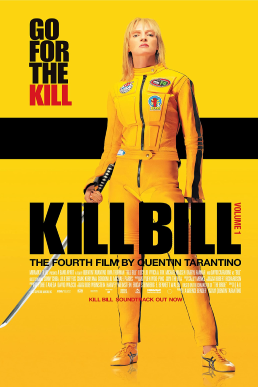
Bonus Review: Kill Bill

Another film scored by RZA. I guess that’s the connection. I can understand if you haven’t seen or heard of Ghost Dog, but come on. You’ve heard of Kill Bill. Uma Thurman is The Bride, an assassin bent on killing her fellow assassins and their boss, Bill, who tried to kill her and her unborn child. It features references to all the classic Tarantino-isms: blaxploitation, Spaghetti Westerns, and Samurai movies (particularly Lady Snowblood). Quentin Tarantino blends them all into a two-film explosion of cult cinema, and even includes an anime sequence.

The Bride (formerly “Black Mamba”) prepares for her wedding at a small chapel in El Paso. She’s a former member of the Deadly Viper gang and is bearing the child of their leader, Bill. Bill and the remaining Deadly Vipers arrive to the chapel and kill everyone, shooting the Bride in the head last. She wakes up from a coma after four years and kills a hospital worker attempting to do unseemly things to her and steals his car. She decides to kill the entire Deadly Viper gang, and so begins with Vernita, aka “Copperhead”. Vernita has also quit the Deadly Vipers and lives a normal life in the suburbs. The two fight until Vernita’s daughter arrives home from school, then they fight more quietly. The Bride kills Vernita and makes her way to Japan. She approaches Hattori Hanzo (an incredible feat since he’s been dead since the 1500s) to make her a sword, which he agrees to after learning she intends to kill Bill, his former student, with it. With her new sword, she travels to Tokyo to face O-Ren, aka “Cottonmouth”. O-Ren is leader of the yakuza and spends her time at a restaurant with her gang, the Crazy 88s. The Bride kills the entire gang and then she and O-Ren fight in the snowy garden outside. The Bride kills O-Ren then gets information on Bill’s whereabouts from her assistant.

The second part begins with the Bride arriving at the trailer of Budd, aka Sidewinder. However, Budd has been tipped off to her arrival and immediately incapacitates her and buries her alive. We then move to a flashback of the Bride being introduced to the martial arts master, Pai Mei. Bill claims he has a technique called “Five Point Palm Exploding Heart” that allows an opponent to take five steps before they die, but he refuses to teach it to anybody. Overtime, the Bride earns Pai Mei’s respect, and back to the present, we see her use his fighting techniques to break out of the coffin she’s buried in. Elle, aka California Mountain Snake, who wears an eyepatch, arrives at Budd’s trailer to buy the Bride’s sword for a million dollars. However, when she opens the bag containing the money a real black mamba pops out and kills Budd. Elle calls Bill, claiming the Bride killed Budd and Elle killed her. The Bride opens the trailer and fights Elle, plucking out her other eye. Then she travels to Mexico to find Bill. When she arrives at his home, she is introduced to B.B., the child she thought she miscarried. To protect B.B., the Bride spends a “nice” evening with her and Bill. When she puts the girl to bed, she and Bill fight. She ultimately defeats Bill using the Five Point Palm Exploding Heart Technique. She and B.B. make their escape to a brighter future.

Kill Bill compiles both the best and the worst of Tarantino’s tendencies. The seamless blend of different genres that don’t initially feel like they should go together, the eclectic soundtrack, and the snappy and pop culture-filled dialogue, but it also overstays its welcome with some of the fight scenes and the desire to combine all these tropes from these different genres and stuff them into one story sacrifices focus and consistency. The film is still great, but that lack of focus is what caused the film to be separated into two movies. And the two movies aren’t equally weighed. Part One is significantly better than Part Two, and that’s a shame since it hurts the payoff of the whole story. Still worth watching, though.

74. The Mission

Rodrigo Mendoza (Robert De Niro) is the worst kind of human being. He sells people into slavery, and he’s a Cain. He killed his own brother. He finds salvation through conversations with a Jesuit priest named Gabriel (Jeremy Irons), who is in Paraguay, attempting to convert the natives to Christianity. He is successful with Mendoza, and somewhat successful with the natives, until political realignments in Spain and Portugal condemn the mission they call home and demand they move. The Guarani natives do not want to leave their home, and plan to resist. Mendoza also wants to stay, and defends his newfound faith and home the only way he knows how – with a sword. The Mission is a testament to the strength of faith when it’s genuine and the detriment a wayward believer can have on a new convert or the overlap of politics and religion can have on entire groups of people.

The Mission is based on real events. In 1750, The Treaty of Madrid instituted a passing of land in Jesuit Paraguay from Spain to Portugal, and the ending battle is considered part of the Guarani War, where the Guarani defended their homes from the implementing of the Treaty. The Guarani are an indigenous people in South America that was without European contact until the mid-1500s. They were completely isolated before that. Then, in the early 1600s, Spain began setting up missions in Guarani territory to convert the Guarani to Catholicism. Luckily, some of their culture survived and even continues today, such as their language. The film mostly took place around where the Guarani actually live, which covers a range of Argentina, Paraguay and Brazil, roughly where they intersect at Iguazu Falls. You know, this place…

I probably talk too much about movie scores in my reviews, but listen when I say that The Mission‘s soundtrack, composed by the legendary Ennio Morricone, is absolutely gorgeous. It’s the sound of Heaven for our ears. How many scores can you name that prominently feature an oboe, especially a silky smooth oboe? That’s right, none. The score for The Mission is one of a kind and it’s one of the few soundtracks I can listen to on its own. Also, I know I rave about acting in just about each review, but I really want to talk about Jeremy Irons for a second. He has a voice for Shakespeare, especially when lions perform it, but typically, Shakespeare is a very boisterous, confident form of acting. Jeremy Irons somehow plays the timid and downtrodden Father Gabriel perfectly. I’ve never seen him in such a role, and it’s a shame. I wish he had done more closer to his work in The Mission.

The Mission is a perfect film if you’re wanting a story of David vs. Goliath odds and Norse-like commitment to the end. It’s also just a beautiful film to look at when it’s not too foggy.

Bonus Review: The New World

Terrence Malick knows how films should look. His eye for photography and his collaborations with cinematographer, Emmanuel Lubezki, make for some of the most gorgeous filmmaking you will ever see. If you’ve seen The Revenant, you know what a Lubezki film can look like. Like The Revenant, The New World is filmed mostly using natural lighting, and in fact, even beyond the cinematography, the rest of the film strives for authenticity. It was filmed near the actual locations for Jamestown and casted Native Americans who were taught to speak a variation of the now-extinct Powhatan language.

I’m sure most everyone knows the story. Three English ships arrive on the coast of Virginia full of settlers ready to conquer the New World. The Powhatans, particularly the chief’s daughter, Pocahontas (Q’orianka Kilcher), watch with apprehension as the settlers make for the shore. The settlers struggle to survive as disease sweeps through the camp and supplies run low. Captain Newport (Christopher Plummer) returns to England to get more supplies, and in his absence, John Smith (Colin Farrell) leads an expedition north and is captured by the Powhatans and nearly killed, but Pocahontas intervenes on Smith’s behalf. Over the course of his imprisonment, Smith and Pocahontas fall in love. Smith is eventually returned to Jamestown and receives an offer to lead his own expedition to find the East Indies. He returns to England. Pocahontas is banished by her tribe for her affair with Smith and she ends up in Jamestown. She is told that Smith died on the return journey to England and she acclimates to the English way of life and marries John Rolfe (Christian Bale). She and Rolfe go to England, which for Pocahontas, is the New World. They live there for a time, and Pocahontas discovers Smith is still alive. They meet again, but part with their relationship unresolved. Pocahontas commits to Rolfe and their new son, Thomas. Just before they are to return to Virginia, Pocahontas gets sick and dies. Rolfe and Thomas go to Virginia anyway so Thomas can see where his mother lived.

For those who care about such things, this marks the second time Christian Bale has been in a movie about Pocahontas. Funnily enough, his character in the Disney version is named Thomas. The real star of the show is Q’orianka Kilcher, who was 15 when The New World was made. This was only her second film, after a random background Who in Ron Howard’s live action How the Grinch Stole Christmas, and so it seems extra impressive how well she carries the two-and-a-half hour film. Surprisingly accurate (outside of the Smith-Pocahontas romance), The New World is a great retelling of the beginning of what will eventually be the United States of America.

75. Lawrence of Arabia

Do you have any interest in spending nearly four hours staring at the desert? If so, Lawrence of Arabia is the movie for you. David Lean was originally known for British melodramas, such as Brief Encounter, before turning his attention to an epic sense of scope with his film prior to this one, The Bridge on the River Kwai. Lawrence of Arabia received numerous accolades and inspired an entire generation of filmmakers, including Steven Spielberg, Martin Scorsese, Stanley Kubrick, Sam Peckinpah, Ridley Scott, George Lucas and Brian De Palma. It even inspired some of David Lean’s contemporaries, like my personal favorite filmmaker, Akira Kurosawa.

Lawrence of Arabia is divided into two parts with an intermission between them. Part One begins with T.E. Lawrence’s death via motorcycle accident before transporting us back to World War I. Lawrence is a lieutenant in the British Army who is requested by the Arab Bureau to assess whether or not Prince Faisal stands a chance in his revolt against the Turks. Lawrence follows his guide, Tafas, but Tafas is killed by Sherif Ali for drinking from another person’s well without permission. Upon his arrival, Lawrence meets Colonel Brighton who tells him to be quiet, make his assessment and leave as soon as possible. Lawrence immediately disobeys, but luckily, Prince Faisal appreciates his outspokenness and encourages it. Faisal is encouraged by the colonel to retreat from a fight he is significantly losing, but Lawrence convinces Faisal to provide him with fifty men to lead to nearby Aqaba for a surprise attack. Their victory would provide them with a port for the British to access and bring in supplies. Faisal agrees, but puts Sherif Ali in charge. They cross the Nefud Desert and barely make it to a source of water. One of them, Gasim, falls off his camel along the journey and no one notices. But later, Lawrence realizes he’s nowhere to be found and turns back for him, successfully returning him to the group. Lawrence convinces the leader of a nearby tribe to turn against the Turks, but before the leader agrees, one of his men is killed by one of Ali’s men because of a personal vendetta. If the leader were to retaliate against Ali’s man, there would be no alliance, so Lawrence agrees to kill the murderer himself. He is shocked to discover that Gasim is the man, but reluctantly shoots him anyway. They successfully win at Aqaba, and Lawrence and his servants cross the Sinai Desert to confirm his victory to the Arab Bureau. Initially, no one believes him, but Lawrence is soon promoted to major.

Part Two begins with Lawrence blowing up a railway controlled by the Ottomans. An American, Jackson Bentley, records Lawrence’s exploits and publishes them, turning Lawrence into a celebrity. On one of their raids, his last living servant, Farraj, is badly injured and incapacitated. Lawrence kills him to prevent him from being tortured by the Turks. Lawrence and Ali move ahead to scout a Turkish-controlled city, but in the process, Lawrence is captured and taken before the chief of the Turks. Originally, Lawrence is just prodded by the Turks, investigated, but when he lashes out at the chief, he is flogged and thrown out into the streets. Ali arrives to carry him away to safety. Lawrence, at this point, is growing weary of the war effort, but he agrees to help in the Capture of Damascus. Lawrence and Ali take Damascus before the rest of the British Army can arrive and the Arab tribesmen debate how to hold the occupation of the city. Their bickering ends in a stalemate and leave Damascus for the British. Lawrence receives another promotion to colonel and instructed to return to Britain. As he leaves the city, a motorcyclist crosses his path, leaving a dust cloud in his wake.

Lawrence of Arabia is one of the most beautiful movies out there. The wide shots of the desert sand dunes and the vast armies have never been outdone. David Lean was inspired by John Ford’s The Searchers in his approach to the look of the film and there are some scenes that look almost identical. He also has all the camera work move from left to right to keep the appearance of one continuous journey. Lawrence of Arabia was Peter O’Toole’s fourth film in his career and the movie that promoted him to superstardom. It also brought Omar Sharif to national attention. The technical achievements of the film is important and gives the film its place among the pantheon of greatest films of all time, but it’s also just an intriguing character study of the ultimate fish out of water.

Bonus Review: The Great Escape

The Great Escape is another epic, though not as long as Lawrence of Arabia, so maybe don’t watch these back to back if you don’t have a free day. The Great Escape is about the escape from the Stalag Luft III POW camp, an actual historical event, though the film is highly exaggerated. It stars Steve McQueen, James Garner, Charles Bronson, Richard Attenborough, James Coburn and Donald Pleasance.

Captain Hilts is a notorious escapee from multiple POW camps and takes Colonel Luger’s suggestion to stop trying to escape with a scoff. He finds a blind spot in the fence around the camp, and to keep the Germans from discovering it, he purposely gets caught trying to escape from a different location. His punishment is to spend the night in “The Cooler” next to another prisoner named Archie Ives. Together, they plot their escape. At the same time, Roger Bartlett reestablishes his escape-planning committee from a previous camp, the “X Organization”. Bartlett argues that if they can successfully escape, the Germans will be forced to draw their attention to the camp instead of on the front lines. The organization begins work on three tunnels named “Tom”, “Dick”, and “Harry”. Their operation is streamlined and everyone has a part to play, but Hilts refuses to join their effort, intending to escape on his own. The camp celebrates the near-completion of one of the tunnels, but during their revelry, the Germans discover it and order it to be closed up. Ives, shaken at the discovery, snaps and tries to scale a fence before being shot down. This encourages Hilts to help the organization. The escape begins, but their digging didn’t make it far enough into the woods to conceal them, but because of an air raid, 76 men are able to escape before the tunnel is discovered. Hilts attempts to escape to Switzerland via motorcycle, but is recaptured. Only three of the other escapees make it to freedom. The rest are taken to a field and shot dead. Hilts is returned to the Cooler and plots his next escape, while Luger is demoted because of the escape, hinting that the escape was in some capacity worth it.

A great story of perseverance in the face of certain death, The Great Escape is both triumph and tragedy. It makes for a whirlwind viewing experience and doesn’t feel like it’s actually length of its runtime. The performances are great, and so is the score from Elmer Bernstein. It’ll get you pumped for anything. I recommend this to everyone, especially if you are a fan of motorcycle stunts.

76. Moonstruck

Okay, enough of that depressing fare. On to something more cheerful. Anyway, Norman Jewison passed away earlier this year, so I guess it’s fitting that I have a few of his movies on this list. Twenty years after he made In the Heat of the Night, and nearly fifteen years after he did Fiddler on the Roof, Jewison came out with Moonstruck, an Italian-American romantic comedy that’s as goofy as it is romantic. Cher and Nicolas Cage star as the moonstruck couple, a clever story-telling device to make it conceivable that Cher and Nicolas Cage would ever get together. The movie is funny and heart-warming and beyond odd, but that’s what makes it so endearing.

Loretta, a widow living in New York City, spends time with her boyfriend Johnny before he flies to Sicily to tend to his dying mother. Before he leaves, he proposes marriage, which Loretta agrees to on the stipulation that they do it “right”, as she fears her previous untraditional courtship is what killed her husband. Also before he goes, Johnny asks Loretta to reach out to his estranged brother, Ronny, to get him to come to the wedding. Later, to her mother, Rose, Loretta admits that she does not love Johnny but agreed to marry Johnny anyway. The next day, Loretta goes to call on Ronny at his bakery. Ronny is standoffish and claims that his brother is the reason he lost his hand. Loretta convinces him to talk privately at his apartment. She cooks dinner and over dinner, they talk and get to know one another. They end up sleeping together and witnessing a bright moon that evening that is similar to the moon that shone on the night Loretta’s parents got together. Loretta wakes up the next morning feeling guilty and Ronny agrees to keep away from her forever if she’ll go to the opera with him that evening. She agrees and goes to confession to admit to her infidelity, but later, she decides to get her hair done and a new dress before the opera. After the performance, Loretta and Ronny run into her father, Cosmo, who is with his mistress. Loretta angrily confronts him, but Cosmo basically says, “I won’t tell if you don’t.” Meanwhile, Rose eats at a restaurant alone and invites a man who she just witnessed being dumped to join her. The man walks Rose home and asks to come up, but she rebuffs him, claiming she is faithful to her marriage. Johnny returns to NYC, saying his mother made a miraculous recovery. Cosmo and Rose, and Loretta, Johnny and Ronny air out their grievances over the most awkward breakfast in film history. Johnny backs out of his engagement to Loretta, superstitiously believing it will make her sick again. Loretta berates him, but Ronny sees the opportunity and proposes marriage with his brother’s engagement ring. Loretta accepts.

I guess it’s true what the songs say: “If you get caught between the moon and New York City, the best that you can do is fall in love.” Cher is not a good actress, but she fits surprisingly well in the NYC Italian, “fuhgeddaboudit” environment. Nicolas Cage performs as if he himself is in an opera. The first scene where he and Loretta meet, he lifts his hands and head toward the sky and bellows, “I lost my hand!” The only thing missing is him laying the back of his other hand against his forehead as if he’s about to swoon. But that campiness is what makes the movie so enjoyable. Love makes us do crazy things, not all of them good, and the events of this film act as a declaration to embrace that crazy with fervor. By doing so, it makes the film even more romantic.

Bonus Bonus Review: Peggy Sue Got Married

Francis Ford Coppola, the director of The Godfather, The Conversation, Apocalypse Now and The Outsiders directed this oddball romance as if he was made for the genre. This time, Nicolas Cage is paired with Kathleen Turner, and while Cher gave the filmmakers of Moonstruck an ultimatum to make Cage her costar, Turner would have liked to throw her weight around to have Cage removed from Peggy Sue Got Married. But what are you gonna do when he’s the director’s nephew? We’re gonna assume Coppola gave Cage free range too, because otherwise his goofy, nasally voice and cartoonish overacting probably wouldn’t have made the cut either.

Peggy Sue attends her 25-year high school reunion without her husband, Charlie, whom she married right out of high school when she found out she was pregnant, as they are now separated due to Charlie’s infidelity. Peggy Sue is surprised when Charlie arrives at the reunion, but ignores her. Peggy Sue is pronounced the reunion’s queen, while Richard, who was the class nerd but now a rich inventor, is crowned king. Peggy Sue faints onstage, overwhelmed by the events, and wakes up in 1960, her senior year. Peggy Sue tries to correct her previous mistakes, so she attempts to get close to Richard and breaks up with Charlie, eventually briefly settling for Michael, an artsy loner with a motorcycle. After they sleep together, Michael asks Peggy Sue to go to Utah with him and another woman so they can live polygamously and he can write. Peggy Sue declines and instead visits a music club where Charlie and his friends are performing as a doo-wop group. She realizes that her getting pregnant stopped Charlie from chasing his passions of singing, and wants to return to her own time so she can stop ruining people’s lives. She discovers her grandmother claims to be psychic and the family, believing her story of time travel, decides to perform a ritual to get her back to 1985. Charlie shows up and swoops Peggy Sue away in the middle of the ceremony and confesses he still loves her and is giving up singing to pursue the family business. He gives her a locket that has their baby pictures in it, bearing a resemblance to photos of their children in the future. Peggy Sue realizes she genuinely loves Charlie and would make the same decisions again, given the opportunity. When she wakes up in her own time, Charlie is right by her side, begging her for forgiveness. She invites him to dinner.

Peggy Sue Got Married is sappy and not in a tongue-and-cheek way like Moonstruck, but it’s a fun, blast-from-the-past, inverted Blast From the Past kind of film. And Coppola does well with the material, giving him his biggest hit until Bram Stoker’s Dracula in 1992, which, at the time of this review, is his last successful movie. Watch it because it’s a rom-com, or watch because it’s nostalgic for the 60s. Also watch for an earlier role of a young Jim Carrey as one of Charlie’s singing buddies.

77. City of God

City of God immediately explodes on the screen with youthful energy and vibrance. Though the subject matter is tragic, the film itself is a manic two-hour ride that can be likened unto a carnival ride. It starts of simple and slow, but ramps up into chaos until it’s finally over, and you hope you can make it without throwing up. City of God is a real place, Cidade de Deus, a suburb of Rio de Janeiro in Brazil, where the neighborhoods are all slums, called “favelas”, and gang violence is not just rampant but encouraged. City of God is partially based on an autobiographical novel by the same title, and partially based on true events, which makes it that much more tragic.

In the 60s, a trio of thieves rob businesses and give the money to the community. A little boy, named Lil’ Dice, convinces the boys to rob a motel and its occupants. The trio plans to not kill anyone and keep Lil’ Dice as their lookout, but Lil’ Dice instead kills everyone in the motel and falsely claims the police are on their way. The trio and Lil’ Dice run away and decide to split up. Lil’ Dice kills the member of the trio who holds the money and takes off with it. Years later, Lil’ Dice goes by Lil’ Ze and runs the biggest drug empire around after ruthlessly killing the competition. A young man named Rocket and his friends walk along the beach until a group of children criminals, known collectively as “The Runts”, interrupt them. Later, one of the Runts interferes with Lil’ Ze’s plans, and so Lil’ Ze forces another of the Runts to shoot and kill them. Benny, Lil’ Ze’s mild-mannered number two, dates a girl Rocket likes named Angelica. The two of them decide to leave City of God and drugs forever. Ze and Benny get into a fight over his desire to leave, but it is interrupted when Benny is shot by a man named Blacky, who happens to be the number two of the only other drug trader in the City, Carrot. Carrot had been allowed to live and continue selling drugs because of his friendship with Benny. Now that Benny is dead, Ze and a group of his men go looking for Carrot to kill him. A drug war breaks out. Another small timer named Knockout Ned sides with Carrot after he is beaten up by Ze. The wars continues for the next ten years, and as each sides builds their armies, Ze decides to arm the Runts. Ze, seeking fame and publicity, has Rocket, who loves photography, take photos of his gang. Since no one from the outside can safely get into City of God, Rocket’s photos are a significant want for a newspaper in Rio de Janeiro, and they convince him to let them publish them. Rocket fears Ze will want him dead for publishing the photos, but Ze is happy with his increased notoriety and wants Rocket to take more photos. This time, before the photoshoot can happen, Carrot’s army arrives and the battle commences. The police get involved to break it up and capture Ze and Carrot, though they let Ze go because he had been bribing them for years. Rocket gets photos of the corrupt cops letting Ze go as well as photos of Ze’s dead body after the Runts take their revenge for Ze’s enforced murder of one of their own. Rocket uses the photos to get a job at the newspaper that published his earlier photos and the Runts begin to take over Ze’s drug empire.

Whew. What a movie! And as I said before, it never lets up. Some of the events are exaggerated from their real-life inspiration, but some things are tragically legitimate. I don’t know if I made it clear in the synopsis, but the Runts are children – like 8-10 in age – and they have a real-life counterpart. Children with guns and sociopathic tendencies is terrifying. City of God is so dangerous that the production, who was determined to shoot on location, required security guards to keep everyone safe. For an additional bribe, the films is full of mostly non-actors from City of God. They were given a crash course in acting for certain scenarios, but most of the film was improvised to keep the non-actors acting natural. The film is very violent, but most of the violence happens either offscreen or otherwise kept in the background to keep from glorifying it. City of God is a wonder of Brazilian cinema and sheds a much-needed light on a horrifying world that’s a lot closer than we might think.

Bonus Review: Menace II Society

Caine and O-Dog are best friends. Caine is mostly mild-mannered, and O-Dog is a little too trigger happy. They go to a convenience store and, when the owner mouths off to the boys, O-Dog shoots him and his wife, stealing his wallet and the contents of the register. He also takes the security tape. Caine lives with his grandparents as his father and mother are both dead from drug-related incidents, and they strictly encourage him to quit living the way he does and hanging out with O-Dog, advice which he ignores. Caine and his cousin, Harold, are carjacked at gunpoint, and Caine is wounded while Harold is killed. Caine, with O-Dog and their friend A-Wax, find the carjackers and avenge Harold’s death. Later, Caine is picked up by the cops after a liquor bottle with his fingerprints is found at the convenience store. However, they have nothing to hold Caine with and have to let him go. After another incident that gets Caine hospitalized, his friend Ronnie invites him to move to Atlanta with her to escape the streets of LA, which he accepts, considering his future if he stays in LA. At a party, Caine beats a man named Chauncey after he makes advances toward Ronnie, and in retaliation, Chauncey sends a copy of the security tape from the convenience store robbery to the police. Caine knocks up a girl named Ilena, but denies paternity to ensure he can still go to Atlanta. Ilena’s cousin goes to Caine’s grandparents’ house to demand he step up as a father, but Caine brutally beats him on the front lawn. Caine’s grandparents kick him out and on the day he and Ronnie are to leave for Atlanta, Ilena’s cousin and his friends engage in a drive-by. Caine is shot and lies in the grass as he slowly dies. He reflects on his grandfather’s question from earlier about caring whether he lives or dies, but at this point, it no longer matters.

In the early 90s, there was a surge of coming-of-age movies set in the culture of South Central LA. Boyz n the Hood, Juice, and Friday are among the more well-known ones. Menace II Society surfs right in the middle of that wave, and also acts as maybe the best example of the trend (though it’s debatable if it’s better than Boyz n the Hood). The characters are a bit cliched, particularly O-Dog, whose only real characterization is that of the foil to Caine and a representation of the lifestyle trying to keep him trapped. Caine is not the hero of the story, but he’s not the villain either. He feels like a real person instead of a caricature. This can most likely be attributed to Allen and Albert Hughes, the film’s directors, who started out by directing music videos for artists like Tupac before tackling this as their first film, as they grew up just east of LA and knew the lifestyle. Their association with hip-hop culture helped their credentials as well.

78. Pirates of the Caribbean: The Curse of the Black Pearl

In 2000, Disney released a film based on one of its theme park rides, Mission to Mars. It bombed. In 2002, they tried again with The Country Bears. It also bombed. Way back in 1997, they released Tower of Terror. It was direct-to-television, so there’s no way to tell if it bombed or not. But you probably haven’t heard of it. Then, in 2003, they tried again with Pirates of the Caribbean: The Curse of the Black Pearl. A box office smash, making over four times its budget and spawning multiple worse sequels. Now, it may be the worst pirate movie you’ve ever heard of, but you have heard of it.

Elizabeth Swann stands at the front of a ship as it floats through the wreckage after a pirate attack. She sees something in the water and the crew pulls it up on deck, revealing that it’s a boy who gives his name as Will Turner. Will has a pretty sweet necklace that Elizabeth swipes while no one is looking. Several years later, Will Turner (Orlando Bloom, doing his best Errol Flynn) is the apprentice of Port Royal’s blacksmith. He takes a sword he crafted to Governor Swann’s residence, and there, awkwardly says hi to Elizabeth (Keira Knightly). The arrival of Captain Jack Sparrow (Johnny Depp) in a sinking dingy shakes things up and that very night, Port Royal is attacked by the pirate crew of the Black Pearl. They’re out looking for that necklace that Elizabeth stole from Will because they’re cursed and undead until all the gold they stole from Cortez’ stash is returned. Elizabeth, because she’s wearing the necklace, gets taken aboard the Black Pearl and gives her name as Turner. Will helps Jack escape from prison and together, they sail out to follow the Black Pearl. The captain of the Black Pearl, Barbossa (Geoffrey Rush), takes Elizabeth to Isla de Muerta and has her give back the gold with a drop of her blood, but the crew soon realizes they are still cursed. Will rescues Elizabeth, leaving Jack behind, and then Jack watches as the crew of the Black Pearl take over the Interceptor, the ship Jack and Will used to get there. Once everyone is captured, Jack and Elizabeth are marooned on an island Jack has been marooned on once before – when the Black Pearl mutinied and removed him as captain – while Will is taken back to Isla de Muerta since the coin necklace was his father’s (who was a crew member of the Black Pearl) piece of the treasure. Jack and Elizabeth are rescued by Port Royal’s commadore, Norrington, and they set out to save Will and destroy the Black Pearl crew. Up until the very end, we are left to wonder whose side Jack Sparrow is on.

As I alluded to earlier, Disney was on a losing streak with theme park-themed movies. And so, originally, The Curse of the Black Pearl was going to look very different. It was going to have Hugh Jackman (doing a Burt Lancaster impression) and Robert De Niro in the Jack and Barbossa roles, and it was going to be played much more straight. When Johnny Depp came in with his Keith Richards impression, Disney’s CEO, Michael Eisner, accused Depp of ruining the movie and at one point, tried to get production shut down. Luckily, the filmmakers persisted. A lot of the supernatural elements to the movie were also added last minute to give it a much-needed edge. This was also the first PG-13 rated film from Walt Disney Pictures. There was a lot of uneasiness going in. However, despite all of the misgivings, it was still released, and it was a big hit as soon as it did. Johnny Depp as the unhinged Jack Sparrow makes the movie a treasure, and speaking of treasure…

Bonus Review: National Treasure

Your favorite actor, and mine, Nicolas Cage, stars as Benjamin Franklin Gates, the descendent of a long line of treasure protectors and nutjobs who are obsessed with treasure that has been held since ancient times and carried over to America during the time of the Founding Fathers. Ben’s grandfather held the idea of the treasure in high regard, telling Ben the stories that had been passed on to him, but Ben’s father, Patrick (Jon Voight), wants nothing to do with it. Ben and his best friend/computer expert, Riley Poole (Justin Bartha), are joined by a crew led by Ian Howe (Sean Bean, but don’t worry, he lives) and travel to the Arctic to find another clue about the treasure’s location on the remains of a ship. That clue indicates that another clue can be found on the back of the Declaration of Independence (in order to present our modern culture with limitless meme fodder, presumably). Ian betrays Ben, leaving him and Riley on the ship as they prepare to make it blow up, but the two men escape just in time. Now, they have to steal the Declaration of Independence before Ian can. Abigail Chase (Diane Kruger), who works at the National Archives and has a strange infatuation with the Declaration, joins Ben and Riley as they make their escape. Clues lead to more clues involving the Silence Dogood letters, the Liberty Bell, and Benjamin Franklin’s 3-D bifocals. But when they make it to Trinity Church in New York, Ian catches up. Together, they investigate the catacombs beneath the church until Ben sends Ian on a misdirect. Ben, Abigail, Riley, and Patrick successfully find the treasure and use it as leverage to get out of going to prison.

I was being genuine earlier. Nicolas Cage is so fun to watch. His overacting is an art form, it transcends style. And he’s really good at half-whispering some pretty goofy dialogue: “I’m gonna steal the Declaration of Independence.” The supporting characters are solid, but are definitely in the background, in my opinion. The real joy of this movie is just that’s another Disney-produced adventure film that actually works. No, it’s not the greatest heist movie of all time. It’s not The Sting or Rififi or Ocean’s Eleven (the George Clooney one, miss me with the Rat Pack version). But it’s exciting, fast-paced and high energy. National Treasure is a great companion to Pirates of the Caribbean, especially if you don’t want to watch one of its sequels.

79. Bamboozled

If Ace in the Hole is Billy Wilder at his angriest, then Bamboozled is Spike Lee at his angriest. It’s a scathing satire of the entertainment industry and the racism that underlines it. It’s all at once hilarious, thought-provoking, and uncomfortable to watch. I do recommend this movie frequently, but it’s definitely not for everybody. That said, it’s an important movie and deserves recognition, and so I’m going to talk about it anyway.

Pierre Delacroix (Damon Wayans) is fed with his boss and the television network he works for. He consistently pitches programs that feature intelligent Black characters, and is constantly turned down for their being too much like the Cosbys. His boss, named Dunwitty (Michael Rapaport), claims himself to be “blacker” than the Harvard-educated Delacroix and frequently uses the “n-word” in front of him. Desperate to escape his contract by being fired, Delacroix pitches the most offensive show he can think of, a variety minstrel show with the black performers in blackface and brings in two street performers to be his show’s hosts, Mantan and Sleep ‘n Eat. Their real names are Manray and Womack, and I’m stressing that now because I’m not about to refer to a character as “Sleep ‘n Eat” for the rest of this review. Womack is immediately put off by the show’s premise, but Manray sees it as his ticket to the big stage to show off his tap dancing talents, so they agree to do it. To Delacroix’s dismay, Dunwitty and the network are very enthusiastic about the show and it immediately becomes a hit, particularly white audiences, and so he changes his tune, declaring the show a satire and defending it, while his assistant, Sloane (Jada Pinkett Smith) is increasingly ashamed of it. An militant rap group, the Mau Maus, claim they will violently destroy the show if it’s not taken off the air immediately, though it is revealed that they originally auditioned to be the show’s in-house band. Womack quits the show, Sloane pushes to get it canceled, and after an argument with Delacroix, Manray also quits but is kidnapped by the Mau Maus as soon as he does and forced to tap dance on camera until he is shot. With everything in disarray, Delacroix retreats to his office where Sloane holds him at gunpoint in order to get him to watch a compilation of Black stereotypes from older Hollywood films and cartoons. They fight over the gun, Delacroix is shot in the process, and slowly dies as the montage plays.

I don’t think I’ve squirmed in my chair as much as during a scene before the show goes on air and they’re ramping up the crowd. White people fill the seats, covered in blackface, and cheer wildly, proudly proclaiming themselves as n****rs. It’s impossible not to laugh at the ridiculousness you see before you, but you also want to shut your eyes and ears. Though that montage at the end comes close on the cringe factor. It’s five unrelenting minutes of stereotypes that, on their own would make you inhale through clenched teeth, but in succession, are the equivalent of surgery without anesthesia. If you watch movies purely for entertainment value (which I am in no way knocking), steer clear of this one. It is entertaining, but that takes such a backseat to the message that it may as well be in the trunk.

I won’t deny my love for Spike Lee, though. He’s a director who is at his best when he’s angry, in my opinion. I know a lot of what he says is divisive, but you can’t deny the passion he puts into his arguments. And in Bamboozled, he’s got a bone to pick with just about everybody: Hollywood, the television industry, White people who cop Black culture, and even Black people who give up the culture for themselves. It’s brash and prickly, and I love the movie for it.

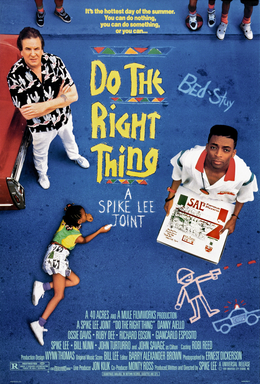
Bonus Review: Do the Right Thing

Here’s another Spike Lee Joint to marinate on, and it’s just and angry and relevant today as it was in 1989. On a hot summer day in Bed-Stuy, Mookie (Spike Lee, himself) is a pizza delivery man working for Sal Frangione (Danny Aiello), who owns a very Italian pizza shop in the predominantly Black neighborhood. One day, Mookie’s friend, Buggin’ Out (a young Giancarlo Esposito), enters the pizzeria and wants to know why Sal doesn’t have any Black people on his Wall of Fame, since his restaurant is in a Black neighborhood. Sal kicks him out. As the scorching day goes on, Buggin’ Out returns to Sal’s along with Radio Raheem (Bill Nunn), who is always carrying around his boombox with him, blasting music, and demands that Sal add some Black celebrities to his Wall of Fame. Tensions rise and Sal smashes Raheem’s boombox with a baseball bat. Raheem retaliates and they continue their fight outside, attracting attention from the neighborhood. The police show up and while attempting to restrain Raheem, an officer chokes him to death. Mookie, in a fit of anger or to keep Sal from facing the wrath of a mob (depends on who you talk to), throws a garbage can through Sal’s window, and the mob trashes and ignites it. After the fire department squelches the fire, a man named Smiley places a photo of Malcolm X and Martin Luther King, Jr. shaking hands on what remains of the Wall of Shame. Mookie returns to Sal’s and, after a brief argument, the two seemingly reconcile.

The movie ends with the following two quotes:

“Violence as a way of achieving racial justice is both impractical and immoral. It is impractical because it is a descending spiral ending in destruction for all. The old law of an eye for an eye leaves everybody blind. It is immoral because it seeks to humiliate the opponent rather than win his understanding; it seeks to annihilate rather than to convert. Violence is immoral because it thrives on hatred rather than love. It destroys community and makes brotherhood impossible. It leaves society in monologue rather than dialogue. Violence ends by destroying itself. It creates bitterness in the survivors and brutality in the destroyers.”–Martin Luther King, Jr.

“I think there are plenty of good people in America, but there are also plenty of bad people in America and the bad ones are the ones who seem to have all the power and be in these positions to block things that you and I need. Because this is the situation, you and I have to preserve the right to do what is necessary to bring an end to that situation, and it doesn’t mean that I advocate violence, but at the same time I am not against using violence in self-defense. I don’t even call it violence when it’s self- defense, I call it intelligence.”–Malcolm X

Both of these quotes deserve analysis and reflection, but I don’t think that’s for me to do publicly. However, I will say that using the quotes in tandem do at least imply that there’s not a black and white answer to any questions that the movie raises. The most commonly asked question is apparently, “Did Mookie do the right thing?”, in reference to throwing the garbage can. I have my own opinions, but instead of sharing them, I’ll acknowledge that Spike Lee has commented on the question, reflecting that he is only ever asked it by White people, and that Black people never ask it. So, if you’re White like me, you may be asking, “Did Mookie do the right thing?” I don’t have an answer for you.

80. The Maltese Falcon

Most consider The Maltese Falcon to be the first noir, and it’s hard to deny it. The movie follows Sam Spade (Humphrey Bogart) as he navigates the schemers and dreamers of San Francisco. When Ruth Wonderly (Mary Astor) walks through his door, Spade gets more than he bargained for. She asks for help in finding her missing sister, and Spade’s partner, Miles Archer readily agrees. The next day, Spade is visited by the cops. Archer is dead, and Spade is suspected to be involved. Spade runs into Wonderly again, only now he discovers her real name is Brigid O’Shaughnessy and Spade suspects she had a hand in Archer’s death. To make matters worse, Spade is offered $50,000 from a greedy pair, Kasper Gutman (Sydney Greenstreet) and Joel Cairo (Peter Lorre), to find a rare artifact, the Maltese Falcon – possibly a more dangerous job than dealing with O’Shaughnessy. Spade has to keep himself afloat and not wind up dead in the gutter.

The Maltese Falcon is based on the novel by Dashiell Hammett, a former Pinkerton Agency detective-turned-writer who put some of his own experiences into his book, and also wrote Red Harvest and The Thin Man. John Huston, son of actor Walter Huston, was given the reins of the movie adaptation as his first directing job. He was so concerned with proving himself as a director that he meticulously planned out and sketched every shot in the film ahead of time. Because of this, he not only finished on time and within his budget, but he was also able to film in sequential order and leave almost nothing on the cutting room floor.

Bogart took the role of Sam Spade when George Raft didn’t want it, and between this film and High Sierra, which came out earlier in 1941, he shot to superstardom. Before 1941, Humphrey Bogart was relegated to villains and sidekicks, which really says something about what the right part can do for an actor. He fit Spade so well and the film was such a hit, that he became a romantic leading man despite having the looks of someone who should play villains their entire life. Mary Astor, based on the trailer, is “the most exciting woman [Spade’s] ever met.” I don’t know about that one. She’s good, don’t get me wrong, but she’s more exciting in the next movie she did, The Palm Beach Story. Peter Lorre does his sniveling, conniving Peter Lorre thing that’s been parodied to death, but like usual, it’s done well. All of the performances shine here.

Proof of the Peter Lorre thing:

Here he is creating Gossamer in a Looney Tunes cartoon.
“I can’t bring people back from the dead. It’s not a pretty picture. I don’t like doing it!”

Bonus Review: Chinatown

Personal feelings of Roman Polanski aside, Chinatown is one of those great examples of noir. Jake Gittes (Jack Nicholson) is hired by Evelyn Mulwray (Faye Dunaway) to gather proof of her husband’s infidelity. Instead, Jake unravels much more than he bargained for after finding the husband’s body in a freshwater reservoir with saltwater in his lungs. Evelyn strings Jake along with lie after lie, leading him into danger at every turn before admitting to the truth of her story. In this revelation, it’s revealed that Evelyn is not the biggest threat to Jake’s life nor is she the worst of the seedy underbelly of Los Angeles. Chinatown refuses to let up off the gas until the very end.

Hey, speaking of John Huston, he’s in this movie as the sexually abusive father of Evelyn and Evelyn’s daughter, Katherine. If that doesn’t read clearly enough, I’ll spell it out. Jack Huston’s character, Noah Cross, rapes his own daughter and impregnates her. Eww. Anyway, Chinatown I think works best as a critique of LA life and culture, particularly Hollywood. The perversions of its denizens are commonplace and so everyone just throws it under the rug, which is rich coming from Roman Polanski who was convicted of raping a 13-year-old girl. But maybe he sees himself in the Cross character instead of Gittes?

Chinatown is a slower-paced noir, so there are times where it feels like nothing is happening, but it builds to a shocking and powerful finale. Honestly, the weight of the ending is what gives the film its staying power when its creator has fallen from grace. It’s definitely a strong example of needing to separate the art from the artist.