Fritz Lang had a decade-long and successful career before he came to America. His silent films Dr. Mabuse, the Gambler, Die Nibelungen, and Metropolis are still acclaimed and considered some of the greatest films of all time. In 1931, he took controversial topics of the day in his native Germany, including the morality of the death penalty, the capture of a child serial killer labeled “The Vampire of Düsseldorf”, and the German version of the Mafia called “Ringvereine”, and combined them into the film, M. M is also an early world cinema example of sound cinema, and it uses the concept of sound in film to great effect by weighing the value of silence versus sound from scene to scene and uses a leitmotif, a whistling of “In the Hall of the Mountain King”, to indicate to the audience when the killer is nearby.
By the time the movie starts, the killings have already started. The entire city of Berlin is on edge and terrified of the child murderer on the loose. As a little girl, Elsie Beckmann, is leaving school, she is approached by a man named Hans Beckert, who offers to buy her a balloon and whistles “In the Hall of the Mountain King” while he walks. The only indication we have of Elsie’s fate is the balloon floating to the heavens. With Elsie missing, Berlin is on even higher alert. Beckert writes a letter to the police, taking credit for the murders, and the police work around the clock to catch him. Inspector Lohmann authorizes multiple raids on the various crime organizations in town in hopes of finding Beckert amongst them. The criminals believe the police’s manhunt is interfering with their “business”, and so the leaders meet together and discuss setting up their own manhunt. They use the homeless as their eyes and ears on the street. Beckert meets another girl along the street and treats her to candy from a candy shop. The blind ballon vendor from earlier recognizes Beckert by his whistling and alerts the Ringvereine. A man puts a letter “M” on Beckert’s coat with chalk so the homeless can keep tabs on him. The girl with Beckert draws his attention to it, and he realizes he’s being watched and leaves the girl and runs into a bank and hides just before they lock up for the night. The Ringvereine stage a break in to get Beckert and quickly take him to an undisclosed location before the police arrive. At this location, they hold a kangaroo court to try Beckert for the murders. Beckert pleads insanity and argues the criminals choose to commit their crimes and so have no right to judge him. Just before they carry out his sentence, the police arrive and make several arrests. At the real trial, a group of mothers sit outside and weep for the children that will not return.
This was only Peter Lorre’s third film when he took on the role of Hans Beckert, and he never could quite shake the typecasting of villains that followed him after he came to Hollywood. What’s interesting is that prior to M, he had only worked in comedy. This movie was difficult to produce at first because Fritz Lang was denied funds and studio space when it was believed that his film would be critical of the Nazi party, the irony being that he was critical of the Nazi party…just not with this movie. In his own words, M was made to “warn mothers about neglecting children.” On a technical level, besides the use of sound, Lang makes excellent use of reflection, having pivotal scenes of action take place through a window or mirror – something that’s been repeated, particularly in the thriller genre, a thousand times. It’s impossible to overstate the impact M has had on thriller, crime and courtroom drama genres.
Bonus Review: Zodiac
Speaking of M’s influence on future films, Zodiac is David Fincher’s investigative thriller over the, you guessed it, Zodiac Killer, who terrorized San Francisco in the late 60s and 70s.
The 90s were the decade of Jim Carrey. In 1994, he starred in Ace Ventura: Pet Detective, The Mask and Dumb and Dumber – all three successful comedies that exceeded expectations at the Box Office. From there, he was on a trajectory of continued success, releasing Ace Ventura: When Nature Calls, The Cable Guy and Liar Liar in subsequent years. Jim Carrey was the guy who got people in seats at the movie theater with his unique brand of manic, zany comedy. However, after all these comedic hits, Carrey sought to prove himself a dramatic actor. For The Truman Show, Carrey settled on a significant pay cut in order to get his shot. The Truman Show was the perfect vehicle to present a more grounded Carrey to the world – it still contained plenty of humor for him to work off of and also gave him a chance to tap into a vulnerable side of himself that for some reason comedians are really good at getting to.
Truman Burbank’s life is not what he thinks it is. Taken at birth, Truman was raised in a dome facility that is designed as the fictional Seahaven Island, where the world around him is manufactured for him and every moment of his life can be recorded on thousands of tiny hidden cameras so audiences can tune in at any time of day. The show’s creator, Christof, controls everything that happens in Truman’s life from a booth above the stage and purposely sets things in motion in order to curb Truman’s desire of exploration, such as giving him a fear of water by witnessing his “father” die in a sea storm. Through a flashback, we see Truman’s time in college and how he falls in love with an extra named Sylvia, despite the story requiring to meet his future “wife”, Meryl. He and Sylvia meet in secret whenever they can, but just when Sylvia is about to tell him the truth about the show, Sylvia is whisked away and never returns to the show. Back in the present, a series of strange incidents occur that cause Truman to question his reality, such as a rain cloud that follows only him and a spotlight that falls from the top of the dome. In one instance, Truman sees the man who played his father and rushes over to him, but the traffic of the island’s citizens prevents him from getting close. Truman breaks and holds Meryl at knifepoint in an attempt to get someone to react. Meryl breaks character and is written out of the show. Shortly after, Truman begins to sleep in his basement every night, behavior that Christof finds suspicious, and so Truman’s best friend, Marlon, is sent over to his house, but upon his arrival, discovers Truman is not there, having escaped through a tunnel he has dug. By the time the crew has located Truman, he is on a boat, having conquered his fear of water, trying to escape. Christof orchestrates a severe storm, nearly drowning him, but Truman remains determined and continues on his quest until the ship crashes into the wall of the dome. Following the wall, Truman eventually sees a staircase leading to a door. Christof, in a last-ditch effort to retain Truman, speaks over the intercom, claiming the world he has built for Truman is better than the outside one. Truman bows to the audience and walks out the door.
There is so much to love about this movie. Jim Carrey passes, with flying colors, his test to prove his dramatic chops. He’s lovable and a solid Everyman, something I’m sure most people didn’t believe he could do after seeing Dumb and Dumber. And Peter Weir takes a very science fiction-y concept and makes it human. In fact, I’d argue The Truman Show is as good as it is because it’s incredibly relatable. Everyone has moments, even if they’re fleeting, where they question whether the world they live in is real or not – either from a place of suspicion or disappointment. And with the introduction and rise of reality television (which has frequently been criticized as scripted), the lines between fiction and reality are more greatly blurred.
Bonus Review: Forrest Gump
Come on, you know this movie. The infinitely quotable, highly rewatchable Forrest Gump is both a critique and love letter to times gone by. Tom Hanks stars as the Southern man who sits on a bench, explaining his life story to anyone who will listen. He tells of his stumbling through big moments in American history between the 50s and the 90s, recounts his love for the ill-fated Jen-nay, and passes along the evergreen wisdom of his mother. It’s a movie that’s simultaneously unbelievable and completely human, walking a fine line that causes it to have both legions of fans and fiery critics alike.
Forrest Gump is a simple man. As a boy, he was forced to wear leg braces due to a curved spine. He meets and becomes fast friends with a girl named Jenny, who is sexually abused by her father. One day, while being attacked by bullies, Jenny tells Forrest to run, Forrest, run and as he does, the leg braces come off, and he discovers himself to be a speedy little guy. He goes to college on a football scholarship, playing for the (eww) Crimson Tide, gets on the All-American team and meet JFK. After college, Forrest enlists in the Army and befriends Bubba, another simple man with an unhealthy obsession with shrimp. While out on patrol in Vietnam, Forrest’s platoon is attacked and he is shot in the buttocks, but he still is able to rescue several of his men, including Bubba and their Lieutenant, Dan. Bubba dies of his wounds, however, and Lieutenant Dan laments being rescued because all of his family prior died bravely in their war efforts, and now, he ain’t got no legs. While Forrest Gump recovers from his injury, he gets all the ice cream he could ever want and becomes a ping pong wizard. He plays at an international level and his success leads him to receive an invitation from Richard Nixon to have a room at the Watergate hotel where he calls up the desk to complain about some guys flashing their flashlights in one of the nearby buildings. Using his ping pong money, Forrest buys a shrimping boat and Lieutenant Dan becomes his first mate. They are the only boat to survive a hurricane, so they get all the shrimp and turn the profits into the Bubba Gump Shrimp Co. Dan invests their money into Apple Computers, making them both filthy rich, but Forrest goes home to take care of his dying mother. Over the course of his years, Forrest runs into Jenny randomly and Forrest falls in love with her. Jenny however rebuffs him, and so he decides to run across country for years until one day he decides to just stop. He receives a letter from Jenny asking him to come visit, and he does so, learning of a son they have from a night together several years back and that Jenny is dying of AIDS. With what brief time she has left, Jenny finally agrees to marry Forrest and they return to his home in Greenbow, Alabama until she passes away. Forrest is left to raise his son alone.
What else is there to say? This movie can be overly sentimental at times, sure, but it’s still a sweet story. I think everyone can find something to be entertained by in it, whether it’s the quick history lesson, the love story, or the fantastic soundtrack (I blame Forrest Gump for making every Vietnam-related movie require “Fortunate Son” by Creedence Clearwater Revival as part of its soundtrack). I’ve read some critical analysis of the film that portrays it in a negative light, but beyond that, I don’t know of a single person who doesn’t like Forrest Gump.
Terry Gilliam is known for three things: his directing career, his animation and occasional acting for Monty Python, and taking nearly 20 years to get The Man Who Killed Don Quixote made. The influence his time in Monty Python has had on the rest of his career cannot be understated. He’s one of a handful of directors that have a distinct surrealist visual style and leans into magical realism in all of his works. Some of his most notable works are Monty Python and the Holy Grail, Time Bandits, Brazil, The Adventures of Baron Munchausen, this one, 12 Monkeys and Fear and Loathing in Las Vegas. The Fisher King is probably one of his less surreal works, but even it has its moments.
Jeff Bridges plays a Howard Stern-like shock jock named Jack. On his radio show, he brushes off a long-time caller who commits a murder-suicide, and it sends him spiraling into depression and alcoholism. He falls so low, he nearly commits suicide, but is stopped by a group of thugs who beat him, thinking he’s a homeless person. He’s rescued by an actual homeless person, Parry (Robin Williams), who tells Jack he’s searching for the Holy Grail and in turns asks for his assistance. Jack discovers that Parry is actually a former college professor named Henry, who had a psychotic breakdown after witnessing his wife die right in front of him during the murder-suicide. Jack, feeling partially responsible, helps Parry woo a shy woman named Lydia. Things are going well until Parry has another psychotic episode manifested as a Red Knight that chases after him, which sends him into another catatonic state. Jack decides to sneak into the building containing what Parry believes to be the Holy Grail and steal it. He does so, and simultaneously saves the life of the man inside. Bringing Parry the grail saves him and helps him both overcome the loss of his wife and profess his new love for Lydia.
It seems a lot darker when you type it all out like that, but I promise watching the movie doesn’t feel so dark. Everything I described is true, but that Gilliam magical realism bleeds through and you somehow know the film will have a happy ending. The highlights of the movie are the performances of Jeff Bridges and Robin Williams. They both put in some of their best work and the balance between these two men trying to save each other carries the movie. Be warned: if you’re going to watch the movie, as I would recommend that you do, you’ll see more of Robin Williams than you ever wanted to.
Bonus Review: The Adventures of Baron Munchausen
Another of Gillian’s better films, but a significantly lighter fare than The Fisher King, to the point where it’s a little cartoonish. One of the early scenes requires Eric Idle’s character to carry a message halfway across the world and he Scooby-Doo runs until his feet have dug halfway to China before he shoots off like a rocket. The Adventures of Baron Munchausen is also strange for its narrative within a narrative. The Baron character interrupts a play of his exploits to decry its inaccuracies and then proceeds to have adventures in real time that are more fantastical than that of the play.
As I said, the Baron interrupts a play occurring and tells the audience a story of when he wagered with the Grand Turk, putting both their lives at stake. After the story, the play is canceled and through a few minor events, the Baron escapes the Angel of Death. To escape the city, the Baron takes a hot air balloon to the moon. The King of the Moon is jealous of the Baron’s previous relationship with the Queen and so expels him back to earth and into the volcano of the Roman god, Vulcan. He is subsequently kicked out of there after dancing with Venus, Vulcan’s wife. He’s then swallowed up by a sea creature and upon his release, save the city where the play took place from the Turkish army. The Baron is shot by the man who put on the play, but at the funeral, it is revealed that this was just another story the Baron was telling the play’s audience from the beginning.
Like I said, it’s very strange, but it’s very fun and revels in its confusing the audience into believing or not believing the stories that are told. Gilliam uses this device in multiple films, and never has the unreliable narrator been so enjoyable a device. I’d recommend giving this a watch, especially as a palate cleanser to The Fisher King.
The ultimate summer blockbuster. Only Steven Spielberg’s third film, Jaws shot him to the stratosphere as well as revitalized the Monster movie genre. When a great white shark terrorizes the beach of a coastal town, the new police chief, Martin Brody (Roy Scheider), closes the beaches. The heartless mayor is on his case about keeping the beaches closed, as he fears the town’s economic suffering for the summer months. Instead, a bounty is placed on the shark, and when the many would-be bounty hunters fail at bringing the shark down, it’s up to Brody, Matt Hooper (Richard Dreyfuss), and Quint (Robert Shaw) to save the local waters. You know the movie. You know the soundtrack. The movie and specifically the image of just a shark fin gliding across the water has been parodied and referenced to death, but that just proves its longevity.
Jaws was originally offered to another director, Dick Richards (if you don’t recognize the name, I’m not surprised; he directed a total of seven films in a 14-year span and none of them hits). Richards was reportedly kicked off the film for unintentionally aggravating the producers by constantly referring to the shark as a “whale”. After Richards was dismissed, Spielberg (who had lobbied hard for the job) was given a shot, even though his theatrical film debut, The Sugarland Express, had yet to be released and was therefore only known for directing episodes of television such as Night Gallery and Columbo. It was a gamble that paid off for everyone involved as the movie made a return of $476.5 million on a $9 million budget, and Steve Spielberg became a household name and jump-started his career off the notoriety that came with Jaws. Even more of a gamble due to all the delays the film underwent in filming because of Spielberg’s to film on the ocean instead of in a studio. Originally, the film was on a $4 million budget, but the weather and shark malfunctions ballooned it to the $9 million figure I mentioned earlier. The shark malfunctions also led to the smartest creative decision in the whole movie.
Alfred Hitchcock famously gave an example on the difference between “suspense” and “surprise” by discussing a theoretical bomb going off in a film. If the bomb is not addressed before the explosion, then there is a brief shock to the audience, a surprise. But if the bomb is established well before it goes off, everything else in the scene is more exciting because the audience knows what’s coming, and is therefore in suspense. He ended the example with the following statement: “There is no terror in the bang, only in the anticipation of it.” I bring this quote up not just because it’ll make sense for the bonus review, but it makes sense for Jaws as well. Spielberg seems to have taken this quote to heart because you don’t see the shark in full until around an hour and twenty minutes into the movie. Before that, you only see the infamous fin, and it makes it that much more suspenseful. We know it’s a shark, but to not actually see it for so long a time…it just kinda gives you the heebie-jeebies thinking about what could be in the water. It makes for a significantly more exciting movie, and it never would have happened if it weren’t for problems with the mechanical shark.
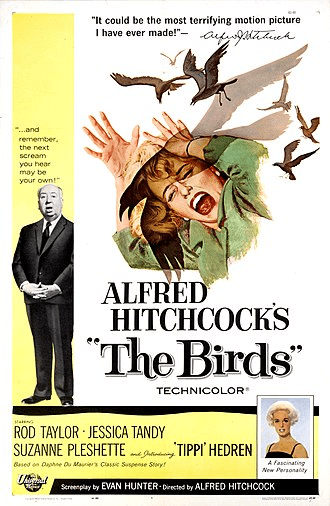
Bonus Review: The Birds
This is Alfred Hitchcock’s third adaptation of a Daphne du Maurier story. What was his obsession with that woman? Already he had made Jamaica Inn and Rebecca – two films that simultaneously indicated the end of his British moviemaking career and the beginning of his American moviemaking career. Jamaica Inn brought Maureen O’Hara to the world’s attention and Rebecca received many accolades, including the distinction of being Hitchcock’s only film to win the Oscar for Best Picture. Despite these credentials, The Birds is the most well-known of the three.
The Birds starts off as a romantic comedy, surprisingly. And it follows Mitch and Melanie who fall in love through happenstance and despite Mitch’s overbearing mother. Things take a turn, however, when bird attacks start happening randomly. Mitch and Melanie struggle to keep themselves and Mitch’s mother and sister safe during the attacks. During a scene in the attic of Mitch’s house, Melanie is attacked and must be rescued. Her wounds and catatonic state cannot be treated at Mitch’s house, so Mitch, his mother and his sister slowly and quietly lead Melanie out to the car and drive away as the birds watch them go. The film never explains why the attacks start or why they stop, or if they even have stopped.
The Birds is not as critically well-received as other Hitchcock films, and that’s probably because of the strange tonal shifts and the lack of conclusion. Although, those are fair criticisms, while the movie is happening, those thoughts will be the furthest from your mind. As mentioned above in my review of Jaws, Hitchcock applies his theories on suspense to this film. Particularly, there is a scene where Melanie is waiting outside of a school to pickup Mitch’s sister, Cathy. As she sits in her car, the audience sees as crow after crow lands on a nearby jungle gym, though Melanie remains oblivious to it. No attacks happen right away, but the audience can see what’s coming, and it’s executed perfectly. The Birds is not Hitchcock’s best by a long shot, nor is it a movie worth defending if the claims Tippi Hedren has made regarding her treatment by Alfred Hitchcock are true, but it is an enjoyable film and a great addition to the canon of both monster movies and natural disaster movies.
Will Kane (Gary Cooper) is getting married when it’s announced that Frank Miller is on the twelve o’clock train, headed for town. This is a problem for Kane, since Miller is a vicious outlaw and Kane is the town’s marshal, and Kane was the one to put Miller behind bars in the first place. He now sees it as his responsibility to do so again. Miller’s gang, including his younger brother, are waiting for Frank at the train station, and when they arrive in town, it will be a very unfair four-against-one. Kane pleads with the town judge, mayor and all his friends in town to help him take care of the Miller gang, but everyone has one excuse or another, except for a fourteen-year-old boy who Kane rightly sends on his way, despite his appreciation of the boy’s courage. His own bride, Amy Fowler (Grace Kelly), urges him to abandon the town, and when he refuses, she abandons him. Come high noon, it’s an empty street as Kane and the Miller gang close the gap between them. This movie plays out in real-time, which increases the tension drastically. High Noon is mostly famous for a great performance by Gary Cooper and being an allegory of the McCarthy era Hollywood Blacklisting. It’s also responsible for its two biggest detractors, Howard Hawks and John Wayne, to make Rio Bravo – a vastly inferior film, but still considered a Western classic.
High Noon is a very contained movie. The time before Frank Miller arrives is exactly how much time the movie gives you. It plays out in real time. It also stays within the town where Kane is the marshal. The furthest it goes is to the train station at the edge of the town. In fact, it operates more like a play than a film in that regard. High Noon is an early example of what is called a “revisionist Western”. By 1952, Westerns had already been around for nearly 50 years and were a popular genre for the last 30. It became an oversaturated market and developed a formula for its storytelling. Basically, the hero is a loner who moseys into town and helps the town rid itself of some outlaws, or the hero is the law and he successfully recruits help to get rid of the outlaws that just rode into town. Revisionist Westerns turned some of these basic stories on their heads, like when a movie makes the outlaws the good guys. High Noon is a revisionist Western because no one helps Kane defeat Miller’s gang.
Screenwriter, Carl Foreman, was interviewed by the House Un-American Activities Committee (HUAC) while he was writing High Noon, due to his affiliation with the Communist Party over ten years prior. He pleaded his case and was considered “no longer a Communist”, but when HUAC asked him to name others he believed to be Communist, Foreman refused. He was labeled an “uncooperative witness” and eventually was blacklisted. Before he had to flee the country, however, he was pressured by his producer and business partner, Stanley Kramer, the head of Columbia Pictures, Harry Cohn, and John Wayne, who is quoted as saying he would “never regret having helped run Foreman out of this country,” to name names. Foreman steadfastly refused. Despite what everyone around him was telling him, he had to do what he felt was right. Sounds a lot like that Will Kane, doesn’t it?
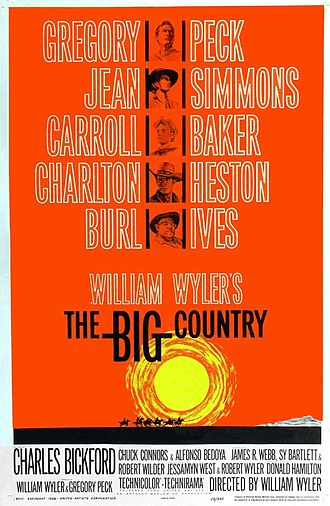
Bonus Review: The Big Country
The Big Country is an epic Western centered on a Hatfields and McCoys-style conflict between two families – the Terrills and the Hannasseys – with Peck’s James McKay caught in the middle. It’s not necessarily anything new, but it’s played out so well and the characters are so believable that you just have to enjoy it. It’s also entirely too long. Two hours and forty-five minutes is nothing for William Wyler (he did make The Best Years of Our Lives, Friendly Persuasion and Ben-Hur, after all). However, the majority of his classic films could have benefitted from some more time in an editing booth. Despite its length, The Big Country is a beautifully-shot, enjoyable story of a man who refuses to stand down from his principles, no matter what. It also makes good use of Burl Ives, who otherwise doesn’t fair too well in movies in my opinion, and he’s not stuck singing “A Holly Jolly Christmas” in the background, so that’s nice.
James McKay is a wise man who travels west to join his fiancee, Patricia, at her father’s ranch. Henry Terrill is Patricia’s father, and later, James also meets the family of Terrill’s rival, Rufus Hannassey. Rufus’ son, Buck, drunkenly berates James, and much to Patricia’s surprise and dismay, James simply laughs off his jibes instead of defending himself. James also meets Patricia’s friend, Julie, a local schoolteacher, who explains the feud to him and shares his disdain for it. The next day, Terrill’s foreman tries to get James to ride a very untrained horse called “Old Thunder”, but James declines. He also presents a pair of pistols that once belonged to his father to Terrill as a gift. Terrill learns about Buck’s antics the previous night and rallies a posse together despite James’ protests. However, neither Buck nor Rufus are home when they arrive, so instead, the Terrills terrorize the women and children and shoot holes in the Hannassey water reservoir. While they’re gone, James secretly tames Old Thunder. Later, at a party hosted by Terrill for Patricia’s upcoming wedding, Rufus and his family barge in, armed, and accuse Terrill of what they did at his place previously. James visits Julie because her house sits on the river at the center of the feud. Both families want to use that river to water their livestock, and Julie and her family have allowed both families to do so without exclusivity. James asks to buy the property as a gift for Patricia and, by maintaining Julie’s rule of access for everyone, hopes to end the feud for good. However, when he tells Patricia that he intends to continue to let the Hannasseys use the river, she leaves him. Rufus attempts to lure Terrill into a trap by kidnapping Julie. To calm him, James promises Rufus that his family will still have access to the river, but Buck forces James into a duel. Buck shoots before the signal and misses, allowing James a free shot, but when Buck cowardly hides under a wagon, James lets him live. Instead of being grateful, Buck grabs a rifle to shoot him again, forcing Rufus to shoot and kill his own son. Rufus then meets Terrill in the canyon and they have a similar duel, ending in both of their deaths. With that, the feud is over and James and Julie, now clearly falling in love, ride away.
Mildred Pierce (Joan Crawford) is a self-made woman. When her husband loses his job, it’s up to Mildred to keep the family afloat by selling baked goods. Instead of being grateful or doing anything to help, her husband leaves. Left alone with two daughters, Mildred works as a waitress to make extra money to buy her eldest daughter, Veda (Ann Blyth), who is a brat and high-society wannabe, the material things that will supposedly make her happy. Mildred is wooed by Monte Beragon, and through hiss dwindling inheritance, Mildred buys her own restaurant. She throws herself into her work, but nothing makes Veda happiness. Mildred decides to marry Monte in order to give Veda the status that she wants, but even that is not enough to make anybody happy.
Joan Crawford is considered one of the greatest actresses of all time, and it’s hard to deny when watching Mildred Pierce. However, she is not the best performance in the movie. That distinction goes to Ann Blyth, who plays her daughter, Veda. Veda is absolutely despicable. She’s bratty, obnoxious, and selfish beyond reason. Next to Gene Tierney in Leave Her to Heaven, and maybe Ann Savage in Detour, Veda is one of the most venomous femme fatales in all of cinema. Her dynamic with Mildred is what makes the movie. Mildred spends her time, money, blood, sweat and tears giving Veda a life of luxury, a life she never had and didn’t think she could have without a wealthy husband. And to the very end of the film, Mildred tries to provide and protect, and it gets her nowhere. Veda throws it all back in her face. The easy life is not enough for her, and it will never be enough.
There are a lot of things going on in Mildred Pierce. First, it’s a feminist work about a self-sufficient woman and how she navigates the world that’s against her. But it’s also a cautionary tale of the dangers of chasing material things. Mildred’s goals are noble, but her methods of provision feed Veda’s heightened sense of materialism, effectively hobbling her instead of helping her. And of course, as greed operates, Veda is never satisfied. She continually wants more and more and it’s ultimately her downfall. Mildred Pierce excels where other noirs fail because of those layers. Making characters three-dimensional is crucial to exceptional filmmaking, and Mildred Pierce delivers in spades.
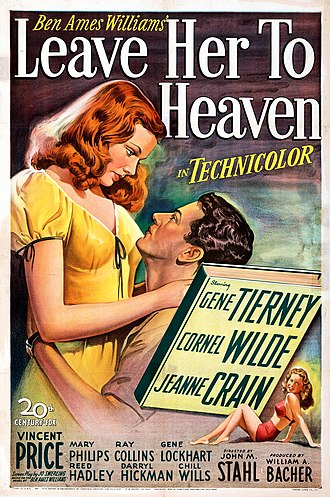
Bonus Review: Leave Her to Heaven
Richard Harland (Cornel Wilde) is a writer who arrives in a New Mexico town to get away and work on his next book. There, he meets Ellen Berent (Gene Tierney), who is visiting the area to spread the ashes of her deceased father, and they fall for each other instantly. Richard loves her spirited personality, and Ellen loves him because he reminds her of her father. Yikes. After a whirlwind romance, the two get married and both get more than they bargained for. Ellen is obsessive about keeping Richard all to herself, and no one is going to interfere with that – not his teenage brother, Danny, or her cousin, Ruth. What was originally a happy love affair quickly sours into torment for Richard Harland. The question eventually becomes: how far is Ellen willing to go to hang on to Richard? The answer: watch the movie and find out.
When I watched Leave Her to Heaven for the first time, my jaw was pretty well on the floor from about halfway through the film all the way to the end. The pivotal scene where Ellen is in a boat watching Richard’s brother, Danny, swim makes the film turn a complete 180 degrees, and it never lets up from there. Before my brother watched the film, I explained that Gene Tierney in the film might be the most villainous woman in film history, with no other details. When he watched it, he texted me simultaneously with the following messages:
“Seems like a regular romance to me.”
“When does she do something bad? It’s pretty tame so far.”
“Oh no…”
“Nevermind. I get it now.”
And when he texted me that “Oh no…”, I knew exactly what scene he was at. That’s how drastic the tone shifts at that scene. I want to say more, but it would spoil too much, so I refuse to elaborate. All I can say is that you should take the time to watch this movie.
I don’t know if many people are aware of this, but Good Morning, Vietnam is a biopic of sorts. Robin Williams’ character, Adrian Cronauer, was a real airman who was stationed in Saigon and acted as a DJ for the Armed Forces Radio Service. However, that’s about where the similarities end. Robin Williams is basically Robin Williams, and was given carte blanche to improvise his time in the booth and several of his interactions with fellow military personnel. If you’ve listened to Robin Williams’ stand-up, particularly A Night at the Met, you’ll recognize some of the jokes being recycled in the film. The film is about 85% comedy, but like the best Robin Williams films, has a deep, emotional center that carries it.
It’s 1965 and Adrian Cronauer has just arrived in Saigon. He is picked up by Private Edward Garlick, probably the closest he has to a kindred spirit, and they travel to the base, where it is immediately apparent that Cronauer does not fit in with the rigid expectations of his superiors, Second Lieutenant Hauk and Sergeant Major Dickerson. Cronauer’s fellow DJs and Brigadier General Taylor are his only companions. Cronauer uses his air time to make irreverent jokes, read censored news and play rock ‘n’ roll. He follows a Vietnamese woman named Trinh to her English class. Desperate to talk to her, Cronauer pretends to be the teacher, and teaches the students profanity and slang terms. His attempts to get close to Trinh are inhibited by her brother, Tuan, but he and Tuan end up developing a friendship. The two men go to a local G.I. bar but are harassed by two racist soldiers to the point where a fight breaks out. Cronauer is reprimanded for the incident, but is allowed to continue his broadcast like normal. Days later, Cornauer returns to the bar, when Tuan rushes in and tells him Trinh wants to speak to him right away. Cronauer follows Tuan out of the building moments before it explodes. Cronauer is shaken by the incident and when it is given to him as a censored report to read over the air, he locks himself in the studio and relays the uncensored version. Dickerson suspends him for his actions and lets Hauk take over the broadcast. After a flood of angry letters and phone calls come through complaining about Hauk’s lack of humor and insistence on playing polka music on the air, Cronauer is reinstated. Before he returns to work, he is held up in traffic with Garlick behind a truckload of soldiers, and at Garlick’s insistence, gives an impromptu broadcast and jokes with the soldiers. In an attempt to be rid of Cronauer, Dickerson “allows” him to interview soldiers in the field and sends him out to the front line via a Viet-Cong controlled highway. His jeep hits a mine and he and Garlick are forced to hide from their patrols. Tuan learns what happened to Cronauer and goes to rescue him. Back at the base, it is revealed that Tuan, as part of the Viet-Cong, was responsible for blowing up the bar from earlier, and therefore his friendship with Cronauer is a liability. Cronauer is honorably discharged and leaves Saigon for good. In his absence, Garlick takes over as the fun DJ.
Robin Williams could best be described as “all over the place”. He was manic, and somehow human and not human at the same time. He had a way of disarming you with a joke and then giving you a glimpse inside his heart. It’s “all over the place”, but in the most beautiful way. For instance, in what other movie are you going to get jabs at Ho Chi Minh and an endearing, impromptu game of softball? Good Morning, Vietnam is like most Robin Williams films: rapid-fire humor on the outside, warm sentimentality on the inside. Where some of Williams’ movies go wrong is by leaning into the sentimentality so much that it dives head-first into schmaltz. Think Jack or Toys or Patch Adams (though I have a soft spot in my heart for that one). Good Morning, Vietnam is perfectly balanced, with extra weight on the comedy side over the dramatic side. The slight edge to comedy is what puts it above Dead Poets Society and Good Will Hunting for me; two great Williams films that emphasize the drama over the comedy. Like Mrs. Doubtfire, Good Morning, Vietnam is perfectly shaped for Williams’ talents and fits him like a glove. It’s the pinnacle of what that man was capable of.
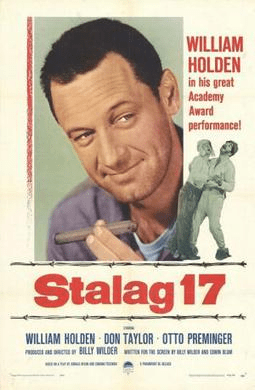
Bonus Review: Stalag 17
Stalag 17 is another movie about smiling in the face of war. Billy Wilder, who moved to the US in part to avoid the rise of Nazism in Germany, spent the majority of his career avoiding films about the subject of war. The only two films where World War II is a major part of the story – this one and Five Graves to Cairo – were based on plays. I don’t know if that means much, but it’s interesting to me.
Stalag 17 is about a group of men in a German POW camp. Two men, Hoffy and Frank Price set up a plan for two other airmen to escape. However, the two men are shot and killed before they can get out. This causes the men of the camp to grow suspicious of an informant amongst their group. They suspect a man named Sefton who is cynical toward the escape attempts and openly trades with the German officers. Over the course of the film, the prisoners attempt to make camp life easier. Sefton uses his ties to the guards to get parts to make a telescope and a distillery. A new man is added to their barracks named Dunbar, who Sefton knows from officers school as an idiot, and the two are at odds. The men’s radio is confiscated and Dunbar is arrested when the extent of his sabotage to the Germans is revealed. Both instances are blamed on Sefton, still believing him to be the informant, and the men beat him up. Dunbar, though arrested, cannot be tried or convicted without evidence so the Germans use the informant to try and get the details of how he made the bomb he used for evidence. Sefton witnesses Price speaking to the officers in German and suspects him of being the informant. When it’s decided that Dunbar needs to be rescued and helped in escaping, Price volunteers. Sefton accuses Price of being the informant, explaining the system he used to communicate with the officers. The men are convinced and they restrain Price and Sefton agrees to help Dunbar escape. The men throw Price out of the barracks with cans tied to his legs to stir up noise. All of the spotlights land on him, giving Dunbar and Sefton the chance to escape.
This movie is surprisingly optimistic for Billy Wilder. Even though William Holden as Sefton is as cynical as can be, we still root for him, and he still wins the day. Compare that to the tragic ending of The Great Escape and you’ll wonder whose movie you’re actually watching. While most of these POW movies end tragically, we still enjoy them because it’s about the determination and perseverance of the characters and even though things end badly, we still appreciate that they tried. Stalag 17 pretty much flips that. Sefton survives and escapes, yes, but he’s no hero. It’s no feat of endurance to make it to the end. He’s just opportunistic. It’s a great twist on the war movie modus operandi and William Holden sells it.
Depending on who you ask, Rocky is the greatest sports movie ever made. Even if you disagree with that statement, you have to recognize it as perhaps the most influential sports movie ever made. Rocky popularized the rags-to-riches story and designed the formula of nearly every sports movie to come after it, with the exception of maybe Caddyshack, which still hints at some similar themes. Basically, since 1976, you can’t escape Rocky.
Apollo Creed is the current heavyweight boxing champion. He sets up a title fight for the United States Bicentennial, a major investment on his part, but just five weeks before the scheduled he is informed that his opponent cannot fight due to an injured hand. To avoid being out so much money, Creed decides to let a local fighter take him on, and he picks the Italian Stallion, Rocky Balboa, to do it. Rocky is initially hesitant to take on the champion, but agrees to it once he understands there’s a $150,000 payout. Mickey, the owner and trainer of a gym that Rocky frequents offers to train him with his unorthodox methods. Rocky spends his downtime wooing Adrian, the sister of his best friend, Paulie, who works at a local pet store. He takes her to an ice skating rink after hours, paying off the night janitor to let them skate. Paulie is jealous of Rocky’s growing fame, putting the two men at odds, but Rocky offers Paulie endorsement of his meat packing business, dissolving their brief feud. Rocky continues his training, not letting up until the day of the fight, while Creed doesn’t take it seriously and focuses more on promoting his name than training. Rocky confides in Adrian that he doesn’t believe he can win against Creed, but hopes to go the distance, as in make it to the last round, just to prove that he can do it. It’s an honorable goal, since no one has ever made it to the last round with Creed. The fight begins, and in the first round, Rocky knocks Creed down, which had never been done before. It puts Creed on alert and convinces him to take the fight seriously. They go blow for blow, both sustaining injuries, but Rocky takes hit after hit, and goes the distance. When the last bell is rung, Rocky and Creed embrace, with a mutual respect for each other. Rocky calls out to Adrian who sneaks past security to get into the ring with him. They embrace and confess their love for each other as the results of the fight are announced. Creed wins by split decision, but Rocky doesn’t even hear it.
The film itself is a rags-to-riches story. Sylvester Stallone supposedly wrote the script in three days, and when he was shopping it around, refused to let anyone buy it if they didn’t let him star. A quickly-written script from an unknown writer and actor is shaky ground for producers in the film industry and it took some time before a studio showed confidence in the production. What helped was Stallone’s commitment to keeping the budget really low – reportedly under $900,000 – which meant that mistakes in the production had to be accounted for during filming. For instance, the production team created a poster for Rocky before the big fight, showing him in red shorts with a white stripe. However, Rocky boxes in white shorts with a red stripe. Since they didn’t have any extra money to redo the poster, Stallone wrote it in the film that Rocky comments on the mistake so the audience would believe it was part of the film. Another example is the ice skating scene. Originally, it was supposed to be filmed in a public rink in the daytime. Since they could not afford the number of extras the scene would require, it was rewritten as it appears in the film. However, despite all of these potential setbacks, the movie was a hit and made over $200 million at the Box Office.
Since its release, love for Rocky has somewhat cooled, at least among critics. In 2005, it was placed on a list of 10 worst Best Picture winners, and a poll of Academy voters indicated that if they could revote, they would have given Best Picture to All the President’s Men. Honestly, that’s fair. If you’ve seen All the President’s Men, you might agree. However, that doesn’t take away from Rocky‘s success or influence, nor does it take away from the sheer fact that Rocky is more well-known among those who don’t spend every available second glued to the TV than All the President’s Men. Besides that, if for no other reason, Rocky deserves its recognition for giving us Rocky IV. Rocky, much like its titular character, has certainly gone the distance.
Bonus Review: Raging Bull
Depending on who you ask, Raging Bull is the greatest sports movie ever made. Allegedly, Robert De Niro read the memoir by the real Jake LaMotta while on set for another film and saw it as an opportunity to make the “anti-Rocky”. However, I don’t know that I believe this. Really, I think he was just really excited at the prospect of bringing Jake LaMotta’s story to the screen. He loved the character so much, he reached out to Martin Scorsese to make it with him. Initially, however, Scorsese declined, as he was not a fan of sports in general and didn’t see the appeal of boxing in particular. After nearly dying of a drug overdose, Scorsese claims to have come to understand LaMotta as a character and agreed to do the movie. Before he even began filming, Scorsese considered Raging Bull his swan song, and with that attitude, he went the distance.
The film covers nearly twenty years of Jake LaMotta’s life. He’s an early success as a boxer, but receives his first loss to Jimmy Reeves via split decision. Jake’s brother, Joey, is tied to the Mafia through a man named Salvy, and Joey tries to persuade Salvy to get Jake a title fight. However, Jake refuses the Mafia’s help, wanting to get to a championship on his own terms. Jake meets Vickie, a young girl at a swimming pool, and, despite his marriage and Vickie’s age (she’s 15 at the time), he pursues her. Jake later fights Sugar Ray Robinson and wins, but when they have a rematch weeks later, Robinson is the victor by decision, though Joey believes it’s because Robinson is being deployed to the Army soon. When she is 18, Jake divorces his wife and marries Vickie. However, Jake is immediately jealous of Vickie’s flirtatious nature and assumes she is having affairs. In a rage, he brutally pummels his next opponent, Tony Janiro. Joey, protective of his brother, sees Vickie approach Salvy and assumes she’s having an affair with, prompting Joey to beat up Salvy. Joey is ordered to apologize and Jake, if he wants a title fight, is told he must throw his next fight. He does so in a lackluster performance, but instead he is suspended by the board on suspicion of throwing the fight. He is later reinstated, and wins the middleweight title against Marcel Cerdan. Jake grows increasingly suspicious that Vickie is having an affair and asks Joey if he is sleeping with her. Joey walks out on him. Jake confronts Vickie and she sarcastically says she’s been sleeping with Joey, as well as several other men, and so Jake walks over to Joey’s house and beats him half to death in front of his wife and child before turning on Vickie and knocking her unconscious. They patch things up, but he and Joey remain estranged. As far as his career is concerned, he defends his title from Laurent Dauthuille, but his career steadily declines without Joey by his side and he loses his title against Sugar Ray Robinson in their third meeting. Jake retires from boxing, moves to Miami and runs a nightclub. He is arrested, however, for introducing underage girls to the men who visit his club and he attempts to bribe his way out of prison with the jewels on his championship belt. Once he is out of prison, he is relegated to performing stand-up comedy at various nightclubs in the area. The movie ends with him prepping before his routine by shadowboxing and quoting On the Waterfront, unable to let go of the high he’s always been chasing.
Over the course of time, Raging Bull has changed in the public eye from “a pretty good film” to “a masterpiece” and “Scorsese’s best work”, even outranking Rocky on the AFI Top 10 Sports Films list. I understand why. Raging Bull is a serious work of art. Scorsese put his blood, sweat and tears into it, as did Robert De Niro and Joe Pesci (who plays Joey, and was his first major film role). It is considered a perfectly edited film. There’s a rhythm to it, particularly in the fight scenes, that dazzles the eyes and punches the audience right in the face. However, the technical proficiency of the film is overshadowed by the nastiness of Jake’s character. He’s so vile and belligerent that he’s off-putting to the typical audience member. Who would want to see a movie about a guy being a major butthole for two hours? Don’t get me wrong, his brutishness and downright abusive personality make for an interesting character study, in fact he’s very similar to Walter White in Breaking Bad in a lot of ways, but really it makes you wonder why De Niro was so invested in the role. Because Rocky is the more uplifting movie, and therefore the more rewatchable movie, and therefore the one I remember better, it makes the Top 100 and Raging Bull gets to sit just outside…sorta reminiscent of their own outcomes.
Give a Charlie Chaplin film sound and you’ll discover he has quite a lot to say. The Great Dictator was released in 1940, just over a year before America entered World War II, while the extent of the horrors of the concentration camps were still unknown to most of the world. Chaplin even said that if he had known what was really going on in the camps, he could not have made the film. Considering there is an eternal debate going on whether there are some things off limits to comedy or if everything is fair game, Chaplin’s statement is an interesting idea – the idea that in truly horrific subjects there is a line that, when crossed, kills comedy. However, I would argue there are no bad joke topics, only bad punchlines. Because of this, I believe my hindsight knowledge of Nazi Germany only makes me enjoy The Great Dictator more. If we can laugh in the face of tragedy, then the tragedy is conquerable.
Charlie Chaplin acknowledges the similarities between the Hitler mustache and his Tramp character’s own with this film. He plays dual roles – an unnamed Jewish barber, who is basically just the Tramp, and Adenoid Hynkel, the Phooey of Tomainia, a parody of the Fuhrer, Adolph Hitler. The film begins in World War I, where the Jewish barber is a soldier in the Tomainian army. He saves the life of Commander Schultz, but their plane crashes, and Schultz is notified of Tomainia’s surrender and the Jewish barber is carted off to the hospital. Twenty years later, the Jewish barber returns to his old profession, but suffers from amnesia. He falls in love with his neighbor, Hannah, but their time together is cut short by stormtroopers arriving and arresting the barber. They intend to kill him for resisting, but Schultz, who has been promoted to dictator Adenoid Hynkel’s number two, recognizes the barber and has the stormtroopers let him go. Hynkel is currently trying to finance his growing military through a Jewish banker named Epstein (oof, how timely), but Epstein refuses to lend him the money. In his anger, Hynkel demands a purge of the Jews. Schultz argues against this and is sent to a concentration camp. He briefly escapes and hides in the barber’s place, but both are captured and sent to the same camp. Meanwhile, Hannah and her family escape to the nearby country of Osterlich.
Benzino Napaloni, the dictator of Bacteria, visits Hynkel and they argue over which of them gets to invade Osterlich. The argument becomes a food fight, but eventually the two come to an agreement and sign a treaty declaring the invasion. This means that Hannah and her family are now trapped between a rock and a hard place. Schultz and the barber escape the camp by dressing up in the uniforms of officers, and they break for Osterlich. They witness a victory procession of the Tomainian army and are waiting for a speech from Hynkel. However, Hynkel is out duck hunting in civilian clothes and mistaken for the barber, so he is captured and thrown in the camp. Schultz convinces the barber to get up and make a speech, impersonating Hynkel. Up until this point, the barber has been completely silent, much like the Tramp has always been. The speech acts as the first time the character has ever spoken in a film. On the podium, he gives an impassioned speech, claiming he has had a change of heart and encourages all those listening to show love and kindness to their fellow man. Hannah recognizes that it’s actually the barber speaking and encourages her family to listen.
Reportedly, Chaplin was inspired to make The Great Dictator after he and another film director, Rene Clair, viewed Leni Riefenstahl’s propaganda film, Triumph of the Will, together. It is said that Clair was deeply horrified by the film, but Chaplin laughed throughout the film. He even went back and watched it several more times in order to get Hitler’s mannerisms and vocal inflection down for Hynkel (who sounds like Hitler, but he’s definitely not speaking German). The Great Dictator is a precursor to other great War spoofs such as To Be or Not to Be and Dr. Strangelove and a companion to other timely World War II comedy, such as the Donald Duck cartoon “Der Fuhrer’s Face” which borrows the song of the same name from Spike Jones, and the Three Stooges’ You Nazty Spy! While the message in The Great Dictator is inspiring and beautifully presented (that ending speech is consistently considered the greatest speech in film history), ultimately, it’s the gags that make it a joy to watch. Whether it’s Hynkel’s gibberish acting as German or his dance around the room with the globe of all he intends to conquer, there are just as many jokes in The Great Dictator as the entirety of Chaplin’s catalogue.
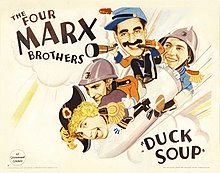
Bonus Review: Duck Soup
I understand the Marx Brothers are not for everybody. I know many people who consider that madcap, relentless joke barrage to be overwhelming and annoying, but for me, they’re hilarious and I appreciate the variety in their work through each brother’s individual sense of humor. Duck Soup, at the time of its release, was not as well-liked as Horse Feathers and Monkey Business, and it wasn’t receiving similar returns at the Box Office, though that can likely be chalked up to its release in 1933, right in the middle of the Great Depression. However, the years have been extremely kind to the film (except for a few outdated jokes and references) and it is now considered their best work. Rightfully so, in my opinion, though Horse Feathers and A Night at the Opera sure come close.
Rufus T. Firefly is appointed leader of the struggling country of Freedonia, thanks to an ultimatum by the country’s greatest benefactor, the widow Mrs. Teasdale. The ambassador of the neighboring country, Sylvania, named Trentino, sends his spies Chicolini and Pinky to Freedonia, hoping to find something on Firefly that will encourage Freedonia to revolt against him. Chicolini and Pinky fail to find anything, and so Chicolini takes up selling peanuts from a cart outside Firefly’s office. Firefly impulsively makes Chicolini his Secretary of War. Soon after, Firefly’s second-in-command, Bob Roland, speaks with him over his suspicions of Trentino’s plot. He argues that Firefly can rile the man up with insults in hopes that Trentino will slap him, inciting his removal as ambassador. Firefly agrees, but when he tries to get at Trentino, he instead riles himself up and ends up slapping him instead. Trentino discovers from another spy named Vera Marcal that Mrs. Teasdale is in possession of Freedonia’s plans of war, and so he decides to send Vera, Chicolini and Pinky to steal them. Firefly catches Chicolini in the act, and puts him on trial. During said trial, war breaks out between Freedonia and Sylvania. From here, the film descends into anarchy. Everyone at the trial is so excited by the idea of war that they break out into song. Then a battle breaks out between the two countries in the courtroom. The film ends with Firefly, Chicolini, Pinky and Roland pelting Trentino with tomatoes. Mrs. Teasdale begins to sing the Freedonia national anthem (probably the 100th time the song has been heard in the film) and so the men turn the tomatoes on her.
Duck Soup contains some of the Marx Brothers’ most famous gags. In particular, the mirror scene, where Harpo imitates Groucho to make him believe he is looking in a mirror, which has been referenced and parodied in films and television since the movie was released. The ending sequence is so incredibly bonkers and sheer anarchy that you can’t help but laugh. If you’re looking for a lighthearted war spoof, both Duck Soup and The Great Dictator are excellent options, but Duck Soup is a tad bit lighter, if that’s your preference.
The following was taken from a full-length review I wrote on this website on 09/05/2023.
I recently watched this film again, also through the Criterion Channel, after not having seen it since college. I remember when I watched it that first time and thinking, “This movie looks cheap. New York City looks so grimy, and the camera is all over the place.” At that time, I naively considered these flaws of the filmmakers, and enough to make me dismiss the film as a whole. Obviously, I have since changed my tune. Those things still remain, but some are due to budgetary restrictions and therefore cannot affect the merit of the movie as a whole, and some are stylistic choices. Most Scorsese gangster movies have a crisp look to them. NYC isn’t the problem, it’s the people who are grimy. Mean Streets informs us that it’s both, and that, in part, was the intention.
Charlie (Harvey Keitel) is a good boy – he works for his mafia-connected uncle, and therefore has to do some unsavory things, but he’s very concerned with his sense of morality and the salvation of his immortal soul. So concerned that, every time he sees fire, he tries to touch it in hopes he can withstand the heat. Anyone who has ever touched a hot stove knows that doesn’t go well for him. Since the Catholic Church will not absolve him of his sins without him actually confessing them, he attempts to earn his salvation another way.
Enter Johnny Boy, played by a nearly brand-new Robert De Niro. Johnny Boy is the cousin of Charlie’s epileptic girlfriend, Teresa, but more importantly, he’s a ne’er-do-well on the path to eternal damnation. Charlie sees Johnny Boy as his ticket to Heaven. If he can get Johnny to walk the straight and narrow, there’s no way Saint Peter would turn him away. The only problem is that the more Charlie interferes with Johnny Boy’s erratic way of living, the worse it gets. Johnny Boy feels coddled. Some people just don’t want to be saved. His antics not only set his life on a downward spiral, but he begins taking everyone else down with him – particularly Charlie. It all comes to a head in a drive-by shooting in those mean streets. Johnny Boy, Teresa and Charlie are all hurt, but Johnny Boy walks away into an alley where the red, flashing lights of a police car hint at his final destination, and Charlie walks out into the street, baptized in the waters of a broken fire hydrant. Only Teresa is unable to get out on her own, more damaged than the others, requiring the EMTs that get to the scene first to help ease her out of the car. Teresa and Charlie will survive, but while he kneels in the street, and images of the sinful life he is potentially leaving passes before his eyes, Charlie doesn’t even acknowledge the condition Teresa is in. And in that moment, that final scene, we understand how selfish Charlie’s quest to earn his own salvation truly is.
As I said before, my views on this film have changed significantly. Where as once I held Mean Streets with slight disdain, even considering it lower-tier Scorsese, I have now nearly flipped that completely. Mean Streets isn’t just a great film, it’s also pure Scorsese, through and through. It’s full of Catholic guilt, religious imagery (a chat between Charlie and Johnny Boy in a graveyard, where Johnny lays on a grave and Charlie leans against a cross, is particularly excellent), an internal wrestle between saint and sinner, a killer 60s pop soundtrack (one of the first examples of a jukebox soundtrack; the infamous bar brawl scene is set to the Marvelettes’ “Please, Mr. Postman”), tracking shots (that same bar brawl), and a whole lot of New York City.
I read that Scorsese wrote the screenplay for this film (not something he does often) after a talk with actor/director John Cassavetes, where Cassavetes criticized his previous film, Boxcar Bertha, for being uninspired. His advice to a young Scorsese was to make films he’s passionate about. You can feel the passion in Mean Streets. I argue you will not find a film so near and dear to Scorsese’s heart again until 2019’s The Irishman. It’s reflective and thoughtful. It’s genuine. It’s a filmmaker in the middle of insecurity, discovering his voice and, somehow, confidently firing on all cylinders. Martin Scorsese’s third film is, dare I say, a masterpiece, and sits alongside Taxi Driver, Raging Bull, and GoodFellas in the discussion for his best.
Bonus Review: All That Money Can Buy
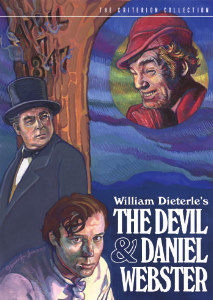
I promise the photo matches the film I’m reviewing. Originally titled The Devil & Daniel Webster, the movie was renamed All That Money Can Buy so as not to confuse audiences with another release the same year: The Devil and Miss Jones. It later regained its original title when rereleased. However, just a few years ago, it was restored for the sake of preservation by the UCLA Film and Television Archive, and since then has been presented as All That Money Can Buy, so that’s the one I’m going with. It’s the same movie, either way. I just thought I’d share.
First, a history lesson. Daniel Webster was a New Hampshire lawyer, orator and served as the US Secretary of State under Presidents Harrison, Tyler and Fillmore. He was strongly opposed to the War of 1812 and argued in the Supreme Court cases McCulloch v. Maryland and Gibbons v. Ogden. He unsuccessfully ran for President multiple times. His biggest claims to fame are his involvement in the Compromise of 1850 and a congressional speech he made in 1830, titled, Second Reply to Hayne. His prominence made him nationally known and liked by both sides of the political spectrum. I presume it’s these two factors that put Daniel Webster into the short story by Stephen Vincent Benet that the movie is based on.
Jabez Stone is a poor farmer in New Hampshire in 1840 who happens to have the worst luck you can imagine. After a string of particularly terrible things occur to Jabez, he exclaims that he would sell his soul to the Devil for just two cents, and wouldn’t you know it, not two seconds later, a man calling himself “Mr. Scratch” comes by with a very enticing offer: in exchange for his soul, Jabez will receive seven years of prosperity. Jabez signs with only minor hesitation. He quickly pays off his debts and buys his wife and mother clothes and jewelry. He also meets and befriends Daniel Webster, a man of integrity, who is also being pestered by Mr. Scratch with the offer of the presidency. Jabez is slowly changed by his wealth, alienating him from his wife and mother, and he begins to spend an unhealthy amount of time with a woman named Belle (who has been sent by Mr. Scratch, though Jabez does not know it). Jabez buys a mansion and hosts lavish parties, though one ends in tragedy when a man named Stevens (who was one of the misers holding Jabez down before his deal with Mr. Scratch) dies as a result of a deal with Mr. Scratch. This makes Jabez realize that his own time is nearly up and desperately attempts to get out of his contract with Mr. Scratch, but Mr. Scratch only offers to extend his contract for the soul of his son. Jabez refuses. Jabez begs his wife’s forgiveness and then pleads with Daniel Webster to help him. Webster agrees to defend him, but Mr. Scratch only allows a trial if Webster’s soul is also on the line. The trial is presided by John Hathorne (one of the judges during the Salem Witch Trials) and the jury of villains includes Benedict Arnold and Stede Bonnet. Webster argues that each man on the jury was in the same situation as Jabez at one time, which led to their downfall, but Jabez still has a chance to be free. The jury tears up the contract and Daniel Webster kicks Mr. Scratch out of New Hampshire. Mr. Scratch yells back at Webster that he will never become president.
The film is basically the story of Faust but with a nauseatingly American twist. It falls in line with a collection of other ridiculously Patriotic films that I can’t help but love, including Sergeant York, The Best Years of Our Lives, Top Gun, Rocky IV and The Patriot. Yes, All That Money Can Buy steers full-throttle into cheese in the last act, but you can’t help but love the unabashed “we can even beat the Devil” mentality. Honestly, though, what truly sets the film up to the standards of others is Walter Huston’s performance as Mr. Scratch. I admit, the only other movies I know Huston from are The Furies and The Treasure of the Sierra Madre – both movies that pull excellent performances out of him – but Mr. Scratch is his best role in my opinion. His blend of carnie, good ol’ boy, and used car salesman is the reason to watch this movie.



 Destined for Mediocrity