21. 12 Angry Men

No, I did not put 12 Angry Men here just for the Rush reference. It was purely coincidental. 12 Angry Men was Sidney Lumet’s feature film debut. He went on to make some of the greatest films of the 60s and 70s, including The Fugitive Kind, The Pawnbroker, Fail Safe, Serpico, Murder on the Orient Express, Dog Day Afternoon, and Network, but what a start. Now, considered one of the greatest films of all time and the second-greatest courtroom drama, just behind another film that we’ll get to later, 12 Angry Men is a simple story constructed from a teleplay. Because of this, there are only four filming locations in the entire movie: the courtroom where the tail end of the trial occurs, the jury room where the majority of the film takes place, the jury bathroom for one conversation, and outside the courthouse for one final, brief conversation. It’s a very contained film, and Lumet uses that fact to great effect. When the deliberation in the jury room begins, the camera is pulled back and the characters are viewed from further away, but as the film gets more intense, the camera zooms in until the characters are all viewed in close-up. It’s an intentional dose of claustrophobia that only elevates the movie higher up.

On a hot day in New York, a jury is tasked with deciding the fate of a poor 18-year old who is accused of killing his abusive father. The judge tells the jury that if there is any reasonable doubt then the jury must vote “not guilty”, and because a “guilty” verdict will result in the electric chair, voting must be unanimous. At first, the case seems cut and dry: there are witnesses to seeing the stabbing, hearing the boy say he will kill his father, and seeing the boy run out of the apartment. He also had purchased a switchblade just like the one found at the scene of the crime, but claims to have lost it. The jurors immediately hold a vote to see where they stand and it is near unanimously “guilty”. Only Juror 8 votes “not guilty” just to ensure they discuss the case more. There is some discussion, but even when Juror 8 produces a switchblade that looks exactly like the murder weapon (which was thought to be one-of-a-kind), the others are not convinced. Juror 8 tells the others to hold a secret ballot and he will abstain. If the rest are “guilty”, he will change his vote. However, there is a single “not guilty” in the secret vote. Juror 9 confesses he agrees there should be more discussion. Over the course of the day, the jurors look at each witness’s account and slowly poke holes in their stories. One by one, the jurors develop a reasonable doubt in the case and change their votes. Juror 3 remains the last holdout and goes on a rant, trying to prove his point, only to realize his own strained relationship with his son is informing his views of the case. He changes his vote and the jurors leave. As they go, Juror 8 helps Juror 3 put his coat on.

The film consists mostly of just the 12 angry-ish men. As the one holdout, Juror 8 is played by leading man, Henry Fonda, but the rest of the cast is rounded out by mostly character actors who you might have seen in other things and not realized it. Juror 1 is Martin Balsam (On the Waterfront, Psycho, Breakfast at Tiffany’s and episodes of Alfred Hitchcock Presents, The Twilight Zone, Have Gun – Will Travel, and The Untouchables). Juror 2 is John Fiedler (A Raisin in the Sun, That Touch of Mink, True Grit, as well as the voice of Piglet on Winnie-the-Pooh). Juror 3 is Lee J. Cobb (On the Waterfront, How the West Was Won, The Exorcist, and episodes of The Virginian and The Young Lawyers). Juror 4 is E. G. Marshall (The Caine Mutiny, Tora! Tora! Tora!, National Lampoon’s Christmas Vacation and episodes of Alfred Hitchcock Presents, Rawhide, and The Defenders). Juror 5 is Jack Klugman (Cry Terror!, Days of Wine and Roses and episodes of Alfred Hitchcock Presents, Gunsmoke, The Twilight Zone, The Fugitive and The Odd Couple). Juror 6 is Edward Binns (North by Northwest, Judgment at Nuremberg, and Patton). Juror 7 is Jack Warden (From Here to Eternity, Donovan’s Reef, Shampoo and All the President’s Men). Juror 9 is Joseph Sweeney (The Man in the Gray Flannel Suit, The Fastest Gun Alive and episodes of Car 54, Where Are You?). Juror 10 is Ed Begley (Odds Against Tomorrow, The Unsinkable Molly Brown and episodes of Route 66, Rawhide, The Dick Van Dyke Show, Gunsmoke and Bonanaza). Juror 11 is George Voskovec (The Bravados, BUtterfield 8, The Spy Who Came in from the Cold, and The Desperate Ones). And finally, Juror 12 is Robert Webber (Harper, The Dirty Dozen, Midway and episodes of Alfred Hitchcock Presents, Route 66, and The Fugitive). The end.

Bonus Review: Anatomy of a Murder
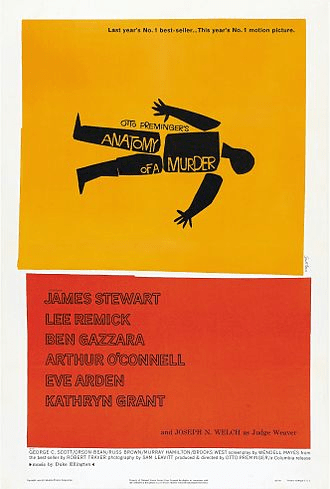
One of the biggest criticisms of the courtroom drama is how unrealistic it is from a legal standpoint. Real lawyers aren’t allowed to raise their voice in the courtroom, or call surprise witnesses, and they don’t object as often as the movies would make you think. There’s no “You can’t handle the truth!” moments. However, Anatomy of a Murder is true to its title and an accurate portrayal of the defense process, so much so that it is used in law schools as a teaching tool. How many movies can you say are two-hour-and-forty-minute crash courses in law?

Paul Biegler is a small-town lawyer and a former district attorney. He is hired to defend Lieutenant Manion, who shot and killed an innkeeper named Barney Quill. Manion admits to the murder, but says it was in response to Quill raping his wife and doesn’t remember the actual course of events. Even with the irresistible impulse (temporary insanity) defense, it’s still an uphill battle for the trial. The prosecution also fights to keep Manion’s motive out of the courtroom, but Biegler convinces the judge to admit it. The one witness to the murder, the bartender, Al Paquette refuses to cooperate with the defense, either because of loyalty to Quill or a love for Quill’s secret illegitimate daughter, Mary. Mary is thought by the prosecution to be Quill’s lover since her true connection to Quill is hidden for her own benefit. Biegler talks Mary into getting Paquette to comply, but even that is a fruitless endeavor. Manion’s wife claims that Quill tore off her underwear during the rape, but the underwear is nowhere to be found. When Mary hears this, she testifies that the underwear was found in the inn’s laundry room the morning after the alleged events. The prosecution tries to argue Mary’s testimony as that of a jealous lover, forcing her to admit to being Quill’s daughter. Manion is found not guilty by reason of insanity.

22. Dr. Strangelove, or: How I Learned to Stop Worrying and Love the Bomb

Stanley Kubrick is now regarded as one of the greatest directors of all time. He was known as a perfectionist and innovator when it came to his work with the camera. Dr. Strangelove is the very center point (film #7 of a 13-feature film career) of his filmography and quite a change of tone from the majority of his work. Kubrick had a sort of black humor to his movies, but Dr. Strangelove is an all-out comedy; a satire of Cold War paranoia and the concept of mutually assured destruction (MAD, for short). The story is taken from a book by Peter George called, Red Alert – a serious novel about the U.S. attempting a preemptive strike against the Soviet Union – but as Kubrick reworked the story for his script, he realized that the philosophies that made up such paranoia couldn’t be taken seriously. The film had to be a comedy. Add in the great Peter Sellers and the film couldn’t be anything but.

Air Force General Jack D. Ripper gives his executive officer, Captain Mandrake, the order to put their base on red alert, confiscate all radios, and send the closest fighter planes to the Soviet Union to prepare to bomb it. Mandrake realizes that this command did not come from the Pentagon, and when he confronts Ripper, Ripper locks them in his office and tells Mandrake of how the Soviets have been fluoridating the American water supply to pollute citizens’ precious bodily fluids. At the Pentagon, General Turgidson explains to President Muffley what is going on. Unable to recall the planes in time, Muffley reaches out to Soviet Premier, Dimitri Kissov, to warn him of what is coming. Muffley is then told that the Soviets built a doomsday machine as a nuclear deterrent, which, if it was made to go off, the fallout would leave the world uninhabitable for 93 years. Muffley’s scientific advisor, the German Dr. Strangelove, points out that for the machine to be effective as a deterrent, people would need to know about it. Meanwhile, Mandrake successfully calls off the air strike, except for one plane that was unable to receive new communications. Major “King” Kong goes to release his plane’s bomb, but there is an electrical issue. He fixes it and the bomb drops with him on it. He hollers and waves his cowboy hat as he descends. Back at the Pentagon, everyone argues about what to do, knowing the doomsday machine is going to go off. Dr. Strangelove, who has been in a wheelchair the entire time, gets out and gleefully revels in the miracle that has happened to him just as the doomsday machine goes off.

Kubrick is an important part of the success of this film, but the true gem here is Peter Sellers. I’ve mentioned him before for playing the original Inspector Jacques Clouseau in The Pink Panther series, but in Dr. Strangelove, he plays not one, not two, but three distinct roles as Mandrake, Muffley and the Nazi Dr. Strangelove. Each role is so vastly different, but still so hilarious in its own way. Mandrake just listening to Ripper explain what he thinks the Soviets are doing to their bodies is ridiculously funny. Muffley’s conversation with Dimitri is great. And of course, Dr. Strangelove’s malfunctioning hand is the star of the show. Whether reaction, dialogue, or physical comedy, Sellers is a natural and can make just about anything funny. Without a doubt, he is what makes Dr. Strangelove the acclaimed work it is today, and makes it worth a watch. Then a rewatch. Then a rewatch.

Bonus Review: It’s a Mad, Mad, Mad, Mad World

It’s the night of the Stanleys! Stanley Kramer was also a famous director, and he was known for making socially-conscious dramas, such as The Defiant Ones, Judgment at Nuremberg, Inherit the Wind and Guess Who’s Coming to Dinner? He then made It’s a Mad, Mad, Mad, Mad World – a comedy of epic proportions – to prove to his critics that he could do it and do it well. The experiment paid off with several awards and a strong return at the box office. Originally a 202-minute epic, the film was cut down by United Artists to 163 minutes without Kramer’s permission. Regardless of how long it is, the film is filled to the brim with jokes in every scene. It’s a Mad, Mad, Mad, Mad World was also a huge influence on future films with its simple, briefcase-chasing plot and movies that fill their cast with a big ensemble of famous faces for a box office draw.

Look, I’m not gonna sit here and explain the details of the plot for this one. They are simply too convoluted. But the what gets the movie going is this: a man runs his car off the highway and some other drivers stop to help him. However, he is dying and uses what time he has left to tell his helpers that he has $350,000 buried in a park under a “big W”. Then, as his soul departs this world, he literally kicks a bucket down the hill. The others attempt to find away to evenly split the money, but they can’t come to a consensus, so they all rush back to their cars and begin a mad-cap race to see who gets their first.

In order to create the ultimate comedy, Kramer pulled in several comedians with different style of comedy to act as his leads (except for Spencer Tracy, who receives top billing) and in cameo appearances. The comedians included are Jimmy Durante, Milton Berle, Sid Caesar, Buddy Hackett, Ethel Merman, Mickey Rooney, Dick Shawn, Phil Silvers, Terry-Thomas, Jonathan Winters, Edie Adams, Eddie Anderson, Jim Backus, Ben Blue, Joe E. Brown, Alan Carney, Peter Falk, Paul Weaver, Buster Keaton, Don Knotts, Carl Reiner, Tom Kennedy, Jerry Lewis, Phil Arnold, Jack Benny and The Three Stooges. Like I said, it’s a full slate of big names in the comedy world. With a cast this huge and the long runtime (especially for a comedy), it’s proof to the talent within Stanley Kramer that It’s a Mad, Mad, Mad, Mad World is as good as it is. This movie is the very definition of “controlled chaos”.

23. Butch Cassidy and the Sundance Kid

Sometimes, there’s a story that is ripe for adaptation. And even more rarely, there are stories that benefit from being told as they really happened and not with embellishment. Butch Cassidy and the Sundance Kid is such a film. Kind of. Other movies about outlaw gangs tend to make their antiheroes tough-as-nails, never-run-away-from-a-fight, and no-nonsense. They’re stoic and, even though their methods aren’t always right, their results are usually seen as a positive. Butch Cassidy and the Sundance Kid was originally rejected as a project because the screenplay depicted Butch and Sundance’s escape to South America, which is what actually happened. So, though the film does embellish in places (their personalities, the timing of events, and “Raindrops Keep Fallin’ on My Head”), but the events that occur in the film were what really happened, and it made for an unusual and more interesting story than most Westerns at the time provided.

Butch Cassidy (Paul Newman) is the fun-loving leader of the Hole-in-the-Wall gang, and Sundance (Robert Redford) is his quiet, crack shot right-hand-man. Together, with the rest of the gang, they successfully rob a couple of trains, but that alerts the attention of the head of Union Pacific, who sends a posse of lawmen after them. Cassidy convinces Sundance and Sundance’s girlfriend, Etta Place (Katharine Ross), to hide out in Bolivia, which Cassidy inexplicably assumes is an outlaw’s paradise. However, they are soon deprived of that fantasy upon their arrival. Sundance particularly loathes the place. Due to their inability to speak Spanish, they are initially unsuccessful at robbing banks, so they consider quitting the criminal life for good. Their first day as honest-working men ends with their boss being killed by bandits in a shootout. They decide the honest life isn’t for them, and return to their old ways. When they arrive in a small Bolivian town, they are met by the local authorities who have also called in the Bolivian army to help bring down Butch Cassidy and the Sundance Kid. The two friends go down in a blaze of glory and the film ends with the greatest freeze-frame of all time (although, Thelma & Louise gives it a run for its money).

Butch Cassidy and the Sundance Kid is another one of those films where everything sort of came together perfectly. George Roy Hill was just eccentric enough of a director to bring this strange story to life and prevent it from being a cartoon. The chemistry between Paul Newman and Robert Redford is magnetic, so much so, between this film and The Sting, they are considered one of the greatest on-screen duos of all time. But what ties it all together is the script from William Goldman. Goldman is one of the best screenwriters who ever lived because he could, and did, write in any genre. He could tackle westerns, detective films (Harper), drama (The Great Waldo Pepper), war epics (A Bridge Too Far), political thrillers (Marathon Man, All the President’s Men), biographical (Chaplin), horror (Magic, Misery), romance and fantasy (The Princess Bride). He was a master, and he fought hard the script he wrote, refusing to cut important elements such as the time in Bolivia. Anything less would not be the iconic movie we know and love today.

Bonus Review: Hell or High Water

Depending on who you talk to, Taylor Sheridan is the savior of the Western genre or just really obsessed with it. He has written a critically-acclaimed trio of neo-Westerns – Sicario, Hell or High Water and Wind River – as well as created your favorite Paramount television show, whether it’s Mayor of Kingstown, Tulsa King or Yellowstone or one of its prequels. He’s become something of a hot commodity and has even been given the directorial reins of the upcoming adaptation of Empire of the Summer Moon (and if he screws it up, there will be Hell Toupee). He got significant recognition for Sicario, but Hell or High Water got him Yellowstone and Yellowstone got him Carte Blanche. Hell or High Water is a neo-western thriller about a pair of brothers who rob banks to gather the money to save their family’s ranch – the quintessential outlaw-with-a-heart-of-gold storyline, almost a cliche really, but it allows for the characters carry the story.

The Howard brothers, Toby and Tanner, rob two branches of the Texas Midlands Bank. They are meticulously planned out by Toby, but Tanner’s erratic behavior poses a danger to their work. Texas Midlands provides the reverse mortgage on their family’s ranch, which their mother lived in but died recently, so the brothers are attempting these robberies to prevent foreclosure. If they can keep that from happening, they can reap the benefits of recently discovered oil on the property. Two Texas Rangers, Hamilton and Parker, pursue them and Hamilton seems to have a knack for profiling the brothers. Tanner robs another bank without alerting Toby and then they take their money to a casino in Oklahoma, passing the money off as winnings to cash into a check, making the money untraceable. They return to Texas to rob another bank, but it turns out be crowded and Tanner ends up shooting a security guard and an armed civilian. A posse pursues them out of the town and the brothers split up. Toby takes the money to a casino to launder, while Tanner holds the posse off with a rifle. Tanner kills Parker, but Hamilton circles around and shoots Tanner in the back. Toby makes it to the bank with the money just in time to avoid foreclosure. Toby is cleared as a suspect in the bank robberies and shootings because he has no prior criminal record and the amount of money he gets from the oil on the land is large enough to where he has no motive. Nevertheless, the now-retired Hamilton still believes Toby to be the mastermind and pays him a visit. When confronted, Toby admits that his motive was to prevent his children from experiencing the poverty he and Tanner grew up in. Hamilton says he holds Toby responsible for Parker’s death. Just then, Toby’s ex-wife and estranged children arrive, and it is revealed that Toby has given the ranch to them. Toby and Hamilton agree to “finish” their conversation another time.

24. The Elephant Man

David Lynch had one feature film under his belt when he was approached by Mel Brooks to direct the adaptation of the life of Joseph Merrick, a man suffering from physical deformity that was never identifiable in the medical community. Merrick’s tragic life as a sideshow “freak” and his desire to be a “normal” human being is surprisingly serious subject matter for both Lynch and Brooks, and to avoid confusing audiences, thinking they’re walking into a comedy, Brooks left his name off the credits, opting to produce solely through his newly created “Brooksfilms” company, and Lynch was still to new on the scene for audiences to know what to expect from him. Lynch, for the most part, is subdued. Known for his surrealist, dreamlike way of filming, mostly plays it straight and realistic, outside of the film’s bookending scenes involving Merrick’s mother. This has put The Elephant Man lower on the list of favorites among Lynch lovers, but it is also probably his most accessible film for the general public. And thank goodness for it. This movie needs to be watched by everyone.

Frederick Treves is a surgeon at London Hospital. He comes across a freak show in the East End featuring a hooded John Merrick (throughout history, Joseph Merrick has been erroneously called “John”; the movie does this as well). Treves pays the ringmaster, Mr. Bytes, to bring Merrick to the hospital for examination. Treves examines Merrick in front of his colleagues and it is revealed Merrick must sleep with his head resting on his knees, otherwise he would asphyxiate in the night. Merrick is returned to Mr. Bytes and is beaten to the point of needing medical attention. Treves brings Merrick back to the hospital. Merrick is treated by Mrs. Mothershead because all the other nurses are terrified of him. Mr. Carr Gomm, the hospital governor does not want to treat Merrick and considers him “incurable”, but when Merrick proves his ability to read and learn by reciting the 23rd Psalm, he is permitted to stay. Merrick becomes somewhat the talk of the town and receives guests. Some are kind to him, and others…are not. The night porter at the hospital begins to sell tickets to see “The Elephant Man”. During the raucous, Mr. Bytes kidnaps Merrick and puts him back in his show. His health deteriorates and Mr. Bytes leaves him for dead. Merrick makes his way back to the London Hospital and he is diagnosed with chronic obstructive pulmonary disease. Treves and Mothershead take Merrick to a show with Princess Alexandra (the one who had guaranteed Merrick’s permanent residence at the hospital). The actress in the show is one of Merrick’s kind visitors from earlier and dedicates the show to him, inviting him to stand for an ovation from the audience. Back at the hospital, Merrick finishes a model of a cathedral he could see from his window, thanks Treves for his kindness, and goes to bed on his back like a “normal person”, dying in the night.

The Elephant Man is a beautiful film, surprisingly sweet and sentimental. For some critics of the movie, this is the biggest complaint, but for others, like myself, it’s what makes it so good. It’s a feature, not a bug. Making the film in black and white provides a sort of hazy look over the entire thing, keeping a sense of mystery and dreaminess throughout. And of course, the characters are the focal point. Anthony Hopkins handles the disgust, curiosity, second-guessing, kindness and tenderness of Treves. John Hurt, up to this point, was mostly in supporting roles, but his lead turn as Merrick was astounding to say the least. His prosthetics made it difficult for him to talk, but it better serves the character. The film is a perfect display of the irony of humanity: those who look like monsters, usually aren’t, and the ones who look humane are deformed. As Merrick says when a mob overcomes him: “I am not an animal! I am a human being!”

Bonus Review: Freaks

They say, when you’re first working on a story of some kind, to “write what you know”. Tod Browning didn’t write Freaks, but he had the carnival background before he became a filmmaker. Browning, by the time he was working on Freaks, was already a successful director as the man behind the original Dracula in 1931, and had made a name for himself as the original King of Horror. The irony of that monicker and this film is that Freaks is probably Browning’s most controversial and most horrific film, and yet, it’s not a Horror film. There are maybe some elements of Horror, such as the ending, but it’s mostly pure drama. The reaction to the making of the film would make you believe it’s a Horror, though. The cast, mostly made of actual “freaks”, was so disturbing to the regular workers at MGM that they relegated to being housed in a tent outside the studio lot and fed in a separate cafeteria.

The visceral reaction from test audiences caused the studio to go behind Browning’s back and cut the film down from 90 minutes to a measly 65 minutes, and now the original cut is gone forever. The film bombed because of the disgusted reaction and MGM tried to hide it from the general public for decades. However, when it was rereleased in the late 60s, it became a small counterculture phenomenon and was reevaluated by audiences and critics alike to great acclaim. One of the original criticisms was that Browning, by making a film about deformed people with deformed people, was being exploitative and mean. However, in this reevaluation, people began to realize that the story and the way scenes are filmed is incredibly sympathetic to the “freaks” and treats them as “normal” people when it shows them doing day-to-day stuff not just their sideshow performances.

Cleopatra, a beautiful trapeze artist, learns that one of the midgets in the show, Hans, has a really large inheritance and decides to marry him for his money. This obviously upsets Hans’ fiancée, Frieda. To get the money quicker, Cleopatra plans with Hercules, the strongman, to kill Hans after they’re married. Hans is head-over-heels for Cleopatra and agrees to the marriage. At their wedding, Cleopatra begins her scheme to gradually poison Hans’ wine. The other “freaks” attempt to be inviting to the “normal” Cleopatra and chant “One of us! One of us!” at the table (yes, this is where that comes from). The “freaks” general happiness upsets Cleopatra to the point where she mocks all of them and humiliates Hans by parading him around on her shoulders. Hans realizes that Cleopatra only wants his money, but he gets sick from the poison. While bedridden, he discovers the extent of Cleopatra and Hercules’ plot and conspires with the other “freaks” to get revenge. In the middle of the night, as the caravan travels to the next town, Hans’ wagon turns over, giving Cleopatra the chance to escape the “freaks”, but they pursue her into the woods. It is later revealed that they have mutilated her, turning her into a “freak” like them. Okay, maybe it’s more Horror than I originally remembered.

25. Saving Private Ryan

Is Saving Private Ryan the greatest war film of all time? With the slight exception of a less combat-based comedy, absolutely it is. More care and attention to detail was put into this movie than most movies get in general – even more so than most war films (explosion fests, shoot ‘em ups, etc.) get. The opening recreation of D-Day alone is so carefully executed, that it gave veterans who went to screenings PTSD. It also single-handedly changed how combat was filmed for war films and epics. No, seriously. Compare any battle scene filmed after Saving Private Ryan came out in 1998, and see for yourself. The jerky handheld-camera movement, the soldier POV, the choreography – it’s all that’s done anymore. Other details, such as the patches on soldiers’ uniforms and ways they would prepare their rifles, it’s all considered incredibly authentic. Steven Spielberg and Tom Hanks’ love of World War II history is what makes the film such a loving tribute to those who sacrificed everything for their country.

Captain John Miller leads a team of soldiers behind German lines after they storm Omaha Beach to secure a victory as part of the Normandy invasion. The U.S. Department of War receives word that of the four Ryan brothers who enlisted, three have been killed in action, and the one who may be alive is considered missing. Miller and his band of brothers are tasked with finding Ryan and bringing him home so his mother can be spared any more heartache. The group thinks they have found Ryan, but it turns out to be a different Ryan with a similar first and middle name. The group makes their way to a rallying point where a soldier, now nearly deaf, claims to know where Ryan is…Ramelle, a town with a bridge that needs defending. Along the way, they lose some of their soldiers, making the survivors question if their mission is worth it. They do find Ryan in Ramelle, but he refuses to leave his men, believing he has no more right than anyone else to leave. Miller and his men stay and help defend the bridge, but all but two of the original company die in battle with the Germans. As Miller himself dies, he whispers to Ryan “earn this”. Decades later, an elderly Ryan stands at Miller’s grave as he reminisces.

Saving Private Ryan notoriously lost the big prize at the Academy Awards to Shakespeare in Love – a rom-com framed around the writing and performing Romeo and Juliet. I really enjoyed Shakespeare in Love, personally, but it pales in comparison to the writing, camera work, story and lasting impact that Saving Private Ryan has. When we think about all the sacrifices soldiers make – the time and energy to get in shape for combat as well as all they have to carry on a daily basis, the time spent away from family, the mental wrestling with the morality and depravity of what they witness in combat, the physical and mental toll of stressful warfare, and the willingness to die if necessary – it doesn’t seem right to just make action films with tons of explosions and shooting to tell their stories. There should be honor and appreciation behind these stories, and if no other movie does it justice, at least Saving Private Ryan delivers.

Bonus Review: Hacksaw Ridge

In the past, I’ve talked about my deep love for the film, Sergeant York. It’s a wonderful film about a religious man who fights in World War I despite his moral objections. In the film (not sure about the real life York), he originally refuses to fight, but eventually justifies it, saying by killing those running machine guns, he was saving the lives of countless others. Yeah, maybe. But Desmond Doss (the real man and the man Hacksaw Ridge is about) staunchly refuses to fight when in the same position. Instead, his compromise (if you can even call it that) is to be a medic. He will serve his country by taking care of the ones who do fight.

Desmond Doss is drafted to fight in World War II, but his Christian morals prevent him from taking the life of another man. His goal is to become a medic so that he can comply with his country’s demands and stick to his moral code. His seeming self-righteousness makes him several enemies among his fellow soldiers, but he sticks to his beliefs in the face of such adversity and ends up saving those who hated him. He becomes a hero. It’s a little simple and straightforward, and most of the conflict is manufactured, but that doesn’t detract from what makes it great. The movie is a testament to unrelenting faith and a lack of compromise when trials come. It’s also a story of not just a general soldier, but a very specific, very honorable one.

26. Django Unchained

By the time I watched Django Unchained, I was already a fan of Quentin Tarantino. His movies were the very definition of “cool”, and he remains a pillar of influence on college dorm posters the world over. Since Django Unchained was released, I have somewhat cooled on my opinion of Tarantino. I still like his work, and I believe he mostly improves as time goes on, but his obsession with 60s and 70s films, particularly Spaghetti Westerns, Blaxploitation, and Kung Fu films, has perhaps run its course as far as his homage-focused style of filmmaking. Having said that, Django Unchained is arguably the greatest use of all those influences, even when it overdoes it. The movie’s title is a send up Sergio Corbucci’s Django for crying out loud! It gets a lot of side-eyes because it’s a film about slavery that puts slavery in the backseat, but because the slavery isn’t the focus of the film and more of a background, the incredible violence, humor and genre-bending mostly gets a pass.

A German bounty hunter/dentist named Dr. King Schultz (Christoph Waltz) seeks to purchase a slave named Django (Jamie Foxx) because he should recognize the faces of his next big bounty, the Brittle Brothers. The deal is, if Django can point them out to Schultz, then Django is a free man. As they track down the Brittles, Schultz gives Django the opportunity to learn to shoot and read, where he proves to be a natural at both. After they successfully kill the Brittle Brothers, Schultz learns that Django was married to a house slave named Broomhilda (Kerry Washington) before they were sold separately and is determined to reunite them. They discover Broomhilda or “Hildi” is a slave at the plantation of Calvin Candie (Leonardo DiCaprio), and come up with a ruse to get Candie to sell Hildi to Schultz by acting interested in one of Candie’s fighting slaves and adding Hildi to the transaction. The main house servant, Stephen (Samuel L. Jackson), discovers the nature of Django and Hildi’s relationship, and alerts Candie who doesn’t appreciate being lied to. Multiple gunfights ensue and it’s going to require all of Django’s wit to get out of Candie’s plantation with Hildi alive.

Christoph Waltz typically gets most of the praise here for his performance Dr. King Schultz, and rightfully so. He’s quick and funny. His introduction is one of the best 10-minute segments of film ever. Schultz is the most entertaining and bombastic part of the movie, so much so that Will Smith, who was originally offered the role of Django, declined it because it “wasn’t the lead”. I disagree with his takeaway, but there’s merit to it to be sure. Jamie Foxx does a superb job with Django, portraying his change from innocent and unknowing slave to aggressive and sly bounty hunter perfectly. Foxx, who is kind of a chameleon when it comes to his performing, is the best person for the job and he takes the reins with familiarity and assurance. A cavalcade of colorful caricatures make for a surprisingly laugh-out-loud experience. It’s rare that a movie can so easily jump between comedy and surreal violence. But even that violence is comical. At least the violence against the slave owners is. The violence against slaves is brutal and without a wink from the director, which is certainly for the best.

The controversy surrounding the film is two-fold: the onscreen violence is so ridiculous that it is considered by some as a mockery of the real violence that happened in that era, and the constant use of the “N-word”, which can be a valid criticism in some other Tarantino films, but I honestly don’t understand how that can be a criticism of a movie set during the 1800s American South. Nevertheless, I mention these two things because for some viewers, it’s best not to go in blind. Quentin Tarantino is not for everybody. I’m well aware of that, but if you can look past his overindulgences, you can find a charming, action-packed, and surprisingly hilarious send up to Spaghetti Westerns in here. The movie has intensity and swagger, and a multitude of well-defined characters in spades. Django Unchained is one for the ages.

Bonus Review: Once Upon a Time in the West

Sergio Leone decided to retire from making Westerns after his Dollars Trilogy (A Fistful of Dollars, For a Few Dollars More, and The Good, the Bad, and the Ugly), and so he went to work on another epic, Once Upon a Time in America, which would not come to fruition until the mid 80s. In the meantime, he was given a massive budget from Paramount Pictures and the use of Henry Fonda (Leone’s favorite actor whom he had always wanted to work with) if he would tackle another Western. Thus, we got Once Upon a Time in the West. In a rare twist, Fonda was cast as the villain of the story, Frank. Fonda was originally reluctant to play the villain, but was convinced by talking to Eli Wallach, who worked on The Good, the Bad and the Ugly, and a pitch from Leone himself regarding using Fonda’s celebrity against the audience. Charles Bronson plays the closest thing to a good guy, “Harmonica”. Unusual for the Leone films that came before it, Once Upon a Time in the West is slow and sparse with dialogue, building tension slowly until sudden bursts of violence occur. The reasoning for this that Leone gave was that he was not interested in violence, he was instead interested in the setup before such violence happens. An emphasis on the calm before the storm. The film dwells in that lull.

A train arrives in town and a man with a harmonica is cornered by three men. He guns all of them down quickly and walks away. The three men work for Frank, an outlaw working for the railroad tycoon, Morton, and is trying to acquire land owned by Brett McBain. Frank kills McBain and his children at their ranch, and leaves evidence to frame another outlaw called Cheyenne. McBain’s new bride, Jill, who gets off the train, is now the sole heir to the ranch. Morton and Frank cut ties because Morton only wanted Frank to intimidate McBain, but Frank wants the land for himself. Harmonica connects with Jill and Cheyenne and discovers Frank’s connection to Morton. He rescues Frank from being gunned down in an ambush. Frank proceeds to intimidate Jill into giving up the land. Eventually, Frank and Harmonica meet at the ranch (with Cheyenne and Jill inside the house) and proceed to have a standoff. In a flashback, Harmonica is revealed to be the younger brother of a man who Frank had previously hanged. Harmonica was forced as a boy to use his shoulders for his brother to stand on just to live a little while longer. Frank placed a harmonica in his mouth and walked away. Back in the present, Harmonica is the faster draw and guns Frank down. Frank, as he dies, asks for Harmonica’s real identity. Harmonica places the harmonica in Frank’s mouth to remind him, and then Frank dies. Jill begs Harmonica to stay, but Harmonica carries Cheyenne (who has been wounded) away.

Once Upon a Time in the West is an interesting film. It’s considered a masterpiece in its own right, but its scenes are made up of references to other Westerns. Leone asked for help from Dario Argento and Bernardo Bertolucci in writing the script, and the way they went about it was by watching older Westerns together and writing down their favorite scenes. A list of the films Once Upon a Time in the West references includes The Iron Horse, Duel in the Sun, Winchester ‘73, Shane, Johnny Guitar, The Searchers, The Comancheros, The Man Who Shot Liberty Valance, and The Last Sunset (the ending fight between Frank and Harmonica is almost a shot-for-shot replica of the gunfight in this film). The scenes that were referenced mostly replace the meaning in a way to give Once Upon a Time in the West a very ironic feel. Despite the pacing, this movie is exciting and brimming with life.

27. The Sting

The Sting is one of those rare instances in movie-making where everything just clicks together effortlessly: the performances of the two leads, the ragtime score, the attention to detail and passion for the big con, as well as simple but thorough direction, and a decidedly cheeky aesthetic. Director George Roy Hill was an eccentric filmmaker to say the least, but he knew how to give audiences what they wanted, and maybe even some things they didn’t even know they wanted. He reteams with Paul Newman and Robert Redford, who he previously directed in Butch Cassidy and the Sundance Kid, but this time, instead of making a thought-provoking and methodical Western, he throws everything away except the method for a fun, endearing caper. A lot of the movie rests on Newman and Redford’s ability to sell it to you, and they succeed with an air of indifference. No wonder they made such a dynamic duo. The film divides itself into chapters and uses title cards that are painted in the style of the Saturday Evening Post to round out the charm and authenticity to the time period where our story takes place.

Johnny Hooker, along with his partners, Luther and Joe, con a man out of $11,000. Hooker immediately loses his share of the money in a roulette game, and Luther decides to retire. The corrupt police lieutenant, who is on the payroll of crime boss, Doyle Lonnegan (who was the owner though not the carrier of the $11,000), shoots and kills Luther while Johnny narrowly escapes to Chicago. Johnny finds a man Luther recommended to him, Henry Gondorff, and invokes his help in taking down Lonnegan. Henry assembles a team of con artists and together they plan to use “the wire” – a now-defunct con that requires an elaborate setup and significant manpower to create and operate a fake horse-betting operation. It is revealed that Lonnegan is now in Chicago and Henry warns Johnny that if he’s caught, he’s on his own. Henry poses as a bookie named “Shaw” and enters Lonnegan’s high-stakes poker game on board a train, irritating him and cheating him out of $15,000. Johnny plays “Kelly”, Shaw’s disgruntled employee who seeks Lonnegan’s help in taking over Shaw’s operation. The police lieutenant that shot Luther arrives, looking for Johnny, and his pursuit attracts the attention of FBI agent Polk, who wants Johnny captured to lure in Henry, his own target. To prove his worth, Johnny as “Kelly” provides Lonnegan with a 7-to-1 tip on a long shot that pays off. Lonnegan presses “Kelly” for more details as to how he had the 7-to-1 sewn up as well as the his plan to take down “Shaw”. “Kelly” claims to have a man named “Harmon” who works for Western Union who can help by past-posting the bets. Lonnegan agrees to go along with the plan after he is provided with the trifecta of another race, and offers a $500,000 bet to get revenge on “Shaw”.

With movies like this that are so naturally twisty, it’s hard to do the synopsis part, so I’m leaving my summary there, even though there is still so much more to discuss. It’s the sign of a great movie when you can’t see the twists coming but when they’re revealed, they make total sense. The Sting has about five or so such twists. It’s a lot to keep up with, but it’s well worth the time and attention given. What I love about a movie like The Sting is that it requires to sit there and watch it. If you leave it running for a bathroom break or you pull out your phone in the middle of it, you’re going to miss something important. That need for immersion is so rare in films these days, so it’s always exciting when you come across something like that. One final thought on The Sting: I mentioned the score before, but I want to briefly point out the power that movies can have in reviving interest in old or forgotten things. The score, which covers several Scott Joplin tunes, most notably “The Entertainer”, brought Joplin’s name back to public attention. By 1973, Scott Joplin was no longer a well-known figure in musical history. Ragtime wasn’t played anywhere except Jazz piano recitals. But the success of The Sting, and the popularity of that score, is in part why Scott Joplin remains a household name. This is not to take away from Joplin’s own fame or contributions to history, but sometimes people who deserve attention fall through the cracks, and if a movie can help rectify a gross oversight, then more power to it.

Bonus Review: Ocean’s Eleven

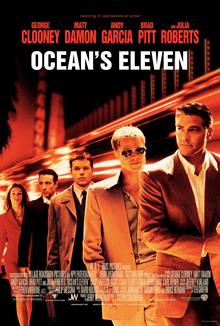
A remake of the 1960s Rat Pack film, Ocean’s 11, here is a film that can sit close beside The Sting. The thing with heists movies that a lot of other films don’t have to worry about is the “coolness” factor. Heists have to be cool, or the movies are boring and the audience doesn’t care. The stakes have to be personal and something above just getting rich, your leading ne’er-do-wells must be charming enough to overcome the fact that they’re thieves, and if you can make it look glamorous while doing it…well, that doesn’t hurt either. The modern day Newman and Redford, George Clooney and Brad Pitt, lead an all-star cast in this fast-paced, snappy, witty good time. They’re helped out by Matt Damon, Bernie Mac, Don Cheadle, Julia Roberts, Elliott Gould, Scott Caan, Casey Affleck, and Carl Reiner, as well as a cool villainous turn from Andy Garcia.

Danny gets out of prison four years after being arrested for his thieving ways. He meets up with his friend, Rusty, and the two of them travel to Las Vegas to meet with Reuben, a wealthy friend of theirs who will hopefully financially back their plan to rob three Vegas casinos: the Bellagio, the Mirage, and the MGM Grand. All three casinos happen to be owned and run by Terry Benedict, Reuben’s rival and Danny’s ex-wife’s new boyfriend. Danny and Rusty recruit their team and explain the heist: the casinos will be holding upwards of $150 million in an underground vault on the night of a well-publicized prize fight. The team survey the casinos to understand how they operate and acquaint themselves with the habits of the staff. They also build a replica of the vault to practice the heist. One of the other con men, Linus, is the one who discovers that Benedict is dating Danny’s ex, Tess, and Rusty confronts him about it, fearing that his personal motives will get in the way of the job. Danny convinces him it won’t, but soon after, he runs into Tess and Benedict, and the three carry on a brief conversation, but alert to Danny’s history, Benedict bans him from the casinos. The next day, the day the heist is to go down, Danny enters the Bellagio and is immediately detained in a room where he is to be beaten by the Bellagio strong man, Bruiser. The rest of the crew begins the heist.

Again, I have to cut it short to avoid spoiling anything. Ocean’s Eleven surpasses all other heist films (including the original) in it’s level of “coolness”. From the lights of Vegas, to the atmosphere of the casinos, to the bossa nova soundtrack, Ocean’s Eleven skyrockets to the top like the Fountains of Bellagio. The script is smart and quick, and the film shines amber like you’re watching it through a glass of cognac. Ocean’s Eleven was surprisingly successful when released in 2001, sandwiched between Harry Potter and the Sorcerer’s Stone and The Lord of the Rings: The Fellowship of the Ring, so much so that it spawned two likewise acclaimed sequels and an all-female lead reboot. Despite its modernity, the film has a lasting and universal appeal, and hopefully we eventually see more movies like this before long.

28. Braveheart

Braveheart is retroactively viewed as one of the worst critically-acclaimed films ever. Much scorn and critical analysis has been given to the historical inaccuracies of the film and the film’s value has slowly deteriorated because of it. Not to mention Mel Gibson’s public issues, which have also contributed to a negative view of the film. I’m gonna say, some of the criticism is warranted, especially for the crimes of emotional manipulation and portraying Edward Longshanks as cartoonishly evil. However, I would argue that if the film is done right, these negativities have little-to-no effect on the finished product and a movie about a historical figure can be enjoyable without being accurate. And in fact, accuracy should have no power to determine whether a movie is good or not. Anyway, back to Braveheart.

The King of England, Edward Longshanks, conquers Scotland and kills many of the nobles under the guise of a meeting to discuss the future of the country. A young William Wallace loses both his father and his brother in battle with the English, and he is taken by his uncle, Argyll, to be raised. Over time, the English reign over Scotland grows significantly more tyrannical. Longshanks marries his effeminate son to the French princess, Isabelle, and grants his lords in Scotland the right to “jus primae noctis”. Wallace returns home and secretly marries his childhood sweetheart, Murron. However, after he saves her from being defiled by an English soldier, she is captured and killed to lure Wallace out. It works, but Wallace is prepared and leads a rebellion, killing the entire English garrison there. While Longshanks is off campaigning through France, Wallace defeats an army at Stirling and sacks York, and also befriends Robert the Bruce (who is after the Scottish kingship). Longshanks returns and sends Isabelle to meet with Wallace and distract him. Instead, she falls in love with him and warns him of Longshanks plans. At Falkirk, Wallace is betrayed by two noblemen, Mornay and Lochlan, as well as Robert the Bruce, and his army is overwhelmed. Robert, however, helps Wallace escape and vows to never be on the wrong side again. William Wallace kills Mornay and Lochlan for their betrayal, but when he is invited to meet with Robert in Edinburgh, he is betrayed and captured. Robert discovers it was his father’s doing and disowns him. Wallace is taken to England, and even though Longshanks is on his deathbed, he still demands Wallace’s torture and execution. Wallace is stretched with rope and disemboweled, but still refuses to beg for mercy despite the magistrate’s promise of a quick death. Instead, Wallace screams for freedom and is beheaded. He dies watching an image of Murron in the crowd. Robert the Bruce is granted the Scottish crown and pleads with his army at Bannockburn to fight with him as they did with Wallace.

The script for Braveheart, which is written by Randall Wallace (no relation), is powerful and intense. Mel Gibson’s directing and acting (always a dangerous combination if you want to avoid accusations of ego) are both superb. Gibson as Wallace is convincing and strong, but not without feeling. As a director, his attention to the action of the battle scenes and his love for the Scottish landscape keep the film exciting and beautiful. The soundtrack from James Horner is epic. The film is based on an equally historically-inaccurate poem, The Actes and Deidis of the Illustre and Vallyeant Campioun Schir William Wallace (The Acts and Deeds of the Illustrious and Valiant Champion Sir William Wallace) – a story so popular that its printing in Scotland was second only to the Bible for hundreds of years following its release. It just goes to show that nothing can get in the way of a good story.

Bonus Review: The Patriot

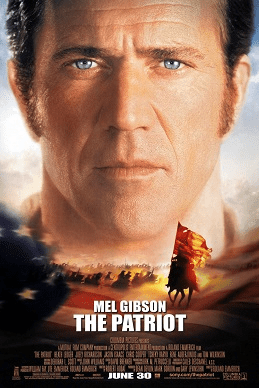
Here’s another plate of historical inaccuracy courtesy of Mel Gibson and the guy who made Independence Day – you know, that movie where aliens attack the world on the 4th of July. The Patriot is the ultimate “America, F*** Yeah!” movie, for better or worse. As with Braveheart five years before it, The Patriot makes the villainous British absolutely monstrous and one-dimensional while their victims (in this case, the United States) are completely innocent and unequivocally good…despite some vague atrocities during the French and Indian War that get swept under the rug. Also like Braveheart, The Patriot follows one man on the “victim” side of the conflict, who just wants to live in peace, but when someone close to him dies, he takes his revenge and sparks a rebellion in the process. And also, it’s a lot of fun.

Benjamin Martin is a widower with seven kids who is called up to Charleston to vote in support of the Continental Army. Martin abstains because he doesn’t want to send others to fight in a conflict he himself will not fight in. The vote passes anyway, and Gabriel, Martin’s eldest son, joins the army despite Benjamin’s protests. Two year later, Charleston is taken over by the British, and Gabriel, now wounded, returns home with rebel dispatches in hand. The Martin family cares for Gabriel as well as other American and British soldiers nearby, but when British Colonel William Tavington arrives, he arrests Gabriel, intending to hang him, and orders the Martin house burned and the American wounded killed. Thomas, another of Benjamin’s sons, tries to free Gabriel and is killed by Tavington for it. Benjamin and his two younger sons ambush the convoy carrying Gabriel and Benjamin brutally kills all but one of the British soldiers so he can go tell Tavington what has happened. Benjamin leaves his children with his sister-in-law, Charlotte, and joins the rebels with Gabriel. Benjamin’s commanding officer, Harry, tasks him with raising a militia intending to use guerrilla warfare to weaken Cornwallis’ army. Benjamin leads his militia with fervor, ambushing British caravans and stealing the supplies, as well as burning bridges Cornwallis intends to use. Cornwallis gives Tavington permission to do whatever it takes to arrest Benjamin. Tavington raids a town that is known to help the militia and gathers the entire town into the church, where he has it barricaded and burned with them inside, including Gabriel’s new bride, Anna. Enraged, Gabriel and some of the other soldiers attack Tavington’s encampment, but they are killed. Benjamin considers deserting the cause, but is reminded of Gabriel’s dedication. He and his militia join the Continental Army at the Battle of Cowpens, where he and Tavington face off. Though injured, Benjamin and the Continental Army are victorious, causing Cornwallis to retreat. Cornwallis is eventually besieged at Yorktown.

So, this movie gets a lot of flack for a supposed anti-British sentiment. Tavington burns buildings left and right and also shoots and kills a child with absolutely zero remorse, so the criticism is fair, but the film is obviously meant to be sheer entertainment. There’s no underlying messages at work here. Tavington is the only completely cold-hearted Brit in the film and he’s not even a real person. Yes, supposedly there is a couple of British officers who were inspiration for the character, just like for Benjamin Martin, but that separation between fiction and reality prevents the film from being overtly anti-British. However, any American-produced movie about the Revolutionary War is going to be in some capacity anti-British, right? If you want accuracy, read a textbook. If you want something fun to watch, you could much worse than Braveheart or The Patriot.

29. City Lights

Charlie Chaplin’s most well-regarded film was also his biggest headache. He fired an actor who would do a scene that was asked of him. He and his leading lady, Virginia Cherrill, did not get along to the point where Chaplin fired her and then, when he realized he had filmed too much of her to replace her, hired her back at her new demanded rate. His success in previous years had driven Chaplin to such a degree of perfectionism that he filmed more takes than most other filmmakers did at that time. For reference, the final film is made of a little over 8,000 feet of film, but over 314,000 feet of film was shot, which makes a ratio of almost 39 feet per foot of film in the final version. Above all of that, in 1931 when City Lights was released, silent films were already out of favor with general audiences who had since moved on to “talkies”. Chaplin, when he was working on City Lights, believed that “talkies” wouldn’t last and gave them “three years” tops. He even had the opportunity to be on the ground floor of sound films when Eugene Augustin Lauste reached out in 1918, offering Chaplin the chance to make a sound film with him (Lauste was not necessarily the inventor of such technology, but his help in developing the sound-on-film process was vital to the rise of “talkies”). Instead, Chaplin relied on the popularity of his Little Tramp character (which he also understood wouldn’t be able to translate to sound films very well), as well as his own name, to sell the movie. City Lights was not only one of his most financially successful films (and the highest-grossing film of the year), but it is widely considered his best, including by the man himself.

The Tramp walks along the street and comes across a woman selling flowers. He buys one from her and, over the course of their interaction, realizes she is blind. For the Tramp, it’s love at first sight. The door of a chauffeured vehicle shuts as the Tramp leaves, making the blind woman believe he’s an incredibly wealthy man. That night, the Tramp saves a drunken millionaire from drowning. The grateful millionaire takes his new best friend out for a night on the town. The Tramp returns the millionaire home in the morning to sleep it off. The millionaire offers the Tramp some money and the use of his car to get wherever he wants to go, and he uses the money to buy all of the flower girl’s flowers and uses the car to take her home. The Tramp leaves the flower girl and the girl tells her grandmother about her rich and helpful friend. The Tramp returns to the millionaire’s mansion, but the millionaire is now sober and doesn’t remember him, promptly kicking him out. Later, when the millionaire is drunk again, he invites the Tramp to his mansion for a party, but the next morning, a sober millionaire kicks him out again. The Tramp goes to find the flower girl, but she is not at her usual spot, so he goes to her house where he overhears a doctor say she is very sick. The Tramp gets a job as a street sweeper to raise money to help. He takes the girl groceries and reads to her from a newspaper a story about a doctor that can cure blindness. As he leaves, he sees an eviction notice and vows to pay the girl’s rent, but when he returns to work, he is promptly fired for showing up late. A boxer offers to fight him for an easy fight and they can split the prize money, but just before the fight, that boxer is replaced by another and the new boxer has no intention of sharing the money or going easy on the Tramp. The Tramp meets the millionaire again, and the millionaire offers him money for the flower girl’s operation, but after the Tramp leaves, burglars knock the millionaire out and take what money is left. The police think the Tramp is the thief and chase after him, but the Tramp gets the flower girl the money before he is apprehended and thrown in jail. When he gets out some time later, he sees the flower girl now owns a flower shop and she can see. She sees his downtrodden state and offers the Tramp a flower and some money, but when she goes to place the money in his hand, she realizes he is the man who paid for her operation. She smiles at him, and the Tramp smiles back.

City Lights is considered one of the greatest romantic comedies – and one of the greatest films – of all time. The final scene where the two reunite is one of the most lauded shots in cinema history for its humanity and performances. So moving is it that, famously, Albert Einstein was brought to tears at the premiere. Very rarely does a movie seem so genuine and heartfelt and still make us laugh so much. Some of Chaplin’s most famous routines happen in this film, notably the boxing match and a scene with the millionaire at a night club. I don’t know that it’s his funniest movie, but it is for sure Chaplin’s most accessible. It blends the comedy and pathos so beautifully that it is my go-to recommendation for anyone willing to try a silent film.

Bonus Review: The Kid

If you’re willing to take on more of the great Charlie Chaplin, look no further than his feature-film debut. It toes the line of “feature film” since it runs a measly 68 minutes, but it makes excellent use of its time, and gives you enough comedy and emotion to sustain. It also marks an early appearance of the world’s first “child star”, Jackie Coogan. Coogan was hired for The Kid at just seven years old, but already he had impressed Chaplin greatly for his ability to mimic others for the sake of performance, and that ability is used to great effect in building the relationship between the Tramp and the kid.

An orphan child is left by its mother in a car with a note. The car is stolen, but the thief leaves the child in an alley where it’s picked up by the wandering Tramp. When he sees the note, the Tramp decides to keep the child and raise him. Later, the mother returns, having had a change of heart, and is informed the car she placed her baby in has been stolen, prompting her to faint. Five years later, the Tramp and kid have a business together: the kid throws rocks at people’s windows and the Tramp is paid to fix them. At the same time, the mother has become wealthy and charitably gives presents to poor children. Unbeknownst to either of them, the mother and the kid cross paths because of this. Later, the kid gets sick in the presence of the mother, and she calls the doctor. The doctor discovers the boy is not the Tramp’s biological child by way of the note the mother left a long time ago and notifies the authorities. The Tramp and kid escape the cops and remain close to each other’s side. The mother comes back to visit the kid, and the doctor shows her the note. She now realizes the kid is hers. The Tramp and kid stay the night in a flophouse, but the proprietor learns of the reward for the kid and takes him while the Tramp is sleeping. After awaking, the Tramp frantically and fruitlessly searches for the kid. Meanwhile, the kid and his mother are reunited. Later, a cop finds the Tramp and drives him over to a mansion. When the door opens, the kid jumps into the Tramp’s arms and the mother invites him in.

30. The Third Man

Every now and then, you come across a movie, whether it’s on a streaming platform, flipping through the channels on cable, going to a small, local theater, or back years ago, picking up something random at a video rental store. Let me tell you how I first came across The Third Man. I was in college, taking film-related classes at school, and there was a guy named Louis who acted as a librarian of sorts for the film collection at the school. His job mostly consisted of sitting in a chair and keeping tabs on which professors are borrowing which movies at what times. It was thrilling stuff. He had a lot of time on his hands, so he would pop in a movie at his desk when he wasn’t busy and sit there and watch it. And he got paid to do it.

Based on my school/work schedule, I got to most of my classes 20-30 minutes early and have to sit out in the hallway while classes were going on. Louis’ library was just around the corner, but I wouldn’t normally know anything about what he was watching as he would usually have headphones in. However, on this fateful day, his ears were naked, and I heard the strangest tune coming from the library. It sounded like a mix between a guitar and a harp, and it had a nice bounce to it. Later, I would learn that the instrument was called a zither, and the movie he was watching was The Thin Man. I watched maybe 10-15 minutes of the movie with him, so intrigued by the soundtrack I was, and I immediately was enthralled. The visuals of a post-war Vienna, the camera angles and stark lighting, even the narration from Joseph Cotten held my attention.

Upon Louis’ recommendation, I checked out my public library to see if they had a copy, and sure enough, they did. I took a well-used DVD copy of the movie home, and sat through the entire thing. It wasn’t until about the 40-minute mark that I remembered the popcorn I had in the microwave. Anyway, because the disc was rather scratched up, it froze on me just as a little cat walks in front of a doorway where a foot is barely revealed from behind the shadows. If you’ve seen the movie, you know exactly what scene I’m talking about. I had to find a way to finish it. Because I’m a snob, I try to buy Blu-rays when I can instead of DVDs, so I snagged an out-of-print copy on eBay for $130. Watch the movie so you can believe me when I say it was worth it.

Holly Martins (Joseph Cotten), a Western author, travels to Vienna after receiving a job offer from his friend Harry Lime. Only trouble is, once Martins arrives, he learns that Lime is dead. At the funeral, he hears of two men who witnessed Lime’s death – he was run over by a car while crossing the street – who carted his body to the side of the road. Martins seeks out Anna Schmidt (Alida Valli), Lime’s girlfriend, to console her and discuss how neither of them believe the stories they hear of Harry’s death. In fact, as they talk, they realize there are conflicting accounts of the incident and Martins is convinced that there was a third man to help transport the body. In order to find out what really happened to his friend, Martins decides to investigate and find out who could possibly be the third man. The chase sequence in the sewers alone makes the film worth a watch, but there’s much here to be witnessed. Do yourself a favor and watch this movie.

Bonus Review: Double Indemnity

Another Billy Wilder classic. The only other filmmaker I have seen juggle both intense drama and ridiculous comedy is Howard Hawks. It’s not a feat many can do and do well. But what makes Double Indemnity so special is two-fold. One, it is the blueprint by which nearly every other noir goes by: the chiaroscuro effect of light and dark, the Venetian blind look (where the light casts the shadows of window blinds over the characters to make them look like prison bars), the femme fatale, the doomed protagonists, and so on. Every movie in the genre after it can trace something back to Double Indemnity. And two, it had the writing power of Billy Wilder and the two biggest names in pulp fiction of the era: James M. Cain, who wrote the book that the film is based on as well as The Postman Always Rings Twice and Mildred Pierce, and Raymond Chandler, who wrote the novels for the Philip Marlowe detective character as well as the screenplay for Double Indemnity. The crime-story know-how attached to this film has yet to be duplicated in any crime film since.

Walter Neff (Fred MacMurray) is an insurance salesman who meets the wife of one of his clients, Phyllis Dietrichson (Barbara Stanwyck). When she brings up the idea of getting a life insurance policy for her husband without his knowledge, Neff agrees to help her get one, finding himself attracted to Phyllis’ calculating nature. Together, they hatch a plot to get the policy and then killing her husband. If they can make it look like an accident, they can invoke the double indemnity clause, which means double the payout. However, Neff’s boss, Barton Keyes (Edward G. Robinson), is not taken for a fool, and tries to investigate the nature of Mr. Dietrichson’s death and Phyllis’ role in it. As things play out, Walter and Phyllis lose faith and trust in each other, and their relationship deteriorates. All the while, Keyes gets closer and closer to discovering the truth.