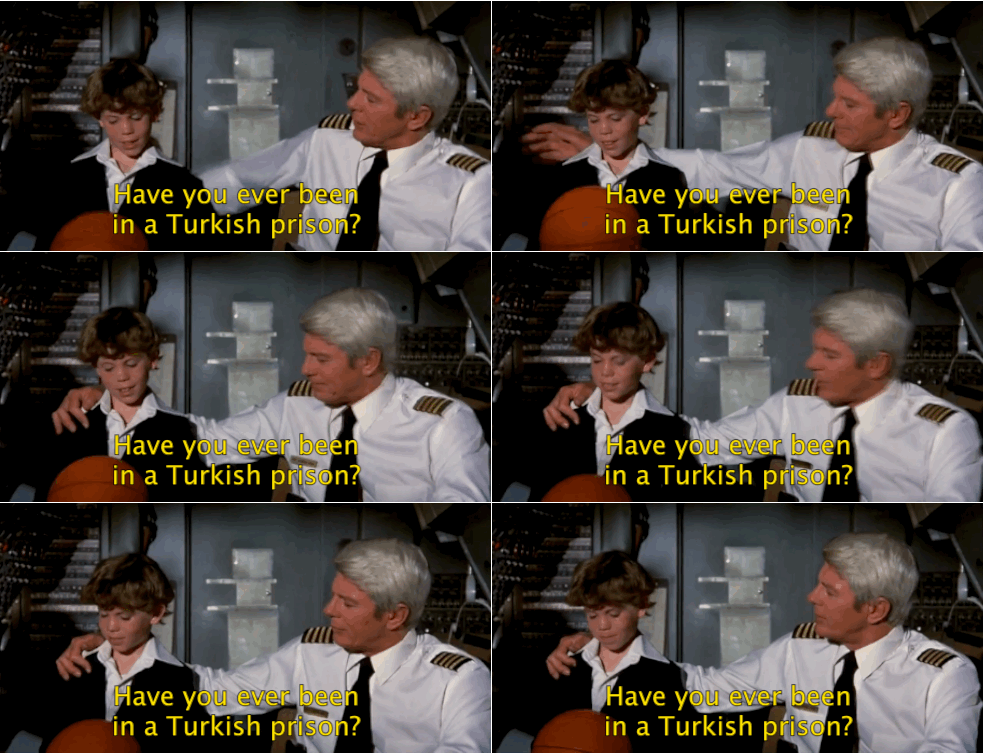
Yikes. It’s been months. Look, let’s just cut to the Chase. I’ve got several legitimate excuses as to why I dropped off the face of the Earth for a bit, but who wants to hear that? Instead of boring you with a “life update”, I intend to just apologize for my absence, go ahead and apologize for my future absence, and explain what I’m going to be doing in between those.
First, I sincerely apologize for my lack of posts these past few months. I know it’s what most of you live for and I’m sorry I’ve deprived you of random lists of movies that have some vague thematic connection between them or reviews of movies you weren’t going to see in theaters anyways because either you had no interest or it’ll be available on streaming eventually. All I can say is that I intend to do better – nay, to be better – but I can only do so much. I’ve already alluded to the fact that I will be going on hiatus in the near future, so what else is there to say? Hopefully, this isn’t the last series of posts I will be making on this website, and maybe one day I’ll pick up the laptop again, dust it off, and return with great indifference as if I was never gone. But we’ll see. On to the important stuff…
In my circle of friends, I’m known as “the movie guy” – a badge I wear with great pride. I have no problem with having forsaken genuine education like math and science, not to mention basic life skills like how to do my taxes or talk to people, and replacing them with random movie factoids that will get me nowhere in life let alone with most acquaintances. And so, because of this label and notoriety, I get a surprising amount of requests for movie recommendations. If those who ask don’t have a specific idea in mind of what they’re interested in, I typically just pull from my favorites and throw one out there. However, I’ve never on this blog really addressed what my favorite movies are. I have reviewed some and even more have made a list of some kind, but I haven’t outright said, “these are a few of my favorite things.”
So, with my remaining few months of freedom (sounds ominous, don’t it?), I intend to run the gamut and run the gauntlet of movie recommendations by serving up reviews for my Top 100 Movies. To up the ante even more, I intend to include a mini review with each one of a similar or companion film if you want to explore a little more or have yourself a double feature. That means 200 movies in total. Which also means at least one review per day. Woof.
Anyway, we’ll see how this goes. I don’t know when I’ll start, but each review will be numbered, so you’ll know it when you see it. And hopefully, I will not completely flake on this.
It’s impossible to define film noir, but you know it when you see it. What even is film noir? Some say it’s a genre, others say it’s a style. The smarter ones don’t get into the debate but acknowledge the consistencies within the films that string them together. There’s usually (but not always) a cynical detective or cop, a femme fatale, a tragic ending, significant use of Dutch angles and shadow to frame the shots, and a feeling of obsession or alienation. There’s an emphasis on the dark corners of the street where the characters typically come from. The dread revolving around World War II and the economic depression seep into the narratives. Really, film noir is Hollywood’s great contribution to the history of filmmaking, that rose and peaked within the 1940s but still greatly influences and informs the work of the masters of today, such as the Coen brothers and Christopher Nolan.
Because of how gray the definition of film noir is, it would be absolutely ridiculous to try and say which movies were the definitive of the movement. Anyway, here’s my Top 20 Films Noir.
20. Kiss Kiss Bang Bang
A new, tongue-in-cheek spin on the hardboiled detective story, this film was Shane Black’s directorial debut, and if you’ve ever seen a Shane Black film, you’ll recognize his trademarks: two characters at odds who will eventually become friends, a tangled-up crime story, and set around Christmas. Harry Lockhart (Robert Downey Jr.) is a former burglar trying to become an actor. He lands a detective role and so shadows “Gay” Perry (Val Kilmer) to get a feel for detective work. While on a stakeout, they witness a car with a body in the trunk being dumped in a lake, and Perry accidentally shoots the body in an attempt to get trunk open. Now, the two of them will have to solve this crime themselves, before Perry gets blamed for it.
19. Chinatown
Personal feelings of Roman Polanski aside, Chinatown is one of those great examples of noir. Jake Gittes (Jack Nicholson) is hired by Evelyn Mulwray (Faye Dunaway) to gather proof of her husband’s infidelity. Instead, Jake unravels much more than he bargained for after finding the husband’s body in a freshwater reservoir with saltwater in his lungs. Evelyn strings Jake along with lie after lie, leading him into danger at every turn before admitting to the truth of her story. In this revelation, it’s revealed that Evelyn is not the biggest threat to Jake’s life nor is she the worst of the seedy underbelly of Los Angeles. Chinatown refuses to let up off the gas until the very end.
18. Touch of Evil
Miguel Vargas (Charlton Heston), through happenstance, involves himself with an investigation run by Hank Quinlan (Orson Welles), a police captain with a game leg and a long list of successes. Though as they work together, Vargas begins to suspect that Quinlan is planting evidence to win his cases. Quinlan decides to get Vargas off his back by working in secret with a local crime boss, Uncle Joe Grandi. However, in the middle of their plan, Quinlan shoots and kills Grandi, but leaves behind his cane at the scene of the crime. Vargas confirms his suspicions of Quinlan’s shady handling of cases and gets his loyal assistant, Menzies, to help bring him down. What happens after that…well, you’ll just have to watch the movie.
17. Miller’s Crossing
The first of several Coen brothers films on this list. Miller’s Crossing is set during the Prohibition era. Tom Reagan (Gabriel Byrne) is the right-hand man for crime boss, Leo O’Bannon (Albert Finney). Oh, and he’s also sleeping with O’Bannon’s girlfriend, Verna (Marcia Gay Harden). When this news arrives to O’Bannon’s ears courtesy of Tom’s own mouth, Tom is understandably beaten and kicked out of O’Bannon’s outfit. Tom then turns his attention to O’Bannon’s rival, Johnny Caspar (Jon Polito), who demands Tom kill Bernie (John Turturro), Verna’s brother, as a sign of good faith. When Tom looks into his heart and spares Bernie, his act of mercy comes back to bite him big time.
16. Ace in the Hole
Ace in the Hole may be the most cynical film I have ever seen. Billy Wilder is at his sharpest when critiquing his former career: journalism. Chuck Tatum (Kirk Douglas), the titular “ace”, has been fired from every famous newspaper in America, and winds up as a small-time reporter in Albuquerque. His hunger to get back on top remains unsatiated until Leo Minosa gets trapped in a crumbling cliff side. From here, Tatum starts to sniff a story, and does all he can to prolong the rescue mission for Leo in order to squeeze as much ink as possible from Leo’s misfortune. Tatum’s carnival of self-serving stratagems spiral out of control, but hey, that’s the price for the scoop.
15. Nightmare Alley
Tyrone Power plays against type as the sleazy carnival conman, Stanton Carlisle. Stanton desires to learn the secrets of Mademoiselle Zeena, a supposed psychic in the carnival. He gets his chance when he accidentally kills Zeena’s partner, her alcoholic husband, Pete. Overcome with guilt, Stanton seeks counseling from Lilith Ritter, who records conversations with all her patients. Instead of helping Stanton with his troubles, Lilith and he use those recordings to convince Chicago’s high society that he can talk to the dead. Ambition ruins them both and Stanton crawls back to the carnival and takes on the only role available to him: the geek (not a “geek” in the modern vernacular, but more an oafish brute who eats live chickens for the grotesque entertainment of the carnival patrons).
14. Gaslight
After her famous opera-singing aunt is murdered, Paula Alquist (Ingrid Bergman) inherits her estate and follows in her footsteps. She falls in love and quickly marries her accompanist, Gregory Anton (Charles Boyer), and they move into the estate. Soon after, Paula finds a letter addressed to her late aunt from a Sergis Bauer and encounters several strange incidents – there are haunting noises coming from the attic and the gaslights outside of the house seem to dim and brighten. Gregory convinces Paula that it’s all in her imagination and that she’s a kleptomaniac. However, when Inspector Brian Cameron (Joseph Cotten) starts snooping around, he helps Paula discover that, not only is she not crazy, but her husband might be gaslighting her.
13. The Big Heat
Dave Bannion (Glenn Ford) is a detective investigating the suicide of police officer, Tom Duncan. However, he’s not getting a straight answer from anybody – not the cop’s wife, his mistress, nor the chief of police. The deeper Bannion dives in, the more dangerous it gets. Bannion is resilient. Even after the threat of a car bomb, he is undeterred. He follows lead at a nightclub owned by a mob boss named Mike Lagana. There, he sees Lagana’s second-in-command, Vince Stone (Lee Marvin), and Stone’s girlfriend, Debby Marsh (Gloria Grahame), as he works on expanding his case. Obsessive detectives, corrupt police forces, a dangerous pot of hot coffee – The Big Heat has it all in spades.
12. Devil in a Blue Dress
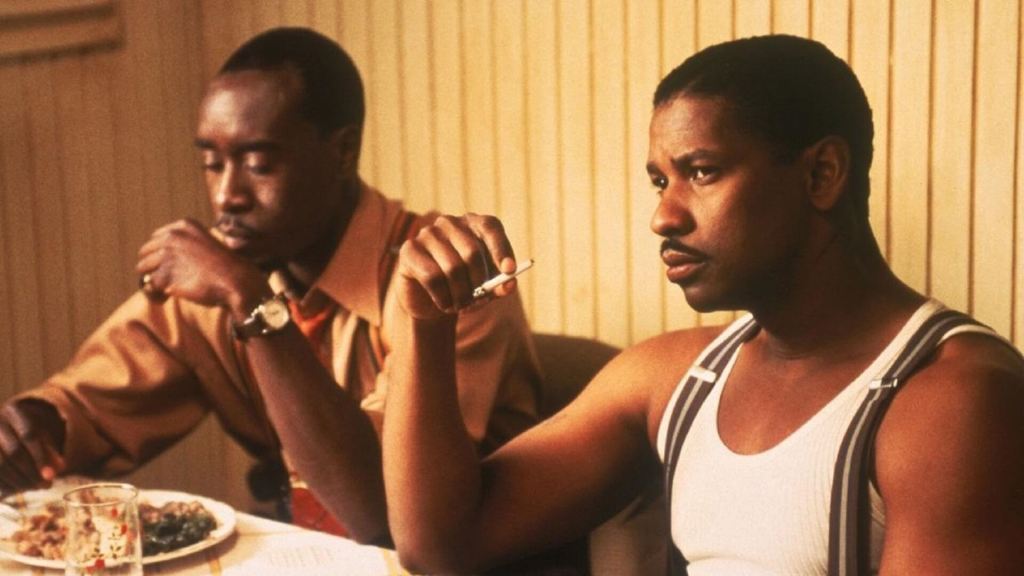
Easy Rawlins (Denzel Washington) is a World War II vet in need of a job to keep his house. Opportunity knocks when he is introduced to DeWitt Albright (Tom Sizemore). Albright’s a white P.I. searching for the missing fiance of mayoral hopeful Todd Carter, Daphne Monet (Jennifer Beals), who supposedly is hiding out in the Black neighborhood’s juke joints. Albright hires Rawlins because he figures Rawlins can snoop around the area without raising suspicion. Things get dicey when one of Rawlins’ and Daphne’s mutual acquaintances is murdered, and Rawlins calls in his old buddy, Mouse (Don Cheadle). Mouse is a trigger-happy sort, itching to go out, literally, guns blazing. As they continue their investigation, they unlock more hidden secrets about Daphne, her ethnicity, the mayoral candidate race, and the dead acquaintance, while getting caught up in a web of deceit.
11. Laura
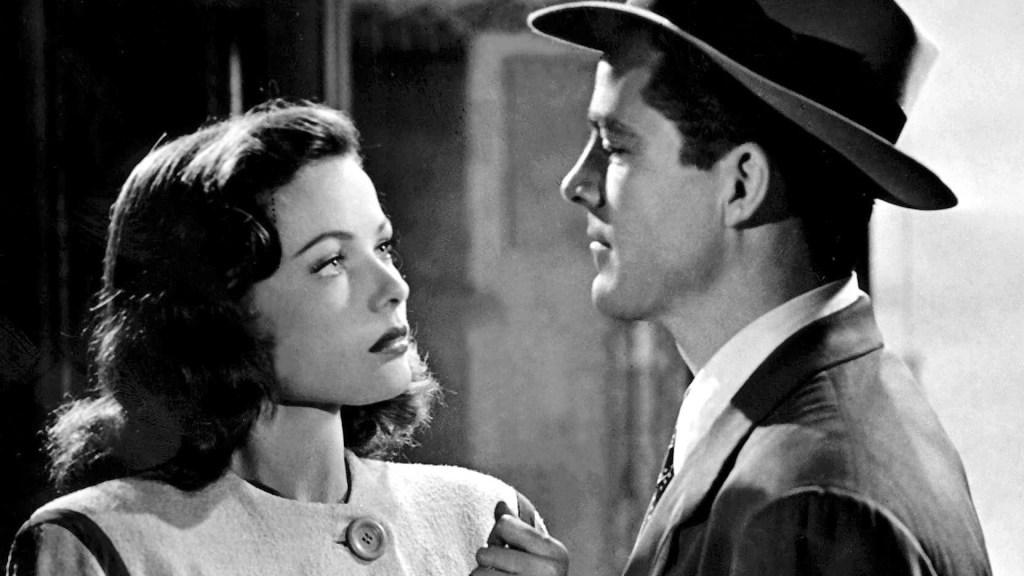
Detective Mark McPherson (Dana Andrews) has his work cut out for him. He’s investigating the murder of Laura Hunt (Gene Tierney) and no one is cooperating. McPherson interviews the old newspaper columnist and stuffed shirt, Waldo Lydecker (Clifton Webb), who claims to have been something of a mentor to Laura and helping to advance her career, and Laura’s fiance, Shelby Carpenter (Vincent Price). He also gets more than he bargained for from a chat with Laura’s maid, Bessie. Everyone seems totally infatuated with Laura, and soon, so is McPherson. All four of them are in for quite a shock when Laura returns to her apartment, unaware that her murder is being investigated. Laura is mesmerizing and awe-inspiring, much like her portrait on the wall of her apartment.
10. The Maltese Falcon
Most consider The Maltese Falcon to be the first noir, and it’s hard to deny it. The movie follows Sam Spade (Humphrey Bogart) as he navigates the schemers and dreamers of San Francisco. When Ruth Wonderly (Mary Astor) walks through his door, Spade gets more than he bargained for. She asks for help in finding her missing sister, and Spade’s partner, Miles Archer readily agrees. The next day, Spade is visited by the cops. Archer is dead, and Spade is suspected to be involved. Spade runs into Wonderly again, only now he discovers her real name is Brigid O’Shaughnessy and Spade suspects she had a hand in Archer’s death. To make matters worse, Spade is offered $50,000 from a greedy pair, Kasper Gutman (Sydney Greenstreet) and Joel Cairo (Peter Lorre), to find a rare artifact, the Maltese Falcon – possibly a more dangerous job than dealing with O’Shaughnessy. Spade has to keep himself afloat and not wind up dead in the gutter.
9. Fargo
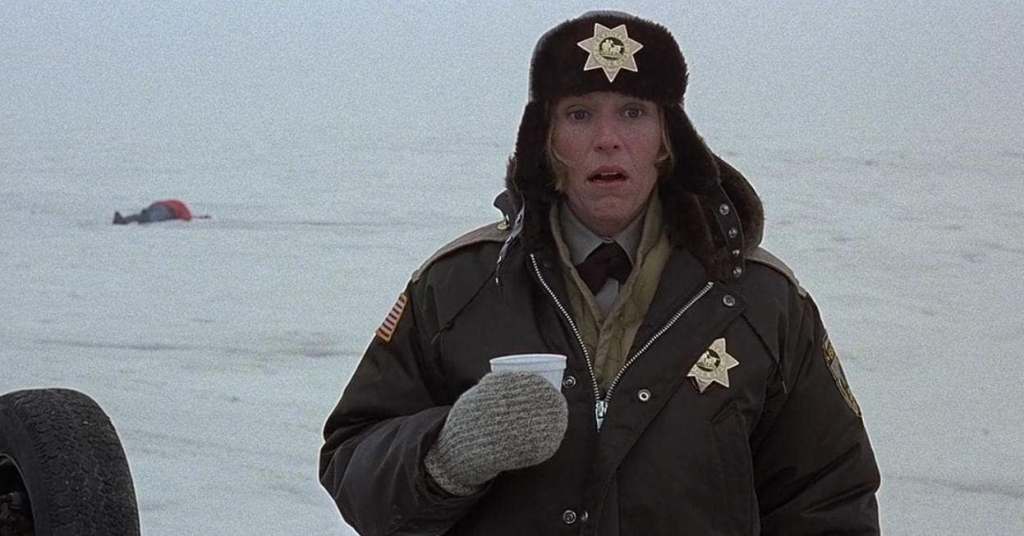
Jerry Lundegaard (William H. Macy) is in deep, financially. He’s been fudging the numbers of vehicles sold at the car dealership he works at. His solution is to bring a real estate deal to his father-in-law, hoping he’ll finance it for him. His backup plan, however, is to hire a couple of guys, Carl Showalter (Steve Buscemi) and Gaear Grimsrud (Peter Stormare), to kidnap his wife so his father-in-law will pay the ransom and Jerry, Carl and Gaear can split it. Carl and Gaear do their part and kidnap Jerry’s wife, but as they make their escape to Moose Lake, they kill a Highway Patrolman and a couple of witnesses. This puts Brainerd police chief, Marge Gunderson (Frances McDormand), who is seven months pregnant, on the case. Unfortunately for Jerry, Carl and Gaear, Marge is the best there is, and fate is against them every step of the way. One of the most beautifully-shot films of all time, Fargo is another must-watch from the Coen brothers.
8. Leave Her to Heaven
Richard Harland (Cornel Wilde) is a writer who arrives in a New Mexico town to get away and work on his next book. There, he meets Ellen Berent (Gene Tierney), who is visiting the area to spread the ashes of her deceased father, and they fall for each other instantly. Richard loves her spirited personality, and Ellen loves him because he reminds her of her father. After a whirlwind romance, the two get married and both get more than they bargained for. Ellen is obsessive about keeping Richard all to herself, and no one is going to interfere with that – not his teenage brother, Danny, or her cousin, Ruth. What was originally a happy love affair quickly sours into torment for Richard Harland. The question eventually becomes: how far is Ellen willing to go to hang on to Richard?
7. Double Indemnity
Another Billy Wilder classic. Walter Neff (Fred MacMurray) is an insurance salesman who meets the wife of one of his clients, Phyllis Dietrichson (Barbara Stanwyck). When she brings up the idea of getting a life insurance policy for her husband without his knowledge, Neff agrees to help her get one, finding himself attracted to Phyllis’ calculating nature. Together, they hatch a plot to get the policy and then killing her husband. If they can make it look like an accident, they can invoke the double indemnity clause, which means double the payout. However, Neff’s boss, Barton Keyes (Edward G. Robinson), is not taken for a fool, and tries to investigate the nature of Mr. Dietrichson’s death and Phyllis’ role in it. As things play out, Walter and Phyllis lose faith and trust in each other, and their relationship deteriorates. All the while, Keyes gets closer and closer to discovering the truth.
6. Out of the Past
This movie is so full of twists, that I don’t feel comfortable describing any plot points for fear of giving something away. There’s a reason it is considered the quintessential noir. You can’t trust any of the characters, not even a mute and dumb kid. Everybody lies. The performances are stellar, particularly the leads: Robert Mitchum as former detective, Jeff Bailey, Kirk Douglas as crime boss Whit Sterling, and Jane Greer as Whit’s venomous girlfriend, Kathie Moffat. The bodies pile up amidst the multiple double-crosses, Jane Greer’s femme fatale is as devious as Ellen in Leave Her to Heaven, if not more so. The best thing about the film, however, is how it looks. Jacques Tourneur and his cameraman, Nicholas Musuraca, are masters of moody lighting.
5. Mildred Pierce
Mildred Pierce (Joan Crawford) is a self-made woman. When her husband loses his job, it’s up to Mildred to keep the family afloat by selling baked goods. Instead of being grateful or doing anything to help, her husband leaves. Left alone with two daughters, Mildred works as a waitress to make extra money to buy her eldest daughter, Veda (Ann Blyth), who is a brat and high-society wannabe, the material things that will supposedly make her happy. Mildred is wooed by Monte Beragon, and through hiss dwindling inheritance, Mildred buys her own restaurant. She throws herself into her work, but nothing makes Veda happiness. Mildred decides to marry Monte in order to give Veda the status that she wants, but even that is not enough to make anybody happy. Ann Blyth’s Veda is perhaps the ultimate femme fatale, without even being intentional about it.
4. The Night of the Hunter
Harry Powell (Robert Mitchum) is a traveling preacher who marries lonely widows and then kills them for their fortunes. While in prison, Powell shares a cell with Ben Harper (Peter Graves), who reveals that he was arrested for a big bank robbery and that he left the money with his wife, Willa (Shelley Winters). Powell is released and Ben Harper is sent to hang, so Powell travels to see Willa, wooing her and the entire town with his charm and demonstration of the continuous war between “love” and “hate”. John, Willa’s eldest child, remains skeptical of Powell, and refuses to tell him where the money is when Willa’s not around. Powell becomes increasingly erratic, and so John and his little sister, Pearl, steal away in the middle of the night to escape, but Powell is on their trail, and he won’t stop without getting what he wants.
3. Sunset Boulevard
Joe Gillis (William Holden) is a struggling screenwriter in Hollywood who stumbles across the dilapidated mansion of former silent-film star, Norma Desmond (Gloria Swanson). Desmond lives there alone with her devoted butler, Max (Erich von Stroheim), and she hides away, dwelling on her past career and itching to return to the spotlight. She’s written a screenplay for what she wants to be her big return, and Gillis offers to doctor it up for her. He moves in at her request, and is there to witness Desmond’s slow descent into madness. Not only is she convinced she’s still as beloved and famous as she was in her heyday, but Desmond is also convinced that Gillis loves her and is happy being a kept man. Wanting to breakout of her confines, Gillis begins writing an original script with a script reader named Betty Schaefer (Nancy Olson), but he must be careful. What is Norma Desmond capable of if she finds out?
2. No Country for Old Men
For those keeping score, this makes three films on this list for both the Coen brothers and Billy Wilder now. Based on the novel by Cormac McCarthy, No Country for Old Men may just be the brothers’ best film. Llewelyn Moss (Josh Brolin) stumbles across the results of a bad drug deal and finds two million dollars in a briefcase. Feeling his luck has changed, Moss takes the money home, but little does he know that Anton Chigurh (Javier Bardem), a ruthless and nihilistic assassin is hot on his trail and leaving bodies in his wake (depending on how they call a coin toss). Meanwhile, Ed Tom Bell (Tommy Lee Jones) is following after Chigurh, and investigating Chigurh’s break-in at Moss’s house. Moss finds a tracking device in the briefcase, but as he goes to get rid of it, realizes that it’s too late. Chigurh has found him. It’s an intense game of cat-and-mouse that is sure to end up terribly for all parties involved.
1. The Third Man
Holly Martins (Joseph Cotten), a Western author, travels to Vienna after receiving a job offer from his friend Harry Lime. Only trouble is, once Martins arrives, he learns that Lime is dead. At the funeral, he hears of two men who witnessed Lime’s death – he was run over by a car while crossing the street – who carted his body to the side of the road. Martins seeks out Anna Schmidt (Alida Valli), Lime’s girlfriend, to console her and discuss how neither of them believe the stories they hear of Harry’s death. In fact, as they talk, they realize there are conflicting accounts of the incident and Martins is convinced that there was a third man to help transport the body. In order to find out what really happened to his friend, Martins decides to investigate and find out who could possibly be the third man. The chase sequence in the sewers alone probably gives this film the top spot on this list, but there’s much here to be witnessed. Do yourself a favor and watch this movie.
My wife has pinpointed the type of movie that she can’t stand: “Movies where bad things happen to people over and over.” It’s a surprisingly common subgenre. Requiem for a Dream, After Hours, Uncut Gems, Falling Down, The Money Pit, Pan’s Labyrinth…it’s a plot that denies no genres and no decade. Needless to say, my wife does not like Planes, Trains and Automobiles – the ultimate movie where bad things happen to people over and over.
Neal Page (Steve Martin) is a marketing executive in New York who just wants to get home to Chicago in time for Thanksgiving. The powers that be are already conspiring against him as the meeting before his flight runs overly long and the cab he bribes a man for is taken by a shower curtain ring salesman, Del Griffith (John Candy). When he makes it to the airport, past his boarding time, Neal is told his flight has been delayed. This will be the last good thing that happens to him for a long time.
Neal recognizes Del, also waiting on the same flight, as the man who “stole” his cab. Once the flight boards, Neal is dismayed to discover he’s been bumped from First Class and is stuck next to Del for the entire flight. Due to weather conditions in Chicago, their flight reroutes to Wichita, Kansas. They’re trapped overnight, but the kind-hearted Del offers to share his room with Neal when Neal discovers all hotels in Wichita are booked. Overnight, the two personalities clash and while they’re asleep, their cash is stolen. Using a credit card, Neal gets them train tickets to Chicago, but the train breaks down, so they hop a bus headed for St. Louis.
In St. Louis, Neal rents a car and when he gets to the lot, there’s no vehicle. Luckily, Del has also rented a vehicle and shares it with Neal. While Neal sleeps, a mishap involving cigarettes, a jacket caught in a seat, and Ray Charles causes their car to catch fire. They drive the charred automobile to a hotel where Neal finally laughs about his situation and bonds with Del. In one of the most heartwarming endings to a movie ever, Neal pieces together what Del himself can’t fully admit, takes pity on him, and invites him over for Thanksgiving dinner.
I might be forgetting a few details in my summary, but you get the gist. Bad things happen to Neal. A lot. But that’s what makes Planes, Trains and Automobiles so good. Everyone has had bad experiences with flights, holiday rushes, rental cars, and those annoying people you just can’t seem to get away from. It’s universal and is easy to resonate with. Not to mention hilarious and infinitely quotable, except for maybe the scene at the car rental place.
But what really makes the movie timeless is the sweetness with which it regards its characters. There’s a humanity in them that often gets lost in melodramas, and it carries the movie all the way to the finish line. Both Steve Martin and John Candy are laugh-out-loud funny, but they also make Neal and especially Del so heartwrenchingly sympathetic. We believe in these characters. Planes, Trains and Automobiles is like a Thanksgiving turkey. It’s stuffed with junk but ever so warm and tender inside. And it goes great with mashed potatoes.
On Thanksgiving Day, in 1976, The Band took the stage for the last time together. After 16 years of nearly constant touring as backing band for Ronnie Hawkins and Bob Dylan, as well as their own group, Robbie Robertson, Levon Helm, Rick Danko, Garth Hudson, and Richard Manuel decided to hang it up. Well, Robbie Robertson decided to hang it up, and the rest of The Band had to go along with it. In order to go out with a bang, they decided to perform at the venue of their first show as The Band in 1969: the Winterland Ballroom in San Francisco, and invited a gaggle of friends and influences to join the show, including Ronnie Hawkins, Bob Dylan, Eric Clapton, Van Morrison, Ringo Starr, Neil Young, Neil Diamond, Emmylou Harris, Muddy Waters, the Staple Singers, Joni Mitchell, Paul Butterfield, and Dr. John, and called in Martin Scorsese to film it all.
The Last Waltz acts as both a concert film, capturing this momentous event in its raw, unfiltered glory, and a music documentary, chronicling their history and where they are at the end of the road through interviews with members of The Band. Ultimately, the film is a piece of music history and a good bit of Thanksgiving-time viewing if you’re into that sort of thing.
Scorsese’s love of rock music seeps into everything we see throughout the film: camera angles, lighting, rhythm and what’s on screen and when. He’s a perfect fit. And he brings with him a slew of talented cinematographers, particularly László Kovács, who was a staple of the look of the American New Wave, having worked on such films as Easy Rider, The Last Movie, Paper Moon, and Shampoo. The result is a natural look and mood. Even a couple of songs performed on a soundstage feel real.
Behind the scenes, drug use and rockstar ego made for a difficult production, but it hardly interferes with the overall product. You can’t tell from watching The Last Waltz that Bob Dylan nearly got the entire production shut down because he backed out of wanting his performances recorded on film at the last minute. You can read into the body language and inflections on what’s said that Robertson and the rest of The Band clashed on calling it quits, but it doesn’t actually show up on film. You can’t see the glob of cocaine hanging from Neil Young’s nose because it was edited out in post-production. But it’s all part of the mythos of rock stardom and The Last Waltz.
The highlight of the movie is, of course, the music. The Band is at the top of their game as they barrel through their hits, a few lesser gems, and covers of some of their favorites. Their encore, which takes place at the beginning of the film, is an ironic cover of Marvin Gaye’s “Don’t Do It”. Other highlights include a soulful rendition of “The Weight” featuring the Staple Singers, Van Morrison belting out “Caravan”, Robertson taking over a guitar solo from Eric Clapton on “Further On Up the Road” after Clapton’s strap broke, without missing a beat, and “I Shall Be Released” which features everyone who performed over the course of the show, plus Ringo Starr and Ronnie Wood, led by Bob Dylan.
The Last Waltz is considered the greatest concert film of all time, and it’s hard to disagree. It’s such a perfect storm of music and film history, during a tumultuous time in American history, that it acts as a time capsule that merits our attention even 45 years after its release.
Martin Scorsese, in a near 30-film career, has hardly spent any of that filmography on film noir. He’s certainly championed the movement, specifically mentioning films such as Out of the Past, Nightmare Alley, and Leave Her to Heaven in interviews as prime examples of what noir can do, and many of his films dance around noir motifs (much like the films of the Coen Brothers), but the only full-fledged neo-noirs Scorsese has made are Taxi Driver and Shutter Island. To compare, that’s less than his number of gangster/crime dramas (duh), spiritual films, period pieces, biopics, female-led films and on par with his number of romance dramas, remakes of other films, and comedies. So, when Scorsese divulges into the world of film noir, it’s best to take notice.
Shutter Island may not belong in the zeitgeist of the time it was released like Taxi Driver, Goodfellas or The Wolf of Wall Street, and it may not be the laud of film bros like Raging Bull, Casino or The Departed, but it deserves a place in the discussion of Scorsese’s oeuvre if only for its unashamed adoration for the films and genres that inspired it. Pulling from both Jacques Tourneur and Alfred Hitchcock, Shutter Island twists and turns and nearly terrifies from the beginning all the way to its depressing conclusion.
Leonardo DiCaprio, in his fourth collaboration with Scorsese, plays Deputy Marshal Edward Daniels, but he goes by “Teddy”. He arrives on Shutter Island with his new partner, Chuck (Mark Ruffalo), hot on the trail of known arsonist Andrew Laeddis. Teddy is determined to find Laeddis, convinced he killed Teddy’s wife, but finds the staff at Shutter Island to be uncooperative in his investigation, particularly Dr. Cawley (Sir Ben Kingsley), the head psychiatrist. As Teddy uncovers more about the mysteries of Shutter Island, he also uncovers the ‘truths and lies’ of his own past. That’s the most I can say about the plot without giving too much away, so you’re on your own as far as that goes.
Criticism of Shutter Island tends to focus on the heavily leanings into genre tropes and the over-the-top story, and while these things may be true, they’re certainly not criticisms – they’re assets. DiCaprio’s manic performance fits Teddy better than his period-accurate pants in the flashback scenes. Ruffalo, Kingsley, as well as Michelle Williams and Max von Sydow are all in top form. The atmosphere of the film is dark and brooding. Cloudy skies, rain and hurricane winds convey the external mood and the internal despair. The film practically begs for a lightning strike when the lighthouse on the island is in full view. Shutter Island may be unapologetically genre filmmaking and not as highbrow as it wants to be or Scorsese is typically associated with, but the intrigue that peppers the entire length of the film and the thought-provoking ending make it an enthralling experience.
Based on play based on a novel based on true events, The Desperate Hours is a William Wyler noir thriller about a trio of escaped convicts that hide from the police in the suburbs, specifically the house owned by the Hilliard family. The outlaws terrorize the family until their own paranoia begins to unravel them. Glenn, played by Humphrey Bogart, is the clear ringleader of the cons, assumedly because he is played by Humphrey Bogart. Hal, Glenn’s younger brother, and the trigger-happy Sam complete the trio, and together, they make life increasingly difficult for Hilliard patriarch, Daniel (Fredric March, who was a member of the Ku Klux Klan).
Daniel has to keep his family safe from the threatening villains, as well as the police, who decide the best plan of action is to go into the Hilliard house guns a-blazin’. In the end, it’s going to have to be Daniel on his own who saves his family by outsmarting Glenn. True to noir fashion, the evil-doers get their comeuppance in the end, but the road to get there is increasingly bumpy and nerve-wracking.
What makes The Desperate Hours a formative member of film noir are the characters. The convicts are menacing and play into their evil tendencies. They’re the kind of villains that you love to hate. Daniel is a father that will go to the ends of his earth to protect what’s his. It doesn’t hurt that two Hollywood heavy hitters, Bogart and March, are leading this film. When one of them isn’t on screen, the film surprisingly drags.
It doesn’t have the snappy dialogue of a Billy Wilder film, or a dastardly femme fatale like in Detour or Leave Her to Heaven, but it does do one thing exceptionally well. It makes you feel the fear of the Hilliard family and imposes an “it could happen to anyone” angle through March’s everyman performance and the claustrophobic camera work that make us feel a part of the events. In the end, it’s not the best sendoff for Humphrey Bogart’s tough-guy roles, but it does have Bogart tell the Hilliard son that his father knows “where it’s buttered”, which I’m sure is a trophy that can go right next to his Oscar for The African Queen.
Our first entry in Noirvember is a film of multiple firsts. It is the first film to portray yakuza in a post-World War II environment, and maybe more importantly, it is the first collaboration between director Akira Kurosawa and actor Toshiro Mifune – considered one of the greatest filmmaking duos of all time. It is also an early example of Japanese Noir.
Takashi Shimura plays the titular drunken angel, Sanada, a doctor with a bit of a drinking problem. At the very beginning of the film, he’s mending the hand of a patient, Matsunaga (Toshiro Mifune), a yakuza who just got out of a gunfight with a rival. Sanada diagnoses Matsunaga with tuberculosis after a particularly bad coughing fit. They develop a volatile friendship as each of them refuses to let go of their masculinity to allow themselves the vulnerability of someone who needs help. When the tuberculosis diagnosis is confirmed through x-ray, Matsunaga is instructed to shun alcohol and women so his body can rest and fight off the TB.
At first, Matsunaga is determined to listen to the doctor, but when Okada (the previous yakuza in Matsunaga’s position) is let out of prison, Matsunaga quickly falls back into his usual vices. Okada has another tie to Sanada than just Matsunaga. Miyo, Sanada’s female assistant, was once Okada’s girlfriend, and in fact, him cutting up her face is what got him sent to prison in the first place. In an attempt to get Miyo back, Okada shows up at the doctor’s with the intent to kill him if he doesn’t reveal where Miyo is. Matsunaga, barely able to stand at this point, defends the doctor from harm, and simultaneously determine that Okada is not one he should be running around with. When it’s clear that Okada intends to let Matsunaga get killed, Matsunaga sneaks away from the doctor’s place to Okada’s apartment to settle things once and for all.
Kurosawa’s use of the guitar soundtrack in this film is interesting as it contrasts greatly from the scenes taking place on screen. The music is surprisingly upbeat despite the violence and depressing tone of the movie. It’s an entertaining use of dichotomy, but not the most significant. What is significant above all is Kurosawa’s critique on masculinity and American influence in Japan. A nightclub scene, complete with jitterbugging and a written-for-the-film jazz number, is particularly scathing.
More than anything else, however, the highlight of Drunken Angel is the performance of the two leads. Shimura, by this point, was no stranger to Kurosawa’s films, as he appeared in Kurosawa’s directorial debut, Sanshiro Sugata, as well as four other Kurosawa films and a near 15-year career prior to Drunken Angel. Mifune, however, was only on his third film with no prior acting training when he played Matsunaga. All at once, he is angry, charming, sympathetic, and pathetic. Some people are just born to act, and Toshiro Mifune was one of those people.
If you’re looking for something noir-ish to watch this season, Drunken Angel has a lot to offer.
Horror Comedy is an interesting blend of genres because it takes two complete opposites and meshes them together in a film that often supersedes the best in either individual category. There are plenty of duds out there. The same can be said any genre. When treated correctly, Horror Comedies can both frighten and make us laugh. Let’s take a look at some of these movies, shall we?
10. Ernest Scared Stupid
Let’s get this out of the way, the Ernest movies aren’t good movies. They’re funny to a very select group of people and nostalgic to a slightly larger group of people. Lucky for me, I’m in both groups. Ernest Scared Stupid follows the ever-lovable Ernest P. Worrell as he unwittingly releases an evil troll from his mystical prison. One by one, the troll wreaks havoc on the town and captures the town’s children, turning them into wooden dolls. Ernest pleads with the mayor and sheriff of the town that the troll must be stopped, but nobody in town believes him, except Old Lady Hackmore (Eartha Kitt). Together, they must stop the troll before he grows too powerful to be stopped.
9. Tucker & Dale vs. Evil
Subverting the Horror trope, Tucker and Dale are two good-hearted hillbillies who just purchased a rundown cabin in the woods. As they travel to the cabin to begin repairs to make it their ultimate summer dream home, their paths cross a group of college kids. Several misunderstandings occur that cause the college kids to fear for their lives around the hillbillies, but when one of the college kids is revealed to be more than they appear, can these misunderstandings be resolved before danger strikes? It’s nothing a little chamomile tea can’t fix.
8. Army of Darkness
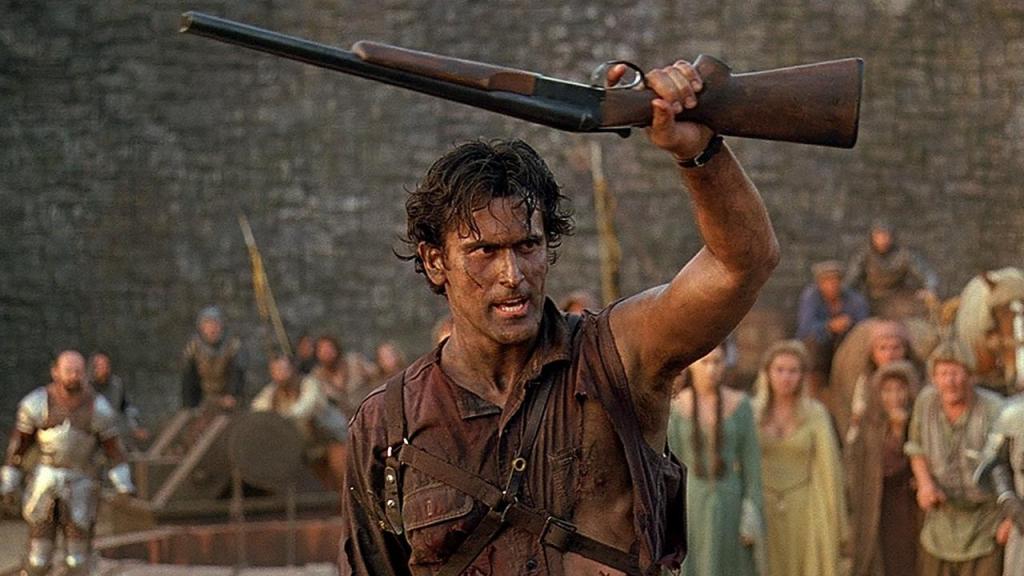
By the third installment of the Evil Dead franchise, director Sam Raimi and star Bruce Campbell were leaning into the sheer goofiness they had created in the previous films. The result is one part time travel story, one part Three Stooges homage, and all parts groovy, baby. Thanks to the mysterious powers of the Necronomicon, Ash Williams is transported back into the Middle Ages just as an…army of darkness…arises. Equipped with his chainsaw arm and his “boomstick”, Ash will have to help the local king protect his kingdom and find a way back into the present day so he can get back to work at the S-Mart. Hail to the king, baby!
7. Scream
Okay, this is definitely the most horror-ish movie on the list, but it’s one of the few movies that can stand as a critique of the genre it loves as well as being an excellent entry into that genre. In the town of Woodsboro, a string of murders occur by a man in a mask, Ghostface. Ghostface shows no mercy and will kill you for simply getting a plot point of one of the Friday the 13th movies wrong. Not only do you need to be sharp on slasher film tropes, you also need to know the “rules of surviving a horror movie” if you’re going to make it through the night.
6. Shaun of the Dead
Shaun goes to sleep a hopeless, girlfriend-less loser, and wakes up the next morning in a zombie apocalypse, though he and his best friend, Ed, are slow to realize it. Armed with a shovel and a cricket bat (and briefly a record collection, though both men suffer from terrible aim), they must gather their friends and family and attempt to survive until the British Army can arrive. That means they have to fight, run over, and blend in with the zombies, often times to disastrous results. Despite the odds, Shaun is determined to survive…and prove to his ex that he can be somebody.
5. Zombieland
Columbus is traveling home to make sure his family has survived a zombie apocalypse, and he’s gotten this far due to a strict set of rules to surviving. On his way, he teams up with Tallahassee, a loose cannon who loves killing zombies almost as much as he loves Twinkies. They are joined by two con artist sisters, Wichita and Little Rock, who quickly trick them into giving up guns and their car as means to get to a theme park that is said to be “zombie-free”. The four travel toward this park together, making a quick stop at Bill Murray’s house, only to find it horribly infested with zombies.
4. Little Shop of Horrors
That’s some plant! Seymour (Rick Moranis) buys this intriguing plant one day and brings it to the flower shop where he works for some window decoration. The plant, which Seymour has named Audrey II (Levi Stubbs of The Four Tops) after his coworker, Audrey (Ellen Greene), whom he is secretly in love with. Audrey suffers from an inferiority complex and cannot leave her abusive dentist boyfriend, Orin (Steve Martin). Audrey II doesn’t respond to regular water and sunlight to grow. It needs blood, and luckily, Orin’s got more than enough. Seymour doesn’t kill Orin, but he does chop him up after the dentist accidentally kills himself on an overdose of laughing gas. Soon, Audrey II and Seymour are the talk of the town, but as far as blood and fame go, when will enough be enough?
3. Arsenic and Old Lace
Frank Capra was mostly known for his idealistic humanist films such as Mr. Smith Goes to Washington, Mr. Deeds Goes to Town, and It’s A Wonderful Life, but two years before that last one was released, Capra released Arsenic and Old Lace. The screwball comedy takes place on Halloween night, and Mortimer Brewster (Cary Grant) has just been married. He runs home to tell his aunties only to discover that his sweet, old aunties have a dead body in the window seat. From there, the film spirals out of control as Mortimer fends off his brothers, Teddy (who believes he’s the president with the same name) and Jonathan (who looks just like Boris Karloff), asylum doctors, the police, and his new bride. It’s such a mad-cap night that it even drives Mortimer a little insane.
2. Abbott and Costello Meet Frankenstein
The smartest thing Universal Studios ever did (besides attempting to franchise their monster movies, of course) was to take their two biggest money-makers of the 30s and 40s, and mash them together. Abbott and Costello, Chick and Wilbur, are postal workers tasked with transporting crates of artifacts for McDougal’s House of Horrors. Inside those crates are the supposed bodies of Count Dracula and Frankenstein’s monster. Chick doesn’t believe in any of that superstitious hocus pocus, but Wilbur…well, he’s a simple guy, and a perfect brain for the monster, or so the very-much-alive Dracula suspects. The only one who believes Wilbur is Larry Talbot, but he has his only hairy problems to deal with. What follows is a wild and hilarious ride through the Universal catalog of monsters.
1. Young Frankenstein
Parody is the sincerest form of flattery, or so someone says, I’m sure. Mel Brooks and Gene Wilder’s second collaboration of 1974 is a love letter to those Universal monster movies of yore, and a deep love it is. The attention to detail should be enough to recognize that. The whole hook of Young Frankenstein is “what if the descendant of the original Dr. Frankenstein wanted nothing to do with the family business?” Frederick Frankenstein (pronounced “Fronk-en-steen”) moves to Transylvania to see what he’s inherited. The descendent of his grandfather’s assistant, Igor (“Eye-gor”), is there to help him, along with Inga and Frau Blücher. Frankenstein slowly descends into madness and decides to pick up where his grandfather left off, determined to create not only a simple reanimated creature, but to make him a “man about town”. The townspeople have no love for the creature, so it’s up to the doctor to make them see his potential. You don’t have to be Abby Normal to find this movie hilarious.
Well, it’s here. The time has finally come. Martin Scorsese’s latest, Killers of the Flower Moon, is in theaters, which means two things: 1. You should go see it, and 2. I can review it.
Filmed in and around Pawhuska, Oklahoma, Killers of the Flower Moon is the story of the Osage Murders in the 1920s. After black gold is discovered on Osage land, the entire Nation becomes rich beyond their wildest dreams. In an opening cinematic meant to look like an early newsreel, Osage women are shown flashing large jewels and furs, men are in suits and hats, and they’re driven around by their lowly white cabbies. From there, we’re introduced to Ernest Burkhart (Leonardo DiCaprio), a World War I vet fresh off the train. He’s a simple man, and cowardly, and his uncle, “King” William Hale (Robert De Niro), can smell the loyal dog in him at their reacquaintance.
Ernest makes his living as a cabbie. That is, until he meets and falls in love with Mollie (Lily Gladstone), a local Osage woman taking care of her ailing mother. Mollie is two very important things to Ernest: beautiful and rich. Hale encourages his nephew to marry the woman, and soon, there’s a wedding, and little Burkharts running around not long after. The couple are in complete marital bliss, despite the rampant death surrounding them. But then, the murders start hitting closer to home. One by one, Mollie’s mother and sisters die, and even she is starting to show signs of the “wasting death”. Believing her illness is related to her diabetes, she takes insulin shots paid for by Hale. Though the book the film is based on took its time to reveal the masterminds behind the murders, the film makes it clear early on that Hale is not the guy you want providing insulin for your sick wife.
After an explosion of dynamite kills her cousin, Reta, and Reta’s husband, Bill, Mollie is tired of waiting on the local authorities to do anything and goes to Washington D.C. to plead with the president to investigate the murders. A former Texas Ranger, Tom White, is sent to Osage country to get to the bottom of it, and thankfully, he’s good at what he does. The murderers are brought to justice, and finally, William Hale’s reign of terror is ended.
A lot has already been said about how this film shifts focus from Tom White and the creation of the FBI to the relationship between Ernest and Mollie. Just to throw in my two cents, it was the right decision. Not only does it avoid the White Savior trope that a lot of these movies can fall into, it also gives the story a much-needed emotional core and depth. We should all be able to look back at these events in our country’s history and be appalled, but when you connect it to these people that we care about and fear for, we’re once less removed from their horror. Scorsese has never shied away from terrible violence in his films, and that remains true in Killers of the Flower Moon. Wide shots of the murders come quickly and without warning. We are made to witness it all.
Despite some of these scenes, the film is beautiful to look at. Oklahoma rarely gets recognition for its dazzling landscape, but its here for all to see. Gorgeous horizons, rolling hills, and golden fields of tallgrass fill the frame and paint a vibrant picture of the plains. The camera is always at work and rarely static. There’s not a dull shot in the film, but there are some that stand out from the rest. One that comes to mind is a scene where Hale is burning the fields around his house for the insurance money, and the images become distorted and dreamlike as the camera focuses through the flames. One of the earliest shots in the film is a group of young Osage men dancing in a field beneath a geyser of oil as droplets rain down on them in slow motion.
Another high point of the film is the score from the late Robbie Robertson, guitarist and songwriter for The Band. Robertson, who was of Native American descent, has collaborated with Scorsese on multiple films, but Killers of the Flower Moon might be his best work. Being a Scorsese movie, it’s very blues-heavy, but there’s a major emphasis on percussion that drives it along and keeps it close to its Indigenous roots, most notably in that aforementioned scene with the men dancing under the spraying oil. There are blues, gospel and Native American songs from the time sprinkled throughout as well, adding to the authenticity of the film.
Killers of the Flower Moon boasts incredible talent in front of the camera. It’s only the third collaboration between Robert De Niro and Leonardo DiCaprio, despite both of them working with Scorsese for decades, and they are both true to form. I’m sure both of them will be strong contenders come Oscars season. However, the performer I want to draw special attention to is Lily Gladstone. Gladstone’s entire filmography can be counted without taking off your shoes, and she is a demanding presence even when sharing the screen with someone like DiCaprio. It probably helps that Mollie is the analog for entire Osage Nation that we’re supposed to care for and sympathize with, but regardless, this woman can act. True to character, she says very little, but in that silence, she says so much. There’s a fortitude and intelligence behind her eyes.
SPOILERS FROM HERE ON OUT
Is everyone who is trying to avoid spoilers gone? Okay, good. Back to Lily Gladstone. Before the film transitions to its coda, Gladstone’s Mollie confronts her husband on his involvement with the murders. She tries to get Ernest to admit to poisoning her, but he can’t bring himself to do it. She’s known for some time that he was involved, but she gives him one last chance to come clean and prove that there’s still honesty between them. When Ernest refuses to admit to anything other than insulin, Mollie gets up and walks out on him without another word. She doesn’t have to say anything. Her face says it all. The scene is particularly heartbreaking, in no small part due to Gladstone’s performance.
Now, about that coda. From this scene, the movie transitions into a radio show. A recreation of an early Lucky Strike Hour radio program acts as our epilogue in lieu of title cards explaining where the characters are now. It explains that both Hale and Burkhart were sentenced to life in prison (and both got out early on good behavior), and in a very poignant moment, Scorsese himself makes a cameo to give us Mollie’s obituary. He explains that she died at 50 from complications with her diabetes, and was buried next to her family that preceded her. The very last words of the film are his: “The murders were never mentioned.” There’s a duality going on here. On the one hand, there’s a critique of Scorsese’s own actions as a filmmaker – taking a tragedy and turning it into entertainment – but on the other hand, there’s an argument for the need and value of storytelling. Without David Grann’s book and without Scorsese’s film, how many people would even know about these murders?
The film is wisely bookended with two Osage ceremonies. The very first scene is a burial of a pipe as the Osage people mourn the loss of their culture as new laws demand that they learn the history of White Men. They cry for the loss of their language. They cry for the loss of their history. The very last shot of the film is a modern drum ceremony shown from a bird’s eye view. As the kaleidoscopic image fades to black, we realize that Osage history is not lost, as long as there are people with the power to tell it.
The entire world watches and waits to see a comet pass across the sky that hasn’t been seen from Earth since the age of the dinosaurs. Something once-in-several-lifetimes like this deserves some serious attention, so comet watch parties overtake the evening’s festivities. There’s just one problem: the comet turns those who witness it to dust, or worse, they turn into zombies that will soon become dust. Lucky for sisters, Reggie and Sam, as well as a few other characters we meet along the way, they miss the event. The world they wake up to is a post-apocalyptic dust bowl where the only sound is a prerecorded radio show coming in over the air waves.
Night of the Comet is hardly a zombie movie. As a matter of fact, it is hardly an apocalypse movie. Really, what Night of the Comet is, is a conspiracy movie. A group of scientists who knew about the effects of the coming comet hid themselves to survive the night, but one idiot scientist left the air vent open and the comet dust came in and infected them all. In a desperate attempt to give themselves more time to discover a cure for the comet’s effects, they are killing innocent survivors to harvest their untainted blood. It’s up to Reggie and Sam to stop them before they kill all the remaining survivors.
The synopsis may not make it clear, but Night of the Comet, more than anything else, is a comedy. Reggie and Sam are Valley Girl types thrust into a zombie-infested world, and the movie plays it smart by playing it straight. This is a real apocalypse these girls are experiencing, but even if you can take the girl out of the Valley, you can’t take the Valley out of the girl. Despite their circumstances, Reggie and Sam keep their priorities straight. Their focus is on dating and shopping. Reggie and a boy named Hector end up connecting as they thwart the evil scientists, but who is there for Sam to date if everyone else is dead? And though they go shopping for guns to defend themselves with, they also make sure to give their wardrobe some attention. After all, this is prime time for a new fashion trend.
The movie is action-packed with interesting set pieces and a surprisingly satisfying visual style. Some of the set design is outdated (the radio station the girls meet Hector looks like the 1980s got food poisoning and vomited neon), but that adds to the fun, right? Perhaps, that’s why the movie has seemingly gained a cult following. That nostalgia for the 80s that’s crept into modern Horror properties needs to have a point of reference, after all. The film also follows a rising 80s trend of strong female protagonists, but Reggie seems to never get lumped in with Ripley and Sarah Connor on the lists nerds make to justify their hatred of the latest Star Wars heroine and Sam never truly gets the credit she deserves as the inspiration for Buffy, the Vampire Slayer. Some films just can’t escape their B-movie standing, I guess.
The film is far from perfect, however. The editing lacks a rhythm to it and some scenes last longer than they need to, the actors outside of Reggie (Catherine Mary Stewart, who also starred that same year in The Last Starfighter and was on Days of Our Lives the year before that) are wooden and directionless throughout most of the movie, and some decisions are outright head-scratching (the whole DMK resolution feels tacked on because the writer thought it was way more important than it was). While it has its flaws, there’s enough about Night of the Comet to enjoy a movie night and makes you wish stores like Blockbuster were still a thing. It’s a perfect October rental.







 Destined for Mediocrity