Two American travelers, David Kessler (David Naughton) and Jack Goodman (Griffin Dunne), get attacked by a wolf out in the Yorkshire moors, leaving David bedridden for weeks and killing Jack. David appears to be healing up rather quickly according to Dr. Hirsch and the nurse, Alex, but he’s convinced he’s getting worse. He and Alex fall in love and sleep together at her apartment. When she goes to work for her night shift, David transforms into a werewolf in one of the most excruciatingly long scenes ever, and then attacks people night after night. His reign of terror on London is ended when the police corner him in an alley behind an adult movie theater. The movie is funnier than you might expect, but it’s also truly horrific, with jump scares and intense shadows. Quite frankly, it’s one of the best monster movies of all time.
An American Werewolf in London revived the monster movie subgenre of horror, which had been on the decline in the US since Creature from the Black Lagoon. Monster movies still had a following in the UK thanks to Hammer Studios, but the US was beginning to become infatuated with slasher films. An American Werewolf in London was so beloved by Michael Jackson, that he hired director John Landis and famed makeup artist Rick Baker to work with him on his “Thriller” music video. Baker’s effects in this movie, specifically the horrific transformation scene, have become points of reference for all future practical horror effects.
On my copy of the movie, it comes with a video essay from Jon Spira called, “I Think He’s A Jew: The Werewolf’s Secret”, which puts the film in the frame of Jewish identity in a foreign land. David’s jewishness was not something I really caught on to on my first watch of the movie, and this video (plus confirmation from the director) helped me to catch little references to the Londoners’ infatuation and fear that is buried in David’s subconscious. This angle elevates the movie from simple horror schlock to a movie worth investigating. I recommend An American Werewolf in London to anyone who can handle some gross prosthetics and slight nudity.
Bonus Review: The Thing
John Carpenter’s best film takes place in Antarctica, where an American research team witness a helicopter blow up in pursuit of a dog. R.J. MacReady (Kurt Russell) investigates and finds an unusual-looking body, which he brings back to base to have investigated. However, it soon becomes clear that the body is that of an alien creature taking the form of a human. As the revelations about the aliens abilities come to fruition, MacReady and the others realize, in their isolation, none of them are safe. The alien could be impersonating any one of them. That paranoia of who is who they say they are drives the movie to it’s explosive end. Kurt Russell’s performance and the special effects, which are still quite impressive if not disgusting, make this film a must-watch.
But that’s looking at The Thing through a modern lens. When it was originally released, the movie bombed at the box office, particularly because of the grotesque effects. I can’t sugarcoat it; the effects are excessively gory, and I know that can be a turnoff for some people. So, if you have an upset stomach, maybe avoid it. But for those of you who can handle it, the story is really what makes The Thing so great. Based on a novella written in the 1930s, Who Goes There?, The Thing is essentially a sci-fi horror reimagining of Agatha Christie’s And Then There Were None. Because the alien creature can imitate the form of anyone in the camp, no one is able to trust each other, and their attempts to prove who the alien is imitating are suspenseful to say the least. John Carpenter’s only truly-great film is a psychological masterpiece.
Italian Neorealism was a film movement that ran roughly from 1943 to 1952, but it’s influence carries on today. Italian Neorealism is easily recognizable by its characteristics – a focus on the poor and working class, filmed with non-actors, and filmed on location instead of in a studio. Except for maybe the use of non-actors, those traits are incredibly common these days, and it’s hard to imagine that they were practically unheard of prior to the Neorealist movement. That influence carried over to the French New Wave, Indian cinema, Iranian cinema, Cinema Verite documentary filmmaking, and even American cinema from the 1970s to now (we have Italian Neorealism to thank for both Martin Scorsese’s Mean Streets and Ice Cube’s Friday). What’s funny is that this film movement was so influential to the rest of the world, but not only was it not well-received in Italy, but the Neorealist filmmakers couldn’t agree on what the value of the movement was. Because of this, 1948’s Bicycle Thieves is considered the quintessential example of Italian Neorealism around the world, and is generally criticized by the other Italian Neorealists.
Bicycle Thieves is a movie where bad things keep happening to good people, and therefore, a movie I can’t get my wife to watch with me. In Rome, just after World War II, a man named Antonio is struggling to find work to provide for his wife and two children. When he does find a job putting up ad posters throughout the city, a bicycle is required to accomplish each day’s task in time, and Antonio has already pawned his off. His wife, Maria, offers the last of their valuables, her bedsheets, in exchange for the pawned bike. The next day, Antonio gets right to work, but while he is on a ladder putting up a poster, his bike is stolen. Antonio is unable to catch the thief on foot. He files a police report, but there is very little the police can do, so Antonio and his son, Bruno, search the city for the thief. Eventually, they do find him, but it’s in the thief’s home turf, and so while Antonio publicly accuses the man for stealing his bike, the man (maybe) fakes a seizure (it could be genuine, but come on, it’s pretty convenient timing) and everyone looking on at the spectacle blame Antonio for what happens. Dejected, Antonio and Bruno head towards home, but as they pass a football stadium, Antonio sees a bike just laying against the wall, ripe for the taking. He tells Bruno to go wait at the bust stop, and goes after the bike. Of course, when he takes a bike, the police and an angry mob are right there to grab him. As they carry him to the police station, Bruno watches from a safe distance and begins to cry. The bike owner sees Bruno crying for his father, and convinces the police to let Antonio go. As they walk through the hostile crowd, Bruno takes his father’s hand.
Sad, isn’t it? On the one hand, Antonio is back to being jobless and hopeless by the end of things, but on the other hand, he’s still alive and not in prison. The ending’s ambiguity may irk some people who want closure, but it keeps the film from falling over the edge of the cliff of saccharinity – something that films from other countries don’t usually run into anyway, but when you grow up on a lot of Hollywood productions, it’s hard to not expect it. Also, I don’t know if this needs to be said or not, but this is an Italian production, about Italian people, in Italian. That means subtitles for us English-speakers. But I wouldn’t recommend the film if I didn’t think it was worth it, and Bicycle Thieves is a powerful masterwork that deserves attention.
Bonus Review: Pee-Wee’s Big Adventure
The following was taken from a full-length review I wrote on this website on 08/02/2023.Pee-Wee’s Big Adventure is basically a modern Bicycle Thieves with a happy ending, anyway.
It feels weird, reviewing a movie that’s been with you since your childhood, and there’s a certain fear that comes with that: Is the movie as good as you remember it? More often than not, you go back to a movie from your past and you stare at the screen in horror over the idea that you ever enjoyed such a thing. And what’s worse, you told people recently that you liked that movie, before you sat yourself down to rewatch it. You have to hang your head in shame, now, around some of your friends because you spent several hours heatedly defending Space Jam. Life, as you knew it, is now over.
But there are other instances, where you return to a film through the eyes of your adult self, and it’s just as good as you remember it. Sometimes better. Pee-Wee’s Big Adventure is one of those movies. With the recent passing of Paul Reubens, a rewatch of the 1985 classic felt necessary. And I am thrilled to say that this film remains one of the best cinematic tales of young love, between a boy and his bike.
Pee-Wee Herman is your normal, everyday acid-trip-induced man-child version of Mister Rogers. He lives in a house with his dog, Speck, covered in gadgets and knick-knacks that overcomplicate the simplest tasks. His entire kitchen is rigged to where you can light a candle and your breakfast is made while you’re off doing something else. As a boy, I always wished for something similar in my future, but the logistics of having such a house seem insurmountable. But above everything else he owns, there is his most cherished possession: a red bicycle with a tiger’s head on the front. And there ain’t no one gonna come between him and that bike.
Paul Reubens saw Tim Burton’s original short, Frankenweenie, and personally requested that he direct this film. His fingerprints are all over the film, too. There are multiple dream sequences, some involving claymation, with black and white, German Expressionism-style set design. There’s a beautiful sunrise seen through the open jaws of a large T-Rex sideshow attraction, complete with jagged teeth framing it. There’s a fun, bouncing score from Danny Elfman, his first music-related project post-Oingo Boingo and his first collaboration of many with Burton. Burton’s style and attitude toward filmmaking are a perfect match for the character of Pee-Wee Herman.
The plot of the movie is hard to describe without sounding absolutely ridiculous, so I might as well just lean into it. All is wonderful in Pee-Wee’s world until he runs into the rich “kid” down the street, Francis Buxton. Buxton wants Pee-Wee’s bike more than anything at the moment and, to get it, he hires a greaser to steal it while Pee-Wee’s out doing a little bit of shopping. Pee-Wee soon realizes that no one is going to help him find his bike (after all, it’s “just a bike”) – not the police, not his friends – so he is on his own. With nowhere else to turn, he meets a fortune teller who tells him his bike is in the basement of the Alamo.
Pee-Wee hitchhikes to Texas with the help of a convict on the run for tearing the tags off mattresses, and a woman truckdriver named Large Marge. Although, this Large Marge lady may not be all that she seems to be. He gets dropped off at an unnamed diner in an unnamed part of the world, and he meets a friendly waitress named Simone. Simone encourages Pee-Wee to keep searching for his bike, and he encourages her to follow her dream of traveling to Paris. Simone’s boyfriend Andy is less understanding of her friendship with Pee-Wee, especially after he overhears them talking about her big “but”. He chases Pee-Wee with a dinosaur bone through a cornfield, forcing Pee-Wee to escape by jumping onto a moving train. He sings old songs with a hobo until he reaches his destination, San Antonio.
Pee-Wee is rightfully disappointed to find out that the Alamo doesn’t even have a basement, and so he’s back to the drawing board. While in San Antonio, he sets a national record in bull-riding. He also suffers from brief amnesia after being thrown from the bull. But don’t you worry, my dear Texans. Pee-Wee may not be able to remember his name, but he remembers the Alamo.
From there, he realizes he needs to get to a phone and call home, so he visits a bar that’s the local hangout of the biker gang, “Satan’s Helpers”. After he knocks over their bikes just outside the bar (which happens in any self-respecting road trip movie), Satan’s Helpers hold him down and debate how they’re going to kill him. He asks for a last request, and is granted it, so he borrows a busboy’s platform shoes and dances on top of the bar to “Tequila” by The Champs. As is expected, this wins over Satan’s Helpers and they offer him one of their bikes so he can travel home. He makes it to the edge of the parking lot before driving into the bar’s streetside signage.
Pee-Wee gets rushed to the hospital and sees a news report on TV that indicates his bike is in Hollywood on a film set. He makes his way to Hollywood, takes back his bike, and flees the Warner Bros. studio lot while being pursued by the entirety of the Warner Bros. security team. He travels through a beach movie, a Christmas movie, a Godzilla movie, a Tarzan movie, and a Twisted Sister music video before successfully escaping with his bike. Unfortunately, his freedom is short-lived. He stops to save all the animals inside a burning pet store, and it is there that he is caught and brought before Warner Bros. execs. Lucky for Pee-Wee, his story is interesting enough to where Warner Bros. wants to make a movie out of it! The film ends at the local drive-in, where all of Pee-Wee’s new friends show up to witness the premiere of this autobiographical movie.
Bonkers, right? Absolutely crazy, but it’s so much fun. The script is tight and throwaway lines earlier on make an appearance again later on. Pee-Wee’s retort to Francis (“I know you are, but what am I?”) is quoted by the film-version of Pee-Wee at the end. When making a police report, Pee-Wee is convinced that “the Soviets” are responsible for his missing bike, and in the fake film, Soviet ninjas are the main villains. It’s smart for knowing that it’s dumb and playing it up. Some scenes are terrifying, or at least were to the younger me – Large Marge, the dream sequences, one involving a T-Rex eating his bike, and another one involving three of a child’s biggest fears: clowns, doctors, and Satan. Pee-Wee’s Big Adventure is a joy to watch. It’s funny, quotable, feverishly ridiculous, and according to my wife, a little creepy, and we have Paul Reubens to thank for all of that.
I’ve got a joke for you. What happens when a brain, an athlete, a basket case, a princess and a criminal walk into their school’s library for Saturday detention? You get The Breakfast Club. Not a very funny one, I guess, but maybe it would have been funnier if the punchline was “The Lunch Bunch”? That was the original title of the movie, but I think, for the sake of legacy and longevity, it was a good change. “The Lunch Bunch” just sounds like a bad spinoff of Our Gang or something.
For those who don’t know, The Breakfast Club is about five teenagers who are forced to attend Saturday detention at their school. At first, they believe they have nothing in common, but over the course of the film, they reveal themselves and discover how similar they really are. They all find common ground in their home lives. Brian (the Brain, Anthony Michael Hall) is under so much pressure to make good grades from his parents that his F in Shop class drives him to consider suicide, and his possession of a flare gun gets him detention. Andrew (the Athlete, Emilio Estevez) is in Wrestling to win the love of his father and gets detention for taping another kid’s butt cheeks together to win the love of his teammates. Allison (the Basket Case, Ally Sheedy) is neglected at home and is a kleptomaniac and compulsive liar. She claims she’s in detention because she has nothing better to do. Claire (the Princess, Molly Ringwald) is caught in the middle of her parents’ constant arguments and is in detention for skipping school to go shopping. John (the Criminal, Judd Nelson) is physically abused by his father and has the cigar burns to prove it. He pulled the fire alarm at school. He’s also the most aggressive with the principal, who is there to keep an eye on them, and eventually gets locked in a closet to be kept separate from the others. Over the course of the day, friendships and romance blossom, but will it last when Monday rolls around?
John Hughes was really in tune with his childhood when he became an adult. His short stories about growing up in Michigan were the basis for his screenplays for National Lampoon’s Vacation and Christmas Vacation. A childhood nightmare inspired his script for Home Alone. His directorial efforts in the 80s were only as good as they were because he was so in tune with high school culture (Sixteen Candles, Weird Science, Pretty in Pink, and Ferris Bueller’s Day Off). And his love for John Candy, who was basically a really big child, gave us Planes, Trains and Automobiles and Uncle Buck. Unless you’re currently a child, you’ve probably seen at least one of his movies. He knew how to make movies economically, too, which meant significant returns on his work. The Breakfast Club used mostly child actors and was set mostly in a single room, and so it just had a budget of $1 million. It made over $50 million at the Box Office. That’s impressive for anybody.
To explain the impact this film had on pop culture, I have to address the “Brat Pack” (forgive me, Emilio Estevez). The Brat Pack was a group of young actors who collaborated periodically throughout the 80s in coming-of-age dramas. There are many actors who are inconsistently listed as members, including Tom Cruise, Charlie Sheen, James Spader, Robert Downey Jr., Sean Penn, Kiefer Sutherland, Matthew Broderick, Lea Thompson, Jennifer Grey, and John Cusack, but the core members – the ones who are consistently on every version of the list – come from just two movies: St. Elmo’s Fire and The Breakfast Club. The five kids in The Breakfast Club and Rob Lowe, Demi Moore, and Andrew McCarthy make up the core Brat Pack. Their names and faces were everywhere – on the big screen, on the small screen, on posters and magazines. They defined an entire decade of pop culture.
Anyway, back to The Breakfast Club. Is it outdated? Oh, yes. In multiple ways. Is it cheesy? More often than it probably should be. But does it also transport you to a place and time so specific that you could confidently say, “That’s what it was really like back then”? Also, yes. The Breakfast Club is an important piece of film history for how it changed the way films for teenagers were made and marketed, as well as being the 1980s in microcosm.
Bonus Review: The Outsiders
A precursor to the Brat Pack, The Outsiders featured what would eventually be considered an all-star cast. Patrick Swayze, Matt Dillon, Rob Lowe, Emilio Estevez, Tom Cruise, Ralph Macchio, and C. Thomas Howell make up “the Outsiders” – a group of greasers living in the poor side of Tulsa, Oklahoma in the 60s. Their rival gang, the Socs, are from the rich side and are just waiting to harass to the greasers whenever they have the chance.
Trouble starts when Ponyboy (C. Thomas Howell) and Johnny (Ralph Macchio) walk a couple of Soc girls home (Diane Lane is one of them) from a movie. Their boyfriends show up and threaten a fight, but the girls get them to leave, avoiding a conflict temporarily. In the middle of a rough night, the Socs return to do some damage and nearly drown Ponyboy, but Johnny rescues him by stabbing and killing the Soc pushing his head into a fountain. Ponyboy and Johnny flee with the help of Dallas (Matt Dillon), fearing retribution from police. While away, they hide out in a church, but unfortunately it catches fire with a bunch of children trapped inside. Ponyboy, Johnny and Dallas rescue the children, but Dallas and Johnny are significantly burned and are taken to a hospital. Meanwhile, the greaser-Soc relations are collapsing and tensions are mounting until the threat of a rumble permeates the air.
Francis Ford Coppola (The Godfather trilogy, The Conversation, Apocalypse Now, Peggy Sue Got Married, Bram Stoker’s Dracula, and a whole bunch of flops you can skip) is a filmmaker that demands authenticity, possibly to a fault, and The Outsiders is no different. They filmed on location in Tulsa, and now, a lot of the locations are sites you can visit, including the house that Ponyboy and his brothers lived in. It’s completely unrelated to value of the film, but it’s too interesting a story to not mention: The house that the movie filmed at was bought in 2016 by rapper and The Outsiders mega-fan, Danny Boy O’Connor (the leader of House of Pain, the rap group that did “Jump Around”). It was in a dilapidated state, and so O’Connor used GoFundMe to take donations for a massive renovation project. Some of the donors include Billy Idol and Jack White from The White Stripes (dude gave $30,000). Anyway, O’Connor received a key to the city of Tulsa for efforts on the restoration and turning the house into a museum. That’s the story. A New York rap artist who dated Punky Brewster has a key to the city of Tulsa. Oh, and an honorary diploma from Will Rogers High School, also in Tulsa. It’s bizarre to the point of being funny.
In conclusion, watch The Outsiders. Better yet, read The Outsiders and then watch The Outsiders – The Complete Novel. And if you already have, revisit it. It’s worth it.
The Little Shop of Horrors is a horror film from 1960 from director Roger Corman. But this is not the movie I’m reviewing. I’m talking about the 1986 movie musical adaptation. Little Shop of Horrors was originally an off-Broadway musical, before it was a movie – the second collaboration from lyricist Howard Ashman and composer Alan Menken. These two went on to work together on the music for The Little Mermaid, Beauty and the Beast and Aladdin. They went on to add two songs specifically for the film version at the request of the film’s director, Miss Piggy. The film adaptation comes with a fantastic cast consisting of Rick Moranis, Ellen Greene (who was in the original theatrical production), Steve Martin, Levi Stubbs (a member of The Four Tops, who provides the voice of the killer plant, Audrey II), with cameos from John Candy, Christopher Guest, Billy Murray and Jim Belushi.
Seymour (Rick Moranis) buys this intriguing plant one day and brings it to the flower shop where he works for some window decoration. He names the plant, Audrey II, after his coworker, Audrey (Ellen Greene), whom he is secretly in love with. Audrey suffers from an inferiority complex and cannot leave her abusive dentist boyfriend, Orin (Steve Martin). Audrey II doesn’t respond to regular water and sunlight to grow. It needs blood to live, and so the plant convinces Seymour that Orin’s got more than enough. Besides, Orin is only a job fair away from being a serial killer. However, Seymour doesn’t kill Orin like he intends to, but he does chop him up after the dentist accidentally kills himself on an overdose of laughing gas. Soon, Audrey II and Seymour are the talk of the town, but as far as blood and fame go, when will enough be enough, and can Seymour and Audrey navigate a future together with a Mean, Green Mother from Outer Space in between them?
Originally, the stage show and the film had the same tragic and hopeless ending, but when the movie was previewed for multiple groups in LA, the ending tested so negatively that the studio completely scrapped it. Yoda, the director, wrote a happier ending for the film that was filmed for an additional $5 million, making it the most expensive production from Warner Bros. at that time. That’s honestly a lot of faith to have in a movie that had to have a rewritten ending, so in some ways, it’s a wonder this film ever saw the light of day. Thank goodness it did, because it contains some of the best work from all parties involved. Cookie Monster never made a better film, except maybe Dirty Rotten Scoundrels. This is one of the few Rick Moranis performances that I like. The cameos are all superb, particularly the sequence between Steve Martin’s sadistic dentist and Bill Murray’s masochistic patient. And of course, the music. A musical is only as good as it’s music, and Little Shop of Horrors delivers a blend of doo-wop, Motown, and rock ‘n’ roll from the 1960s that, at the very least, will have you doing your best Ed Grimley. Highlights include “Skid Row (Downtown)”, “Some Fun Now”, “Dentist!”, and “Mean, Green Mother from Outer Space”.
It’s not difficult to get me onboard with a musical – I’d watch a musical on the human birthing process if the soundtrack was decent – but what really sells the film is the likeability of the characters, even when they’re doing unsavory things like chopping up dentists to feed their talking plant. It’s a wonder to find yourself rooting for Seymour, but it’s nearly impossible not to, such is the marriage of horror and musical. In fact, not since Rocky Horror Picture Show has there been such an energetic collision of the two genres, and not until my bonus review will there be another…
Bonus Review: The Phantom of the Opera
Come on, it was either this or Sweeney Todd. For this one, we transition from cult classic to just classic. Originally a serialized novel written in the early 1900s by Gaston Leroux, The Phantom of the Opera has been put to screen, then sung, then sung on screen. The film version of the stage musical was announced back in 1989, only three years after the musical was first reviewed, with both composer Andrew Lloyd Webber and director Joel Schumacher attached to it (apparently, Webber really liked The Lost Boys), but was left gestating for 13 years before scheduling could be worked out in 2002.
The Phantom of the Opera is the story of a love triangle inside an opera house in early-1900s Paris, between two childhood sweethearts and their socially awkward third wheel who is so pitied, he gets the movie named after him. In the beginning, Christine Daae is a backup dancer in the opera who has been getting secret singing lessons from her Angel of Music (don’t worry, it’s just the third wheel that lives under the opera house, nothing creepy). Through sheer luck, Christine is reunited with her childhood sweetheart, Raoul, who is the new patron for the opera house. They reignite their romance while the Phantom tries to win her heart by making her the lead in the opera and killing those who get in his way (again, socially awkward). The question becomes how far is the “like a brother to me” Phantom willing to go to get out of the friendzone?
Apparently, this movie could have looked very different from the finished product, as at one point, both Hugh Jackman and Anne Hathaway were in line to star as the Phantom and Christine Daae. Scheduling conflicts with Van Helsing and The Princess Diaries 2: Royal Engagement kept them from filming. I imagine Jackman at least has many sleepless nights over this sequence of events. But Gerard Butler and Emmy Rossum do a superb job and makes it easy to forget what could have been.
Before he became one of the most versatile film writer-directors of all time, Billy Wilder was a journalist in Berlin. He changed career paths when he fell in love with screenwriting, and worked on a handful of films in Germany before the rise of the Nazi party forced him to make his way to Hollywood. As far as I’ve read, Wilder enjoyed his time writing for tabloids, so Ace in the Hole feels like it comes out of nowhere.
Chuck Tatum (Kirk Douglas) is a reporter who has been kicked out of every major publication due to his temper and has therefore been reduced to begging for a job with a small newspaper in Albuquerque. A hit story falls into his lap when he and his photographer stop for gas at a station in the middle of nowhere. There, they find out that a man named Leo Minosa, who actually owns and operates the gas station with his wife Lorraine, is trapped in a collapsed cliff dwelling. Tatum does everything in his power to extend the rescue mission so he has a week’s worth of news stories. As people hear about the incident, they come in droves to the cliff dwelling to see the rescue mission unfold, and the whole area becomes a big carnival. However, through time and faulty method, it becomes clear that Leo isn’t making it out of the cliff dwelling and Tatum finally realizes he went too far for a scoop, but it’s too late.
It’s funny to me, reading reviews from the time of the film’s release, how indignant film critics were about the idea of a lack of journalistic integrity. Reviews were scathing and a lot of them focused on how unbelievable the idea that a journalist would have put an innocent man’s life on the line for the sake of a good story was. Since then, critics have reevaluated the film as another gem in the crown of an illustrious career, and rightfully so. Ace in the Hole is more poignant than ever in an age of clickbait headlines and “fake news”. It’s also the most cynical work of a man who was notorious for cynicism. Wilder’s firing on all cylinders, which was clearly too much for critics and audiences of the day. The film didn’t make back it’s budget until it was rentable in the Blockbuster Video age, and was considered a flop in the middle of a strong run of movies, sandwiched between Sunset Boulevard and Stalag 17.
I’m glad it’s getting more respect as time goes on. It’s not my favorite Wilder film, but I love the anger behind it. And maybe I’m on the internet too much, but the plot doesn’t seem too farfetched. Honestly, the most unbelievable part of the movie is that Tatum is the only journalist trying to exploit the situation. Ace in the Hole may not be for everyone. Remember, Tatum is a violent man, but don’t worry, he isn’t unscathed by the end.
Bonus Review: A Face in the Crowd
If you’re looking to make a night of cynical features, look no further than A Face in the Crowd. Andy Griffith’s film debut is a far cry from what would be his well-known Mayberry Sheriff persona…well, maybe not that far a cry. Andy Griffith plays Larry “Lonesome” Rhodes, a drifter who comes to a town in Arkansas and gets picked up for a radio station. His folksy demeanor takes the area by storm and he becomes a sensation, growing in wealth and power, but behind the scenes, he’s a vicious, vile man who thinks his followers are morons who will believe anything he says. Sound like anyone you know?
A Face in the Crowd is another cynical film that was ahead of its time, under-appreciated at the time of its release, but is hopefully being discovered by more people as time goes on. The only hang up is whether or not you’ve watched The Andy Griffith Show. If you’ve seen the show, you’re going to fall into two camps: either you can’t see wholesome Andy in such a venomous role or you appreciate the true range he possesses as an actor. If you’re in the former camp, you probably won’t like this movie. Just fair warning.
Eight Men Out is John Sayles’ take on the story of the 1919 Chicago White Sox – one of the greatest teams of baseball ever assembled – until they weren’t. It’s the all-too-true and sad story of a team, slighted by their benefactors, who decide their only way to get the pay they desire is to throw the World Series. Boxing and Gangster movies would have you believe that throwing games has been a constant practice in the world of sports, but in 1919 in America’s Pastime, it was unheard of.
Eight Men Out is also the ultimate “Oh, that guy’s in this?” movie. Some household names, like John Cusack and Charlie Sheen, as well as David Strathairn (practically in every John Sayles movie as well as Edward R. Morrow in Good Night, and Good Luck), D.B. Sweeney (Dish Boggott in Lonesome Dove and Travis Walton in Fire in the Sky), Don Harvey (bit roles in The Untouchables, Die Hard 2 and brief stint on General Hospital), Michael Rooker (McMasters in Tombstone, Yondu in Guardians of the Galaxy and Merle in The Walking Dead), Perry Lang (Jacob’s Ladder and Cattle Annie and Little Britches), James Read (North and South, Days of Our Lives, Charmed), Gordon Clapp (that guy from NYPD Blue), Bill Irwin (CSI, Northern Exposure), and Jace Alexander (…you know what, let’s not talk about him) round out the players. Richard Edson (Desperately Seeking Susan, Platoon, Good Morning, Vietnam), Christopher Lloyd (Great Scott! Do you really need his filmography?), Kevin Tighe (Emergency!), and Michael Lerner (the guy who thought it was a smart idea to have a pitch meeting for a children’s book on Christmas Eve in Elf) are the seedy gangsters and former ballplayers who claim a big payday if the boys throw the games. The floor walker from Cool Hand Luke and Fraser’s dad play the owner and manager of the team respectively. I guess you didn’t need to know all of that, but I think it’s fun.
Writer/Director John Sayles started off working under Roger Corman, a director who worked mostly outside of the studio system, except for a string of highly successful Edgar Allen Poe adaptations. For context of how important that is, here’s a list of filmmakers who were mentored under Roger Corman: Joe Dante, Peter Bogdanovich, Jonathan Demme, Ron Howard, Martin Scorsese, Francis Ford Coppola, and James Cameron. Impressive, innit? Sayles followed Corman’s way of self-financing his projects by writing genre scripts and using the paydays to fund his passions. So, the same guy who wrote and directed this movie, Passion Fish, Matewan, and Lone Star, also wrote a bunch of schlocky 80s creature features such as Piranha, Alligator and The Howling. The history lesson isn’t really necessary, but I’d always rather give my readers too much information rather than not enough. And I think John Sayles is an interesting director. Back to the movie.
After winning the American League pennant, the 1919 Chicago White Sox feel they are owed compensation, but the money-grubbing team owner, Comiskey, thinks they should be content with flat champagne. Seeds of discontent sow within the team, and that’s when wolves in former-baseball-player’s clothing swoop in and present an offer: lose the World Series on purpose and you’ll make more money than if you win. More powerful gangsters get involved, and it seems like a done deal. Some of the players, when faced with the proposition, balk at the notion and prefer the feeling of winning and playing your best, but others are all too eager to get what they think they should have already gotten from Comiskey. The de facto leader of the team, pitcher Eddie Cicotte, is on the fence at first, and goes to Comiskey to address a previous agreement that if Cicotte won 30 games in the regular season, he would receive a $10,000 bonus. Comiskey informs Cicotte that he only won 29 games and staunchly refuses. Equally motivated by revenge and a desire to provide for his family, Cicotte joins the conspiracy to throw the World Series.
Rumors float around as the Series begins, and with the White Sox’s initial performance against the Cincinnati Reds, it’s seemingly confirmed. The team manager, Kid Gleason, refuses to believe his players are cheating. Those who aren’t cheating are frustrated and fighting with those that are. Tensions and dangers mount as the gangsters start making threats against the players’ families. It’s really not a good time to be a White Sox fan…or player. After the Series ends, it only gets worse for the conspirators when a couple of journalists do enough digging to find evidence of their cheating. The players go trial, and despite being found not guilty, they are barred from Major League baseball forever.
Most sports movies are triumphant, feel-good experiences. Rocky goes toe-to-toe with Apollo Creed. Rudy plays a game for Notre Dame. Happy Gilmore saves his grandmother’s house. Kevin Costner gets to play catch with his dead dad. People remember the Titans. You get the idea. It’s much rarer to see a sports movie with a melancholic ending. These guys never got to play in the Majors again. One of the more innocent-but-still-not-totally-innocent-because-he-should-have-brought-the-conspiracy-to-someone’s-attention-if-he-knew-about-it players, Buck Weaver (John Cusack), sits at a minor league game, watching an incognito “Shoeless” Joe Jackson hit a home run and reminiscing on what could have been. It’s the what-ifs that make the story so interesting. What if Buck had said something about the conspiracy? What if Cicotte hadn’t chosen revenge? What if Kenesaw Mountain Landis (we really should bring back “mountain” as a middle name) had stood by the jury’s verdict or shone leniency? What if the conspirators had just said “no”? What if the players had just been compensated fairly in the first place?
Because of that approach, the film goes beyond the sport to shine a light on the unfair balance between those who did the work and those who reaped the benefits. And it was genuinely unfair. This was a long time before baseball players saw multimillion-dollar contracts. Owners were able to keep most of the earnings while maintaining low salaries for the players. Now, the film may not be 100% fair in it’s leaning towards the players. There are some things that we genuinely can’t be sure of. Was Buck Weaver as innocent as he claimed? Was Eddie Cicotte so concerned with money strictly for the sake of his family? Was the illiterate Joe Jackson really tricked into signing a confession of wrongdoing? These motivations, portrayed as black and white, are a lot grayer when looking at the real history. But in the end, it’s just a movie. And Eight Men Out is a fascinating one, to be sure.
Bonus Review: Matewan
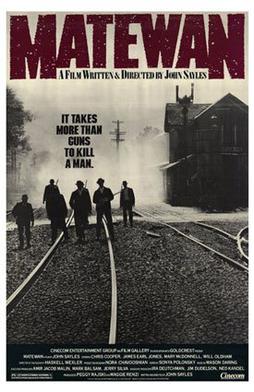
Eight Men Out was released in 1988. The year before, John Sayles released another historical drama called Matewan, named after the West Virginian town where the story takes place. In 1920, coal miners in Matewan go on strike against the Stone Mountain Coal Company after wage cuts. A man named Joe Kenehan (the woefully neglected and underrated Chris Cooper in his film debut) comes to town to encourage the miners to unionize. Soon after, two men from the Baldwin-Felts Detective Agency arrive on a tip from a spy for the company within the town and attempt to frighten the strikers. When the townspeople refuse to leave, the detectives have to bring in backup. It culminates in what is known as the Battle of Matewan – a shootout between the coal miners and detectives working for the coal company.
Matewan is like Christmas – green and reds everywhere. The color grading of the film stock strengthens the greens of the trees and grass of Appalachia. It’s beautiful to look at, and rightfully received an Oscar nomination for Cinematography. The union organizer, Joe, is labeled by the detectives as a “red” – a Communist. Chris Cooper does a wonderful job for not only his first film role, but as the lead. He’s backed up by strong performances from David Strathairn and James Earl Jones.
I love the open-ended view of the politics in the film. Not everyone will agree with the pro-union message of the movie, but it does go out of it’s way to show that both sides escalate the tension and do more harm than good (the miner-supporting town sheriff starts the gunfight in the film, though in real life, no account of who fired first is made). Political messaging isn’t always the best reason for watching movies, however. Sayles’ historical dramas are informative replications of rarely-discussed events in American history. That alone makes them worth watching. Matewan makes a great double-feature with Eight Men Out mostly just to see more of Sayles’ filmography, but there’s a lot to say for the similarities between them in theme, in time period, and in actors (four of the actors are in both films). Both movies are timeless tales of timely situations.
Yikes. It’s been months. Look, let’s just cut to the Chase. I’ve got several legitimate excuses as to why I dropped off the face of the Earth for a bit, but who wants to hear that? Instead of boring you with a “life update”, I intend to just apologize for my absence, go ahead and apologize for my future absence, and explain what I’m going to be doing in between those.
First, I sincerely apologize for my lack of posts these past few months. I know it’s what most of you live for and I’m sorry I’ve deprived you of random lists of movies that have some vague thematic connection between them or reviews of movies you weren’t going to see in theaters anyways because either you had no interest or it’ll be available on streaming eventually. All I can say is that I intend to do better – nay, to be better – but I can only do so much. I’ve already alluded to the fact that I will be going on hiatus in the near future, so what else is there to say? Hopefully, this isn’t the last series of posts I will be making on this website, and maybe one day I’ll pick up the laptop again, dust it off, and return with great indifference as if I was never gone. But we’ll see. On to the important stuff…
In my circle of friends, I’m known as “the movie guy” – a badge I wear with great pride. I have no problem with having forsaken genuine education like math and science, not to mention basic life skills like how to do my taxes or talk to people, and replacing them with random movie factoids that will get me nowhere in life let alone with most acquaintances. And so, because of this label and notoriety, I get a surprising amount of requests for movie recommendations. If those who ask don’t have a specific idea in mind of what they’re interested in, I typically just pull from my favorites and throw one out there. However, I’ve never on this blog really addressed what my favorite movies are. I have reviewed some and even more have made a list of some kind, but I haven’t outright said, “these are a few of my favorite things.”
So, with my remaining few months of freedom (sounds ominous, don’t it?), I intend to run the gamut and run the gauntlet of movie recommendations by serving up reviews for my Top 100 Movies. To up the ante even more, I intend to include a mini review with each one of a similar or companion film if you want to explore a little more or have yourself a double feature. That means 200 movies in total. Which also means at least one review per day. Woof.
Anyway, we’ll see how this goes. I don’t know when I’ll start, but each review will be numbered, so you’ll know it when you see it. And hopefully, I will not completely flake on this.
It’s impossible to define film noir, but you know it when you see it. What even is film noir? Some say it’s a genre, others say it’s a style. The smarter ones don’t get into the debate but acknowledge the consistencies within the films that string them together. There’s usually (but not always) a cynical detective or cop, a femme fatale, a tragic ending, significant use of Dutch angles and shadow to frame the shots, and a feeling of obsession or alienation. There’s an emphasis on the dark corners of the street where the characters typically come from. The dread revolving around World War II and the economic depression seep into the narratives. Really, film noir is Hollywood’s great contribution to the history of filmmaking, that rose and peaked within the 1940s but still greatly influences and informs the work of the masters of today, such as the Coen brothers and Christopher Nolan.
Because of how gray the definition of film noir is, it would be absolutely ridiculous to try and say which movies were the definitive of the movement. Anyway, here’s my Top 20 Films Noir.
20. Kiss Kiss Bang Bang
A new, tongue-in-cheek spin on the hardboiled detective story, this film was Shane Black’s directorial debut, and if you’ve ever seen a Shane Black film, you’ll recognize his trademarks: two characters at odds who will eventually become friends, a tangled-up crime story, and set around Christmas. Harry Lockhart (Robert Downey Jr.) is a former burglar trying to become an actor. He lands a detective role and so shadows “Gay” Perry (Val Kilmer) to get a feel for detective work. While on a stakeout, they witness a car with a body in the trunk being dumped in a lake, and Perry accidentally shoots the body in an attempt to get trunk open. Now, the two of them will have to solve this crime themselves, before Perry gets blamed for it.
19. Chinatown
Personal feelings of Roman Polanski aside, Chinatown is one of those great examples of noir. Jake Gittes (Jack Nicholson) is hired by Evelyn Mulwray (Faye Dunaway) to gather proof of her husband’s infidelity. Instead, Jake unravels much more than he bargained for after finding the husband’s body in a freshwater reservoir with saltwater in his lungs. Evelyn strings Jake along with lie after lie, leading him into danger at every turn before admitting to the truth of her story. In this revelation, it’s revealed that Evelyn is not the biggest threat to Jake’s life nor is she the worst of the seedy underbelly of Los Angeles. Chinatown refuses to let up off the gas until the very end.
18. Touch of Evil
Miguel Vargas (Charlton Heston), through happenstance, involves himself with an investigation run by Hank Quinlan (Orson Welles), a police captain with a game leg and a long list of successes. Though as they work together, Vargas begins to suspect that Quinlan is planting evidence to win his cases. Quinlan decides to get Vargas off his back by working in secret with a local crime boss, Uncle Joe Grandi. However, in the middle of their plan, Quinlan shoots and kills Grandi, but leaves behind his cane at the scene of the crime. Vargas confirms his suspicions of Quinlan’s shady handling of cases and gets his loyal assistant, Menzies, to help bring him down. What happens after that…well, you’ll just have to watch the movie.
17. Miller’s Crossing
The first of several Coen brothers films on this list. Miller’s Crossing is set during the Prohibition era. Tom Reagan (Gabriel Byrne) is the right-hand man for crime boss, Leo O’Bannon (Albert Finney). Oh, and he’s also sleeping with O’Bannon’s girlfriend, Verna (Marcia Gay Harden). When this news arrives to O’Bannon’s ears courtesy of Tom’s own mouth, Tom is understandably beaten and kicked out of O’Bannon’s outfit. Tom then turns his attention to O’Bannon’s rival, Johnny Caspar (Jon Polito), who demands Tom kill Bernie (John Turturro), Verna’s brother, as a sign of good faith. When Tom looks into his heart and spares Bernie, his act of mercy comes back to bite him big time.
16. Ace in the Hole
Ace in the Hole may be the most cynical film I have ever seen. Billy Wilder is at his sharpest when critiquing his former career: journalism. Chuck Tatum (Kirk Douglas), the titular “ace”, has been fired from every famous newspaper in America, and winds up as a small-time reporter in Albuquerque. His hunger to get back on top remains unsatiated until Leo Minosa gets trapped in a crumbling cliff side. From here, Tatum starts to sniff a story, and does all he can to prolong the rescue mission for Leo in order to squeeze as much ink as possible from Leo’s misfortune. Tatum’s carnival of self-serving stratagems spiral out of control, but hey, that’s the price for the scoop.
15. Nightmare Alley
Tyrone Power plays against type as the sleazy carnival conman, Stanton Carlisle. Stanton desires to learn the secrets of Mademoiselle Zeena, a supposed psychic in the carnival. He gets his chance when he accidentally kills Zeena’s partner, her alcoholic husband, Pete. Overcome with guilt, Stanton seeks counseling from Lilith Ritter, who records conversations with all her patients. Instead of helping Stanton with his troubles, Lilith and he use those recordings to convince Chicago’s high society that he can talk to the dead. Ambition ruins them both and Stanton crawls back to the carnival and takes on the only role available to him: the geek (not a “geek” in the modern vernacular, but more an oafish brute who eats live chickens for the grotesque entertainment of the carnival patrons).
14. Gaslight
After her famous opera-singing aunt is murdered, Paula Alquist (Ingrid Bergman) inherits her estate and follows in her footsteps. She falls in love and quickly marries her accompanist, Gregory Anton (Charles Boyer), and they move into the estate. Soon after, Paula finds a letter addressed to her late aunt from a Sergis Bauer and encounters several strange incidents – there are haunting noises coming from the attic and the gaslights outside of the house seem to dim and brighten. Gregory convinces Paula that it’s all in her imagination and that she’s a kleptomaniac. However, when Inspector Brian Cameron (Joseph Cotten) starts snooping around, he helps Paula discover that, not only is she not crazy, but her husband might be gaslighting her.
13. The Big Heat
Dave Bannion (Glenn Ford) is a detective investigating the suicide of police officer, Tom Duncan. However, he’s not getting a straight answer from anybody – not the cop’s wife, his mistress, nor the chief of police. The deeper Bannion dives in, the more dangerous it gets. Bannion is resilient. Even after the threat of a car bomb, he is undeterred. He follows lead at a nightclub owned by a mob boss named Mike Lagana. There, he sees Lagana’s second-in-command, Vince Stone (Lee Marvin), and Stone’s girlfriend, Debby Marsh (Gloria Grahame), as he works on expanding his case. Obsessive detectives, corrupt police forces, a dangerous pot of hot coffee – The Big Heat has it all in spades.
12. Devil in a Blue Dress
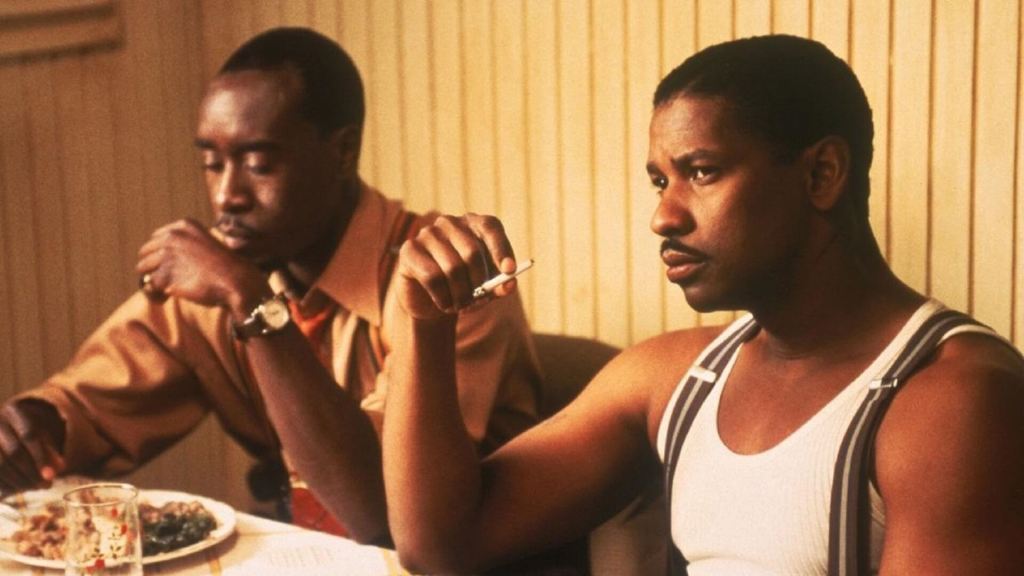
Easy Rawlins (Denzel Washington) is a World War II vet in need of a job to keep his house. Opportunity knocks when he is introduced to DeWitt Albright (Tom Sizemore). Albright’s a white P.I. searching for the missing fiance of mayoral hopeful Todd Carter, Daphne Monet (Jennifer Beals), who supposedly is hiding out in the Black neighborhood’s juke joints. Albright hires Rawlins because he figures Rawlins can snoop around the area without raising suspicion. Things get dicey when one of Rawlins’ and Daphne’s mutual acquaintances is murdered, and Rawlins calls in his old buddy, Mouse (Don Cheadle). Mouse is a trigger-happy sort, itching to go out, literally, guns blazing. As they continue their investigation, they unlock more hidden secrets about Daphne, her ethnicity, the mayoral candidate race, and the dead acquaintance, while getting caught up in a web of deceit.
11. Laura
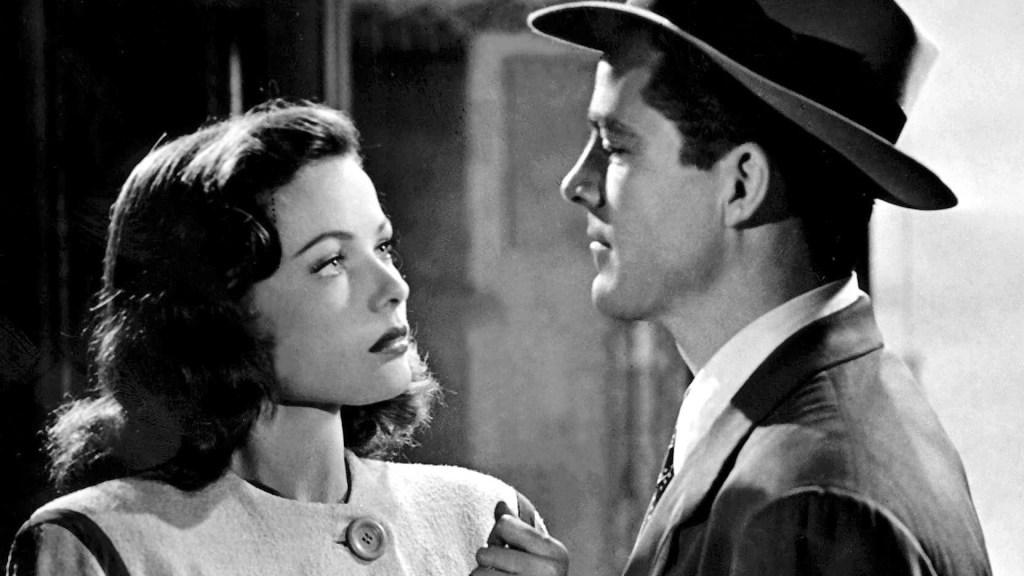
Detective Mark McPherson (Dana Andrews) has his work cut out for him. He’s investigating the murder of Laura Hunt (Gene Tierney) and no one is cooperating. McPherson interviews the old newspaper columnist and stuffed shirt, Waldo Lydecker (Clifton Webb), who claims to have been something of a mentor to Laura and helping to advance her career, and Laura’s fiance, Shelby Carpenter (Vincent Price). He also gets more than he bargained for from a chat with Laura’s maid, Bessie. Everyone seems totally infatuated with Laura, and soon, so is McPherson. All four of them are in for quite a shock when Laura returns to her apartment, unaware that her murder is being investigated. Laura is mesmerizing and awe-inspiring, much like her portrait on the wall of her apartment.
10. The Maltese Falcon
Most consider The Maltese Falcon to be the first noir, and it’s hard to deny it. The movie follows Sam Spade (Humphrey Bogart) as he navigates the schemers and dreamers of San Francisco. When Ruth Wonderly (Mary Astor) walks through his door, Spade gets more than he bargained for. She asks for help in finding her missing sister, and Spade’s partner, Miles Archer readily agrees. The next day, Spade is visited by the cops. Archer is dead, and Spade is suspected to be involved. Spade runs into Wonderly again, only now he discovers her real name is Brigid O’Shaughnessy and Spade suspects she had a hand in Archer’s death. To make matters worse, Spade is offered $50,000 from a greedy pair, Kasper Gutman (Sydney Greenstreet) and Joel Cairo (Peter Lorre), to find a rare artifact, the Maltese Falcon – possibly a more dangerous job than dealing with O’Shaughnessy. Spade has to keep himself afloat and not wind up dead in the gutter.
9. Fargo
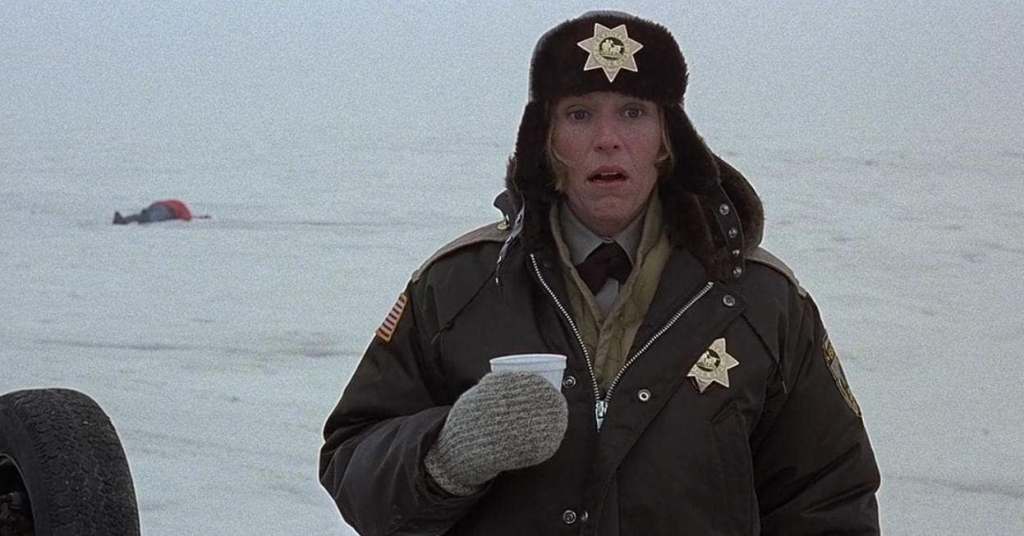
Jerry Lundegaard (William H. Macy) is in deep, financially. He’s been fudging the numbers of vehicles sold at the car dealership he works at. His solution is to bring a real estate deal to his father-in-law, hoping he’ll finance it for him. His backup plan, however, is to hire a couple of guys, Carl Showalter (Steve Buscemi) and Gaear Grimsrud (Peter Stormare), to kidnap his wife so his father-in-law will pay the ransom and Jerry, Carl and Gaear can split it. Carl and Gaear do their part and kidnap Jerry’s wife, but as they make their escape to Moose Lake, they kill a Highway Patrolman and a couple of witnesses. This puts Brainerd police chief, Marge Gunderson (Frances McDormand), who is seven months pregnant, on the case. Unfortunately for Jerry, Carl and Gaear, Marge is the best there is, and fate is against them every step of the way. One of the most beautifully-shot films of all time, Fargo is another must-watch from the Coen brothers.
8. Leave Her to Heaven
Richard Harland (Cornel Wilde) is a writer who arrives in a New Mexico town to get away and work on his next book. There, he meets Ellen Berent (Gene Tierney), who is visiting the area to spread the ashes of her deceased father, and they fall for each other instantly. Richard loves her spirited personality, and Ellen loves him because he reminds her of her father. After a whirlwind romance, the two get married and both get more than they bargained for. Ellen is obsessive about keeping Richard all to herself, and no one is going to interfere with that – not his teenage brother, Danny, or her cousin, Ruth. What was originally a happy love affair quickly sours into torment for Richard Harland. The question eventually becomes: how far is Ellen willing to go to hang on to Richard?
7. Double Indemnity
Another Billy Wilder classic. Walter Neff (Fred MacMurray) is an insurance salesman who meets the wife of one of his clients, Phyllis Dietrichson (Barbara Stanwyck). When she brings up the idea of getting a life insurance policy for her husband without his knowledge, Neff agrees to help her get one, finding himself attracted to Phyllis’ calculating nature. Together, they hatch a plot to get the policy and then killing her husband. If they can make it look like an accident, they can invoke the double indemnity clause, which means double the payout. However, Neff’s boss, Barton Keyes (Edward G. Robinson), is not taken for a fool, and tries to investigate the nature of Mr. Dietrichson’s death and Phyllis’ role in it. As things play out, Walter and Phyllis lose faith and trust in each other, and their relationship deteriorates. All the while, Keyes gets closer and closer to discovering the truth.
6. Out of the Past
This movie is so full of twists, that I don’t feel comfortable describing any plot points for fear of giving something away. There’s a reason it is considered the quintessential noir. You can’t trust any of the characters, not even a mute and dumb kid. Everybody lies. The performances are stellar, particularly the leads: Robert Mitchum as former detective, Jeff Bailey, Kirk Douglas as crime boss Whit Sterling, and Jane Greer as Whit’s venomous girlfriend, Kathie Moffat. The bodies pile up amidst the multiple double-crosses, Jane Greer’s femme fatale is as devious as Ellen in Leave Her to Heaven, if not more so. The best thing about the film, however, is how it looks. Jacques Tourneur and his cameraman, Nicholas Musuraca, are masters of moody lighting.
5. Mildred Pierce
Mildred Pierce (Joan Crawford) is a self-made woman. When her husband loses his job, it’s up to Mildred to keep the family afloat by selling baked goods. Instead of being grateful or doing anything to help, her husband leaves. Left alone with two daughters, Mildred works as a waitress to make extra money to buy her eldest daughter, Veda (Ann Blyth), who is a brat and high-society wannabe, the material things that will supposedly make her happy. Mildred is wooed by Monte Beragon, and through hiss dwindling inheritance, Mildred buys her own restaurant. She throws herself into her work, but nothing makes Veda happiness. Mildred decides to marry Monte in order to give Veda the status that she wants, but even that is not enough to make anybody happy. Ann Blyth’s Veda is perhaps the ultimate femme fatale, without even being intentional about it.
4. The Night of the Hunter
Harry Powell (Robert Mitchum) is a traveling preacher who marries lonely widows and then kills them for their fortunes. While in prison, Powell shares a cell with Ben Harper (Peter Graves), who reveals that he was arrested for a big bank robbery and that he left the money with his wife, Willa (Shelley Winters). Powell is released and Ben Harper is sent to hang, so Powell travels to see Willa, wooing her and the entire town with his charm and demonstration of the continuous war between “love” and “hate”. John, Willa’s eldest child, remains skeptical of Powell, and refuses to tell him where the money is when Willa’s not around. Powell becomes increasingly erratic, and so John and his little sister, Pearl, steal away in the middle of the night to escape, but Powell is on their trail, and he won’t stop without getting what he wants.
3. Sunset Boulevard
Joe Gillis (William Holden) is a struggling screenwriter in Hollywood who stumbles across the dilapidated mansion of former silent-film star, Norma Desmond (Gloria Swanson). Desmond lives there alone with her devoted butler, Max (Erich von Stroheim), and she hides away, dwelling on her past career and itching to return to the spotlight. She’s written a screenplay for what she wants to be her big return, and Gillis offers to doctor it up for her. He moves in at her request, and is there to witness Desmond’s slow descent into madness. Not only is she convinced she’s still as beloved and famous as she was in her heyday, but Desmond is also convinced that Gillis loves her and is happy being a kept man. Wanting to breakout of her confines, Gillis begins writing an original script with a script reader named Betty Schaefer (Nancy Olson), but he must be careful. What is Norma Desmond capable of if she finds out?
2. No Country for Old Men
For those keeping score, this makes three films on this list for both the Coen brothers and Billy Wilder now. Based on the novel by Cormac McCarthy, No Country for Old Men may just be the brothers’ best film. Llewelyn Moss (Josh Brolin) stumbles across the results of a bad drug deal and finds two million dollars in a briefcase. Feeling his luck has changed, Moss takes the money home, but little does he know that Anton Chigurh (Javier Bardem), a ruthless and nihilistic assassin is hot on his trail and leaving bodies in his wake (depending on how they call a coin toss). Meanwhile, Ed Tom Bell (Tommy Lee Jones) is following after Chigurh, and investigating Chigurh’s break-in at Moss’s house. Moss finds a tracking device in the briefcase, but as he goes to get rid of it, realizes that it’s too late. Chigurh has found him. It’s an intense game of cat-and-mouse that is sure to end up terribly for all parties involved.
1. The Third Man
Holly Martins (Joseph Cotten), a Western author, travels to Vienna after receiving a job offer from his friend Harry Lime. Only trouble is, once Martins arrives, he learns that Lime is dead. At the funeral, he hears of two men who witnessed Lime’s death – he was run over by a car while crossing the street – who carted his body to the side of the road. Martins seeks out Anna Schmidt (Alida Valli), Lime’s girlfriend, to console her and discuss how neither of them believe the stories they hear of Harry’s death. In fact, as they talk, they realize there are conflicting accounts of the incident and Martins is convinced that there was a third man to help transport the body. In order to find out what really happened to his friend, Martins decides to investigate and find out who could possibly be the third man. The chase sequence in the sewers alone probably gives this film the top spot on this list, but there’s much here to be witnessed. Do yourself a favor and watch this movie.
My wife has pinpointed the type of movie that she can’t stand: “Movies where bad things happen to people over and over.” It’s a surprisingly common subgenre. Requiem for a Dream, After Hours, Uncut Gems, Falling Down, The Money Pit, Pan’s Labyrinth…it’s a plot that denies no genres and no decade. Needless to say, my wife does not like Planes, Trains and Automobiles – the ultimate movie where bad things happen to people over and over.
Neal Page (Steve Martin) is a marketing executive in New York who just wants to get home to Chicago in time for Thanksgiving. The powers that be are already conspiring against him as the meeting before his flight runs overly long and the cab he bribes a man for is taken by a shower curtain ring salesman, Del Griffith (John Candy). When he makes it to the airport, past his boarding time, Neal is told his flight has been delayed. This will be the last good thing that happens to him for a long time.
Neal recognizes Del, also waiting on the same flight, as the man who “stole” his cab. Once the flight boards, Neal is dismayed to discover he’s been bumped from First Class and is stuck next to Del for the entire flight. Due to weather conditions in Chicago, their flight reroutes to Wichita, Kansas. They’re trapped overnight, but the kind-hearted Del offers to share his room with Neal when Neal discovers all hotels in Wichita are booked. Overnight, the two personalities clash and while they’re asleep, their cash is stolen. Using a credit card, Neal gets them train tickets to Chicago, but the train breaks down, so they hop a bus headed for St. Louis.
In St. Louis, Neal rents a car and when he gets to the lot, there’s no vehicle. Luckily, Del has also rented a vehicle and shares it with Neal. While Neal sleeps, a mishap involving cigarettes, a jacket caught in a seat, and Ray Charles causes their car to catch fire. They drive the charred automobile to a hotel where Neal finally laughs about his situation and bonds with Del. In one of the most heartwarming endings to a movie ever, Neal pieces together what Del himself can’t fully admit, takes pity on him, and invites him over for Thanksgiving dinner.
I might be forgetting a few details in my summary, but you get the gist. Bad things happen to Neal. A lot. But that’s what makes Planes, Trains and Automobiles so good. Everyone has had bad experiences with flights, holiday rushes, rental cars, and those annoying people you just can’t seem to get away from. It’s universal and is easy to resonate with. Not to mention hilarious and infinitely quotable, except for maybe the scene at the car rental place.
But what really makes the movie timeless is the sweetness with which it regards its characters. There’s a humanity in them that often gets lost in melodramas, and it carries the movie all the way to the finish line. Both Steve Martin and John Candy are laugh-out-loud funny, but they also make Neal and especially Del so heartwrenchingly sympathetic. We believe in these characters. Planes, Trains and Automobiles is like a Thanksgiving turkey. It’s stuffed with junk but ever so warm and tender inside. And it goes great with mashed potatoes.
Horror Comedy is an interesting blend of genres because it takes two complete opposites and meshes them together in a film that often supersedes the best in either individual category. There are plenty of duds out there. The same can be said any genre. When treated correctly, Horror Comedies can both frighten and make us laugh. Let’s take a look at some of these movies, shall we?
10. Ernest Scared Stupid
Let’s get this out of the way, the Ernest movies aren’t good movies. They’re funny to a very select group of people and nostalgic to a slightly larger group of people. Lucky for me, I’m in both groups. Ernest Scared Stupid follows the ever-lovable Ernest P. Worrell as he unwittingly releases an evil troll from his mystical prison. One by one, the troll wreaks havoc on the town and captures the town’s children, turning them into wooden dolls. Ernest pleads with the mayor and sheriff of the town that the troll must be stopped, but nobody in town believes him, except Old Lady Hackmore (Eartha Kitt). Together, they must stop the troll before he grows too powerful to be stopped.
9. Tucker & Dale vs. Evil
Subverting the Horror trope, Tucker and Dale are two good-hearted hillbillies who just purchased a rundown cabin in the woods. As they travel to the cabin to begin repairs to make it their ultimate summer dream home, their paths cross a group of college kids. Several misunderstandings occur that cause the college kids to fear for their lives around the hillbillies, but when one of the college kids is revealed to be more than they appear, can these misunderstandings be resolved before danger strikes? It’s nothing a little chamomile tea can’t fix.
8. Army of Darkness
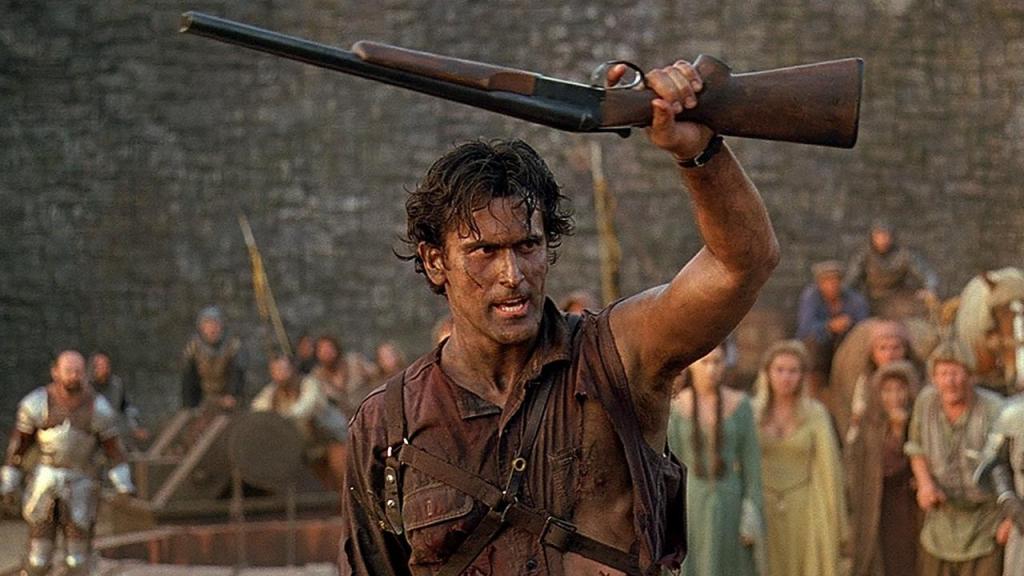
By the third installment of the Evil Dead franchise, director Sam Raimi and star Bruce Campbell were leaning into the sheer goofiness they had created in the previous films. The result is one part time travel story, one part Three Stooges homage, and all parts groovy, baby. Thanks to the mysterious powers of the Necronomicon, Ash Williams is transported back into the Middle Ages just as an…army of darkness…arises. Equipped with his chainsaw arm and his “boomstick”, Ash will have to help the local king protect his kingdom and find a way back into the present day so he can get back to work at the S-Mart. Hail to the king, baby!
7. Scream
Okay, this is definitely the most horror-ish movie on the list, but it’s one of the few movies that can stand as a critique of the genre it loves as well as being an excellent entry into that genre. In the town of Woodsboro, a string of murders occur by a man in a mask, Ghostface. Ghostface shows no mercy and will kill you for simply getting a plot point of one of the Friday the 13th movies wrong. Not only do you need to be sharp on slasher film tropes, you also need to know the “rules of surviving a horror movie” if you’re going to make it through the night.
6. Shaun of the Dead
Shaun goes to sleep a hopeless, girlfriend-less loser, and wakes up the next morning in a zombie apocalypse, though he and his best friend, Ed, are slow to realize it. Armed with a shovel and a cricket bat (and briefly a record collection, though both men suffer from terrible aim), they must gather their friends and family and attempt to survive until the British Army can arrive. That means they have to fight, run over, and blend in with the zombies, often times to disastrous results. Despite the odds, Shaun is determined to survive…and prove to his ex that he can be somebody.
5. Zombieland
Columbus is traveling home to make sure his family has survived a zombie apocalypse, and he’s gotten this far due to a strict set of rules to surviving. On his way, he teams up with Tallahassee, a loose cannon who loves killing zombies almost as much as he loves Twinkies. They are joined by two con artist sisters, Wichita and Little Rock, who quickly trick them into giving up guns and their car as means to get to a theme park that is said to be “zombie-free”. The four travel toward this park together, making a quick stop at Bill Murray’s house, only to find it horribly infested with zombies.
4. Little Shop of Horrors
That’s some plant! Seymour (Rick Moranis) buys this intriguing plant one day and brings it to the flower shop where he works for some window decoration. The plant, which Seymour has named Audrey II (Levi Stubbs of The Four Tops) after his coworker, Audrey (Ellen Greene), whom he is secretly in love with. Audrey suffers from an inferiority complex and cannot leave her abusive dentist boyfriend, Orin (Steve Martin). Audrey II doesn’t respond to regular water and sunlight to grow. It needs blood, and luckily, Orin’s got more than enough. Seymour doesn’t kill Orin, but he does chop him up after the dentist accidentally kills himself on an overdose of laughing gas. Soon, Audrey II and Seymour are the talk of the town, but as far as blood and fame go, when will enough be enough?
3. Arsenic and Old Lace
Frank Capra was mostly known for his idealistic humanist films such as Mr. Smith Goes to Washington, Mr. Deeds Goes to Town, and It’s A Wonderful Life, but two years before that last one was released, Capra released Arsenic and Old Lace. The screwball comedy takes place on Halloween night, and Mortimer Brewster (Cary Grant) has just been married. He runs home to tell his aunties only to discover that his sweet, old aunties have a dead body in the window seat. From there, the film spirals out of control as Mortimer fends off his brothers, Teddy (who believes he’s the president with the same name) and Jonathan (who looks just like Boris Karloff), asylum doctors, the police, and his new bride. It’s such a mad-cap night that it even drives Mortimer a little insane.
2. Abbott and Costello Meet Frankenstein
The smartest thing Universal Studios ever did (besides attempting to franchise their monster movies, of course) was to take their two biggest money-makers of the 30s and 40s, and mash them together. Abbott and Costello, Chick and Wilbur, are postal workers tasked with transporting crates of artifacts for McDougal’s House of Horrors. Inside those crates are the supposed bodies of Count Dracula and Frankenstein’s monster. Chick doesn’t believe in any of that superstitious hocus pocus, but Wilbur…well, he’s a simple guy, and a perfect brain for the monster, or so the very-much-alive Dracula suspects. The only one who believes Wilbur is Larry Talbot, but he has his only hairy problems to deal with. What follows is a wild and hilarious ride through the Universal catalog of monsters.
1. Young Frankenstein
Parody is the sincerest form of flattery, or so someone says, I’m sure. Mel Brooks and Gene Wilder’s second collaboration of 1974 is a love letter to those Universal monster movies of yore, and a deep love it is. The attention to detail should be enough to recognize that. The whole hook of Young Frankenstein is “what if the descendant of the original Dr. Frankenstein wanted nothing to do with the family business?” Frederick Frankenstein (pronounced “Fronk-en-steen”) moves to Transylvania to see what he’s inherited. The descendent of his grandfather’s assistant, Igor (“Eye-gor”), is there to help him, along with Inga and Frau Blücher. Frankenstein slowly descends into madness and decides to pick up where his grandfather left off, determined to create not only a simple reanimated creature, but to make him a “man about town”. The townspeople have no love for the creature, so it’s up to the doctor to make them see his potential. You don’t have to be Abby Normal to find this movie hilarious.









 Destined for Mediocrity