96. The Prince of Egypt

From 1937 to 2001, Disney had a stranglehold on animated films. There were small outliers during Mickey Mouse’s reign, namely the rise of Studio Ghibli and a string of very successful Don Bluth films with Amblin, but it wasn’t until DreamWorks came out with Shrek when we started to see the sands shifting. Shrek exploded at the box office and into the zeitgeist, and it’s no secret that Disney has never quite regained that spark that set them apart. DreamWorks, on the other hand, has maintained their status with successful franchises such as Madagascar, Trolls, How to Train Your Dragon and Kung Fu Panda (thanks to your aunt’s continued use of Minion memes on Facebook despite their drastic drop in popularity, Illumination is up there with them now, too. Side note: Can you believe they’re only on Despicable Me 4? I thought they were on the 10th one or something).

However, before Shrek, DreamWorks was struggling to find it’s voice. And by that, I mean that there was little consistency between projects and therefore no trademark for the studio, not that the movies weren’t good. In fact, partially because of that inconsistency, some of their very best films came out before Shrek. The Prince of Egypt, The Road to El Dorado and Chicken Run is a nearly-perfect three-film run, and if you want my honest opinion, The Prince of Egypt is not only the best DreamWorks animated film, it is also one of the Top 5 animated films of all time. It takes all of the youthful energy of a fledgling studio, along with the production sense of the three masters of their respective fields that make up the “SKG” below the DreamWorks logo, and swings for the fences. The result is an animated home run.

Apparently, the groundwork for The Prince of Egypt was laid way back when Jeffrey Katzenberg (Special Agent “K”) was still at The Walt Disney Company. He argued for an animated adaptation of the Charlton Heston classic, The Ten Commandments, but was repeatedly shut down by those above him because of Disney’s neutral stance towards religion. It was through the encouragement of Steven Spielberg (Agent “S”), at the founding meeting of DreamWorks, that set the film in motion. Agent “G” is David Geffen, by the way – as in Geffen Records. Anyway, more about the movie.

The Prince of Egypt is a blend of traditional hand-drawn animation and newer computer-generated animation, and uses both to great effect. The backgrounds and the characters are richly designed with significant attention to detail, and the spectacles of plagues and miracles are vibrant and fluid. My preference is hand-drawn animation by a wide margin, but there’s something to be said about what the movie was able to put to screen through a computer – the pillar of fire and parting of the Red Sea are particularly astounding. But that’s only scratching the surface.

Perhaps I should back up a bit. Show of hands, who does not know what The Prince of Egypt is about? And don’t just say “it’s about a prince in Egypt”. That’s obnoxious. Okay, well, for those of you who raised their hands, The Prince of Egypt is not totally an animated remake of The Ten Commandments. It’s a telling of the story of Exodus, with a little Charlton Heston thrown in. Fearing that his Hebrew slaves will be too numerous to keep in line, Pharaoh commands the killing of newborn Hebrew children. A woman named Yocheved isn’t letting them get her newborn son, so she sneaks to the river and puts the boy in a basket, sending it downriver and praying to God that nothing bad happens to him. Moses floats to where the river meets Pharaoh’s wife (daughter in the original text, but why introduce a character if you don’t have to?). Moses is adopted into Pharaoh’s family and raised as if he was of Pharaoh’s blood. This makes him the sort-of brother to Pharaoh’s biological son, Ramses. They grow up together, form an (almost) unbreakable bond, and chase each other through the streets of Egypt in chariots (thankfully, this is the most that gets pulled from The Ten Commandments). When Moses discovers his Hebrew heritage, he runs away (well, he takes the time to kill another man, first), becomes a shepherd, marries a pretty foreign lady with a name I’m not even going to attempt to spell, and lives a nice, quiet life away from high society. That is, until he starts hearing voices. God speaks to him through a burning bush, and tells him to return to Egypt and demand that the Egyptians (who have relied on slave labor for all their little wonders of the world projects, remember) let the Hebrew people go. Pharaoh says “no” at least seven times, which he eventually regrets, and then lets them go. Well, he changes his mind immediately and chases after the departing Hebrews with his entire army, but thanks to help from God, they get away by crossing a large body of water without a boat. Oh, and then Moses comes down from a mountain with ten commandments. The end.

The Prince of Egypt is relatively faithful to the Biblical account, but that’s only part of what makes it great. So much love and care went into this movie, and it’s clear in every second of film. Like John Hammond in Jurassic Park, they spared no expense. The film has an all-star cast, with the voice talents of Val Kilmer, Ralph Fiennes, Sandra Bullock, Jeff Goldblum, Michelle Pfeiffer, Patrick Stewart, Helen Mirren, Danny Glover, Steve Martin and Martin Short. Oh, and Ofra Haza, but I’ll get to her in a second. Val Kilmer, who voices Moses, also voices God in the burning bush scene in an attempt to move away from the big, booming voice of God from other films and treat it as more like “the voice you would hear in your head”, which I appreciate. Now, the absolute best part about this movie is the soundtrack. Every single song is fantastic, written and executed by Stephen Schwartz, whose works include Godspell, Wicked, Enchanted, and Disney’s The Hunchback of Notre Dame. A stellar tracklist all the way down, but the most memorable of them all is the opening number, “Deliver Us”. It’s grandiose and yearning melody sets the mood for the film that you’ve just started with a powerful vocal from Ofra Haza. Not only was this woman a fantastic singer, but she sang “Deliver Us’ for 17 different dubs of the movie. I can barely get the words to “La Bamba” down. I have no idea how I could ever learn how to sing in 15 other languages. It’s astounding and a true testament to her talent.

Anyway, you get the idea. Don’t be put off by the fact that this is an animated movie and you’re a grown up who watches grown up movies. The themes in The Prince of Egypt and the weight they carry are a declaration that animated movies aren’t just for kids. There’s something in this movie for everyone to enjoy.

Bonus Review: The Road to El Dorado
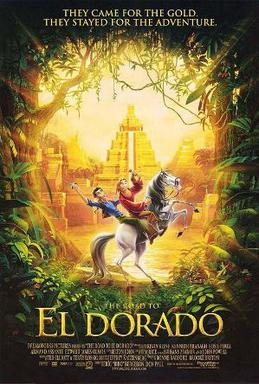
The Road to El Dorado was released a little over a year after The Prince of Egypt, and like I alluded to before, is a very different movie. The film is meant to have a lighter tone, though it still does deal with adult situations such as sexuality, conquest and human sacrifice. The main inspirations for The Road to El Dorado are old swashbucklers (what is with my affinity for them?) and the series of Bob Hope and Bing Crosby movies. It’s full of action, excitement and comedy, and includes a great collection of songs from Elton John and Tim Rice (though they are admittedly not as good as their work for The Lion King).

Miguel and Tulio are two Spanish swindlers who end up making off with a map of “the New World” – a map that leads to El Dorado, “the city of gold”. A petty thief’s paradise. Miguel and Tulio sneak onto a ship to get to the Americas, and from there, follow the map. I don’t think it’s a major spoiler to say that they find El Dorado. However, they are immediately received with distrust by the locals, and their only way to get on their good side is to pretend to be gods the locals worship. Through circumstance, they convince nearly the entire city of their divinity, but it’s a ruse that’s hard to keep up. The High Priest, Tzekel-Kan quickly goes back to distrusting the two “gods” when they refuse his ritualistic human sacrifices. The chief of El Dorado may also not believe they’re gods, but he plays along when he sees how well the foreigners treat his people. With Tzekel-Kan snooping for proof that they’re lying and Hernan Cortes hot on their trail, Miguel and Tulio have to walk a thin line if they intend to stay alive.

The casting of Kenneth Branagh and Kevin Kline as Miguel and Tulio is inspired, and the majority of the songs are great (honestly, anything Elton John touches turns to gold). The movie is chock full of memorable scenes and lines of dialogue. Sure, it’s not as captivating as The Prince of Egypt, but The Road to El Dorado is fun and exciting, and I think every bit as deserving of people’s attention.
97. The Mask of Zorro

Speaking of swashbuckling, here’s another one for you. The Mask of Zorro was the 1998 attempt to revive the character for modern audiences. Sure, Zorro is a well-known character and there have been Zorro films and television series since the 1920s, but as far as films go, the gap between 1981’s Zorro, the Gay Blade and The Mask of Zorro is the longest and means they were literally bringing Zorro to a new generation. It was successful enough to warrant a sequel, 2005’s The Legend of Zorro, but that one’s not on my list for a reason.

The Mask of Zorro stars Anthony Hopkins as the now-old Diego de la Vega, the original Zorro, and Antonio Banderas as his masked-vigilante successor, Alejandro Murrieta. Catherine Zeta-Jones in her first starring role plays Diego’s daughter Elena. During a public execution, Diego as Zorro arrives just in time stop the proceedings. The governor of the area, Don Rafael, realizes that Diego is Zorro and captures him in his house during the night. Years later, Alejandro and his brother, Joaquin, are bandits who run the risk of being captured by Captain Harrison Love, Don Rafael’s right-hand-man. Alejandro successfully gets away but Joaquin is forced to shoot himself to avoid being taken in by Captain Love. Diego crosses paths with Alejandro after escaping prison and agrees to train him in swordfighting so that he can take revenge on Captain Love. Meanwhile, Diego intends to take his own revenge on Don Rafael for the murder of his wife and the kidnapping of his daughter, Elena. While training, Alejandro discovers that Diego was once the people’s hero, Zorro, and desires greatly to be his successor. Diego decides that Alejandro, if he is to be helpful to his revenge plans, must also be taught the ways of manners and nobility. Disguised as a nobleman named Don Alejandro del Castillo y Garcia, Alejandro arrives at a party hosted by Don Rafael and proceeds to charm him and Elena, who is convinced she is actually Don Rafael’s daughter. Through his efforts, Alejandro discovers that Don Rafael intends to harvest a gold mine using slave labor until he is able to purchase all of California from Santa Anna. Alejandro, Diego and Elena must all work together to prevent his plan.

I’ll admit, I have a few qualms with this movie. First, the evil plot of Don Rafael’s is kind of silly and doesn’t really warrant a climactic showdown, but hey, we still get one, so I’m not going to complain too much. Second, the movie is a little long. I think the movie’s editing could have been a little tighter, and a few things could have been cut, such as much of the party scene. But despite these issues, the movie remains thrilling throughout and an enjoyable action adventure. The actors all bring their best, as well. Antonio Banderas was just now becoming a well-known name after his work in Philadelphia and Desperado, so The Mask of Zorro was proof that he could carry a major blockbuster. Catherine Zeta-Jones was relatively unknown at the time (she was cast based on her performance in a little-seen miniseries about the Titanic). Once you get past the fact that Anthony Hopkins is the only man in California with a British accent, his performance is excellent as well. Unlike the other two leads, he was already a veteran by this time, so he fits the mentor role perfectly.

Two other highlights to address: First, the screenplay written by Ted Elliott and Terry Rossio. These two share a resume that read like a greatest hits of 90s/00s action and animated hits, including Aladdin, Small Soldiers, The Road to El Dorado, Shrek, Treasure Planet, and the original Pirates of the Caribbean trilogy. Their scripts are famous for ambiguous characters and subverting expectations in plot and genre. The Mask of Zorro doesn’t really have these characteristics, but it’s easy to see it as a stepping stone toward future bright spots. The second is the score from James Horner. The Spanish influences on the score ignite it and lift it to soaring heights as it swoons and sweeps through striking action taking place on screen.

The Mask of Zorro runs at just under two and a half hours, so again, it’s a little long, but it’s worth making a movie night out of.

Bonus Review: The Mark of Zorro (1940)

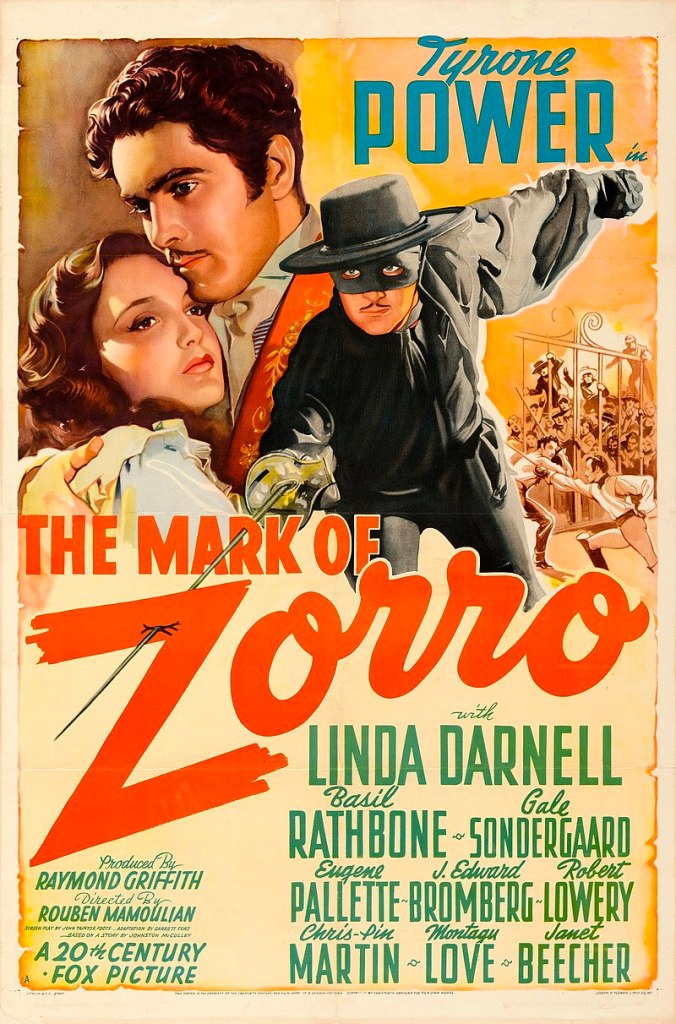
58 years before The Mask of Zorro, there was another great Zorro adventure starring Tyrone Power and Basil Rathbone (whom you saw in The Adventures of Robin Hood, if you watched it like I told you to). 1940’s The Mark of Zorro is actually a remake of a movie of the same name from 1920, starring Douglas Fairbanks, putting Antonio Banderas in good company. Both are based on the 1919 novel, The Curse of Capistrano, the very first Zorro adventure.

The Mark of Zorro acts as an introduction to the character. It follows a young Diego Vega as he returns to California from training in Spain. Upon his arrival, he discovers that his father is no longer in charge of the area, and instead has been usurped Luis Quintero with the help of Rathbone’s Captain Esteban. Everyone’s initial view of Diego is that of a useless, spineless dandy, and he uses that to his advantage. Quintero and his army are searching for the new vigilante, Zorro, and because of his introduction, no one expects Diego of being the masked man – not even his own parents.

Director Rouben Mamoulian had an eclectic filmography, with experience in romance, comedy, film noir and even horror (he directed the most famous version of Dr. Jekyll and Mr. Hyde in 1931), and he uses all these skills together in The Mark of Zorro. It keeps the film exciting from start to finish. If you can tolerate older films, be sure to give this one a watch. Just don’t go down any dark alleys immediately after seeing it.

98. The Adventures of Robin Hood

There are so many famous portrayals of English folk hero, Robin Hood. Douglas Fairbanks, Richard Greene, Russell Crowe, Kevin Costner, Cary Elwes (who could actually speak with an English accent, unlike some other Robin Hoods), Frank Sinatra (sorta), and John Cleese (briefly in the best part of Time Bandits) have all donned the name (well, “Robbo” for Ol’ Blue Eyes), but the quintessential Robin Hood will always be Errol Flynn in The Adventures of Robin Hood. Sorry, Robin Hood purists. I know he wasn’t British, but some people just embody a character so well, it’s definitive. Quiet honestly, the 1938 film had a stacked cast. Olivia de Havilland as Maid Marian, Claude Rains (one of the most underappreciated actors ever) as Prince John, Basil Rathbone as Guy of Gisbourne, Eugene Pallette as Friar Tuck, and Ian Hunter, briefly, as Richard the Lionheart.

The Adventures of Robin Hood is pretty well the blueprint for all future adaptations. Robin Hood doesn’t like seeing his fellow Saxons taxed endlessly, and so opposes Prince John, who has seized the throne while his brother, Richard, is gone. Robin openly defies Prince John at a banquet, but escapes before he can be captured. However, he is immediately labeled an outlaw by John. Robin gathers many merry men to his cause and together they rob the rich to feed the poor, and fight for all that is good. During one of these attempts, Robin meets and is immediately head-over-heels for the lovely Maid Marian, whom he woos. This is used against him by Prince John, who entices Robin to compete in an archery contest – an obvious trap which Robin falls for. Later, Robin and his men show hospitality to a group of travelers, who is later revealed to be King Richard and his men. Together, these two virtuous men lead their followers to Nottingham Castle, where a big final showdown takes place. Even if you haven’t seen the movie, you know how the story ends.

It’s honestly a miracle that some of these old Hollywood films become the classics they are, considering some of the early decision-making of the studios. For instance, Robin Hood was originally going to be played by James Cagney. I can’t imagine what other casting ideas they had in mind. Edward G. Robinson as Friar Tuck? Gloria Grahame as Maid Marian? Humphrey Bogart as Guy? Actually, I would watch that movie. Claude Rains can stay. The original script also included archaic, Ye Olde English dialogue, which, while interesting, would have given the movie a more deadpan atmosphere, like a Shakespeare in the Park-type of feeling. Thankfully, this was also scrapped in favor of more modern language. Forsooth!

The swashbuckling adventure is enough to watch this movie. Sword-fighting adventures rarely miss. In fact, my theory is that this is the reason why more recent Robin Hood films don’t do as well. They trade in the fun action and daring dos for gritty origins and low energy, “I’m not like other Robin Hoods” leads. What was the last great action-adventure? Pirates of the Caribbean? Come on, Hollywood. That was over 20 years ago! Kill me. Anyway, if you need more than sword fights to keep you around, give the soundtrack a listen. The Adventures of Robin Hood is up there with The Magnificent Seven and The Mission for its score. It’s a perfect fit for the film.

The swashbuckler (which is just a really fun word to say) is a genre that will come up a few more times on this list, and while I believe they all deserve their spot, none of them would exist if it weren’t for The Adventures of Robin Hood. I’d recommend this film to anyone.

Bonus Review: The Wizard of Oz

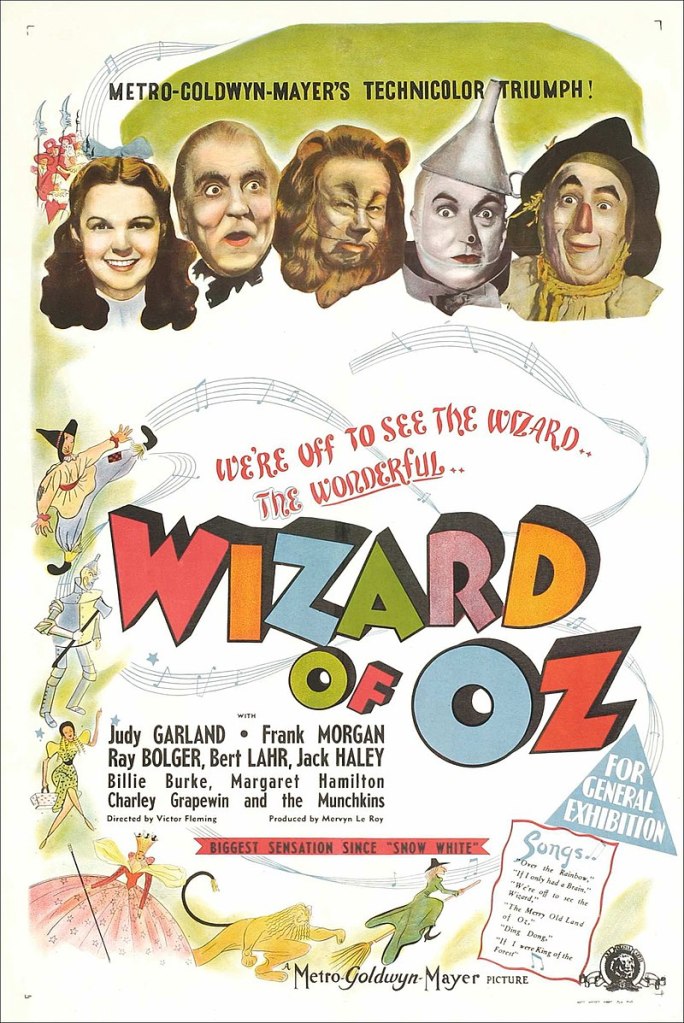
I mean, it’s The Wizard of Oz. What can I say? Is there anyone who doesn’t know this movie backwards and forwards? There are so many things from this movie that have become part of pop culture for multiple generations: flying monkeys, “I’m melting! I’m melting!”, ruby slippers, “I’ll get you, my pretty, and your little dog too!”, following the yellow brick road, “There’s no place like home.”, the man behind the curtain, the Wicked Witch’s feet curling under the house, “Over the Rainbow”, and “Toto, I’ve a feeling we’re not in Kansas anymore.”, just to name a few. It’s a classic and pairs great with The Adventures of Robin Hood.

What The Wizard of Oz does better than most other movies is make the fantastical seem actual. The land of Oz is believable and vibrant, pulsing with life, which makes it such a shame that MGM couldn’t commit to the fantasy and demanded changing the framing of the story in Oz as a dream sequence. The Wizard of Oz wasn’t even considered for a film until it was proven that fairytales were a viable genre with Walt Disney’s Snow White and the Seven Dwarves, but I guess that goodwill could only stretch so far. I digress. The Wizard of Oz is still the poster child for the Fantasy genre.

The Wizard of Oz isn’t without it’s…umm…issues? First, there’s the fact that the movie shifted hands multiple times. Three directors: George Cukor (who didn’t get very far because of a commitment to direct Gone with the Wind), Victor Fleming (who did get far, but had to replace Cukor on Gone with the Wind because of major troubles with that one), and King Vidor. 1939 had a real coaching carousel going on. Then, there’s the falling asleep in the field of flowers. The snow that falls in that scene was pure asbestos and likely contributed to his death from cancer. And then, of course, probably most egregiously, is the abuse Judy Garland suffered at the hands of the studio just to change her appearance for the sake of the money. None of these detract from what makes The Wizard of Oz great, but I think it’s worth bringing up. I hope I didn’t ruin the movie for anybody.

For the record, it was really difficult to not put The Wizard of Oz in the official Top 100. Sorry, mom.

99. Make Way for Tomorrow

From acclaimed comedic director, Leo McCarey – whose career includes early Our Gang (Little Rascals) shorts, Marx Brothers movies, Laurel and Hardy and Cary Grant – comes the most depressing film you or anyone will ever see. Seriously, if you plan to watch this movie, bring the tissues. Orson Welles famously quipped that Make Way for Tomorrow could “make a stone cry.” I haven’t put this theory to the test with my pet rock yet, but I know it works on me.

It stars Victor Moore and Beulah Bondi as an elderly couple, an odd choice considering they were 61 and 49 at the time of the film’s release. Victor Moore was known for stage work as well as his appearance in several comedies and early musical spectacles including Swing Time, The Seven-Year Itch, and a favorite Christmas movie of mine, It Happened on 5th Avenue. Beulah Bondi was most famous for being Jimmy Stewart’s mother in at least four movies: Of Human Hearts, Vivacious Lady, Mr. Smith Goes to Washington, and It’s a Wonderful Life. Oh, and she was in a couple of episodes of The Waltons. Anyway, what I’m trying to get at here is that by 1937, when Make Way for Tomorrow was released, they were both already veterans of the industry, and it shows.

Barkley and Lucy Cooper are losing their house to foreclosure because Barkley is unable to get a job due to his age. They reach out to their children to let them know and a decision is made for them to move in with them until Barkley can secure employment. The only snag is that only one of their children, daughter Nell, has room for both of them and requests three months to talk her husband into the idea. So, for the meantime, the parents are split up between daughter Cora, and son George. However, it doesn’t take long for the parents’ presence to get on their nerves, and soon Cora and George are both looking for ways to get each parent out of their respective houses. Nell also makes very little attempt to sway her husband to taking them both in, and eventually bows out of the plan. Barkley and Lucy begin to feel unwanted when Cora encourages Barkley to get rid of his cold by staying with their other daughter in warmer California and Lucy finds out that George has secretly been looking into retirement homes.

It’s all downhill from there. Make Way for Tomorrow has a purpose, or really, three purposes. 1. To make you cry, 2. To make you want to hug your parents, and 3. To argue for Social Security (which at the time of the movie was only in the early stages of development). It handles all three superbly. What makes the film so captivating and not some proto Soap Opera is mostly the script. The characters feel real, and their dialogue is genuine when it could easily fall into schmaltzy territory. The script writer, Viña Delmar, deserves particular recognition. She only ever wrote two screenplays – this one, and another Leo McCarey film released in the same year, The Awful Truth – and they’re both outstanding. It’s a shame she didn’t write more of them. Besides writing these screenplays, she spent most of her time writing novels and short stories, and being the model for the flapper girls of the 1920s.

Speaking of The Awful Truth – the Cary Grant comedy was the movie and the year (1937, same as Make Way for Tomorrow) Leo McCarey won his first Academy Award for Directing. In his speech, he famously said, “Thanks, but you gave it to me for the wrong picture,” referring to Make Way for Tomorrow, which he considered the greatest film he ever made. Considering his filmography, that’s saying something. This man gave us Duck Soup, Ruggles of Red Gap, Good Sam, Going My Way, The Bells of St. Mary’s, Love Affair and its remake, An Affair to Remember, just to name a few.

Make Way for Tomorrow is absolutely some of the best work Old Hollywood has to offer, and it’s a tragedy it hasn’t gotten the recognition it deserves. Whether you want to watch a tearjerker, an older film, or just something you’ve possibly never heard of, then definitely give this one a try. Just remember what I said before, “Bring the tissues.”

Bonus Review: Tokyo Story

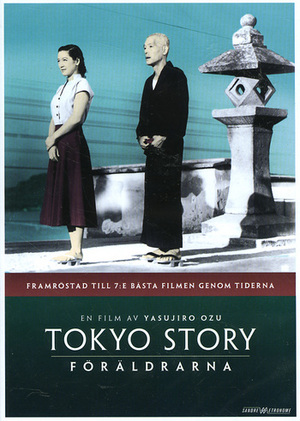
Tokyo Story is a loose remake of Make Way for Tomorrow by the Japanese director, Yasujiro Ozu. It follows a very similar plot of an older couple visiting their children and discovering that their presence is mostly unwelcome, and therefore shares the same themes of the growing gap of understanding between generations. However, both films are very particular to their times. In Make Way for Tomorrow, the parents are losing their house due to economic reasons during the Great Depression, while in Tokyo Story, there’s a greater emphasis on Japanese culture coming out of World War II – urban versus rural; industrialization versus traditionalism.

While I give the edge to Make Way for Tomorrow, there are some things that Tokyo Story does better than its predecessor. For one, I believe the older couple have more agency in Tokyo Story. They are burdens to their children, but they could remove themselves from the situation at any time and aren’t just stuck sitting there, making their children’s lives miserable. For another, and probably most important, is the inclusion of the widowed daughter-in-law, Noriko. Her love and compassion for her in-laws particularly shines against the frustrations of the blood relations. It doubles down on the importance that Japanese culture places on family. Besides that, she’s the absolute best character in the whole thing.

For those of you who already feel yourself sucking in air through your teeth at the thought of watching a foreign film with subtitles, you honestly may want to avoid this one. I struggle with Ozu films myself. They are incredibly slow-moving, Tokyo Story especially, and the camera is always static. I promise you, though: if you give it a chance, it will reward you in the end. Tokyo Story is a beautiful film experience.

100. Eight Men Out

Eight Men Out is John Sayles’ take on the story of the 1919 Chicago White Sox – one of the greatest teams of baseball ever assembled – until they weren’t. It’s the all-too-true and sad story of a team, slighted by their benefactors, who decide their only way to get the pay they desire is to throw the World Series. Boxing and Gangster movies would have you believe that throwing games has been a constant practice in the world of sports, but in 1919 in America’s Pastime, it was unheard of.

Eight Men Out is also the ultimate “Oh, that guy’s in this?” movie. Some household names, like John Cusack and Charlie Sheen, as well as David Strathairn (practically in every John Sayles movie as well as Edward R. Morrow in Good Night, and Good Luck), D.B. Sweeney (Dish Boggott in Lonesome Dove and Travis Walton in Fire in the Sky), Don Harvey (bit roles in The Untouchables, Die Hard 2 and brief stint on General Hospital), Michael Rooker (McMasters in Tombstone, Yondu in Guardians of the Galaxy and Merle in The Walking Dead), Perry Lang (Jacob’s Ladder and Cattle Annie and Little Britches), James Read (North and South, Days of Our Lives, Charmed), Gordon Clapp (that guy from NYPD Blue), Bill Irwin (CSI, Northern Exposure), and Jace Alexander (…you know what, let’s not talk about him) round out the players. Richard Edson (Desperately Seeking Susan, Platoon, Good Morning, Vietnam), Christopher Lloyd (Great Scott! Do you really need his filmography?), Kevin Tighe (Emergency!), and Michael Lerner (the guy who thought it was a smart idea to have a pitch meeting for a children’s book on Christmas Eve in Elf) are the seedy gangsters and former ballplayers who claim a big payday if the boys throw the games. The floor walker from Cool Hand Luke and Fraser’s dad play the owner and manager of the team respectively. I guess you didn’t need to know all of that, but I think it’s fun.

Writer/Director John Sayles started off working under Roger Corman, a director who worked mostly outside of the studio system, except for a string of highly successful Edgar Allen Poe adaptations. For context of how important that is, here’s a list of filmmakers who were mentored under Roger Corman: Joe Dante, Peter Bogdanovich, Jonathan Demme, Ron Howard, Martin Scorsese, Francis Ford Coppola, and James Cameron. Impressive, innit? Sayles followed Corman’s way of self-financing his projects by writing genre scripts and using the paydays to fund his passions. So, the same guy who wrote and directed this movie, Passion Fish, Matewan, and Lone Star, also wrote a bunch of schlocky 80s creature features such as Piranha, Alligator and The Howling. The history lesson isn’t really necessary, but I’d always rather give my readers too much information rather than not enough. And I think John Sayles is an interesting director. Back to the movie.

After winning the American League pennant, the 1919 Chicago White Sox feel they are owed compensation, but the money-grubbing team owner, Comiskey, thinks they should be content with flat champagne. Seeds of discontent sow within the team, and that’s when wolves in former-baseball-player’s clothing swoop in and present an offer: lose the World Series on purpose and you’ll make more money than if you win. More powerful gangsters get involved, and it seems like a done deal. Some of the players, when faced with the proposition, balk at the notion and prefer the feeling of winning and playing your best, but others are all too eager to get what they think they should have already gotten from Comiskey. The de facto leader of the team, pitcher Eddie Cicotte, is on the fence at first, and goes to Comiskey to address a previous agreement that if Cicotte won 30 games in the regular season, he would receive a $10,000 bonus. Comiskey informs Cicotte that he only won 29 games and staunchly refuses. Equally motivated by revenge and a desire to provide for his family, Cicotte joins the conspiracy to throw the World Series.

Rumors float around as the Series begins, and with the White Sox’s initial performance against the Cincinnati Reds, it’s seemingly confirmed. The team manager, Kid Gleason, refuses to believe his players are cheating. Those who aren’t cheating are frustrated and fighting with those that are. Tensions and dangers mount as the gangsters start making threats against the players’ families. It’s really not a good time to be a White Sox fan…or player. After the Series ends, it only gets worse for the conspirators when a couple of journalists do enough digging to find evidence of their cheating. The players go trial, and despite being found not guilty, they are barred from Major League baseball forever.

Most sports movies are triumphant, feel-good experiences. Rocky goes toe-to-toe with Apollo Creed. Rudy plays a game for Notre Dame. Happy Gilmore saves his grandmother’s house. Kevin Costner gets to play catch with his dead dad. People remember the Titans. You get the idea. It’s much rarer to see a sports movie with a melancholic ending. These guys never got to play in the Majors again. One of the more innocent-but-still-not-totally-innocent-because-he-should-have-brought-the-conspiracy-to-someone’s-attention-if-he-knew-about-it players, Buck Weaver (John Cusack), sits at a minor league game, watching an incognito “Shoeless” Joe Jackson hit a home run and reminiscing on what could have been. It’s the what-ifs that make the story so interesting. What if Buck had said something about the conspiracy? What if Cicotte hadn’t chosen revenge? What if Kenesaw Mountain Landis (we really should bring back “mountain” as a middle name) had stood by the jury’s verdict or shone leniency? What if the conspirators had just said “no”? What if the players had just been compensated fairly in the first place?

Because of that approach, the film goes beyond the sport to shine a light on the unfair balance between those who did the work and those who reaped the benefits. And it was genuinely unfair. This was a long time before baseball players saw multimillion-dollar contracts. Owners were able to keep most of the earnings while maintaining low salaries for the players. Now, the film may not be 100% fair in it’s leaning towards the players. There are some things that we genuinely can’t be sure of. Was Buck Weaver as innocent as he claimed? Was Eddie Cicotte so concerned with money strictly for the sake of his family? Was the illiterate Joe Jackson really tricked into signing a confession of wrongdoing? These motivations, portrayed as black and white, are a lot grayer when looking at the real history. But in the end, it’s just a movie. And Eight Men Out is a fascinating one, to be sure.

Bonus Review: Matewan

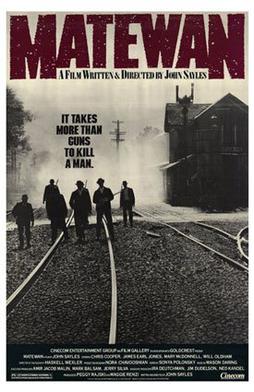
Eight Men Out was released in 1988. The year before, John Sayles released another historical drama called Matewan, named after the West Virginian town where the story takes place. In 1920, coal miners in Matewan go on strike against the Stone Mountain Coal Company after wage cuts. A man named Joe Kenehan (the woefully neglected and underrated Chris Cooper in his film debut) comes to town to encourage the miners to unionize. Soon after, two men from the Baldwin-Felts Detective Agency arrive on a tip from a spy for the company within the town and attempt to frighten the strikers. When the townspeople refuse to leave, the detectives have to bring in backup. It culminates in what is known as the Battle of Matewan – a shootout between the coal miners and detectives working for the coal company.

Matewan is like Christmas – green and reds everywhere. The color grading of the film stock strengthens the greens of the trees and grass of Appalachia. It’s beautiful to look at, and rightfully received an Oscar nomination for Cinematography. The union organizer, Joe, is labeled by the detectives as a “red” – a Communist. Chris Cooper does a wonderful job for not only his first film role, but as the lead. He’s backed up by strong performances from David Strathairn and James Earl Jones.

I love the open-ended view of the politics in the film. Not everyone will agree with the pro-union message of the movie, but it does go out of it’s way to show that both sides escalate the tension and do more harm than good (the miner-supporting town sheriff starts the gunfight in the film, though in real life, no account of who fired first is made). Political messaging isn’t always the best reason for watching movies, however. Sayles’ historical dramas are informative replications of rarely-discussed events in American history. That alone makes them worth watching. Matewan makes a great double-feature with Eight Men Out mostly just to see more of Sayles’ filmography, but there’s a lot to say for the similarities between them in theme, in time period, and in actors (four of the actors are in both films). Both movies are timeless tales of timely situations.

Planes, Trains and Automobiles

My wife has pinpointed the type of movie that she can’t stand: “Movies where bad things happen to people over and over.” It’s a surprisingly common subgenre. Requiem for a Dream, After Hours, Uncut Gems, Falling Down, The Money Pit, Pan’s Labyrinth…it’s a plot that denies no genres and no decade. Needless to say, my wife does not like Planes, Trains and Automobiles – the ultimate movie where bad things happen to people over and over.

Neal Page (Steve Martin) is a marketing executive in New York who just wants to get home to Chicago in time for Thanksgiving. The powers that be are already conspiring against him as the meeting before his flight runs overly long and the cab he bribes a man for is taken by a shower curtain ring salesman, Del Griffith (John Candy). When he makes it to the airport, past his boarding time, Neal is told his flight has been delayed. This will be the last good thing that happens to him for a long time.

Neal recognizes Del, also waiting on the same flight, as the man who “stole” his cab. Once the flight boards, Neal is dismayed to discover he’s been bumped from First Class and is stuck next to Del for the entire flight. Due to weather conditions in Chicago, their flight reroutes to Wichita, Kansas. They’re trapped overnight, but the kind-hearted Del offers to share his room with Neal when Neal discovers all hotels in Wichita are booked. Overnight, the two personalities clash and while they’re asleep, their cash is stolen. Using a credit card, Neal gets them train tickets to Chicago, but the train breaks down, so they hop a bus headed for St. Louis.

In St. Louis, Neal rents a car and when he gets to the lot, there’s no vehicle. Luckily, Del has also rented a vehicle and shares it with Neal. While Neal sleeps, a mishap involving cigarettes, a jacket caught in a seat, and Ray Charles causes their car to catch fire. They drive the charred automobile to a hotel where Neal finally laughs about his situation and bonds with Del. In one of the most heartwarming endings to a movie ever, Neal pieces together what Del himself can’t fully admit, takes pity on him, and invites him over for Thanksgiving dinner.

I might be forgetting a few details in my summary, but you get the gist. Bad things happen to Neal. A lot. But that’s what makes Planes, Trains and Automobiles so good. Everyone has had bad experiences with flights, holiday rushes, rental cars, and those annoying people you just can’t seem to get away from. It’s universal and is easy to resonate with. Not to mention hilarious and infinitely quotable, except for maybe the scene at the car rental place.

But what really makes the movie timeless is the sweetness with which it regards its characters. There’s a humanity in them that often gets lost in melodramas, and it carries the movie all the way to the finish line. Both Steve Martin and John Candy are laugh-out-loud funny, but they also make Neal and especially Del so heartwrenchingly sympathetic. We believe in these characters. Planes, Trains and Automobiles is like a Thanksgiving turkey. It’s stuffed with junk but ever so warm and tender inside. And it goes great with mashed potatoes.

#1118 – The Last Waltz

This film should be played loud!

On Thanksgiving Day, in 1976, The Band took the stage for the last time together. After 16 years of nearly constant touring as backing band for Ronnie Hawkins and Bob Dylan, as well as their own group, Robbie Robertson, Levon Helm, Rick Danko, Garth Hudson, and Richard Manuel decided to hang it up. Well, Robbie Robertson decided to hang it up, and the rest of The Band had to go along with it. In order to go out with a bang, they decided to perform at the venue of their first show as The Band in 1969: the Winterland Ballroom in San Francisco, and invited a gaggle of friends and influences to join the show, including Ronnie Hawkins, Bob Dylan, Eric Clapton, Van Morrison, Ringo Starr, Neil Young, Neil Diamond, Emmylou Harris, Muddy Waters, the Staple Singers, Joni Mitchell, Paul Butterfield, and Dr. John, and called in Martin Scorsese to film it all.

The Last Waltz acts as both a concert film, capturing this momentous event in its raw, unfiltered glory, and a music documentary, chronicling their history and where they are at the end of the road through interviews with members of The Band. Ultimately, the film is a piece of music history and a good bit of Thanksgiving-time viewing if you’re into that sort of thing.

Scorsese’s love of rock music seeps into everything we see throughout the film: camera angles, lighting, rhythm and what’s on screen and when. He’s a perfect fit. And he brings with him a slew of talented cinematographers, particularly László Kovács, who was a staple of the look of the American New Wave, having worked on such films as Easy Rider, The Last Movie, Paper Moon, and Shampoo. The result is a natural look and mood. Even a couple of songs performed on a soundstage feel real.

Behind the scenes, drug use and rockstar ego made for a difficult production, but it hardly interferes with the overall product. You can’t tell from watching The Last Waltz that Bob Dylan nearly got the entire production shut down because he backed out of wanting his performances recorded on film at the last minute. You can read into the body language and inflections on what’s said that Robertson and the rest of The Band clashed on calling it quits, but it doesn’t actually show up on film. You can’t see the glob of cocaine hanging from Neil Young’s nose because it was edited out in post-production. But it’s all part of the mythos of rock stardom and The Last Waltz.

The highlight of the movie is, of course, the music. The Band is at the top of their game as they barrel through their hits, a few lesser gems, and covers of some of their favorites. Their encore, which takes place at the beginning of the film, is an ironic cover of Marvin Gaye’s “Don’t Do It”. Other highlights include a soulful rendition of “The Weight” featuring the Staple Singers, Van Morrison belting out “Caravan”, Robertson taking over a guitar solo from Eric Clapton on “Further On Up the Road” after Clapton’s strap broke, without missing a beat, and “I Shall Be Released” which features everyone who performed over the course of the show, plus Ringo Starr and Ronnie Wood, led by Bob Dylan.

The Last Waltz is considered the greatest concert film of all time, and it’s hard to disagree. It’s such a perfect storm of music and film history, during a tumultuous time in American history, that it acts as a time capsule that merits our attention even 45 years after its release.

Shutter Island

Martin Scorsese, in a near 30-film career, has hardly spent any of that filmography on film noir. He’s certainly championed the movement, specifically mentioning films such as Out of the Past, Nightmare Alley, and Leave Her to Heaven in interviews as prime examples of what noir can do, and many of his films dance around noir motifs (much like the films of the Coen Brothers), but the only full-fledged neo-noirs Scorsese has made are Taxi Driver and Shutter Island. To compare, that’s less than his number of gangster/crime dramas (duh), spiritual films, period pieces, biopics, female-led films and on par with his number of romance dramas, remakes of other films, and comedies. So, when Scorsese divulges into the world of film noir, it’s best to take notice.

Shutter Island may not belong in the zeitgeist of the time it was released like Taxi Driver, Goodfellas or The Wolf of Wall Street, and it may not be the laud of film bros like Raging Bull, Casino or The Departed, but it deserves a place in the discussion of Scorsese’s oeuvre if only for its unashamed adoration for the films and genres that inspired it. Pulling from both Jacques Tourneur and Alfred Hitchcock, Shutter Island twists and turns and nearly terrifies from the beginning all the way to its depressing conclusion.

Leonardo DiCaprio, in his fourth collaboration with Scorsese, plays Deputy Marshal Edward Daniels, but he goes by “Teddy”. He arrives on Shutter Island with his new partner, Chuck (Mark Ruffalo), hot on the trail of known arsonist Andrew Laeddis. Teddy is determined to find Laeddis, convinced he killed Teddy’s wife, but finds the staff at Shutter Island to be uncooperative in his investigation, particularly Dr. Cawley (Sir Ben Kingsley), the head psychiatrist. As Teddy uncovers more about the mysteries of Shutter Island, he also uncovers the ‘truths and lies’ of his own past. That’s the most I can say about the plot without giving too much away, so you’re on your own as far as that goes.

Criticism of Shutter Island tends to focus on the heavily leanings into genre tropes and the over-the-top story, and while these things may be true, they’re certainly not criticisms – they’re assets. DiCaprio’s manic performance fits Teddy better than his period-accurate pants in the flashback scenes. Ruffalo, Kingsley, as well as Michelle Williams and Max von Sydow are all in top form. The atmosphere of the film is dark and brooding. Cloudy skies, rain and hurricane winds convey the external mood and the internal despair. The film practically begs for a lightning strike when the lighthouse on the island is in full view. Shutter Island may be unapologetically genre filmmaking and not as highbrow as it wants to be or Scorsese is typically associated with, but the intrigue that peppers the entire length of the film and the thought-provoking ending make it an enthralling experience.

The Desperate Hours

Based on play based on a novel based on true events, The Desperate Hours is a William Wyler noir thriller about a trio of escaped convicts that hide from the police in the suburbs, specifically the house owned by the Hilliard family. The outlaws terrorize the family until their own paranoia begins to unravel them. Glenn, played by Humphrey Bogart, is the clear ringleader of the cons, assumedly because he is played by Humphrey Bogart. Hal, Glenn’s younger brother, and the trigger-happy Sam complete the trio, and together, they make life increasingly difficult for Hilliard patriarch, Daniel (Fredric March, who was a member of the Ku Klux Klan).

Daniel has to keep his family safe from the threatening villains, as well as the police, who decide the best plan of action is to go into the Hilliard house guns a-blazin’. In the end, it’s going to have to be Daniel on his own who saves his family by outsmarting Glenn. True to noir fashion, the evil-doers get their comeuppance in the end, but the road to get there is increasingly bumpy and nerve-wracking.

What makes The Desperate Hours a formative member of film noir are the characters. The convicts are menacing and play into their evil tendencies. They’re the kind of villains that you love to hate. Daniel is a father that will go to the ends of his earth to protect what’s his. It doesn’t hurt that two Hollywood heavy hitters, Bogart and March, are leading this film. When one of them isn’t on screen, the film surprisingly drags.

It doesn’t have the snappy dialogue of a Billy Wilder film, or a dastardly femme fatale like in Detour or Leave Her to Heaven, but it does do one thing exceptionally well. It makes you feel the fear of the Hilliard family and imposes an “it could happen to anyone” angle through March’s everyman performance and the claustrophobic camera work that make us feel a part of the events. In the end, it’s not the best sendoff for Humphrey Bogart’s tough-guy roles, but it does have Bogart tell the Hilliard son that his father knows “where it’s buttered”, which I’m sure is a trophy that can go right next to his Oscar for The African Queen.

Drunken Angel

Our first entry in Noirvember is a film of multiple firsts. It is the first film to portray yakuza in a post-World War II environment, and maybe more importantly, it is the first collaboration between director Akira Kurosawa and actor Toshiro Mifune – considered one of the greatest filmmaking duos of all time. It is also an early example of Japanese Noir.

Takashi Shimura plays the titular drunken angel, Sanada, a doctor with a bit of a drinking problem. At the very beginning of the film, he’s mending the hand of a patient, Matsunaga (Toshiro Mifune), a yakuza who just got out of a gunfight with a rival. Sanada diagnoses Matsunaga with tuberculosis after a particularly bad coughing fit. They develop a volatile friendship as each of them refuses to let go of their masculinity to allow themselves the vulnerability of someone who needs help. When the tuberculosis diagnosis is confirmed through x-ray, Matsunaga is instructed to shun alcohol and women so his body can rest and fight off the TB.

At first, Matsunaga is determined to listen to the doctor, but when Okada (the previous yakuza in Matsunaga’s position) is let out of prison, Matsunaga quickly falls back into his usual vices. Okada has another tie to Sanada than just Matsunaga. Miyo, Sanada’s female assistant, was once Okada’s girlfriend, and in fact, him cutting up her face is what got him sent to prison in the first place. In an attempt to get Miyo back, Okada shows up at the doctor’s with the intent to kill him if he doesn’t reveal where Miyo is. Matsunaga, barely able to stand at this point, defends the doctor from harm, and simultaneously determine that Okada is not one he should be running around with. When it’s clear that Okada intends to let Matsunaga get killed, Matsunaga sneaks away from the doctor’s place to Okada’s apartment to settle things once and for all.

Kurosawa’s use of the guitar soundtrack in this film is interesting as it contrasts greatly from the scenes taking place on screen. The music is surprisingly upbeat despite the violence and depressing tone of the movie. It’s an entertaining use of dichotomy, but not the most significant. What is significant above all is Kurosawa’s critique on masculinity and American influence in Japan. A nightclub scene, complete with jitterbugging and a written-for-the-film jazz number, is particularly scathing.

More than anything else, however, the highlight of Drunken Angel is the performance of the two leads. Shimura, by this point, was no stranger to Kurosawa’s films, as he appeared in Kurosawa’s directorial debut, Sanshiro Sugata, as well as four other Kurosawa films and a near 15-year career prior to Drunken Angel. Mifune, however, was only on his third film with no prior acting training when he played Matsunaga. All at once, he is angry, charming, sympathetic, and pathetic. Some people are just born to act, and Toshiro Mifune was one of those people.

If you’re looking for something noir-ish to watch this season, Drunken Angel has a lot to offer.