21. 12 Angry Men

No, I did not put 12 Angry Men here just for the Rush reference. It was purely coincidental. 12 Angry Men was Sidney Lumet’s feature film debut. He went on to make some of the greatest films of the 60s and 70s, including The Fugitive Kind, The Pawnbroker, Fail Safe, Serpico, Murder on the Orient Express, Dog Day Afternoon, and Network, but what a start. Now, considered one of the greatest films of all time and the second-greatest courtroom drama, just behind another film that we’ll get to later, 12 Angry Men is a simple story constructed from a teleplay. Because of this, there are only four filming locations in the entire movie: the courtroom where the tail end of the trial occurs, the jury room where the majority of the film takes place, the jury bathroom for one conversation, and outside the courthouse for one final, brief conversation. It’s a very contained film, and Lumet uses that fact to great effect. When the deliberation in the jury room begins, the camera is pulled back and the characters are viewed from further away, but as the film gets more intense, the camera zooms in until the characters are all viewed in close-up. It’s an intentional dose of claustrophobia that only elevates the movie higher up.

On a hot day in New York, a jury is tasked with deciding the fate of a poor 18-year old who is accused of killing his abusive father. The judge tells the jury that if there is any reasonable doubt then the jury must vote “not guilty”, and because a “guilty” verdict will result in the electric chair, voting must be unanimous. At first, the case seems cut and dry: there are witnesses to seeing the stabbing, hearing the boy say he will kill his father, and seeing the boy run out of the apartment. He also had purchased a switchblade just like the one found at the scene of the crime, but claims to have lost it. The jurors immediately hold a vote to see where they stand and it is near unanimously “guilty”. Only Juror 8 votes “not guilty” just to ensure they discuss the case more. There is some discussion, but even when Juror 8 produces a switchblade that looks exactly like the murder weapon (which was thought to be one-of-a-kind), the others are not convinced. Juror 8 tells the others to hold a secret ballot and he will abstain. If the rest are “guilty”, he will change his vote. However, there is a single “not guilty” in the secret vote. Juror 9 confesses he agrees there should be more discussion. Over the course of the day, the jurors look at each witness’s account and slowly poke holes in their stories. One by one, the jurors develop a reasonable doubt in the case and change their votes. Juror 3 remains the last holdout and goes on a rant, trying to prove his point, only to realize his own strained relationship with his son is informing his views of the case. He changes his vote and the jurors leave. As they go, Juror 8 helps Juror 3 put his coat on.

The film consists mostly of just the 12 angry-ish men. As the one holdout, Juror 8 is played by leading man, Henry Fonda, but the rest of the cast is rounded out by mostly character actors who you might have seen in other things and not realized it. Juror 1 is Martin Balsam (On the Waterfront, Psycho, Breakfast at Tiffany’s and episodes of Alfred Hitchcock Presents, The Twilight Zone, Have Gun – Will Travel, and The Untouchables). Juror 2 is John Fiedler (A Raisin in the Sun, That Touch of Mink, True Grit, as well as the voice of Piglet on Winnie-the-Pooh). Juror 3 is Lee J. Cobb (On the Waterfront, How the West Was Won, The Exorcist, and episodes of The Virginian and The Young Lawyers). Juror 4 is E. G. Marshall (The Caine Mutiny, Tora! Tora! Tora!, National Lampoon’s Christmas Vacation and episodes of Alfred Hitchcock Presents, Rawhide, and The Defenders). Juror 5 is Jack Klugman (Cry Terror!, Days of Wine and Roses and episodes of Alfred Hitchcock Presents, Gunsmoke, The Twilight Zone, The Fugitive and The Odd Couple). Juror 6 is Edward Binns (North by Northwest, Judgment at Nuremberg, and Patton). Juror 7 is Jack Warden (From Here to Eternity, Donovan’s Reef, Shampoo and All the President’s Men). Juror 9 is Joseph Sweeney (The Man in the Gray Flannel Suit, The Fastest Gun Alive and episodes of Car 54, Where Are You?). Juror 10 is Ed Begley (Odds Against Tomorrow, The Unsinkable Molly Brown and episodes of Route 66, Rawhide, The Dick Van Dyke Show, Gunsmoke and Bonanaza). Juror 11 is George Voskovec (The Bravados, BUtterfield 8, The Spy Who Came in from the Cold, and The Desperate Ones). And finally, Juror 12 is Robert Webber (Harper, The Dirty Dozen, Midway and episodes of Alfred Hitchcock Presents, Route 66, and The Fugitive). The end.

Bonus Review: Anatomy of a Murder
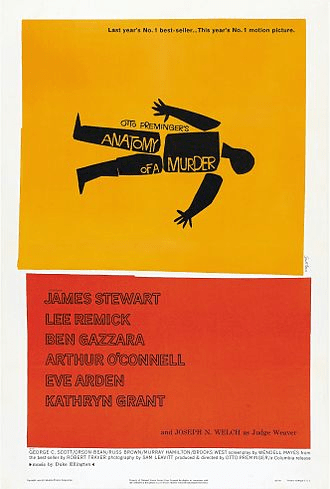
One of the biggest criticisms of the courtroom drama is how unrealistic it is from a legal standpoint. Real lawyers aren’t allowed to raise their voice in the courtroom, or call surprise witnesses, and they don’t object as often as the movies would make you think. There’s no “You can’t handle the truth!” moments. However, Anatomy of a Murder is true to its title and an accurate portrayal of the defense process, so much so that it is used in law schools as a teaching tool. How many movies can you say are two-hour-and-forty-minute crash courses in law?

Paul Biegler is a small-town lawyer and a former district attorney. He is hired to defend Lieutenant Manion, who shot and killed an innkeeper named Barney Quill. Manion admits to the murder, but says it was in response to Quill raping his wife and doesn’t remember the actual course of events. Even with the irresistible impulse (temporary insanity) defense, it’s still an uphill battle for the trial. The prosecution also fights to keep Manion’s motive out of the courtroom, but Biegler convinces the judge to admit it. The one witness to the murder, the bartender, Al Paquette refuses to cooperate with the defense, either because of loyalty to Quill or a love for Quill’s secret illegitimate daughter, Mary. Mary is thought by the prosecution to be Quill’s lover since her true connection to Quill is hidden for her own benefit. Biegler talks Mary into getting Paquette to comply, but even that is a fruitless endeavor. Manion’s wife claims that Quill tore off her underwear during the rape, but the underwear is nowhere to be found. When Mary hears this, she testifies that the underwear was found in the inn’s laundry room the morning after the alleged events. The prosecution tries to argue Mary’s testimony as that of a jealous lover, forcing her to admit to being Quill’s daughter. Manion is found not guilty by reason of insanity.

22. Dr. Strangelove, or: How I Learned to Stop Worrying and Love the Bomb

Stanley Kubrick is now regarded as one of the greatest directors of all time. He was known as a perfectionist and innovator when it came to his work with the camera. Dr. Strangelove is the very center point (film #7 of a 13-feature film career) of his filmography and quite a change of tone from the majority of his work. Kubrick had a sort of black humor to his movies, but Dr. Strangelove is an all-out comedy; a satire of Cold War paranoia and the concept of mutually assured destruction (MAD, for short). The story is taken from a book by Peter George called, Red Alert – a serious novel about the U.S. attempting a preemptive strike against the Soviet Union – but as Kubrick reworked the story for his script, he realized that the philosophies that made up such paranoia couldn’t be taken seriously. The film had to be a comedy. Add in the great Peter Sellers and the film couldn’t be anything but.

Air Force General Jack D. Ripper gives his executive officer, Captain Mandrake, the order to put their base on red alert, confiscate all radios, and send the closest fighter planes to the Soviet Union to prepare to bomb it. Mandrake realizes that this command did not come from the Pentagon, and when he confronts Ripper, Ripper locks them in his office and tells Mandrake of how the Soviets have been fluoridating the American water supply to pollute citizens’ precious bodily fluids. At the Pentagon, General Turgidson explains to President Muffley what is going on. Unable to recall the planes in time, Muffley reaches out to Soviet Premier, Dimitri Kissov, to warn him of what is coming. Muffley is then told that the Soviets built a doomsday machine as a nuclear deterrent, which, if it was made to go off, the fallout would leave the world uninhabitable for 93 years. Muffley’s scientific advisor, the German Dr. Strangelove, points out that for the machine to be effective as a deterrent, people would need to know about it. Meanwhile, Mandrake successfully calls off the air strike, except for one plane that was unable to receive new communications. Major “King” Kong goes to release his plane’s bomb, but there is an electrical issue. He fixes it and the bomb drops with him on it. He hollers and waves his cowboy hat as he descends. Back at the Pentagon, everyone argues about what to do, knowing the doomsday machine is going to go off. Dr. Strangelove, who has been in a wheelchair the entire time, gets out and gleefully revels in the miracle that has happened to him just as the doomsday machine goes off.

Kubrick is an important part of the success of this film, but the true gem here is Peter Sellers. I’ve mentioned him before for playing the original Inspector Jacques Clouseau in The Pink Panther series, but in Dr. Strangelove, he plays not one, not two, but three distinct roles as Mandrake, Muffley and the Nazi Dr. Strangelove. Each role is so vastly different, but still so hilarious in its own way. Mandrake just listening to Ripper explain what he thinks the Soviets are doing to their bodies is ridiculously funny. Muffley’s conversation with Dimitri is great. And of course, Dr. Strangelove’s malfunctioning hand is the star of the show. Whether reaction, dialogue, or physical comedy, Sellers is a natural and can make just about anything funny. Without a doubt, he is what makes Dr. Strangelove the acclaimed work it is today, and makes it worth a watch. Then a rewatch. Then a rewatch.

Bonus Review: It’s a Mad, Mad, Mad, Mad World

It’s the night of the Stanleys! Stanley Kramer was also a famous director, and he was known for making socially-conscious dramas, such as The Defiant Ones, Judgment at Nuremberg, Inherit the Wind and Guess Who’s Coming to Dinner? He then made It’s a Mad, Mad, Mad, Mad World – a comedy of epic proportions – to prove to his critics that he could do it and do it well. The experiment paid off with several awards and a strong return at the box office. Originally a 202-minute epic, the film was cut down by United Artists to 163 minutes without Kramer’s permission. Regardless of how long it is, the film is filled to the brim with jokes in every scene. It’s a Mad, Mad, Mad, Mad World was also a huge influence on future films with its simple, briefcase-chasing plot and movies that fill their cast with a big ensemble of famous faces for a box office draw.

Look, I’m not gonna sit here and explain the details of the plot for this one. They are simply too convoluted. But the what gets the movie going is this: a man runs his car off the highway and some other drivers stop to help him. However, he is dying and uses what time he has left to tell his helpers that he has $350,000 buried in a park under a “big W”. Then, as his soul departs this world, he literally kicks a bucket down the hill. The others attempt to find away to evenly split the money, but they can’t come to a consensus, so they all rush back to their cars and begin a mad-cap race to see who gets their first.

In order to create the ultimate comedy, Kramer pulled in several comedians with different style of comedy to act as his leads (except for Spencer Tracy, who receives top billing) and in cameo appearances. The comedians included are Jimmy Durante, Milton Berle, Sid Caesar, Buddy Hackett, Ethel Merman, Mickey Rooney, Dick Shawn, Phil Silvers, Terry-Thomas, Jonathan Winters, Edie Adams, Eddie Anderson, Jim Backus, Ben Blue, Joe E. Brown, Alan Carney, Peter Falk, Paul Weaver, Buster Keaton, Don Knotts, Carl Reiner, Tom Kennedy, Jerry Lewis, Phil Arnold, Jack Benny and The Three Stooges. Like I said, it’s a full slate of big names in the comedy world. With a cast this huge and the long runtime (especially for a comedy), it’s proof to the talent within Stanley Kramer that It’s a Mad, Mad, Mad, Mad World is as good as it is. This movie is the very definition of “controlled chaos”.

23. Butch Cassidy and the Sundance Kid

Sometimes, there’s a story that is ripe for adaptation. And even more rarely, there are stories that benefit from being told as they really happened and not with embellishment. Butch Cassidy and the Sundance Kid is such a film. Kind of. Other movies about outlaw gangs tend to make their antiheroes tough-as-nails, never-run-away-from-a-fight, and no-nonsense. They’re stoic and, even though their methods aren’t always right, their results are usually seen as a positive. Butch Cassidy and the Sundance Kid was originally rejected as a project because the screenplay depicted Butch and Sundance’s escape to South America, which is what actually happened. So, though the film does embellish in places (their personalities, the timing of events, and “Raindrops Keep Fallin’ on My Head”), but the events that occur in the film were what really happened, and it made for an unusual and more interesting story than most Westerns at the time provided.

Butch Cassidy (Paul Newman) is the fun-loving leader of the Hole-in-the-Wall gang, and Sundance (Robert Redford) is his quiet, crack shot right-hand-man. Together, with the rest of the gang, they successfully rob a couple of trains, but that alerts the attention of the head of Union Pacific, who sends a posse of lawmen after them. Cassidy convinces Sundance and Sundance’s girlfriend, Etta Place (Katharine Ross), to hide out in Bolivia, which Cassidy inexplicably assumes is an outlaw’s paradise. However, they are soon deprived of that fantasy upon their arrival. Sundance particularly loathes the place. Due to their inability to speak Spanish, they are initially unsuccessful at robbing banks, so they consider quitting the criminal life for good. Their first day as honest-working men ends with their boss being killed by bandits in a shootout. They decide the honest life isn’t for them, and return to their old ways. When they arrive in a small Bolivian town, they are met by the local authorities who have also called in the Bolivian army to help bring down Butch Cassidy and the Sundance Kid. The two friends go down in a blaze of glory and the film ends with the greatest freeze-frame of all time (although, Thelma & Louise gives it a run for its money).

Butch Cassidy and the Sundance Kid is another one of those films where everything sort of came together perfectly. George Roy Hill was just eccentric enough of a director to bring this strange story to life and prevent it from being a cartoon. The chemistry between Paul Newman and Robert Redford is magnetic, so much so, between this film and The Sting, they are considered one of the greatest on-screen duos of all time. But what ties it all together is the script from William Goldman. Goldman is one of the best screenwriters who ever lived because he could, and did, write in any genre. He could tackle westerns, detective films (Harper), drama (The Great Waldo Pepper), war epics (A Bridge Too Far), political thrillers (Marathon Man, All the President’s Men), biographical (Chaplin), horror (Magic, Misery), romance and fantasy (The Princess Bride). He was a master, and he fought hard the script he wrote, refusing to cut important elements such as the time in Bolivia. Anything less would not be the iconic movie we know and love today.

Bonus Review: Hell or High Water

Depending on who you talk to, Taylor Sheridan is the savior of the Western genre or just really obsessed with it. He has written a critically-acclaimed trio of neo-Westerns – Sicario, Hell or High Water and Wind River – as well as created your favorite Paramount television show, whether it’s Mayor of Kingstown, Tulsa King or Yellowstone or one of its prequels. He’s become something of a hot commodity and has even been given the directorial reins of the upcoming adaptation of Empire of the Summer Moon (and if he screws it up, there will be Hell Toupee). He got significant recognition for Sicario, but Hell or High Water got him Yellowstone and Yellowstone got him Carte Blanche. Hell or High Water is a neo-western thriller about a pair of brothers who rob banks to gather the money to save their family’s ranch – the quintessential outlaw-with-a-heart-of-gold storyline, almost a cliche really, but it allows for the characters carry the story.

The Howard brothers, Toby and Tanner, rob two branches of the Texas Midlands Bank. They are meticulously planned out by Toby, but Tanner’s erratic behavior poses a danger to their work. Texas Midlands provides the reverse mortgage on their family’s ranch, which their mother lived in but died recently, so the brothers are attempting these robberies to prevent foreclosure. If they can keep that from happening, they can reap the benefits of recently discovered oil on the property. Two Texas Rangers, Hamilton and Parker, pursue them and Hamilton seems to have a knack for profiling the brothers. Tanner robs another bank without alerting Toby and then they take their money to a casino in Oklahoma, passing the money off as winnings to cash into a check, making the money untraceable. They return to Texas to rob another bank, but it turns out be crowded and Tanner ends up shooting a security guard and an armed civilian. A posse pursues them out of the town and the brothers split up. Toby takes the money to a casino to launder, while Tanner holds the posse off with a rifle. Tanner kills Parker, but Hamilton circles around and shoots Tanner in the back. Toby makes it to the bank with the money just in time to avoid foreclosure. Toby is cleared as a suspect in the bank robberies and shootings because he has no prior criminal record and the amount of money he gets from the oil on the land is large enough to where he has no motive. Nevertheless, the now-retired Hamilton still believes Toby to be the mastermind and pays him a visit. When confronted, Toby admits that his motive was to prevent his children from experiencing the poverty he and Tanner grew up in. Hamilton says he holds Toby responsible for Parker’s death. Just then, Toby’s ex-wife and estranged children arrive, and it is revealed that Toby has given the ranch to them. Toby and Hamilton agree to “finish” their conversation another time.

24. The Elephant Man

David Lynch had one feature film under his belt when he was approached by Mel Brooks to direct the adaptation of the life of Joseph Merrick, a man suffering from physical deformity that was never identifiable in the medical community. Merrick’s tragic life as a sideshow “freak” and his desire to be a “normal” human being is surprisingly serious subject matter for both Lynch and Brooks, and to avoid confusing audiences, thinking they’re walking into a comedy, Brooks left his name off the credits, opting to produce solely through his newly created “Brooksfilms” company, and Lynch was still to new on the scene for audiences to know what to expect from him. Lynch, for the most part, is subdued. Known for his surrealist, dreamlike way of filming, mostly plays it straight and realistic, outside of the film’s bookending scenes involving Merrick’s mother. This has put The Elephant Man lower on the list of favorites among Lynch lovers, but it is also probably his most accessible film for the general public. And thank goodness for it. This movie needs to be watched by everyone.

Frederick Treves is a surgeon at London Hospital. He comes across a freak show in the East End featuring a hooded John Merrick (throughout history, Joseph Merrick has been erroneously called “John”; the movie does this as well). Treves pays the ringmaster, Mr. Bytes, to bring Merrick to the hospital for examination. Treves examines Merrick in front of his colleagues and it is revealed Merrick must sleep with his head resting on his knees, otherwise he would asphyxiate in the night. Merrick is returned to Mr. Bytes and is beaten to the point of needing medical attention. Treves brings Merrick back to the hospital. Merrick is treated by Mrs. Mothershead because all the other nurses are terrified of him. Mr. Carr Gomm, the hospital governor does not want to treat Merrick and considers him “incurable”, but when Merrick proves his ability to read and learn by reciting the 23rd Psalm, he is permitted to stay. Merrick becomes somewhat the talk of the town and receives guests. Some are kind to him, and others…are not. The night porter at the hospital begins to sell tickets to see “The Elephant Man”. During the raucous, Mr. Bytes kidnaps Merrick and puts him back in his show. His health deteriorates and Mr. Bytes leaves him for dead. Merrick makes his way back to the London Hospital and he is diagnosed with chronic obstructive pulmonary disease. Treves and Mothershead take Merrick to a show with Princess Alexandra (the one who had guaranteed Merrick’s permanent residence at the hospital). The actress in the show is one of Merrick’s kind visitors from earlier and dedicates the show to him, inviting him to stand for an ovation from the audience. Back at the hospital, Merrick finishes a model of a cathedral he could see from his window, thanks Treves for his kindness, and goes to bed on his back like a “normal person”, dying in the night.

The Elephant Man is a beautiful film, surprisingly sweet and sentimental. For some critics of the movie, this is the biggest complaint, but for others, like myself, it’s what makes it so good. It’s a feature, not a bug. Making the film in black and white provides a sort of hazy look over the entire thing, keeping a sense of mystery and dreaminess throughout. And of course, the characters are the focal point. Anthony Hopkins handles the disgust, curiosity, second-guessing, kindness and tenderness of Treves. John Hurt, up to this point, was mostly in supporting roles, but his lead turn as Merrick was astounding to say the least. His prosthetics made it difficult for him to talk, but it better serves the character. The film is a perfect display of the irony of humanity: those who look like monsters, usually aren’t, and the ones who look humane are deformed. As Merrick says when a mob overcomes him: “I am not an animal! I am a human being!”

Bonus Review: Freaks

They say, when you’re first working on a story of some kind, to “write what you know”. Tod Browning didn’t write Freaks, but he had the carnival background before he became a filmmaker. Browning, by the time he was working on Freaks, was already a successful director as the man behind the original Dracula in 1931, and had made a name for himself as the original King of Horror. The irony of that monicker and this film is that Freaks is probably Browning’s most controversial and most horrific film, and yet, it’s not a Horror film. There are maybe some elements of Horror, such as the ending, but it’s mostly pure drama. The reaction to the making of the film would make you believe it’s a Horror, though. The cast, mostly made of actual “freaks”, was so disturbing to the regular workers at MGM that they relegated to being housed in a tent outside the studio lot and fed in a separate cafeteria.

The visceral reaction from test audiences caused the studio to go behind Browning’s back and cut the film down from 90 minutes to a measly 65 minutes, and now the original cut is gone forever. The film bombed because of the disgusted reaction and MGM tried to hide it from the general public for decades. However, when it was rereleased in the late 60s, it became a small counterculture phenomenon and was reevaluated by audiences and critics alike to great acclaim. One of the original criticisms was that Browning, by making a film about deformed people with deformed people, was being exploitative and mean. However, in this reevaluation, people began to realize that the story and the way scenes are filmed is incredibly sympathetic to the “freaks” and treats them as “normal” people when it shows them doing day-to-day stuff not just their sideshow performances.

Cleopatra, a beautiful trapeze artist, learns that one of the midgets in the show, Hans, has a really large inheritance and decides to marry him for his money. This obviously upsets Hans’ fiancée, Frieda. To get the money quicker, Cleopatra plans with Hercules, the strongman, to kill Hans after they’re married. Hans is head-over-heels for Cleopatra and agrees to the marriage. At their wedding, Cleopatra begins her scheme to gradually poison Hans’ wine. The other “freaks” attempt to be inviting to the “normal” Cleopatra and chant “One of us! One of us!” at the table (yes, this is where that comes from). The “freaks” general happiness upsets Cleopatra to the point where she mocks all of them and humiliates Hans by parading him around on her shoulders. Hans realizes that Cleopatra only wants his money, but he gets sick from the poison. While bedridden, he discovers the extent of Cleopatra and Hercules’ plot and conspires with the other “freaks” to get revenge. In the middle of the night, as the caravan travels to the next town, Hans’ wagon turns over, giving Cleopatra the chance to escape the “freaks”, but they pursue her into the woods. It is later revealed that they have mutilated her, turning her into a “freak” like them. Okay, maybe it’s more Horror than I originally remembered.