Schindler’s List is a hard film to review because, what do you say about it? I’m sure most people not only know of the film but have seen it. I’m pretty sure I watched clips of it in high school. It’s also absolutely perfect in every way. Every creative decision has weight to it. Filmed mostly in black and white, the film uses color sparingly to bookend the film – the opening lighting of the candles for Shabbat, and the closing, the living Schindlerjuden and their actor counterparts placing stones on Oskar Schindler’s grave in Jerusalem – as well as a little Jewish girl’s bright red coat that Schindler notices on two occasions. The movie is filmed like a documentary, in black and white to give it a timelessness, and is visually heavily inspired by Shoah, the nine-hour French documentary about the Holocaust by Claude Lanzmann. This documentary style keeps the film from sensationalization and allows it to maintain reverence over its three-hour runtime, which is impressive since Steven Spielberg was editing Jurassic Park while filming Schindler’s List.
The film begins in Kraków, as the Nazis crowd Polish Jews into the Kraków Ghetto. Oskar Schindler is a member of the Nazi Party from Czechoslovakia and arrives in Kraków to get rich. He bribes members of the SS to obtain a factory to produce enamelware in and then hires Itzhak Stern to act as administrator and arrange financing. Stern is Jewish and so has an in with the Jewish business community and seeks to get as many Jews jobs as possible to avoid them going to concentration camps and being killed. Schindler enjoys his rich lifestyle and schmoozes with Nazi officials. Amon Göth is an SS second lieutenant who arrives in Kraków to oversee the building of the Płaszów concentration camp. When it’s finished, Göth orders as many from the Ghetto are transferred to the camp, and the rest killed. Schindler witnesses the massacre and pays particular attention to a little girl in a red coat, and later sees her body on a wagon of corpses, which affects him greatly. He maintains his friendship with SS officers, including Göth, but keeps his own work and intentions under wraps. Göth, meanwhile, abuses his Jewish maid, Helen, and enjoys randomly shooting the workers in the camp from his balcony. Schindler’s priorities change from getting rich to saving as many lives as possible, so he bribes Göth to let him build a sub-camp at his factory to protect his workers.T
he Germans begin to lose the war, so Göth is tasked with getting all remaining Jews at the camp to Auschwitz. Schindler asks Göth permission to move his workers to a munitions factory near his hometown, effectively saving them. Göth demands a large bribe to allow it, but Schindler agrees to it and with Stern begins writing up a list of those who need to be sent to Brünnlitz instead of Auschwitz. It ends up being over 1100 names. As they are being transported, the women are mistakenly taken to Auschwitz, so Schindler must bribe the commandant at Auschwitz to let them go. At the new factory, Schindler denies SS officers access to the facility and allows his workers to observe the Sabbath. The factory does not have the required equipment to make ammunition, so Schindler uses his wealth to purchase shell casings, as well as bribing the Nazis to stay away. He runs out of money just as Germany surrenders. To avoid arrest as a Nazi Party member, Schindler must flee the country and intends to surrender to the Americans. He says goodbye to his workers and they gift him with a statement attesting to his role in saving Jewish lives, signed by everyone, and a ring engraved with a quote from the Talmud: “Whoever saves one life saves the world entire.” This causes Schindler to break down and cry that he could have done more and should have done more, but his workers comfort him and he gets into a car with his wife so they can escape. The workers are soon liberated by a Soviet officer, and they walk along the countryside.
As you might would guess, Schindler’s List isn’t very cheerful of a movie, and for the Jewish Spielberg, I can only imagine how difficult a production it was to get through. Originally, he tried to get someone else to direct the movie, thinking he wasn’t mature enough to do it himself, but everyone else passed on it with at least a few claiming that someone Jewish should be the one to do it. I don’t think Spielberg gives himself enough credit. He handles the subject of Schindler’s List in a very grounded way, giving each scene the weight it deserves. It also seems to have maybe brought him closer to his Jewish heritage. Apparently, to cheer him up, Robin Williams (who worked with Spielberg on Hook only two years prior) would call him regularly and make him laugh. Despite whatever toll it took on those involved, it’s a masterpiece of cinema. It’s an important film and is essential viewing for everyone, lest we be doomed to repeat it.
Bonus Review: The Pianist
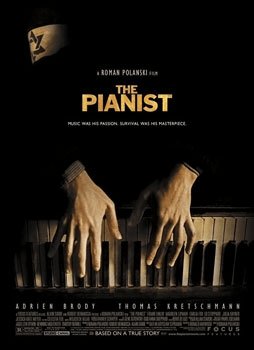
One of the men who turned down Schindler’s List from Spielberg was Roman Polanski, who is of Polish-Jewish descent. Nearly a decade later, he made his own Holocaust film, The Pianist, a biographical film about Władysław Szpilman, a Polish-Jewish pianist and composer who survived the Holocaust. The film is certainly very personal for Polanski, who survived the Holocaust as well once he escaped the Kraków Ghetto. His father also survived; his mother did not. Polanski was just a boy at the time. For those who don’t know, Roman Polanski is convicted of unlawful sex with a minor. In the 70s, he raped a 13-year old girl. He is not a good person, and doesn’t warrant much sympathy despite surviving the Holocaust and his wife, Sharon Tate, being murdered by the Manson family while he was away filming a movie. But I’m also not gonna sit here and tell you shouldn’t watch this movie (or any of his movies, for that matter) just because of what he’s done outside of filmmaking. Plus, I think understanding what’s behind these films adds context and value to how we understand the movies themselves.
In 1939, Szpilman is performing live at a radio station in Warsaw when it’s besieged by Nazis as they enter Poland. Szpilman escapes and makes it home to his family. They rejoice when they learn that Britain and France have joined the war, but the German and Soviet fighting continues for some time. Germany takes over Warsaw as part of their General Government and the Jews in the area are made to wear armbands with the Star of David on them and are denied work and owning their own businesses. By the next year, Szpilman and his family are forced to live in the Warsaw Ghetto, where food becomes scarce and the SS are violent. Szpilman is able to secure work by performing in a cafe, but life in the Ghetto is not easy and he witnesses a young boy beaten to death by a guard and a family killed during a round-up. In 1942, Szpilman and his family are in a holding area, waiting to be sent to an extermination camp, but Szpilman is pulled away from his family by a member of the Ghetto Police who recognizes him. Szpilman becomes a laborer and helps smuggle weapons into the ghetto for a coming Jewish revolt. Szpilman escapes before the revolt happens and hides in an apartment provided by a non-Jewish friend of his. From the apartment, he can see the revolt – the Warsaw Ghetto Uprising – happen, but it fails. Later, he is discovered and must flee to another apartment to hide in. The new one has a piano in it, but Szpilman cannot play it for fear of being discovered.
Another uprising happens, this one spilling into the streets of Warsaw, and Szpilman’s hiding place is destroyed, forcing him to move again. Over the course of a few months, Warsaw is razed to the ground. On the verge of starving to death, Szpilman roams the ruins of Warsaw. He finds a can of pickled cucumbers in a house, but when he tries to open it, he is discovered by a German captain. The captain, Hosenfeld, learns Szpilman is a pianist and asks him to play on the piano in the house. Szpilman, despite his deterioration, he successfully plays a Chopin piece. Hosenfeld lets him hide in the attic of the house and supplies him with food. In 1945, the Germans are in retreat and so Hosenfeld must leave. He leaves a large amount of food and his coat for Szpilman and promises to listen to him on Polish Radio after the war. Warsaw is liberated, but Szpilman is nearly killed by the Polish People’s Army, being mistaken for a German officer because of the coat. As some former concentration camp inmates pass a Soviet POW camp, they take the opportunity to verbally berate the captured German soldiers, whom Hosenfeld is one of. Hosenfeld asks one of the Jewish men if they know Szpilman, and when the guy confirms he does, Hosenfeld begs him to bring Szpilman to rescue him. The man brings Szpilman, but when they arrive, the camp is abandoned. After the war, Szpilman returns to Polish Radio with another Chopin piece.
 Destined for Mediocrity