Remember that quote from The Man Who Shot Liberty Valance? “When the legend becomes fact, print the legend.” The events that occurred in Tombstone, Arizona on October 26, 1881 have long since become legend. Many stories and myths have spun from that very real event and it’s become difficult to discern the fact from the legend. The movie, Tombstone, is very much about the legend. It trades in the truth for pure Western lore with larger-than-life characters, complete with real, homegrown mustaches. It shuffles timelines and players around for the sake of heightening the drama (to great effect, by the way). The production itself became a legend. Kevin Jarre wrote the screenplay and was adamant about period accuracy and an epic scope. Dialogue in particular is authentic to the “Wild West”. The studio was so impressed with the script, they gave Jarre his first chance to direct. However, just a few weeks in, he was already over budget. They brought in George P. Cosmatos to take over and rein it in. Depending on the account you believe, it’s also possible that Cosmatos became overwhelmed and walked off the set, and Kurt Russell (Wyatt Earp) took over in an uncredited role. It doesn’t matter what went on behind the scenes. The final result is nearly perfect.
In 1879, members of an outlaw gang known to wear red sashes called the Cowboys, led by “Curly Bill” Brocious, ride into a Mexican town and interrupt a wedding. They massacre the entire town, but just before being shot, the priest warns them that the town will be avenged, and references the fourth horseman of the Apocalypse. Wyatt Earp reunites with his brothers Virgil and Morgan and they travel with their families to Tombstone to settle down. Wyatt’s friend, Doc Holliday, who is seeking relief in the dry climate from his worsening tuberculosis, is already there. Actors Josephine Marcus and Mr. Fabian are also newly arrived with a traveling theater troupe. Meanwhile, Wyatt’s common-law wife, Mattie, is becoming dependent on laudanum. Wyatt and his brothers begin to profit from a stake in a gambling emporium and saloon when they have their first encounter with the Cowboys. Tensions rise and Wyatt is pressured to help rid the town of these Cowboys, though he is no longer a lawman. Curly Bill shoots Marshal Fred dead after coming out of an opium den and is forcibly taken into custody by Wyatt. The arrest infuriates cowardly Ike Clanton and the other Cowboys. Curly Bill stands trial but is found not guilty due to a lack of witnesses. Virgil, unable to tolerate lawlessness, becomes the new marshal and imposes a weapons ban within the city limits. This leads to the infamous gunfight at the O.K. Corral, in which Billy Clanton and the McLaury brothers are killed. Virgil and Morgan are wounded, and the allegiance of county sheriff Johnny Behan with the Cowboys is made clear.
As retribution for the Cowboy deaths, Wyatt’s brothers are ambushed; Morgan is killed, while Virgil is left handicapped. A despondent Wyatt and his family leave Tombstone and board a train, with Ike Clanton and Frank Stilwell close behind, preparing to ambush them. Wyatt sees that his family leaves safely, and then surprises the assassins. He kills Stilwell but lets Clanton live to send a message: Wyatt announces that he is a U.S. marshal and that he intends to kill any man he sees wearing a red sash. Wyatt, Doc, a reformed Cowboy named McMasters, Texas Jack Vermillion, and Turkey Creek Jack Johnson form a posse to take the Cowboys down. The posse is ambushed in a riverside forest by the Cowboys. Wyatt walks into the creek, miraculously surviving the enemy fire, and kills Curly Bill along with many of his men. Curly Bill’s second-in-command, Johnny Ringo, becomes the new head of the Cowboys. When Doc’s health worsens, the group is accommodated by Henry Hooker at his ranch. Ringo lures McMasters into the Cowboys’ clutches under the pretense of parley and then sends a messenger dragging McMasters’ corpse to tell Wyatt that he wants a showdown to end the hostilities; Wyatt agrees. Wyatt sets off for the showdown, not knowing that Doc has already arrived at the scene. Doc confronts a surprised Ringo, who was expecting Wyatt, and challenges him to a duel to finish their succession of previous standoffs, which Ringo accepts. Wyatt runs when he hears a gunshot, only to encounter Doc, who has killed Ringo. They then press on to complete their task of eliminating the Cowboys, although Clanton escapes their vengeance by renouncing his red sash. Doc is sent to a sanatorium in Colorado, where he dies of his illness. At Doc’s urging, Wyatt pursues Josephine to begin a new life.
There are so many characters in this movie that it can get rather confusing on a first watch. Even some of the important ones get only a line or two. That’s what happens when you try to condense years-worth of events into a two-hour movie. However, we cannot gloss over the cast so easily; not when there’s Val Kilmer playing Doc Holliday. Val Kilmer is a good actor who took on too many bad roles. Most of the time, it’s either a bad movie (Real Genius, The Island of Dr. Moreau, Red Planet) or he’s just not given enough to do (Heat, Masked and Anonymous, The Missing). But when he’s got a good role, he steals the spotlight (Kiss Kiss Bang Bang, Top Secret!, Heat, The Doors, Willow). Tombstone is the ultimate. He’s cool, he’s shifty, he’s sickly, and he’s drunk most of the time, but he so perfectly embodies the character, that if he had no other film credits, we would assume he was actually Doc Holliday raised from the dead just to do this movie. I’ve never seen someone be so smooth while being so sweaty. He gets all the best dialogue too. Even if you’re just a casual Tombstone viewer, you probably know at least three of his lines. It’s okay, there’s no one around. You can say it. “I’m your huckleberry.” Felt good, right? For the record, the phrase means “I’m the one you want” or some variation thereof. One last thing: I know for some people, the movie can start off kinda slow. First of all, that’s hogwash, but if you are so inclined to agree; power through. Once the O.K. Corral scene happens, it moves like lightning.
Bonus Review: Dances with Wolves
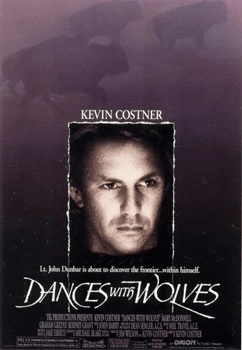
Kevin Costner is nothing if not authentic. So much detail was put into the Civil War-era costuming, location-filming and the use of the Lakota language. Dances with Wolves was just Costner’s first directorial effort, and what success it was. The original film was an award winner and made it on many critics best-of-the-year lists, but if you have watched the film on home media, you probably haven’t seen it. You’ve more likely seen the Extended Edition, which was released a few years later, marketed as an enhanced version of the film (not necessarily the “true vision” or “director’s cut”). It adds nearly an hour of footage that was left on the cutting room floor, making it a nearly-four hour epic. This extended cut is now considered the definitive version, although Costner has claimed he was not involved in it at all. Dances with Wolves holds a special place in my heart because it was the culmination to a perfect date with my wife. Back when we were dating, we took a day trip to a Native American cultural center, which had a museum and a replica village with demonstrations of the tribe’s customs. We finished a little early, so we went to a local Hastings store (R.I.P.) and decided we were going to purchase a movie neither of us had seen before. We didn’t pay attention to the runtime, so we walked away with Dances with Wolves. We went to my house with dinner and popped it in, and at least for me, those four hours flew by. I can’t speak for my wife, but she did marry me, so I think it was okay for her too. Dinner was pizza, I think, so maybe that’s how I got her to stay.
John Dunbar is a Union lieutenant who is wounded in battle in Tennessee. He is told his leg will probably have to be amputated. Preferring death, he hops on a horse and runs across Confederate lines. His distraction allows the Union to lead a successful attack. Dunbar receives care that keeps his leg intact and is given his choice in placement. He asks to be posted in the American frontier, hoping to see it before it’s gone. Major Fambrough gives him the furthest post in his jurisdiction: Fort Sedgwick. However, Fambrough kills himself shortly after Dunbar leaves for his post, which means no one else knows of Dunbar’s assignment. Fort Sedgwick is deserted, so Dunbar attempts to rebuild, and does not know that no reinforcements are coming. Dunbar tries to befriend his Sioux neighbors after a hostile introduction, and he gradually builds a rapport with them through the translation of Stands with a Fist, a white woman raised by the Sioux. Dunbar is accepted by the Sioux when he locates and participates in a hunt of buffalo. He also befriends a wolf with white forepaws that he names “Two Socks”. This is what gives him the name Dances with Wolves.
Dunbar learns the Lakota language, supplies the tribe with guns to defend themselves against the rival Pawnee tribe, and falls in love with Stands with a Fist. Chief Ten Bears decides to move the tribe to their winter camp, but Dunbar decides to retrieve his journal from Fort Sedgwick first, because he fears it would give away the Sioux’s location if it’s found. He arrives at the fort to find it preoccupied with the U.S. army who shoot at him and capture him for his Sioux clothing. After he tells his story, they believe he’s a deserter and decide to take him back east as a prisoner. When Two Socks tries to follow Dunbar, he is shot and killed by the soldiers. The Sioux follow the convoy, kill the soldiers and free Dunbar. However, Dunbar decides it best to leave the tribe with Stands with a Fist because his presence would endanger the tribe. The Sioux proclaim everlasting friendship with Dunbar and he, with Stands with a Fist, goes into hiding, never to be found.
 Destined for Mediocrity