45. My Man Godfrey

Franklin D. Roosevelt described the concept of a “forgotten man” as “at the bottom of the economic pyramid.” The lower class. The derelict. Basically, the “forgotten man” is whom society has left in the dust because they are unable to take care of themselves. During the Great Depression, this applied to a lot of people throughout the country. Roosevelt claimed his “New Deal” would fix some of these problems, but that would take time to implement, which meant a lot of forgotten men and women would remain forgotten for quite some time. My Man Godfrey, released in 1936 and based on a book released in 1935, is a screwball comedy about one such forgotten man.

Godfrey, along with several other homeless men, live in a dump on the edge of New York City during the Great Depression. The NYC upper crust are playing a city-wide scavenger hunt and so that night, a socialite named Cornelia Bullock approaches Godfrey, offering him $5 to be her forgotten man for the scavenger hunt. Godfrey is insulted by the offer (and likely the game as well) and refuses. Cornelia’s sister, Irene, is there as well, and Godfrey finds her to be much kinder and honest, and so he offers to be her forgotten man, if it means she’ll beat Cornelia. At the Ritz, Godfrey is presented and verified as a forgotten man, giving Irene the victory, but Godfrey takes a moment to berate everyone playing the game. Irene apologizes for the game and decides to make Godfrey her protégé – hiring him on as the family butler. In his first day on the job, he is informed by the maid that butlers don’t last long at the Bullock house. Godfrey, however, goes above and beyond the call of duty, proving his staying power, but also inadvertently causing Irene to fall in love with him. He tries unsuccessfully to outline the boundaries of their employee-employer relationship.

Later, Godfrey runs into an old friend of his, Tommy, and so he makes up a story of their relationship, saying he used to be Tommy’s valet. Tommy plays along, adding a wife and children to the story. Irene, after hearing this, impulsively announces her engagement to a young man named Charlie, who is just as shocked as everyone else, but she breaks down into tears when Godfrey congratulates her. Godfrey and Tommy meet for lunch on his day off, and we learn that Godfrey has loved and lost and found the enduring spirit of the forgotten men a comfort to him. Cornelia plants a pearl necklace under Godfrey’s mattress and calls the cops, claiming it’s been stolen, but when the police investigate, the necklace is not there. Irene breaks off her engagement and goes on a trip to get over it, but when she returns, her love for Godfrey is unwavering. She faints and swoons into Godfrey’s arms and so he carries her up to bed, but when he realizes she’s faking it, he throws her in a cold shower. This, according to Irene, only proves that he loves her as well. Godfrey quits at the same time that Mr. Bullock tells his family that he is financially ruined, but Godfrey has one last trick up his sleeve. He pawned the pearl necklace, and used the money to buy Bullock’s stock that he sold short back, and used the remainder to go into business with Tommy opening a nightclub called “The Dump” and hiring the homeless people. Irene argues that since he doesn’t work for her anymore that they can get married, and Godfrey finally has no reason to say “no”.

The film somewhat struggles to balance the romance and the commentary on the effects of the Great Depression to the point where the ending feels very rushed and the resolution to the romance feels shoehorned in. Despite that, however, My Man Godfrey is very funny, charming and uses its two leads to great effect. William Powell and Carole Lombard were married for a time, a few years before the film, and their chemistry really does a lot for the movie. It’s also surprisingly mild for a screwball comedy, compared to some others. In Bringing Up Baby, Katherine Hepburn has a pet leopard that she treats like a child. In His Girl Friday, the lengths Cary Grant and Rosalind Russell go to keep hidden their juicy front-page story is borderline cartoonish. Arsenic and Old Lace has Cary Grant balancing new married life while hiding the fact that his aunts kill men and keep them hidden in a chest. But that’s okay. Where My Man Godfrey lacks in zaniness, it makes up for with pure fun.

Bonus Review: Ball of Fire

Another screwball comedy classic. Ball of Fire was written by Billy Wilder and his longtime-collaborator, Charles Brackett, and directed by the great Howard Hawks. Wilder was growing tired of studio and director interference with his scripts, and so Hawks offered to let him study directing under him on this film to learn the ropes. Wilder never let someone direct a script of his again.

A group of single professors live together in a house where they are compiling an encyclopedia of all human knowledge. Professor Potts is researching modern American slang for his contribution, but is made aware that he is way behind the times for it. He meets a nightclub performer who calls herself “Sugarpuss”, and asks for her help in his research. Sugarpuss is reluctant at first, but agrees after the cops coming knocking on her door to ask questions about her boyfriend, Joe Lilac, a local mob boss. Sugarpuss comes to stay with Potts and the other professors to avoid the police and helps him in his slang research. Meanwhile, Joe decides to marry Sugarpuss because, as his wife, she will not be allowed to testify against him in court. Sugarpuss teaches the professors slang terms as well as how to conga, and slowly falls in love with Potts. He reciprocates her feelings by proposing to her. She does not give an answer right away, hesitant by the sudden request, and agrees to have the professors drive her to New Jersey to marry Joe. Once there, she realizes how much she loves Potts, but she is forced to marry Joe or his henchmen will dispatch the professors. The professors, however, outsmart Joe and his henchmen, and run off with Sugarpuss and she and Potts profess their feelings for one another.

Gary Cooper and Barbra Stanwyck make a great pair in this film, but my favorite part about this film is the other professors. They were modeled after the seven dwarves from the Disney film, Snow White and the Seven Dwarves, and they are the funniest part of an already hilarious movie. Especially with the slang, the movie feels incredibly dated, but honestly, I think that just makes it funnier.
46. All Quiet on the Western Front

Erich Maria Remarque was a German man who fought in World War I for the Imperial Army. Like most veterans, he returned to his home shellshocked and completely disgusted with the nature of war. He turned his time in the War into the novel All Quiet on the Western Front – one of the first examples of a veteran writing about conflict. All Quiet on the Western Front was released in 1929, and just four years later, in 1933, Joseph Goebbels, the minister of Nazi propaganda, declared Remarque’s books as unpatriotic and banned them from the country. Remarque took the opportunity to get out of Germany just as World War II was ramping up in earnest. Over the course of his life after coming to America, he continued writing novels set in wartime, much to Germany’s dismay. Remarque’s sister, Elfriede Scholz, remained in Germany with her husband and children and was arrested by the Nazis and accused of undermining morale. However, a comment made by the judge at her trial hints at an ulterior motive for the arrest, saying, “Your brother is unfortunately beyond our reach – you, however, will not escape us.” She was beheaded in December 1943. Remarque was not notified until World War II had ended. Think this little history lesson is too depressing for a film review? Wait until we get to the movie.

Through encouragement at school, several young German men decide to enlist in the army to help the war effort. They are, however, quickly disillusioned to the Great War between their time in bootcamp and their venture to the front lines. The veterans already positioned there are unwelcoming and the constant bombardment rakes against their nerves. When they attempt to gain ground against the French, the casualties are so numerous that they can afford a double-helping of rations at the end of the day. One of the young men, Paul, successfully stabs a French soldier behind enemy lines, but is forced to hide in a shell-hole with his dying enemy. He breaks down and tries to help the man, but when that is unsuccessful, he begs him for forgiveness. Paul is later wounded behind enemy lines and is sent to an infirmary that is notorious for a low survival rate. He makes a speedy recovery, but his fellow soldier, Albert, must have his leg amputated. Paul is allowed to visit home and is taken aback by how ignorant and optimistic everyone is regarding the war effort. He returns to his old schoolroom and is allowed to share his experience so far, but he instead expresses his disillusionment, causing the students to label him a “coward”. Paul is disgusted by everyone’s unabashed excitement about the war and returns to the front lines to be with those who knows what he’s going through. However, upon his return, most of his troop has been replaced with newer and younger recruits. He learns that most of his comrades have died. One of the few who remain, Kat, is killed by an explosion while in Paul’s arms. While hiding behind the sandbags on the frontline, Paul sees a butterfly floating nearby. He reaches out to the butterfly and is shot and killed by an enemy sniper. He falls back and dies, and the butterfly floats mere inches from his hand.

War is somewhat a catch-22 (hmm…I wonder if there’s a book about this topic). Those who instigate don’t fight in it and those who do fight in the war have to be manipulated into doing so (at least in America where, outside of a draft, no one is required to join the cause) because if the army were upfront about the nature of war, no one would volunteer. I’m not so anti-war that I don’t understand the pros to it (overcoming an oppressor, helping someone else overcome their oppressor, maintaining balance), but even more so, I understand and believe that if those in power weren’t so greedy and power-hungry, then less wars would occur and that would certainly be ideal. A lot of times, we are blinded by a sense of patriotism – which is typically encouraged heavily by the government, so I cut the everyman a break on it – that joining the effort is a personal source of pride and glory. However, that same everyman is the one who is forgotten and left out in the cold. If you want proof of how America feels about those who fight for their country, take a look at the state of their veterans programs. All Quiet on the Western Front was dismissed as unpatriotic upon its release, and I can certainly see some folks reading this coming to the same conclusion, but All Quiet on the Western Front is a beautiful film and an important story, because it does not forget the everyman.

Bonus Review: 1917

World War I doesn’t get as much attention in film as World War II does. The only reason I can think of for this is the fact that film as a medium was less established at the time of World War I. Also (I guess there’s two reasons), the patriotic spirit within the film industry during World War II meant that movies of a patriotic nature were being churned out like the offspring of rabbits. It’s kind of sad, honestly, because World War II feels much more similar to our modern way of warfare but World War I has a foot in both the modern and the primitive.

British reconnaissance has discovered that the German forces who have seemingly retreated from fighting France are now in a position to ambush the British with artillery. Two corporals, Blake and Schofield, are instructed to travel into dangerous territory to relay the message to the troops that are scheduled to attack the next morning. Blake and Schofield cross no man’s land and get to the now-abandoned German trenches where an explosive boobytrap has been laid. The two survive, though Schofield does get injured, and they continue on to a farmhouse. There, they see a German plane get shot down and it lands near the farmhouse. Blake insists on rescuing the pilot and so they do, and Blake tells Schofield to get the man some water. While Schofield is away, the pilot awakens and stabs Blake. Schofield returns in time to shoot the pilot and comfort Blake as he dies. Schofield makes it to a town that seems abandoned, but he is soon under sniper fire, and the two have a shootout. Schofield kills the sniper, but he is hit by a bullet to the helmet, knocking him unconscious. When he wakes up, it is now night before the morning’s attack. The town is now overrun with German soldiers and so Schofield must now sneak his way out of it, but this is unsuccessful. He kills a German soldier and runs from several others, jumping into a river as the early morning light shines through. The river leads to a waterfall, which Schofield survives falling from, and when he reaches the bank, he is in the midst of the last wave of British soldiers of the scheduled attack. He tries to make his way to the colonel, but the trenches are too crowded, so Schofield goes up to the battlefield and sprints along the trenches as the infantry begins its charge. He makes it to the colonel, giving him the message, and the colonel calls off the attack. Schofield was earlier informed that Blake’s brother would be in this group and so he seeks him to tell him his brother is dead and to give him his dog tag. Schofield is given his permission to write their mother a letter about Blake’s bravery.

Sam Mendes, the director, wanted to write a film about the exploits of his grandfather during the War and so began his work on 1917. And in doing so, he made a film about the dangers that even simply carrying a message can entail. It’s the ultimate wartime Everyman. Mendes also, to give the film a sense of urgency (the mission has to be completed in less than 24 hours), constructed the camera work to appear as if it’s made up of only two shots, the break being when Schofield is knocked unconscious and the screen goes black. This required extensive choreography for the camera to follow the main action and the extras to work around it. The film is impressively shot, and the scene where Schofield runs along the trenches as the infantry comes over the top for their charge will surely be considered an iconic scene of cinema in the near future.

47. Fargo

Fargo is a crime drama set in the northern states of Minnesota and North Dakota. It inhabits the world – a world the Coen brothers grew up in – with a fervor and passion that rarely comes through in their other films, which is probably because the Coen brothers typically keep their films at an arm’s length, preferring to analyze their characters under a microscope rather than emoting through them. The two biggest factors at play here is the snow and the accents. The snow makes Fargo look like one of the most beautiful things ever put to film. The opening shot of the movie is one of my favorites in all of cinema. It’s just snowy white as the camera waits for a car to come into view (though it’s so covered in snow, that until you see the car, you can’t even be sure you’re looking at a road). All that is visible prior to the car is a bird flying across the screen, however, you can’t even be sure that it is a bird – the image is so dark – except for how it moves. That image, plus Carter Burwell’s score that is based on a Norwegian folk song called, “Den bortkomne sauen”, or “The Lost Sheep”, sweeps you up into the story. You have no idea where you’re going, but you’re all in for the ride. The accents is the other key factor. Most of the characters speak with what is called the “Minnesota nice” dialect – think, “Yah, you betcha” and “Aww, geez”. It’s very grounded in the geography and culture in the north, very Scandinavian in its attempt to sound self-deprecating and understated. It also makes the film surprisingly funny that there are murderers running around talking this way – a little off-kilter, maybe, but that’s why you watch a Coen brothers movie.

Jerry Lundegaard (William H. Macy) is in deep, financially. He’s been fudging the numbers of vehicles sold at the car dealership he works at. His solution is to bring a real estate deal to his father-in-law, hoping he’ll finance it for him. His backup plan, however, is to hire a couple of guys, Carl Showalter (Steve Buscemi) and Gaear Grimsrud (Peter Stormare), to kidnap his wife so his father-in-law will pay the ransom and Jerry, Carl and Gaear can split it. Carl and Gaear do their part and kidnap Jerry’s wife, but as they make their escape to Moose Lake, they kill a Highway Patrolman and a couple of witnesses. This puts Brainerd police chief, Marge Gunderson (Frances McDormand), who is seven months pregnant, on the case. Unfortunately for Jerry, Carl and Gaear, Marge is the best there is, and she catches little details that her fellow officers easily miss, putting her hot on their trail. Carl calls Jerry and demands the entire sum they were intending to split because of the murders. Jerry tells his father-in-law that the kidnappers want a million dollars and will only deal with him, however, his father-in-law refuses to let anyone other than himself handle the money. Carl meets with Jerry’s father-in-law in a parking garage and the two shoot each other. Jerry’s father-in-law dies and Carl is bleeding from his jaw, but makes it out. He investigates the briefcase full of money, discovers it actually has a million in it, and pulls off to the side of the road where he takes out $80,000 to share with Gaear (the amount they originally agreed on with Jerry) and buries the rest in the snow, hoping to come back for it. When he returns to their cabin at Moose Lake, Gaear has killed Jerry’s wife because “she wouldn’t shut up”, and the two argue, leading Gaear to kill Carl with an ax and dispose of the body using a woodchipper. Marge shows up during this, already having the state police arrest Jerry in a motel after he fled from work, and shoots Gaear in the leg and arrests him. Marge returns home to her husband and they cuddle and talk about his day.

“This is a true story. The events depicted in this film took place in Minnesota in 1987. At the request of the survivors, the names have been changed. Out of respect for the dead, the rest has been told exactly as it occurred.”

Sorry to burst anyone’s bubble, but no, it’s not. Fargo is entirely fictional, even though some viewers speculated that the story was based around T. Eugene Thompson, an attorney from St. Paul, Minnesota who hired a hitman to murder his wife. Thompson’s story is not well known outside of the Twin Cities area, however, the Coen brothers were raised in the same area, where it is in fact a local historical fascination. The Coen brothers originally said there was a true crime story that inspired their story, though the story itself was completely made up, but since then, they have gradually admitted that there is no particular crime they looked to for inspiration and that Fargo is completely original. They have also denied even knowing Thompson’s story at all. So, then why put a fake disclaimer at the beginning of their movie? Something that Joel Coen said in an interview with Time Out may shed some light on this. He is quoted as saying, “If an audience believes that something’s based on a real event, it gives you permission to do things they might otherwise not accept.” Okay, fair, but then what do the Coen brothers want us to accept that’s so otherwise outlandish? Is it the image of a leg hanging out of a woodchipper? Perhaps. Is it the tenacity of seven-month pregnant police chief amidst unspeakable evil? Less likely. Or is it the outright ineptitude of every single character in the film outside of Marge? More than likely, it’s this. There is a Yiddish word for the types of characters that make up Fargo: “schlemiel”, not to be confused with “schlimazel”, and for those who don’t know the difference – “a schlemiel is somebody who often spills his soup and a schlimazel is the person it lands on.” The Coens have made a career of making movies about schlemiels (and schlimazels, though less often are their characters not responsible for their misfortune), and Fargo is no different. But where other Coen brothers films have a comical air about them, Fargo is taken rather seriously (though you can surely still find things to laugh about in the film) because of a few short sentences before anything appears onscreen.

Bonus Review: In Bruges

Like Fargo, In Bruges is a black comedy disguised as a crime drama. Director Martin McDonagh made his debut with this film, having previously made a career in theatre as a playwright. As such, his films feel very play-like, as in they’re relatively contained in regards to location, and the characters are (perhaps intentionally) overdramatic. He is also known for a very Irish form of absurdist humor in his works, and his collaborations with Colin Farrell, Brendan Gleeson, Sam Rockwell and Woody Harrelson. Besides In Bruges, he has also made Seven Psychopaths, Three Billboards Outside Ebbing, Missouri, and The Banshees of Inisherin – all of which have received critical acclaim and are lauded for their characters and sharp blend of humor and drama. Being a playwright first and foremost, his characters are beautifully painted and complex, which also means that under his direction, his stars shine. The chemistry between Farrell and Gleeson in In Bruges and The Banshees of Inisherin is more than enough proof of that.

Ray and Ken are two hitmen that are instructed to travel and wait in Bruges for further instructions. Ken loves Bruges and the peacefulness and beauty the city bears, but Ray is bored and complains frequently about how awful Bruges is. We soon find out that the reason for their sabbatical in Bruges is because of a hit gone wrong for Ray. He was required to shoot and kill and priest, and in doing so, also killed an altar boy. Ray befriends Jimmy, a dwarf working on a movie set nearby along with Chloe, the film’s production assistant. Ray and Chloe go to dinner where Ray gets into an argument with a Canadian couple whom he mistakes for Americans and beats them up. Harry, their boss, calls Ken and tells him to kill Ray, claiming that even though it was an accident, killing the boy was unforgiveable. Ken attempts to carry out his task, but when he finds Ray, Ray is about to kill himself over his guilt, so instead, Ken stops him by taking his gun away and tells him what Harry wanted him to do. Then, he gives Ray some money and tells him to get on a train and go somewhere to make a fresh start. Ken then reports back to Harry the truth, infuriating Harry, who is then immediately on his way to Bruges. Ray gets on the train, but it doesn’t get very far as the police have caught up to him regarding the assault on the Canadian couple. Chloe bails him out of jail and the two go for drinks near a church. Harry meets with Ken and tells him, almost boastingly, that if he had killed a child he would have killed himself right then and there. Ken argues that Ray deserves a chance at redemption. They continue their conversation as they make their way up the belltower at the same church that Ray is near, but when they reach the top, Ken says he will take whatever punishment Harry wishes to administer. Harry shoots him in the leg for his insubordination and leaves him up in the belltower while he makes his way down to kill Ray. Ken, seeing no other way to alert Ray to what is coming for him, jumps from the belltower to his death. Ray and Harry have a chase and shootout through the streets of Bruges, ending near where that film is still under production. Harry shoots Ray multiple times, but one of the bullets ricochets and hits Jimmy who is dressed for a scene as a schoolboy. Thinking he just killed a child, Harry turns the gun on himself despite Ray’s protests. Ray is carried to an ambulance, though he had been shot several times, and his fate is left unanswered.

48. Yojimbo

At one time, when I thought I’d really try with this blog, I was going to make double-feature reviews for movies that were foreign remakes of others to show the impact one culture could have on another as well as emphasize where those cultures differed. If I had gone that route, Yojimbo would certainly have been one of them. Yojimbo is a loose remake of a US noir called The Glass Key, based on a novel by Dashiell Hammett. It would have been an interesting to look at the intersectionality between early crime dramas in America and the samurai films of Japan. However, the even greater spiritual connection to the samurai film is the Western. Yojimbo was remade by Sergio Leone as A Fistful of Dollars – the first film in a trilogy that ended with The Good, the Bad and the Ugly. Leone’s film was so close to Yojimbo that Toho (the studio that made the film) successfully sued Leone for a failure to license his film as a remake. Not only are the plots between the two nearly identical, but Clint Eastwood, who stars in Leone’s trilogy as a man with no name, has admitted to impersonating Toshiro Mifune’s character in Yojimbo.

An unnamed ronin wanders along the Japanese countryside. He enters a small, quiet town and stops at a tavern. He learns from the tavern owner that two different gang leaders (Ushitora and Seibei) are each trying to take control of the town and have each claimed one of their “friends” as the town’s mayor. The tavern owner encourages the ronin to get out while he can. Instead, the ronin convinces Seibei to hire him after killing three of Ushitora’s men easily. The ronin stays the night at Seibei’s house as he prepares to take down Ushitora in the morning. The ronin eavesdrops on a conversation between Seibei’s wife and son and learns they intend to kill him after they take care of Ushitora so they don’t have to pay him. As the battle begins, the ronin resigns from the fight supposedly because of Seibei’s deceit. Just before the battle commences, a government official enters the town, causing both Seibei and Ushitora to withdraw. The ronin then becomes a liaison between the camps as they try to find a one-up on the other. After the ronin is discovered to playing both sides, Ushitora has him captured and beaten, but he escapes as the two gangs meet in the center town to finish their fight. However, he returns to the town when he discovers the tavern owner who helped him escape undetected is captured. Singlehandedly, the ronin dispatches both sides, freeing the town from gang control.

Akira Kurosawa is most famous for his samurai films, even though they don’t make up even half of his filmography. Most likely, this is a revisionist history due to the influence of the genre on Western films (both the Western genre, and more broadly, Western culture). I already mentioned the influence of Kurosawa and Yojimbo, specifically, on the spaghetti westerns of Sergio Leone, but Kurosawa’s samurai films have also been a source of inspiration for George Lucas. The first Star Wars film pulls some from the plot of Yojimbo, but even more so, Kurosawa’s The Hidden Fortress. The entire series pulls a lot from samurai films. The Jedi is basically a space samurai, and the influence was so strong that Lucas originally tried to get Toshiro Mifune (Kurosawa’s most famous collaborator who appeared in most of his samurai films) for the role of Obi-Wan Kenobi. If you have any interest in world cinema, I’d recommend Kurosawa to everyone. He’s easily the most accessible for Americans, and he’s definitely the most fun.

Bonus Review: Sanjuro

Sanjuro was originally its own film, but after the explosive popularity of Yojimbo, it became an official sequel. Mifune’s nameless ronin again comes to a town to help its people with their problems. However, Sanjuro is considerably less influenced by western films than its predecessor. And, unlike other sequels, there is significant discourse regarding whether Yojimbo or Sanjuro is the superior film, which proves that Sanjuro can stand on its own if nothing else.

A group of samurai fear their local chamberlain is corrupt and notify the superintendent who tells them he will take care of the situation. As they discuss the situation at a shrine, our favorite ronin overhears them and tells them they shouldn’t trust the superintendent. Sure enough, the ronin helps the samurai fend off an ambush. Though about to leave, the ronin decides against it, realizing that means the chamberlain is in danger. The ronin and the other samurai learn that the chamberlain has been abducted and his wife and daughter are being held prisoner in their own house. The ronin rescues them and they all hide out in a house next to the superintendent’s compound. The ronin decides to get closer to the superintendent and so makes friends with his right-hand man, Hanbei, who is impressed with the ronin’s skill. The ronin realizes that the chamberlain is being held at the superintendent’s compound, but cannot win the day in a frontal assault, so he tells Hanbei that the samurai are at a temple nearby. The superintendent immediately takes his men to the temple, but Hanbei becomes suspicious and ties him up, preparing to kill him. However, through the ronin’s ingenuity, the samurai arrive and fight off the remaining forces. The chamberlain is restored to his palace, the superintendent commits hara-kiri and Hanbei, in his anger, forces the ronin to duel with him. The ronin tries to dissuade him, but seeing its foolish, agrees.

49. Thelma & Louise

From the director of Alien, Blade Runner, Legend, Gladiator, Black Hawk Down, The Martian, The Last Duel, and Napoleon comes something very different. Thelma & Louise is the ultimate ride-or-die buddy road trip movie. Geena Davis and Susan Sarandon portray Thelma and Louise, respectively – two women in Arkansas who are getting tired of the banality of their daily lives. Ridley Scott originally intended only to produce the film, but was convinced to also direct by Michelle Pfeiffer. Callie Khouri won awards and great praise for her whip-smart first screenplay.

Thelma is a housewife, married to the controlling Darryl. Louise is a waitress in a diner who dates a musician named Jimmy, off and on. Thelma leaves a note for Darryl letting him know that she is going with Louise to a weekend getaway at a cabin in the mountains. They stop at a roadside bar and Thelma dances with a stranger. That stranger takes her out to the parking lot and attempts to rape her, but Louise intervenes with a gun. Thelma and Louise get the heck outta Dodge. At the motel they stay the night at, they discuss their options. Since the rape ended up not happening, Louise figures they’ll be charged with murder, and so they decide to escape to Mexico, though Louise refuses to travel through Texas to get there. Louise contacts Jimmy, asking him to wire her life savings to her, but he appears in person. Thelma meets and takes a liking to a young drifter named J.D., who is actually a convicted robber who is breaking his parole. Overnight, he sneaks off with Louise’s life savings. Thelma takes it on herself to get them some money, so she robs a convenience store using non-violent techniques that J.D. taught her.A

rkansas State Investigator, Hal, leads the investigation with the FBI and is sympathetic to Thelma and Louise’s situation. In several phone conversations with Louise, Hal attempts to make it clear that he’s genuine in his desire to help them and encourages them to give up and let the law do its work, but is unsuccessful. Thelma and Louise continue on their way, and in New Mexico, they are pulled over for speeding. Thelma holds the state trooper at gunpoint and gets him to get in his trunk. Later, they get a skeevy truck driver who has been making obscene gestures at them along the road to pull over, and they shoot his fuel tank, making the truck explode. Finally, Thelma and Louise are caught between the FBI and the Grand Canyon and…well, if you’ve seen the movie, you know what happens. If you haven’t, you should watch it.

Thelma & Louise toes the line of comedy and drama better than most films, and even though the plot is undeniably feminist in nature, it isn’t aggressive in the presentation of the message – something most modern films can’t, or otherwise refuse to, do. It puts the story first, instead of working a story around a message, and it’s so much better for it. Thelma and Louise are realized characters, three-dimensional, and fun to watch. They’re women you’d want to hang out with, so it’s so easy to sympathize with them from the outset. The way the film plays with the road trip subgenre is just a fun bonus.

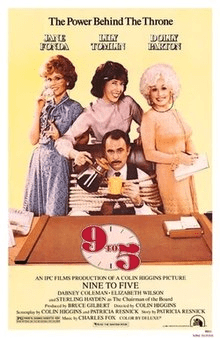
Bonus Review: 9 to 5

Even if you haven’t seen the movie, I’m sure you’ve heard the Dolly Parton song. But if you haven’t seen 9 to 5, you should. It’s a charming, hilarious movie that’s a throwback to a lot of screwball comedies from the 1930s and 1940s. The tag team of Jane Fonda, Lily Tomlin and Dolly Parton (in her first film role) play off each other so well, and has led beyond the movie to a lifelong friendship between the three.

Violet is a widow working at Consolidated Companies. She actually trained her boss, company vice president, Mr. Hart. Judy is a recently divorced woman who is now forced to work after her husband left her for his secretary. She is put under Violet for training. Doralee is Hart’s secretary, married, but Hart has spread a rumor that they are having an affair. The three women end up hanging out, griping about Hart and discussing how they would get revenge on him if given the opportunity. Violet mentions poisoning Hart’s coffee. The next day, Violet accidentally puts rat poison in Hart’s coffee, and only discovers it when Hart falls out of his chair, hits his head, and blacks out, thinking the rat poison is the cause. After several misunderstandings, the three women believe Hart is dead from poisoning and so Violet steals the dead body to avoid there being an autopsy. Later, they discover the body is not Hart and quietly return it to the hospital.

When Hart shows up to work the next day, the women are shocked. Doralee discovers the truth from all the misunderstandings and explains it to Violet and Judy in the bathroom. Hart’s assistant, Roz, hears the entire conversation and reports back to Hart. Hart gives Doralee an ultimatum: sleep with him or he’ll report the three of them for attempted murder. Doralee refuses and ends up hogtying him to his chair and stuffing a scarf in his mouth. The three women also discover that Hart has been selling the company’s inventory and pocketing the profits. However, the invoices that will prove his crimes won’t arrive for 4-6 weeks, so the women take Hart to his home and keeps him confined in his bedroom until they come in. While Hart is unavailable, the women implement favorable programs in the office including flexible hours, in-house daycare, job sharing and equal pay for men and women. Hart’s wife returns home from a trip and frees him, giving him the time to purchase back the inventory he sold. He’s about to report the women to the police when there’s a surprise visit from Consolidated’s chairman. He praises Hart for the programs at the office that has led to significant increase in productivity and offers Hart to join him in Brazil for a multi-year project, which Hart basically cannot refuse. At the end, it is revealed that he was kidnapped by Amazons and never heard from again.

50. All the President’s Men

In the summer of 1972, the United States experienced a scandal it never had before. The President had betrayed the trust of the nation that elected him and attempted to cover it up. Good thing nothing like that happens anymore. To avoid the black mark of impeachment on their career, the President resigned. Sarcasm aside, that truly doesn’t happen anymore, apparently. But I’m not here to deride the current state of our political world, I’m here to talk about the past state of our political world.

After a security guard at the Watergate complex calls the police about a break-in, the authorities arrest five men in the Democratic National Committee headquarters in the building. Bob Woodward, a reporter for The Washington Post, covers the story. They are revealed to have ties to the CIA and Woodward connects them to Charles Colson, part of Richard Nixon’s White House counsel. As the story grows, Carl Bernstein is assigned to work with Woodward on covering it. Initially, their investigation reveals no evidence, but their editor, Benjamin Bradlee, encourages them to continue. Woodward contacts an anonymous senior government official who goes by “Deep Throat”, who encourages Woodward to “follow the money” for his investigation. Woodward and Bernstein connect the five men to campaign contributions in Nixon’s Committee to Re-Elect the President, but Bradlee still believes the information is circumstantial. Why would Nixon break the law when he’s practically guaranteed to beat his opponent, George McGovern? The investigation goes deeper and deeper, connecting to H.R. Haldeman, the White House chief of staff. They look for sources to confirm the connection, but while they do so, the White House issues a non-denial denial. Woodward meets with Deep Throat again and gets confirmation for everything. They’re given the go-ahead from Bradlee and the two reporters type up their story as Nixon is inaugurated for his second term.

Alan J. Pakula directed three movies that made up what he called his “paranoia trilogy” – Klute, The Parallax View and All the President’s Men. Klute is pretty good, and The Parallax View is tolerable, but All the President’s Men is the best of the three, and the only one based on true events, making it the most terrifying. Robert Redford and Dustin Hoffman are excellent as Woodward and Bernstein, and do a good job of performing with an intensity despite being in a dense, dialogue-heavy film. I didn’t live through the time of the Watergate scandal, so I don’t know what it’s like living in a time of journalistic integrity, but thank goodness for their tenacity and thoroughness. Politicians need pressure on them so they are held accountable and kept honest. Since journalism nor the American public no longer do this, we’re stuck with the politicians we have. All the President’s Men is a time capsule and a sad reminder of when a country lost its innocence and integrity was the expectation.

Bonus Review: Mr. Smith Goes to Washington

Another film critical of government. However, where All the President’s Men was acclaimed by the politicians of its day, likely because it was hard to deny the truth, Mr. Smith goes to Washington was heavily criticized as displaying a pessimistic and villainous look at Congress. Which makes sense, since the government was never corrupt prior to Watergate. The movie accomplished two things: 1. It made James Stewart a star (look at the poster above, he’s not even top billing here) and 2. It showed a dramatic shift in tone for Frank Capra’s films. Earlier Capra films like It Happened One Night, Mr. Deeds goes to Town, and You Can’t Take It With You are known for their relentless optimism and rosy-cheeked characters. Starting with Mr. Smith goes to Washington, and most famously in It’s a Wonderful Life, the optimistic main character is still there, but they’re surrounded by corruption, greed and selfishness. It gives the movies a darker tone, but still redemptive.

Jefferson Smith is elected to the U.S. Senate because he’s naive and hopefully easy to manipulate. A fellow senator, Joseph Paine, takes Smith under his wing, as he was Smith’s father’s good friend. Smith takes a liking to Paine’s daughter, Susan. The press aggressively berates Smith as a naive country bumpkin, tarnishing his reputation. Paine suggests Smith propose a bill to repair his reputation and so he comes up with one, using the help of his streetwise secretary, that will use a federal loan to buy land for a national boys’ camp near his hometown. The idea is loved by the public and donations immediately start pouring in. However, it is revealed that the proposed campsite is already the location for an underhanded dam-building project, supported by Paine. Paine urges Smith to keep quiet because Paine’s power comes from the influence of senator Taylor, who spearheaded the dam-building project. Paine accuses Smith of trying to profit from his bill proposal to get the smoke away from his own dealings and Smith runs away, too hurt to defend himself. His secretary, Saunders, convinces him to delay the vote to expel him from the Senate through filibuster. He speaks on the Senate floor for 25 hours, disclosing the true motives of the dam project and appealing to American ideals. Taylor uses his influence to get the newspapers to report falsely on what Smith said on the floor in an attempt to get the public against him. In the end, Smith collapses on the floor, but Paine, racked with remorse, makes a confession to the truth of the dam project and demands he be expelled from the Senate instead of Smith.

51. Gladiator

Are you not entertained? How could you not be when watching Gladiator? Russell Crowe became the talk of the town for his role of the father to a murdered son, husband to a murdered wife, Maximus Decimus Meridius. With direction from Sir Ridley Scott and a background of Hans Zimmer music, Crowe Spartacuses his way into our hearts and our dreams. There is nary a man in high school or college at the time of this movie’s release who did not want what they did in life to echo in eternity. Though a story of revenge, Maximus is made sympathetic and all too human, which is why we like him, but he is also superhuman when he needs to be, which is why we want to be him. We’ll see if our protagonist is half as likable in the sequel.

Maximus begins the film a Roman general on his way home from a victory over the Germanic tribes, but first he makes a stop at his boss’s house, Emperor Marcus Aurelius. Marcus Aurelius tells Maximus that his son, Commodus, is not fit to rule and so he intends to let Maximus rule as regent when he dies so he can restore the Roman Republic. However, after Maximus leaves, an obviously upset Commodus murders his father. Unfit to rule, indeed. Commodus proclaims himself Emperor and demands fealty from Maximus. Maximus refuses, so Commodus demands he and his family are to be killed, and he is immediately arrested by Quintus, leader of the Praetorian Guards. Maximus kills his captors, but is wounded in the fight. He ignores his injuries and grabs a horse, racing home to his family, but when he arrives, they are already dead. Maximus buries them and then collapses from his wounds. He is picked up by slave traders and sold to gladiator trainer, Proximo. Because of his training as a Roman general, Maximus easily wins his fights and is given the nickname, “the Spaniard”, by the people who cheer him on. He befriends Juba, another gladiator. Proximo learns that Commodus is planning a celebratory 150 days of gladiator fights in honor of his father (but really to gain the love of the Roman people), and so he tells Maximus that he can possibly win his freedom if he “wins the crowd”. Maximus disguises himself with a helmet so Commodus does not recognize him as he fights, but after a victory, Commodus demands that he removes it. Upon doing so, Maximus declares he will have his revenge. Commodus does not kill Maximus due to the love of the Roman people.

Commodus arranges to have Maximus duel an undefeated gladiator named Tigris, in hopes of getting him taken care of in the coliseum. However, Maximus defeats Tigris, and when he is ordered to finish him off, Maximus refuses. The crowd cheers him as “Maximus the Merciful”. Commodus fears that killing Maximus will turn him into a martyr. Maximus learns that his former legions remain loyal to him and he devises a plan with Lucilla (Commodus’ sister whom he has incestuous feelings for) and Gracchus (a Roman senator, who will be in power if the Republic is restored) to get out of Rome and rendezvous with his men. When word of the conspiracy reaches the ear of Commodus, he orders the Praetorian Guards to attack the gladiator barracks. Proximo and some others fight off the guards, giving Maximus the chance to escape, but Maximus is captured soon after. Commodus challenges him to a duel in the colosseum, hoping that a victory will regain the public’s favor. However, before the match begins, Commodus stabs Maximus to give himself an advantage in the fight. Surely that’ll win the public back. Maximus is still able to disarm Commodus in the fight, and when his own guards refuse to help him, Commodus pulls a knife on Maximus in a last-ditch effort to kill him. Maximus, however, successfully turns the knife on Commodus, killing him. Growing weak from his wounds, Maximus quickly demands the restoration of the Republic. As he dies, he envisions reuniting with his family in the afterlife. Lucilla gives him the honor of being carried out of the colosseum as a “soldier of Rome”.

I won’t say much about the film’s historical inaccuracies because Ridley Scott is indifferent to them and they never have any bearing over whether a film is good or not, but I will point out two things I discovered about gladiator stuff that I found interesting. First, the thumbs up/thumbs down thing Commodus does in the film is backwards. In real life, the thumbs up represented a ready blade, which meant to kill the defeated. The thumbs down represented a sheathed sword and meant the gladiator would be spared. Secondly, apparently gladiators had product endorsements, much like our athletes do today. They were originally going to make this fact part of the film, but decided against it, thinking it too unbelievable for audiences. Honestly, that was probably the right call.

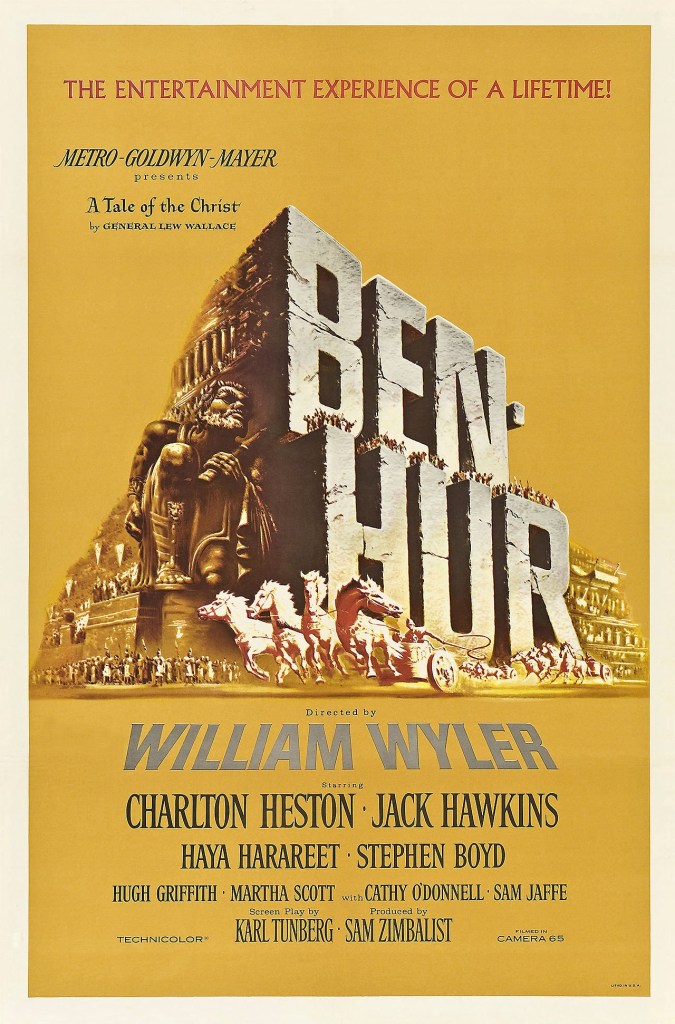
Bonus Review: Ben-Hur

Ben-Hur is a four-hour epic about a man who just wants to get back to his family. Judah Ben-Hur spends time in prison, as a galley slave, and a charioteer before successfully returning home. Throughout the trials that Judah Ben-Hur endures, he grows increasingly angry, fueling his hate for the man who betrayed him until it consumes him. Jesus Christ appears four times in the story, mostly in the background – his birth, a scene at a well where he gives Judah a drink of water, when he preaches the Sermon on the Mount, and his crucifixion, where Judah recognizes him as the man who gifted him water so long ago and attempts to return the favor. It is the crucifixion where Christ comes to the forefront, and acts as the ending to the film. At seeing Christ on the cross, Judah Ben-Hur’s rage dissipates.

A lot has been said about the film’s exciting chariot race scene. The stunt work from Yakima Canutt is excellent and the scene is edited so quickly that it offers a rapid-fire delivery to the screen, and it has rightfully been analyzed by film students and critics everywhere. However, one of my favorite aspects about Ben-Hur is something that doesn’t appear on screen: the face of Christ. Art, for millennia, has concerned itself with the appearance of Christ, and Hollywood is no exception to this, despite what certain political pundits would tell you. Just look at other biblical epics from the same time period: The Robe, The Greatest Story Ever Told, and King of Kings. All of these – and then some – concern themselves with a depiction of Jesus. But Ben-Hur refuses to do it. It’s probably because Ben-Hur is as much a Jewish story as it is a Christian one, but I like to believe – even if it is a symptom of placating two different groups – that it’s intentional reverence.

52. The Fugitive

I think this is my first Harrison Ford movie on this list, so let’s do a double feature! In my younger years, I used to put a lot of stock in both the Oscars and the AFI, and I would look at winners and nominees on their lists and watch them to see what all the fuss was about. I’m glad I had this experience because it means I got to watch a lot of good movies (as well as some head-scratchers) because of it. One such movie was The Fugitive. An action-thriller nominated for Best Picture? Tommy Lee Jones only Oscar-winning performance? Color me intrigued. I wasn’t old enough to have lived through the show the film is based on, so my entire degree of interest was based on the above specs and the fact that it starred Indiana Jones (Han Solo, for all you plebeians).

Dr. Richard Kimble is falsely accused and convicted of his wife’s murder, and is sentenced to death. Tough break. On his transport to Death Row, his fellow inmates on the bus initiate an escape, causing the bus to fall down a ravine and on train tracks. Kimble rescues the corrections officer just before a train plows through the bus. Deputy Marshal, Samuel Gerard, arrives on the scene and learns that Kimble lives. They hurriedly begin a manhunt for Kimble, but Kimble sneaks in and out of a hospital to treat his wounds and alters his appearance. He makes his way down a storm drain, but Gerard follows him down, losing his gun in the process. Kimble picks the gun up and points it at Gerard, leading to the most famous exchange in the movie:

Kimble: I didn’t kill my wife!

Gerard (with his hands in the air): I don’t care!

Instead of shooting Gerard, Kimble jumps out to the spillway below, escaping. Kimble returns to Chicago and, through some financial help from his friend, Dr. Charles Nichols, begins his hunt for the real killer. Having witnessed the killer escaping, Kimble is aware that he only has one arm, and so he begins at the hospital, looking into patients who needed a prosthetic arm. While at the hospital, he corrects a misdiagnosis, saving a patient’s life. Kimble follows his leads, eventually checking out the apartment of Frederick Sykes – a former cop who now runs security for a pharmaceutical company that’s pushing a new drug called Provasic. Kimble had previously investigated Provasic, discovering that it caused liver damage…which would prevent it from getting FDA approved. He also finds evidence, proving Sykes as the killer, and that his friend, Dr. Nichols, switched the bad samples with good ones to get Provasic FDA approved and ordered Sykes to kill Kimble. It was merely circumstance that he killed the wrong Kimble. Now, Dr. Kimble must find a way to take down Nichols and Sykes while being pursued by Gerard.

Bonus Review: Witness

It’s another Harrison Ford thriller that I discovered through its recognition at the Oscars. Witness is a fantastic look at the clash between cultures. The majority of the film takes place in an Amish community and with a plethora of Amish characters, and much time is spent analyzing and admiring the Amish way of life. It’s a very informative film because of it, as well as a crime drama and romance. The performances are very visually focused with some scenes containing no dialogue at all but still saying so much, so while it still has its thrilling moments – especially the climax – the film is surprisingly quiet and subdued.

Rachel and her son, Samuel Lapp, temporarily leave their Amish community and travel to visit Rachel’s sister after her husband and Samuel’s father passes away. Their train stops in Philadelphia, and while they’re waiting for a connector, Samuel goes to the restroom and witnesses a murder. Sergeant John Book interviews the child and asks him to look at a lineup of suspects, but Samuel does not see the killer among them. While at the station, Samuel points out a newspaper clipping of officer James McFee and quietly confirms he’s the killer. McFee works in Narcotics and Book deduces that he stole police evidence to distribute to drug dealers. He goes to Chief of Police, Paul Schaeffer, who tells Book to keep it quiet until they figure out what to do. Book is shot by McFee in a parking garage soon after, confirming Schaeffer’s involvement and corruption. Book takes Rachel and Samuel home and decides to stay with them until his partner can destroy the Lapps’ files at the precinct and can get more info for him. Later, Book calls his partner and finds out he is dead. Schaeffer and McFee, as well as another cop, Ferguson, locate Book and go to the Amish community where he is hiding. Because of the Amish way, Book is unarmed and must sneak around and take out the corrupt cops one by one in order to survive and protect Rachel and Samuel.

53. Stagecoach

1939 was the year for John Ford. He directed three films that year – this one, Young Mr. Lincoln (a courtroom drama about a trial that Abraham Lincoln defended before he became president), and Drums Along the Mohawk (a Revolutionary War-era film about settlers encroaching on Indian territory in the Northeast). Of the three, Stagecoach is the probably the most enjoyable (though they’re all good films) and the most important. Stagecoach did more for the Western genre than any other film. It imbued John Ford with his love for wide shots in Monument Valley, it made John Wayne a superstar lead actor (through Ford’s stubbornness; his producer wanted Wayne replaced with Gary Cooper since Wayne, at the time, was a nobody), and it brought the Western out of B-Movie Hell and brought it to a place of prominence and prestige. After Stagecoach, Westerns became critically-acclaimed high art after nearly 40 years.

You’ve probably seen some variation of this movie before: A group of strangers meet on a stagecoach as they make their way from Arizona to New Mexico. They have a multitude of reasons to make the trip – a fresh start, meeting family, vengeance – and they have to brave through Apache territory to get there. Along the way, John Wayne’s Ringo Kid, who has busted out of jail to kill the men who murdered his father and brother, falls in love with Dallas (Claire Trevor), a prostitute that has been kicked out of town and must now find somewhere she’s accepted. In the end, Ringo Kid takes his revenge and the law, having spent time with him and realizing he’s not such a bad guy, lets him ride off into the sunset with his new gal.

Action, romance, and great characters – this movie has it all. While not the film’s climax, one of the most thrilling scenes in the film is when the Apaches charge and attack the stagecoach. The people on the stagecoach have to protect themselves and the Ringo Kid must leap from the coach to yolk to yolk to yolk to get to the front of the horse team. It’s an exciting piece of cinema, but I bring it up to bring up Yakima Canutt. Yakima Canutt did all the stunts in the film, including this one, and he deserves for his name to be known. He did these fantastic stunts, some of which had yet to be repeated, while stunt work in films was still in its infancy and was much more primitive and therefore much more dangerous. Canutt’s work has been imitated and referenced in numerous action films and Westerns. In fact, the aforementioned stunt on Stagecoach was given a nod in Raiders of the Lost Ark when Harrison Ford jumps from the top of a German truck to the front of it, then falls underneath and is dragged by it.

Bonus Review: The Gunfighter

Gregory Peck is Jimmy Ringo, the Gunfighter. Weary of his gunslinging lifestyle and tired of being viewed as an outcast or some kid’s ticket to fame as “the man who shot Ringo”, he decides it’s time to retire and become a respectable member of society. He returns to Cayenne, the town where his wife he hasn’t seen in eight years and the son he’s never met live. Through mutual friends, Ringo is given the chance to plead to his wife to join him in California, but she asks for a year to consider it and see whether he stays out of trouble. At the urging of the marshal, Ringo decides to leave town, but it’s too late. The brothers of a young man Ringo shot and killed in self-defense have arrived and are waiting to ambush Ringo. This film’s conclusion is a meditation on the price of fame and the circular perpetuation of an eye-for-an-eye mentality.

Hopefully you have or will watch The Gunfighter, but if you’ve never seen it and are a John Wayne purist, it’s very similar to The Shootist – Wayne’s swan song and the last film he made before his death. However, where The Shootist is a little bloated and dragged out, The Gunfighter is a tight hour-and-a-half. It’s a good thing, too, with such a simple plot, but the movie does not drag, and it really fits Gregory Peck’s personality as the deep-voiced, stoic, one-man powerhouse. It’s ironic, though, as John Wayne was originally wanted for the role of Jimmy Ringo before Peck was chosen. When the film failed to explode at the box office, two things were blamed for its bomb: the lack of John Wayne, and Gregory Peck’s era-authentic mustache.