35. Tootsie

Man. Some Like It Hot and now Tootsie. Apparently, I really like movies about cross-dressing. What can I say? These comedies are hilarious! And what I love about Tootsie in particular is that it fits right in with the screwball comedies of the 30s and 40s. It’s a satirical love story with quick and witty dialogue, and with an outlandish premise. Dustin Hoffman’s ability to transition from Michael Dorsey to Dorothy Michaels and back within the same scene is a level of acting that has rarely been duplicated. From the walk, to the posture, to the talk – he nails it. It’s certainly more convincing than Tony Curtis and Jack Lemmon. It’s impossible to imagine anyone other than Dustin Hoffman in the role, so it’s probably a good thing production was delayed long enough that neither Michael Caine or Peter Sellers could take it.

Michael Dorsey is a struggling actor in New York City. Between specific qualities wanted for roles and Michael being difficult to work with, it’s been months since he’s successfully landed an acting job. His friend, Sandy, casually brings up a role she’s pursuing – the hospital administrator for the soap opera, Southwest General. Desperate for work not in a restaurant or classroom setting, Michael disguises himself as a woman, Dorothy Michaels, and lands the part. Dorothy takes charge of her part, playing the administrator, Emily, as a strong, confident feminist, which makes her a national sensation. To look for clothes for Dorothy, Michael raids Sandy’s closet, but she catches him in a state of undress and plays it off that he wants to sleep with. She reciprocates. However, Michael is actually falling in love with one of his costars, Julie, who is also the girlfriend of the soap’s director, the sleazy Ron (if you recognize the guy in this role, it’s because he plays the equally sleazy boss in 9 to 5). Julie and Dorothy become close friends, and it’s Dorothy who encourages Julie to end things with Ron for her own well-being. Dorothy has a couple of admirers of her own, the veteran actor on the soap, John, and Julie’s father, Les. Les goes so far as to propose marriage to Dorothy. John just shows up to her apartment and attempts to put himself on her. As soon as John is removed from the apartment, Sandy shows up, having been ghosted by Michael since their night together. Michael admits to her that he’s in love with someone else, which obviously upsets Sandy. To get out of his contract, Michael sets up a situation where the soap has to go live for their next episode and reveals himself a man, claiming to be Emily’s brother, Edward, who is seeking revenge for Emily’s “murder”. The reveal is a shock to everyone and Julie punches Michael as soon as the cameras stop rolling. Some time later, he approaches Julie to apologize and admit that “I was a better man with you as a woman than I ever was with a woman as a man.” Julie admits to missing Dorothy’s company and they walk down the street in conversation.

I’ve already said plenty on Dustin Hoffman’s performance, but alongside that, it should be mentioned that Hoffman has been on record multiple times to explain what the role in Tootsie has done for him. He claims that playing Dorothy allowed him to realize that he found the woman incredibly interesting, but because she’s unattractive, if she were a real person, he never would have approached her. He felt ashamed of his internalized sexism. While that easily sounds like a celebrity posturing to make themselves sound better, it still opens up a conversation about the truth behind what he’s saying. That’s what all the best comedies do anyway – open the doors that would otherwise remain closed. I guess it’s true what they say: you can’t judge a woman until you’ve walked a mile in her heels.

Bonus Review: Mrs. Doubtfire

Speaking of men dressing as women for the sake of work, there was another film, very similar to Tootsie, that came out eleven years later: Mrs. Doubtfire. I expect most of my readers have seen this film, so it’s not much of a recommendation to watch something new as much as a recommendation to rewatch this hilarious movie from one of the greatest comedy talents ever to walk the earth.

Daniel quits his job as a voice actor over a scene that he argues encourages kids to take up smoking. He picks his three children up from school, and takes them home to have a birthday party for his son, Chris, despite, Miranda’s, his wife, objections. Miranda, who is very devoted to her job, returns home and sees the chaos ensuing in her living room. In her frustration and with the news that Daniel quit his job, Miranda decides to divorce. Because of Daniel’s lack of a job or home, Miranda gets sole custody of the children. Daniel gets a job in shipping at a television station, and then, when Miranda reveals she’s putting a want ad in the paper for a nanny, he takes a second job. His brother who is a makeup artist helps Daniel create Mrs. Doubtfire, the greatest nanny across two continents. As Mrs. Doubtfire, Daniel is very strict with his children, allowing them to be more disciplined and Miranda to be more relaxed, and Daniel himself becomes more responsible. After hours, Daniel is caught playing with some of the props for the children show the station works on by the CEO, Jonathan. Impressed by his talent and imagination, Jonathan invited Daniel to dinner to discuss ideas. The same night, Miranda is having a birthday dinner at the same restaurant with her new boyfriend and the children and insists Mrs. Doubtfire join them. Daniel must juggle both dinners to little success. However, Miranda admits his help in raising their kids is best for everybody so she works out a joint custody deal. He also becomes the star of a successful children’s show, as Mrs. Doubtfire.

I know I’ve reviewed Good Morning, Vietnam already, but I’ll mention it again because that film left so much open room for improvisation that some of Robin Williams’ monologues feel like retreads of his stand-up specials. There’s no harm in that fact. The material’s funny so why would anything else matter? However, Mrs. Doubtfire is significantly more structured than Good Morning, Vietnam, which means that Williams’ improv had to fit the scenes and was much more tightly leashed. This also means that the comedy in Mrs. Doubtfire feels more original. So when Williams, as the Doubtfire character, is ignored in his attempt to discourage his ex-wife from wearing sexy clothing on a date and instead suggests an ugly frock, his comment that he will “get the frock out of here” is immaculate. Or when he throws a fruit at Pierce Brosnan’s head, he can claim as a witness that it was “a run-by fruiting”. It’s a film that is hilarious, joyful, and tender.

36. No Country for Old Men

The Coen brothers have made a career of genre bending and homages to old Hollywood. They have made six noirs, three westerns, a retelling of the Book of Job, an homage (borderline parody) of Frank Capra comedies, two of the most quotable movies ever made (The Big Lebowski and O Brother, Where Art Thou?), and a movie where Nicolas Cage steals a baby and robs a convenience store with pantyhose on his head. “Eclectic” doesn’t even begin to describe them. Though they have elements of genre filmmaking across their entire filmography, the one example that is equal parts noir and western, is their critically lauded masterpiece, No Country for Old Men, an adaptation of the novel by Cormac McCarthy. As I said in my review of Fargo, the Coens frequently play with the Yiddish concept of the schlemiel. However, whether it’s because the film has source material or just the serious nature of the film, this film has no schlemiel (though it could be argued that Llewelyn Moss is one for taking the drug money).

Llewelyn Moss (Josh Brolin) stumbles across the results of a bad drug deal and finds two million dollars in a briefcase. Feeling his luck has changed, Moss takes the money home, but little does he know that Anton Chigurh (Javier Bardem), a ruthless and nihilistic assassin is hot on his trail and leaving bodies in his wake (depending on how they call a coin toss). Meanwhile, Ed Tom Bell (Tommy Lee Jones) is following after Chigurh, and investigating Chigurh’s break-in at Moss’s house. Moss finds a tracking device in the briefcase, but as he goes to get rid of it, realizes that it’s too late. Chigurh has found him. It’s an intense game of cat-and-mouse that is sure to end up terribly for all parties involved.

No Country for Old Men is the very definition of “sparse”. The West Texas landscape is vast and void. There is minimal amounts of dialogue throughout the whole film and practically none during the tense chase scenes which make up a big chunk of the movie. Josh Brolin even commented on the lack of dialogue and how hard it was for him as an actor to emote on screen without the assistance of words. The most interesting part of the film, however, is the significant lack of score. There is virtually no music until the end credits, and even when there is music in the background, it’s drastically muted. It makes the sounds that are heard in the film that much more singled out and loud. It builds the tension considerably, like during a scene where Llewelyn is listening for Anton Chigurh’s footsteps outside his motel door. Each step carries with it so much weight because it and Llewelyn’s breathing are all you can hear. What No Country for Old Men does better than most thrillers is captivate its audience. That, and staying true to its source material. The movie is almost exactly like Cormac McCarthy’s novel. Nothing is added and very little is removed. It’s simply condensed. McCarthy’s themes of fate and the presence of evil are front and center, as well as right in the Coen’s wheelhouse.

Bonus Review: Miller’s Crossing

Miller’s Crossing is set during the Prohibition era. Tom Reagan (Gabriel Byrne) is the right-hand man for crime boss, Leo O’Bannon (Albert Finney). Oh, and he’s also sleeping with O’Bannon’s girlfriend, Verna (Marcia Gay Harden). When this news arrives to O’Bannon’s ears courtesy of Tom’s own mouth, Tom is understandably beaten and kicked out of O’Bannon’s outfit. Tom then turns his attention to O’Bannon’s rival, Johnny Caspar (Jon Polito), who demands Tom kill Bernie (John Turturro), Verna’s brother, as a sign of good faith. When Tom looks into his heart and spares Bernie, his act of mercy comes back to bite him big time.

The Coen brothers’ Miller’s Crossing is another fine example of their ability to twist and combine genres. Where No Country for Old Men is a western/noir hybrid, Miller’s Crossing is a noir twist on the gangster genre. In fact, the movie is bookended by an homage to each. The beginning of the film, in Leo’s office, is a sendup to the opening of The Godfather, while the funeral scene at the end is a nod to the ending of The Third Man. Bookending the bookends is a repeated shot of a hat, blowing through the wind along the ground, which is likely a reference to the film, Le Doulos, a French crime film that ends with a hat falling into the frame on the forest floor as its owner, Silien, falls down dead. There’s a sense of futility that arises from witnessing a hat floating on the wind, with no one in proximity to grab it. I suspect from how they treat their characters throughout their films, the Coen brothers view the lives of their characters in much the same way we view the hat. It comes into view for a bit and then is carried away by the lightest breeze.

37. Some Like It Hot

The first time I watched Some Like It Hot, I thought it was funny. The second time I watched it, I thought it was surprisingly clever. The third time I watched it, I saw it for the genius it truly is. I’ve always believed that Billy Wilder is one of the great comedy screenwriters of all time, but it wasn’t until Some Like It Hot that I had clear, definitive proof. Originally pulled from another film, Fanfare of Love, that follows two down-on-their-luck musicians who dress in drag for the sake of gig, Some Like It Hot adds an interesting element: the two musicians are on the run from a gangster who they witnessed killing his rival.

In Prohibition-era Chicago, Joe and Jerry are two friends who perform with a jazz ensemble in a speakeasy. When the police raid the place, Joe and Jerry narrowly escape the scene only to witness the speakeasy’s owner, “Spats” Colombo, gunning down his rival and the man who tipped off the police, “Toothpick” Charlie. Without other options, Joe and Jerry pose as women so they can tour with the all-female band, Sweet Sue and her Society Syncopators, and become obsessed with the band’s singer and ukulele player, Sugar Kane. Joe goes by Josephine and Jerry goes by Daphne, and both struggle to avoid giving themselves away and not make passes at Sugar. In Miami, Joe adopts another persona, Junior, the heir to the Shell Oil company in an attempt to woo Sugar, while an older millionaire named Osgood attempts to woo Daphne. Joe uses Jerry as Daphne to occupy Osgood while he uses Osgood’s yacht to spend a night with Sugar. When both men return to their room, Jerry reveals that Osgood proposed and Daphne said “yes”. Meanwhile, a secret meeting between the country’s gangsters under the name “Friends of the Italian Opera” is happening at the same hotel, and of course, Spats is there. Joe and Jerry are discovered, even in their disguises, and must escape. Seeing his last chance, Joe as Josephine jumps onstage and kisses Sugar, causing her to realize that Josephine and Junior are the same person. Jerry as Daphne convinces Osgood to bring them on his yacht as he sets sail so they can escape. In a last ditch effort to get out of marry Osgood, Jerry, as Daphne makes the following argument:

Jerry: We can’t get married at all!

Osgood: Why not?

Jerry: Well, in the first place, I’m not a natural blonde.

Osgood: Doesn’t matter.

Jerry: I smoke! I smoke all the time!

Osgood: I don’t care.

Jerry: Well, I have a terrible past. For three years now, I’ve been living with a saxophone player.

Osgood: I forgive you.

Jerry: I can never have children!

Osgood: We can adopt some.

Jerry: But you don’t understand, Osgood! I’m a man!

Osgood: Well, nobody’s perfect.

Typing the punchlines out will never be as funny as witnessing the actual film, so forgive me for that whole bit there, but it’s such a famous bit of dialogue that I didn’t see any harm in it. Anyway, it’s one of the few movies I would argue that’s “laugh out loud” funny. So much so, that the scene where Jerry explains his engagement to Osgood to Joe had to be redone and the dialogue spaced out because the first audiences were laughing over the jokes. Things behind the scenes, however, were not as humorous. Marilyn Monroe, who plays Sugar, showed up late to set frequently, delaying filming, and had to do multiple takes on simple scenes because she couldn’t remember her lines. One line, “It’s me, Sugar”, required 47 takes before she got it right. Legend has it that Tony Curtis (Joe) and Jack Lemmon (Jerry) placed bets on how many takes any particular scene would require. It’s incredibly heartbreaking to know how much her life and addiction was taking a toll on her, but it’s also impressive the performance she could bring to the table despite all of that.

That was a surprisingly depressing note to end on, so against my better judgment, here’s another snippet of dialogue where Jerry as Daphne attempts to hit on Sugar with a private drinking party, hoping to reveal he’s an eligible man:

Daphne: No lights. We don’t want anyone to know we’re having a party.

Sugar: But I might spill some.

Daphne: So spill it! Spills, thrills, laughs and games. This may even turn out to be a surprise party.

Sugar: What’s the surprise?

Daphne: Not yet.

Sugar: When?

Daphne: Better have a drink first.

Sugar: There. That’ll put hair on your chest.

Daphne: No fair guessing.

Bonus Review: Cat Ballou

Much like Some Like It Hot, Cat Ballou is riotously funny movie. Perhaps with a little more pathos than the former, but it doesn’t cut short the comedy for it. There are actually a small handful of excellent Western comedies, including Blazing Saddles and the made-for-television film, Evil Roy Slade (which gets no other mention in my Top 100, though it probably should…Dick Shawn is hilarious as a singing, scatting, guitar-strumming cowboy). Cat Ballou, however, is special. The two leads are not well-known for comedy – Jane Fonda more so than Lee Marvin, perhaps, but both are more dramatic types.

Catherine Ballou (Jane Fonda) is a schoolteacher who returns home to her father’s ranch only to discover that the Wolf City Development Corporation is threatening Frankie Ballou (John Marley) to give up his ranch so they can use it for their own purposes. When Frankie refuses to give in to their demands, they send the killer, Tim Strawn (Lee Marvin), to do what he does best. Cat hires the notorious sharpshooter, Kid Shelleen (also Lee Marvin), in an attempt to save her father, but Shelleen is revealed to be a drunken buffoon – still a crack shot, but past his prime. After the murder of her father, Cat Ballou demands justice from the town of Wolf City, but she doesn’t get it. With a ragtag team, she decides to take matters into her own hands, becoming a notorious outlaw. When she accidentally kills the head of the Wolf City Development Corporation, she finds the town now all too willing to pursue justice. It’s hard out there for a woman.

This Western Comedy is equal parts hilarious, dramatic, and action-packed, and Lee Marvin shines as the uproarious Kid Shelleen, and as his own brother, Strawn. It’s a shame that this is the role Lee Marvin gets accolades for, but it’s also well-warranted. There’s also Nat King Cole and Stubby Kaye as two banjo-wielding minstrels to narrate the story, which is a fun play on the Greek chorus storytelling device and an unusual comedic addition. Cat Ballou is great, especially for a first-time watch, because you’re not quite sure what you’re going to get until you get it.

38. Fantasia

Fantasia is unlike any other animated movie. All at once, it is an audio and video experiment, a collection of vignettes held together with a concert, and an overbudget Mickey Mouse cartoon gone wrong, and somehow, totally right. Walt Disney was not only innovative, he was smart about turning a disaster into a masterpiece, and Fantasia is certainly no different. Originally, Fantasia was no more than the famous The Sorcerer’s Apprentice sequence – intended to be a Mickey Mouse cartoon short to springboard the mouse back into the zeitgeist after Walt spent years devoting all his attention into Snow White and the Seven Dwarves. When the short got to be so expensive that Walt and his brother, Roy, were convinced it would never recoup its money, they decided on the feature film we got. Leopold Stokowski, conductor of the Philadelphia Orchestra, was brought in to conduct the musical segments as well as give input on which pieces of music were chosen. Great attention was given to each segment and the overall experience for the audience, and though it was abandoned before release, there was originally intended to be an early example of smell-o-vision for certain segments. Ballerinas and dancers were filmed for the Dance of the Hours and The Nutcracker Suite segments. For the Rite of Spring dinosaur sequence, Disney brought in the director of the American Museum of Natural History, and Edwin Hubble, the namesake of the Hubble Space Telescope. Bela Lugosi, the quintessential Dracula, was brought in as a character model for Chernabog, the huge demon portrayed in the Night on Bald Mountain segment.

The film is interspersed with introductions and intermissions from master of ceremonies, Deems Taylor, including a segment where he shakes hands with Mickey Mouse – Disney’s first example of the blend of live action and animation they leaned into in the 40s through 60s, and therefore a very impressive feat at the time. Beyond that, each musical segment is its own. Inspired by an abstract animation called A Colour Box, the opening Toccata and Fugue in D Minor segment is a demonstration of the experimental nature of the film. Images of the orchestra turn to animation and then simplify into lines and shapes that move with the nature of the music. The Nutcracker Suite uses the medley from the ballet to carry images of the changing of the seasons and animates faeries, fish, flowers, and mushrooms to visualize it. The Sorcerer’s Apprentice is a musical piece based on a poem by Goethe, and the animation tells a very Disney-fied version of that poem, starring Mickey Mouse and the new sorcerer character, Yen Sid (read it backwards). The Rite of Spring segment visualize the beginnings of the Earth through the extinction of the dinosaurs. It scared me as a kid, but now, it’s my favorite part of the whole movie. The Pastoral Symphony is a pastiche on Greek mythology. No particular story is told, but it features centaurs, fauns, and cupids as they prepare a celebration of Bacchus. I guess Zeus gets jealous because he starts throwing lightning bolts at everybody. Dance of the Hours follows four groups of animals as they dance the four parts of the day: ostriches (Morning), hippos (Afternoon), elephants (Evening) and alligators (Night). And finally, there are two pieces put together: Night on Bald Mountain and Ave Maria. The demon Chernabog releases the restless, villainous spirits from their graves. They dance and celebrate their release until a church bell tolls, signifying the coming morning. The spirits return to their graves and Chernabog returns to his sleep as a procession of monks pass through the forest to the ruins of a cathedral.

Upon its release, Fantasia was not a financial success. Though that can mostly be attributed to the fact that it came out in 1940. There was a war going on. Since then, it has been rereleased numerous times throughout the years and, adjusted for inflation, is the fourth highest-grossing animated movie of all time. Even with some controversy hanging over its head (the Pastoral Symphony segment had depictions of Black centaurs that were subservient to the White ones in its original release that have since been edited out), it remains one of the greatest cinematic achievements and experiences for animation as a medium.

Bonus Review: Pinocchio

Earlier that same year, Disney released their second feature film, Pinocchio. And much like Fantasia, it scared a very-young me half to death. The scene on Pleasure Island where the children turn into donkeys for doing bad things? The mischievous little boy I was couldn’t bear the thought. Critically comparable to both Fantasia and Snow White and the Seven Dwarves, Pinocchio still suffered the same fate as Fantasia financially, due to the active World War going on in the background. It too made up its budget over time thanks to Disney’s concept of rereleases (which was started for this very purpose). It also has a permanent place near the top of the Disney canon for what has become the Disney mantra and theme song, “When You Wish Upon a Star”.

Jiminy Cricket attempts to make a home at Geppetto’s workshop as he finishes a wooden marionette named Pinocchio. Geppetto wishes on a star that Pinocchio will be made into a real boy. After Geppetto falls asleep, the Blue Fairy appears and halfway grants Geppetto’s wish, turning Pinocchio, but he will remain a puppet until he learns to be brave, honest and unselfish. The very next day, Pinocchio is led astray by “Honest” John and Gideon on his way to school. They convince him to join Stromboli’s traveling puppet show, despite Jiminy’s objections. Stromboli locks Pinocchio away, only letting him out to perform. The Blue Fairy appears, catches Pinocchio in a lie, but helps him get free and escape. She tells him she can offer no further help. “Honest” John finds Pinocchio again later, and convinces him to join a Coachman who delivers children to a place called Pleasure Island. Along with the other kids, Pinocchio participates in drinking beer, smoking cigars, fighting the other boys and vandalizing the Island. What is initially a rocking good time, quickly becomes a nightmare when the boys physically transform into that which they have already been acting like. Pinocchio barely escapes before completely transforming, but he does have ears and a tail now. Pinocchio discovers that Geppetto has gone looking for him and has been swallowed up by the great whale, Monstro. Pinocchio goes out to find him, and is also swallowed. He reunites with Geppetto and gets Monstro to spit them out by starting a fire. However, the whale gives chase, and soon Pinocchio is killed. As Geppetto mourns Pinocchio, the Blue Fairy returns and turns him into a real boy.

Pinocchio has been called “the most down to earth film Disney ever made”, despite the magic and fairytale nature of the story, because it acts as a simple morality tale. And it’s through changes to the original story that makes this possible. In the original book by Carlo Collodi, Pinocchio is a brat if ever there was one. He baulks at authority figures, especially Geppetto, and he willingly goes astray to explore the world around him. Jiminy Cricket, Pinocchio’s conscience, is also original to the Disney movie, though there is a cricket in the book that Pinocchio gleefully smashes to death with a hammer. Walt Disney insisted on finding ways to make Pinocchio likable so the audience could sympathize with him, so he turned the very rude boy into an innocent, albeit ignorant, one, and expanded the cricket’s character to not only have a role, but act as the moral compass for the wayward boy. If you want to see what a “true to the source material” version looks like, watch Guillermo Del Toro’s stop-motion adaptation. It’s practically unwatchable outside of admiring the craft that went into making it.

39. Glory

I task each and every one of you to find a better Civil War film than Glory. You can’t do it. Maybe Lincoln comes close, but still pales in comparison to this rich story of the 54th Massachusetts Infantry Regiment, even with a great performance from Daniel Day-Lewis. What Glory does that most slavery-centered movies don’t is round out the Black characters. Typically, the plot is a Black person trying to escape the tyranny of their master, and so strongly are their convictions to escape that there is no further characterization beyond that. However, in Glory, the slave emancipation storyline is broadened to the scope of the entire Civil War. And each character that makes up the 54th has their own personality. Rawlins is a wise and diplomatic older man whose demeanor gets him promoted. Even though he doesn’t want it, he accepts the promotion because he knows he can be used for the betterment of the regiment. Trip is an angry young man, who lashes out at everyone, including his fellow Black soldiers just to try and make himself feel better. Thomas is a well-educated and articulate freeman who is somewhat ostracized from the others because he walks and talks like a White man. Despite his own freedom, he fights just as determined as the others for the sake of them all.

Captain Robert Gould Shaw is promoted to colonel of the 54th Massachusetts Infantry Regiment, the first all-black regiment in the Union army. He appoints his friend Cabot Forbes as his second-in-command. They receive a group of volunteers that includes the men I mentioned above. Thomas is Shaw’s family secretary, so they are already well-acquainted. The Confederacy issues a response to the Emancipation Proclamation claiming they will capture any Black men fighting for the Union and enslave or kill them, as well as many White men charged over them. Other problems plague the regiment. Trip seemingly deserts and is returned and flogged. Shaw learns from Rawlins that Trip was not deserting, he was only going to find shoes, something the 54th in particular has been denied. Shaw confronts the quartermaster and gets the regiment shoes. The federal government makes it clear that the Black soldiers will not be paid as much as the White soldiers. Trip leads a protest by convincing everyone to tear up their payment vouchers. Shaw tears his up as well and declares the White officers will not take payment either until the dispute is settled. Shaw works to finally get his regiment to see combat. The regiment is sent to Fort Wagner to capture it for the Union.

Glory is an intense, thrilling war movie and it contains many staples of that genre: excellent camera work, powerful and emotional score, and great performances. The film stars Matthew Broderick, Cary Elwes, Morgan Freeman, and Denzel Washington, as well Andre Braugher (Captain Raymond Holt of Brooklyn’s 99th Precinct) in his first film role. Denzel Washington not only received awards for his performance as the hot-headed Trip, but he also turned into a household name, nearly overnight. Morgan Freeman was already known to some for his work on The Electric Company, but he also had a big year in 1989 between Glory, Driving Miss Daisy, and Lean On Me, which certainly increased his stardom.

Glory is a powerful film. It is an important film, because it is an important story in our nation’s history that doesn’t often get told.

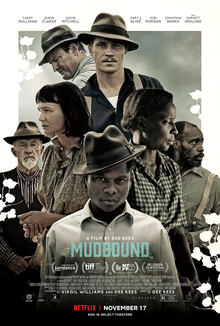
Bonus Review: Mudbound

It feels like an eternity ago, but there was a brief time in history where Netflix tried with its original programming. The very first Netflix Original Movie was Beasts of No Nation – a story about a child soldier in an African civil war – for crying out loud. Mudbound, also based on a novel, deals with themes of surviving PTSD, racism in the South, and generational sins. Quite a step up from The Noel Diary.

Henry McAllen is conned out of renting a home and must take his wife, Laura, their children and his father, Pappy, to live next to the Jacksons near Marietta, Mississippi. Hap Jackson is a Black tenant farmer and a preacher at a nearby church. He and his wife, Florence, do what they can to provide for their family. Henry’s brother, Jamie, and the Jackson’s eldest son, Ronsel, enlist in the military to fight in World War II. The two families work together to stay afloat, financially, but at the encouragement of Pappy, Henry pushes for an edge over the Jacksons, demanding half of the Jackson’s crop for the use of his mule. Hap breaks his leg while building a church and is unable to work. Laura sneaks some of Henry’s money to them to keep the Jacksons going until Hap can get back on his feet, but this further sours the already loveless McAllen marriage.

Ronsel and Jamie return from the war and develop a friendship. Jamie, however, medicates his PTSD with alcohol and Ronsel deals with increased racial disdain. Because of Jamie’s alcoholism, Henry demands that he leave the farm before Henry returns from a trip. Ronsel receives a letter from a White German woman he fell in love with while overseas, along with a photo of her and the mixed-race child they conceived. Jamie and Laura grow close while Henry is away, keeping Jamie from leaving the farm. Pappy finds the letter from Ronsel’s love and with the help of his friends in the Ku Klux Klan, they ambush and beat Ronsel within an inch of his life. When Jamie shows up and sees the state Ronsel is in, he points a gun at his father. However, he is immediately restrained and beaten as well. Pappy makes Jamie choose what sensitive part of Ronsel’s body he will lose or they will kill him and a dejected Jamie picks his tongue. Later that night, Jamie returns to the farm and smothers Pappy with a pillow. When Henry returns home, Laura tells him that Pappy died in his sleep. Henry and Jamie struggle to bury Pappy the next day, and Henry asks Hap to help them as the Jacksons are leaving. Jamie also gives the Jacksons the letter and photo of Ronsel’s lover and child to return to him. Jamie moves to the city and Ronsel returns to Germany.

As Pappy is buried, Hap says a prayer over the grave and quotes the following passage from the Book of Job:

He cometh forth like a flower, and is cut down: he fleeth also as a shadow, and continueth not. And dost thou open thine eyes upon such a one, and bringest me into judgment with thee? Who can bring a clean thing out of an unclean? not one. Seeing his days are determined, the number of his months are with thee, thou hast appointed his bounds that he cannot pass; Turn from him, that he may rest, till he shall accomplish, as an hireling, his day. For there is hope of a tree, if it be cut down, that it will sprout again, and that the tender branch thereof will not cease. Though the root thereof wax old in the earth, and the stock thereof die in the ground; Yet through the scent of water it will bud, and bring forth boughs like a plant. But man dieth, and wasteth away: yea, man giveth up the ghost, and where is he? As the waters fail from the sea, and the flood decayeth and drieth up: So man lieth down, and riseth not: till the heavens be no more, they shall not awake, nor be raised out of their sleep.

40. Diabolique

I can only think of two films that are so revered for their thrilling twists that people agree they are the spitting image of a Hitchcock film: Charade and Diabolique (or Les Diaboliques, the true French title). Diabolique actually has the distinction of nearly being made by Hitchcock. The story goes that Henri-Georges Clouzot was given the novel that was the basis for Diabolique (She Who Was No More) by his wife, Vera Clouzot, and was so engrossed in its story that he stayed up one night and read the entire thing. Early the next morning, he called and bought the rights to adapt it. The story also goes that Alfred Hitchcock was denied the rights to the book when he called only a few hours later. Both filmmakers took the comparisons in stride, however, with Clouzot admitting to being an admirer of Hitchcock and took it as a sign of success whenever such a comparison was made, and Hitchcock used Diabolique as a source of inspiration when making Psycho.

Michel runs a boarding school with an iron fist. He is horrible to the students, mocks the frailty of his wife, Christina, due to a heart condition, and both beats his mistress, Nicole, and parade her in front of his wife. Surprisingly, Christina and Nicole develop a close bond over their mutual hatred for Michel. Nicole comes up with a plan to murder Michel and coerces Christina to help her. They get Michel over to Nicole’s apartment, sedate him and drown him in the bathtub. They return his body to the school and throw him in the pool to make it look like an accident. However, the body does not float back to the top. The next day, the pool is drained, and still there is no body. Many strange happenings worsen Christina’s heart condition. First, the suit Michel wore on the day he was drowned is returned from the dry cleaners. Then, a boy who is raking leaves outside the school yard tells Christina that Michel told him to do it as punishment for breaking a window. Finally, a photo is taken of the school and Michel’s ghost appears in one of the windows. Christina’s condition is worsened to the point of being confined to her bed. But even in bed, she hears strange noises all around her.

To go any further with a film description would be to do you a disservice. If you have not seen the film, I implore you to do so and to go in without any more knowledge of the film’s events beforehand. I wish to respect the words that appear over the end credits of the film. Translated, it reads, “Don’t be Diabolical! Do not destroy the interest your friends may have in this movie. Do not tell them what you have seen. Thank you, on their behalf.” Diabolique is actually one of the first films to use this sort of anti-spoiler messaging during the movie – another thing that inspired Hitchcock for an intense marketing campaign for Psycho. If you have any interest in a great thriller (with some elements of horror) with beautifully conceived twists, please watch this movie. Enjoy what has been referred to as the original “twist ending which forces you to reassess everything you thought you had been told earlier in the film.”

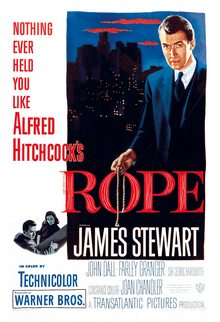
Bonus Review: Rope

Speaking of Hitchcock, one of his better films that I feel is increasingly underappreciated is Rope. Rope is based on a play, which was inspired by the very real crime committed by Nathan Leopold and Richard Loeb. On May 21, 1924, while Leopold and Loeb were still students at the University of Chicago, they attempted to pull off the perfect crime – kidnap and kill 14-year-old Bobby Franks and send the family and authorities on a complex wild goose chase with an extended ransom arrangement. The two young men – they were 19 and 18 when committing this crime – were inspired by the writings of Friedrich Nietzsche and his concept of some humans being superior to others based solely on intellect, the “Beyond-Man” or “Ubermensch”, and wanted to test themselves. However, a pair of glasses was found at the scene of the crime that were fitted with an unusual hinge, which narrowed the police’s search to just three individuals in the Chicago area…Leopold being one of them. Ubermenschen, these boys were not.

The film was rather experimental for Hitchcock. He intended to film in as few takes as possible and extended scenes to the length of a roll of film (which, at the time, was only about 10 minutes). To make the film look like one continuous shot, the camera movement had to be choreographed extensively and it also had to be given opportunities to cut without the audience noticing. This was accomplished by the camera ending and beginning shots zoomed in on actor’s black suits or behind an overly-shadowed piece of furniture. James Stewart was particularly incensed by the technique and complained that the camera was being given more attention than the actors. Years later, he calmed down a tad on his opinion, but still claimed it was an experiment that just didn’t work.

Brandon and Phillip are two young men who have taken the teachings of their professor, Rupert, over Nietzsche’s theories to heart. They decide to murder one of their schoolmates, David, in their apartment and hide the body in a chest before inviting David’s closest friends and family to a dinner party. They also invite Rupert. At the party, David’s absence is noted and conversation about his whereabouts and the possibility of murder is encouraged by Brandon. Phillip, on the other hand, keeps to himself, drinking heavily. The food is laid out, buffet-style, on the chest containing David’s body. It is mentioned over dinner that Phillip has a knack for strangling chickens, which he vehemently denies. This, along with several other peculiarities over the course of dinner, make Rupert suspicious (he has witnessed Phillip strangling chickens before), and so he questions him. The conversation at the dinner table increasingly turn to David’s absence from the party and when David’s mother calls the apartment (she did not attend due to an illness) to see if David has turned up, David’s father decides to leave. The party quickly peters out, and everyone leaves. Rupert, on his way out, is given the wrong hat. The hat in his hands is monogrammed with David’s initials, further increasing his suspicions. He returns to the apartment and questions Brandon and Phillip again, demanding to look in the chest. Seeing David’s body, Rupert wrestles a gun from Phillip and fires two shots out the apartment window to alert the police.

41. The Thin Man

The comedy-mystery is a surprisingly successful and enduring subgenre of the mystery film. Movies like Murder by Death, Clue, and more recently Knives Out and Hail, Caesar!, as well as television shows such as Monk, Psych and Only Murders in the Building. One of the earliest examples of the comedy-mystery, The Thin Man, was so popular upon its release that it spawned five sequels. Like most sequels, they gradually deteriorate as they go along, but the first three or so are outstanding, and even the sixth one is a good watch. The constantly-drinking married couple, Nick and Nora Charles are endearing and fan-favorite characters to all who watch these movies.

Clyde and his daughter, Dorothy, discuss her upcoming wedding. After Clyde bids Dorothy adieu, he goes to his office and looks for a collection of bonds worth $50,000 that he intends to gift Dorothy for a wedding present. However, when he checks the safe, they are missing. He speaks to his secretary who admits to cashing them out, and currently only has $25,000 left. Clyde threatens to call the police if she does not come up with the remaining $25,000, and storms out. Dorothy approaches Nick Charles because he had previously worked a case for Clyde. Nick is now married to Nora, a wealthy heiress, and has given up the detective life for her sake. However, Nora is eager to watch her husband in action and helps convince him to take the case. When Clyde’s secretary is found dead, the case officially becomes a murder investigation. Nick interviews an informant named Nunheim, but when Nunheim briefly excuses himself, he makes a break for it to meet up with the murderer. When he arrives at the meeting place, Nunheim is shot and killed by a mystery man.

Nick goes to Clyde’s office at night to snoop around and discovers a fully-dressed skeleton under the floor. He calls the police and they assume the body is a man named Rosebreen, but Nick has another theory, so he invites several people, mostly suspects, to an elegant dinner party. At the dinner party, Nick explains that the skeleton is actually Clyde, killed because he discovered the murderer was embezzling from him. He then killed Julia, his accomplice, and then Nunheim, who had accidentally witnessed Julia’s murder. As Nick recounts his story, Herbert, Clyde’s attorney, grows increasingly nervous and pulls a gun on Nick, but Nick, expecting it, knocks Herbert out. He is arrested for all three murders.

The mysteries in this series take a significant backseat to the dynamic between Nick and Nora and their banter. The couple are so fun and charming that you don’t even care that the suspects have little screen time. William Powell and Myrna Loy have great chemistry and they’re one of the few married couples in cinema that are genuinely happy and in love with each other. Not to mention, their dog, Asta, often steals the show.

Bonus Review: The Pink Panther series

A woman named Dala, who is the owner of the biggest diamond in the world called “the Pink Panther”, is staying at a ski resort. A debonair Englishman, Sir Charles Lytton, is also at the resort and he just so happens to be a renowned jewel thief called “the Phantom”. George, Charles’ American nephew also shows up the resort. French detective, Inspector Jacques Clouseau, is on the Phantom’s trail, though he’s not doing a good job, because his wife is having an affair with the man and acting as a fence for the jewels he steals. At a costume party, both Charles and George attempt to steal the Pink Panther, but the diamond is not in its case. Clouseau finds both men near the diamond case and arrests them. At the trial, Clouseau is called as the sole witness and is asked a series of questions that imply that he is the Phantom. When he nervously pulls out a handkerchief to wipe his brow, the Pink Panther falls out. Clouseau is carried away to prison, but his newfound fame as the Phantom makes him a hit with the ladies.

Look, I’m gonna level with you, this is the plot line for the original movie, The Pink Panther. It’s without a doubt the worst one in the series that features Peter Sellers as Inspector Clouseau, but being the original and the fact that I can’t pick my favorite between the others, I thought I’d present it for my review. What makes the series so funny is all Peter Sellers. He plays the role of Inspector Clouseau a sort of endearing haughtiness that feels like it shouldn’t be possible. His ridiculous French accent and his equally ridiculous disguises make each one a laugh riot. The three best films in the series are The Return of the Pink Panther, The Pink Panther Strikes Again, and Revenge of the Pink Panther. I’d recommend any of the three to anyone, but if I had to give you just one to start with, The Return of the Pink Panther is the least cartoony of the three and the least convoluted plot.

42. BlacKkKlansman

I wish Spike Lee did more with comedy. I think he has a knack for it. Maybe it’s just the somewhat humorous situation of the film’s premise, but I view BlacKkKlansman as a genuinely funny movie. Now, don’t go into it expecting an all-out comedy – it’s definitely not – but it’s better than most of his films that don’t ease up on the tension to allow breathing room. I’m also a sucker for true stories, the stranger the better, and this is a very strange, true story. Another high point for the film is the introduction of John David Washington, Denzel’s son, who plays Ron Stallworth. Hopefully, his star status continues to rise because he’s great in the film.

Ron Stallworth moves to Colorado Springs in 1972 and gets hired on with the police department, becoming the city’s first Black police officer. After spending time in the records department, he asks for a transfer to be an undercover cop. His first assignment is to attend a Kwame Ture lecture and report his observations back. At the rally, Ron meets Patrice, leader of the Black Student Union at the local college. After the rally, Patrice and Kwame Ture are pulled over and aggressively manhandled by a racist officer in Ron’s precinct. Later, Ron reads an ad in the paper that seeks to revive the local chapter of the Ku Klux Klan and calls the number listed, posing as a White man interested in joining. After the call, he realizes that he used his real name on the phone and he will have to meet these people in person, so he recruits a Jewish coworker, Flip, to pose as him for the in-person meetings. At the meeting, Flip is introduced to Walter, Felix and Ivanhoe, the three current members of the chapter. In an attempt to push his membership paperwork through faster, Ron calls the KKK headquarters in New Orleans and speaks with the Grand Wizard, David Duke. The two begin regular phone conversations and David personally sees to his application. Ron and Patrice begin a romantic relationship, but Ron does not disclose that he is a cop. It is later announced that David Duke is coming to Colorado Springs for Ron’s induction into the KKK, and while Flip will be playing Ron’s part for the induction, the real Ron is put on security detail for David Duke. During the ceremony, Ron notices Felix’s wife, Connie, leaving the ceremony. Realizing that she is going to plan a bomb at a nearby civil rights rally, Ron follows her and alerts the local police. Connie notices heavy police presence at the rally, so instead, she puts the bomb under Patrice’s car. Ron tackles her before she can flee, but some nearby policemen witness the situation and beat Ron despite his claims that he’s an undercover cop. Felix, Ivanhoe and the guy who made the bomb, Walker, park right by Patrice’s car, unaware that is where the bomb is instead of at the rally, and detonate it, killing themselves. Flip arrives at the police station, releases Ron and arrests Connie. Sometime after the induction, Ron calls up David Duke and very emphatically reveals that he is a Black man.

Spike Lee received flack from some in the Black community for showing some of the cops in the film as good guys (I’m sure he received flack from others for making some of them bad guys, too), but Lee responded with the comment that while he has made films criticizing police, he would never say that all police are corrupt or that they all hate people of color. I’m sure it’s a struggle to present a nuanced film about such a sensitive topic, but I think Lee succeeds with this film. Having said that, Spike Lee is also very good at propaganda. He ends this film with a montage of footage from the Unite the Right rally that happened in Charlottesville, Virginia back in 2017, specifically the footage of the person that ran over protestors of the rally with their car. There is also footage of David Duke around the time of the rally, making a speech praising what President Donald Trump will do for the White community. It intends to stir up certain emotions in the viewer and it does so well. There’s a much more subtle scene in the film earlier where Harry Belafonte (in his final film role) recounts a lynching of a 17-year-old Black man named Jesse Washington that occurred in 1916. The two scenes work in contrast to point out the past of the Black struggle as well as the present, which to some, looks just as bleak. I know the topic of politics in film is a point of contention for some, but anyone who read my previous review on My Man Godfrey should know that politics have always played a role in the film industry. Spike Lee’s not subtle about it, but he does it better than most.

Bonus Review: Malcolm X

John David Washington’s father is also an actor. His name is Denzel Washington and he collaborated with Spike Lee on four films over the course of over a decade. A film about a controversial figure is bound to be controversial itself, and Malcolm X certainly was controversial. The original director, Norman Jewison (the guy who did In the Heat of the Night, if you recall), left the project because he felt like he could not make it work. There was also significant public outcry that a White man was going to direct a film about Malcolm X, so Spike Lee took over. Then there was public outcry because Lee was too middle-class to direct a film about Malcolm X, but he stayed with the film as it had always been a passion project of his. The budget was an even greater issue. Warner Bros. was incredibly stingy with the budget for a sweeping epic like this and demanded that the film be no longer than 2 hours and 15 minutes. These restrictions caused the film to be temporarily shut down during post-production. However, many prominent figures in the Black community, including Oprah, Prince, Michael Jackson, Michael Jordan, Magic Johnson and Bill Cosby, donated funds to complete the film and give Lee the reigns to make the film as he saw fit, which included an over-three-hour runtime.

Malcolm Little is a young boy when his father is killed by the local Black Legion. The death is registered as a suicide, so the family receives no compensation. Malcolm’s mother’s mental health deteriorates dramatically and she is put in a mental institution and Malcolm and his siblings are put in child care. When Malcolm is a teenager, he and his White girlfriend, Sophia, become thieves to earn money. Malcolm goes by the name Detroit Red during this time. However, they are arrested and while Sophia is given a two-year sentence as a first-time offender, Malcolm is given 8-10 years. In prison, Malcolm becomes attracted to the Muslim religion and follows the teachings of Elijah Muhammad. After he is released from prison, he travels to Chicago to meet Muhammad, who tells him to change his last name from “Little” to “X”. Malcolm goes to New York City to preach the teachings of Islam and praises the idea of the separation of White and Black Americans. He also meets a nurse named Betty Sanders. The two quickly fall in love and marry. During this time, Malcolm discovers that Elijah Muhammad has had numerous children outside his marriage, actively contradicting his teachings and the beliefs of Islam. Malcolm loses his faith in Islam and decides to create the Organization of Afro-American Unity, which promotes tolerance rather than separation of the races. He is exiled from the Nation of Islam, and one day in 1965, when he goes to speak in Harlem, he is gunned down by some of their members. The movie ends with Martin Luther King Jr. reading a eulogy at his funeral.

I imagine this film was difficult to make because so many of Malcolm X’s views turned a 180 over the course of his life. I’m sure it was difficult to reconcile these changes in viewpoint, but I think it makes the movie better. People are contradictory, almost by nature, and the characterization of Malcolm X in the movie feels genuine. It’s not only about the times when he was right, and it’s not only about the times he was wrong. It doesn’t downplay his petty criminal days and it doesn’t over-exaggerate the worship he receives by many in his community. Malcolm X was a man, first and foremost, and Malcolm X is thorough representation of that man.

43. Princess Mononoke

Studio Ghibli is world cinema’s greatest contribution to animation. Since the rise of foreign animation in the early 2000s, Studio Ghibli has been competition for American animation, specifically Disney, and has been critically revered for more adult thematic material. One of the top animators/filmmakers for the company, Hayao Miyazaki, has basically confirmed this intention. Miyazaki’s own work started off with a younger audience in mind. Movies like Castle in the Sky, My Neighbor Totoro and Kiki’s Delivery Service are all definitely children’s films. However, even they deal with somewhat mature themes (there’s an intentionally ambiguous plot line in My Neighbor Totoro that implies that the two main characters’ mother is dying). But, even Miyazaki’s first original film, Nausicaa of the Valley of the Wind, is considerably more adult than its contemporaries.

Princess Mononoke is similarly more adult in nature. It deals with more adult concepts such as environmentalism, and also plays on the ambiguity of its characters. There are no clear heroes or villains, outside of the main character, Ashitaka. It also deals with distinctly Japanese themes, as the story is formed around a medieval Japan and deals with forest spirits and gods associated with the Shinto religion. Because of this, I certainly wouldn’t recommend the film to anyone under the age of a teenager. However, for the age appropriate, there isn’t a better film to showcase what possibilities animation as film is capable of.

The film begins with a village under attack by a large, squiggly demon. The village’s own Ashitaka successfully kills it before it does too much harm, but before it dies, the demon curses Ashitaka by grabbing his arm. The curse is painful and will eventually kill him, but in the meantime, his arm has superhuman strength. As the demon dies, the curse slowly melts away from its body, revealing that it was a boar god corrupted by a bullet in its skin. Ashitaka is shunned from his village because of his curse, but is told he might could find a cure in the land to the west. Ashitaka meets up with a caravan led by the leader of nearby Iron Town, Lady Eboshi, but is soon interrupted by an attack by a wolf goddess. With the wolf goddess is a young woman named San. In the attack, two men fall of a cliff side, but Ashitaka saves them and has to carry them back to Iron Town. He carries them through the forest and while there, he glimpses the Great Forest Spirit, who has taken the form of a giant deer. Ashitaka and the two men arrive in Iron Town – a city built in the middle of the forest to mine the iron there in order to make weapons. It is also home to outcasts and lepers, as Lady Eboshi deeply cares for the people who cannot help themselves. Eboshi freely admits to shooting the boar god, turning him into a demon, and also lets Ashitaka know that San was raised by wolves and hates humankind.

That very night, San infiltrates Iron Town to kill Eboshi, but Ashitaka intervenes, subduing both of them, and carries San out of the town, though he is shot by one of Iron Town’s citizens. When San wakes up, Ashitaka is in a weakened state and so she sees her chance to kill him, but she witnesses the Great Forest Spirit remove Ashitaka’s bullet and heal him, and so decides to trust Ashitaka. Eboshi decides to find and take the head of the Great Forest Spirit, thinking if she gifts it to the Emperor, he will grant her protection from her enemies. A battle ensues between the wolves, the boars and Eboshi’s fighters. At night, the Great Forest Spirit becomes a giant nightwalker, but mid-transformation, Eboshi decapitates it. They make off with the head, and the body continues to grow and walks around in search of its head. As it does so, its neck oozes blood that kills everything it touches and the forest starts to die. Ashitaka and San take back the head and return it to the Great Forest Spirit, effectively healing the land and Ashitaka’s curse. As all is restored, Eboshi decides to rebuild Iron Town elsewhere and San returns to her forest home.

Bonus Review: The Breadwinner

Ireland’s Cartoon Saloon is a steadily growing animation studio known mostly for a trio of Irish-themed films: The Secret of Kells, Song of the Sea, and Wolfwalkers. However, in 2017, they also took on The Breadwinner, a story of a young girl in Afghanistan based on the book of the same name. Much like the acclaimed work from Studio Ghibli, The Breadwinner is a story of children but with very adult themes, particularly the violent nature of the Taliban and the difficulties of womanhood in an Islamic state.

Parvana is an 11-year-old girl in Kabul just as the War on Terror is beginning. She lives with her father, Nurullah, and mother, Fattema, as well as her two sisters and baby brother. One day, Nurullah is arrested because a young Taliban jerk felt slighted by him in the market. With Nurullah arrested, Parvana’s family is unable to provide for themselves since the Taliban forbids women to go outside without a male relative. Parvana and Fattema try to go to the prison to appeal Nurullah’s arrest, but Fattema is severely beaten and threatened to be arrested if she returns out without a male relative. Parvana comforts her baby brother by telling him a story of a boy who seeks out the Elephant King to take back his village’s seeds so they can grow things.

To circumvent the Taliban’s rule, Parvana cuts her hair and wears boy clothes so she can pass for the family’s nephew, Aatish. Her plan works and so is able to provide for her family. She is told that she might be able to bribe a guard to see her father again, so she takes on hard labor jobs in an attempt to earn extra money for a bribe. She also befriends an illiterate man named Razaq, who asks Parvana to read a letter he received claiming his wife was killed by a land mine. Meanwhile, Fattema writes a letter to a relative outside of Kabul, offering her eldest daughter’s hand in marriage in exchange for the family’s protection. When Parvana comes home, Fattema forbids her from going out as a boy anymore as their relatives will be there the next day to pick them up. Parvana demands the chance to see Nurullah to let him know where they’re going. However, while she’s away, Fattema’s cousin arrives early to take them away, and demands they leave Parvana behind since the war is starting and soon there will be no way out of the city. Fattema stands up to her cousin, so the cousin leaves the family on the side of the road. Razaq helps Parvana find her father and bring him out of the prison after she reveals her true identity, and as they escape, Parvana witnesses some of the weaker prisoners being executed. She returns home with her father and the family is reunited.

44. Rebecca

Alfred Hitchcock is, even now, a household name. He is the film director. With over 50 films to his name, he had a long, distinguished career. So it often comes as a surprise when people find out that Hitchcock never won a Best Director Academy Award, and the only film of his to win Best Picture was Rebecca, which for most people, doesn’t even crack a Top 10 list of Hitchcock films (these are main arguments when I suggest the lack of value in the Academy Awards). However, I don’t point this out to say Rebecca is undeserving of the attention. On the contrary, it’s on this list because it is at the very least a Top 5 Hitchcock film for me.

A young woman traveling along the French Riviera meets and falls in love with a widower named Maxim de Winter. Their whirlwind romance leads to wedding bells, and the woman comes home with Maxim to his home, Manderley. Maxim’s first wife, Rebecca, seemingly still haunts Manderley because everyone at the house speaks of her in hushed and reverent tones, especially the house keeper Mrs. Danvers, who has also kept Rebecca’s old room exactly how it was with monogrammed decorations everywhere. The new Mrs. De Winter believes Maxim to still be in love with Rebecca, so to cheer him up, she decides to host a ball. Mrs. Danvers convinces her to wear a dress similar to one that one of Maxim’s ancestors is seen wearing in a painting. She does, but Maxim is distraught when seeing her in it, because Rebecca wore the same one to the last ball they had before her death. Mrs. De Winter confronts Mrs. Danvers about this and Mrs. Danvers tells her she will never take Rebecca’s place and she should just kill herself by jumping from Rebecca’s second-story window. Rebecca and Mrs. Danvers were apparently very close. Like very, very close. Like very, very, very close. Anyway, Maxim then confesses to Mrs. De Winter that Rebecca had no intention of keeping her marriage vows and implied that she was pregnant with her lover and cousin, Jack’s, baby. During an argument, Rebecca “fell” and died from hitting her head on a rock. Maxim and his wife seek to once and for all prove Maxim’s innocence, and succeed, Rebecca’s death ruled a suicide. Upon returning to Manderley, Maxim sees that Mrs. Danvers has set the whole mansion on fire. She is the only one who doesn’t make it out.

This was Hitchcock’s first film to be made in America. He had been courted by Hollywood for years, but only agreed to a contract from independent producer, David O. Selznick, with the promise of Rebecca as his first project and much more freedom than from anyone else. The freedom thing may be true, but it wasn’t enough for Hitchcock. Selznick was a bit of a control freak and edited all the films he produced himself. So, it made him rather mad when Hitchcock would edit as he filmed and only filmed what he wanted in the final film. This prevented Selznick from getting what he wanted from the ending, which was a giant, smoky “R” coming from Manderley as it burned. Selznick’s only other demand was that the film be incredibly faithful to the source novel, which was an easier sacrifice for Hitchcock, though it does mean the film lacks his trademark humor. Rebecca may not be Hitchcock’s most suspenseful work, but it is still rather terrifying.

Bonus Review: Notorious

Notorious is more of a romance than any other Hitchcock film with the exception of maybe Mr. and Mrs. Smith. Cary Grant, Ingrid Bergman, and Claude Rains make up an interesting love triangle, indeed. The leads have fantastic chemistry and do a great job of carrying the suspense not only in the deeply serious times, but throughout the romance as well. The film also uses the love triangle to great ironic effect, but maybe you’ll pick up on that in the synopsis. Here we go!

In 1946, Alicia, the daughter of a convicted Nazi spy is recruited by American agent, Devlin, to infiltrate a group of Nazis hiding out in Brazil now that the war is over. Devlin receives word that Alicia is to seduce Alex, the leader of the Nazi group as well as one of Alicia’s father’s friends who has always loved her. Devlin, despite his growing love for Alicia, tells her of the mission with no hint of personal feeling. Alicia interprets this as Devlin never having loved her in the first place. Devlin forces a chance meeting between Alex and Alicia and Alex invites her to his house for dinner, where he will be hosting his business associates. Devlin tells Alicia to get names from the dinner, and during her observation, she watches a guest’s horrified reaction to one of the wine bottles. Alex proposes to Alicia and when she tells Devlin, he coldly tells her to do whatever she wants. She reluctantly marries Alex. Alicia realizes that Alex is hiding something in the wine cellar and so she hosts a big party and invites Devlin so he can investigate. Devlin and Alicia search the cellar, and when Devlin accidentally breaks a bottle of wine, they discover it is filled with uranium. Alex comes down to the cellar for more wine, and so Devlin and Alicia clean up quickly and they come up with a story where Devlin is drunk and Alicia brought him down to the cellar so he doesn’t make a scene. Alex becomes suspicious and later investigates the cellar to find the broken bottle with uranium. Alex cannot silence his wife without alerting the other Nazis to the fact that he married an American agent, so his mother convinces him to slowly poison Alicia. He does so, and Alicia becomes bedridden. Devlin, worried over Alicia’s absence, sneaks into the house and into her room where she admits that she believes Alex is poisoning her. Devlin confesses his love for Alicia and carries her out of the house, demanding to take Alicia to a hospital. Alex begs Devlin to take him with them, but he is left behind to deal with the other Nazis who now know the truth.