The Sting is one of those rare instances in movie-making where everything just clicks together effortlessly: the performances of the two leads, the ragtime score, the attention to detail and passion for the big con, as well as simple but thorough direction, and a decidedly cheeky aesthetic. Director George Roy Hill was an eccentric filmmaker to say the least, but he knew how to give audiences what they wanted, and maybe even some things they didn’t even know they wanted. He reteams with Paul Newman and Robert Redford, who he previously directed in Butch Cassidy and the Sundance Kid, but this time, instead of making a thought-provoking and methodical Western, he throws everything away except the method for a fun, endearing caper. A lot of the movie rests on Newman and Redford’s ability to sell it to you, and they succeed with an air of indifference. No wonder they made such a dynamic duo. The film divides itself into chapters and uses title cards that are painted in the style of the Saturday Evening Post to round out the charm and authenticity to the time period where our story takes place.
Johnny Hooker, along with his partners, Luther and Joe, con a man out of $11,000. Hooker immediately loses his share of the money in a roulette game, and Luther decides to retire. The corrupt police lieutenant, who is on the payroll of crime boss, Doyle Lonnegan (who was the owner though not the carrier of the $11,000), shoots and kills Luther while Johnny narrowly escapes to Chicago. Johnny finds a man Luther recommended to him, Henry Gondorff, and invokes his help in taking down Lonnegan. Henry assembles a team of con artists and together they plan to use “the wire” – a now-defunct con that requires an elaborate setup and significant manpower to create and operate a fake horse-betting operation. It is revealed that Lonnegan is now in Chicago and Henry warns Johnny that if he’s caught, he’s on his own. Henry poses as a bookie named “Shaw” and enters Lonnegan’s high-stakes poker game on board a train, irritating him and cheating him out of $15,000. Johnny plays “Kelly”, Shaw’s disgruntled employee who seeks Lonnegan’s help in taking over Shaw’s operation. The police lieutenant that shot Luther arrives, looking for Johnny, and his pursuit attracts the attention of FBI agent Polk, who wants Johnny captured to lure in Henry, his own target. To prove his worth, Johnny as “Kelly” provides Lonnegan with a 7-to-1 tip on a long shot that pays off. Lonnegan presses “Kelly” for more details as to how he had the 7-to-1 sewn up as well as the his plan to take down “Shaw”. “Kelly” claims to have a man named “Harmon” who works for Western Union who can help by past-posting the bets. Lonnegan agrees to go along with the plan after he is provided with the trifecta of another race, and offers a $500,000 bet to get revenge on “Shaw”.
With movies like this that are so naturally twisty, it’s hard to do the synopsis part, so I’m leaving my summary there, even though there is still so much more to discuss. It’s the sign of a great movie when you can’t see the twists coming but when they’re revealed, they make total sense. The Sting has about five or so such twists. It’s a lot to keep up with, but it’s well worth the time and attention given. What I love about a movie like The Sting is that it requires to sit there and watch it. If you leave it running for a bathroom break or you pull out your phone in the middle of it, you’re going to miss something important. That need for immersion is so rare in films these days, so it’s always exciting when you come across something like that. One final thought on The Sting: I mentioned the score before, but I want to briefly point out the power that movies can have in reviving interest in old or forgotten things. The score, which covers several Scott Joplin tunes, most notably “The Entertainer”, brought Joplin’s name back to public attention. By 1973, Scott Joplin was no longer a well-known figure in musical history. Ragtime wasn’t played anywhere except Jazz piano recitals. But the success of The Sting, and the popularity of that score, is in part why Scott Joplin remains a household name. This is not to take away from Joplin’s own fame or contributions to history, but sometimes people who deserve attention fall through the cracks, and if a movie can help rectify a gross oversight, then more power to it.
Bonus Review: Ocean’s Eleven
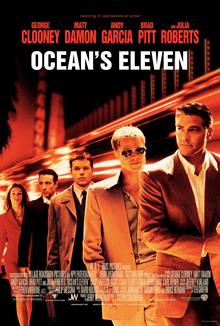
A remake of the 1960s Rat Pack film, Ocean’s 11, here is a film that can sit close beside The Sting. The thing with heists movies that a lot of other films don’t have to worry about is the “coolness” factor. Heists have to be cool, or the movies are boring and the audience doesn’t care. The stakes have to be personal and something above just getting rich, your leading ne’er-do-wells must be charming enough to overcome the fact that they’re thieves, and if you can make it look glamorous while doing it…well, that doesn’t hurt either. The modern day Newman and Redford, George Clooney and Brad Pitt, lead an all-star cast in this fast-paced, snappy, witty good time. They’re helped out by Matt Damon, Bernie Mac, Don Cheadle, Julia Roberts, Elliott Gould, Scott Caan, Casey Affleck, and Carl Reiner, as well as a cool villainous turn from Andy Garcia.
Danny gets out of prison four years after being arrested for his thieving ways. He meets up with his friend, Rusty, and the two of them travel to Las Vegas to meet with Reuben, a wealthy friend of theirs who will hopefully financially back their plan to rob three Vegas casinos: the Bellagio, the Mirage, and the MGM Grand. All three casinos happen to be owned and run by Terry Benedict, Reuben’s rival and Danny’s ex-wife’s new boyfriend. Danny and Rusty recruit their team and explain the heist: the casinos will be holding upwards of $150 million in an underground vault on the night of a well-publicized prize fight. The team survey the casinos to understand how they operate and acquaint themselves with the habits of the staff. They also build a replica of the vault to practice the heist. One of the other con men, Linus, is the one who discovers that Benedict is dating Danny’s ex, Tess, and Rusty confronts him about it, fearing that his personal motives will get in the way of the job. Danny convinces him it won’t, but soon after, he runs into Tess and Benedict, and the three carry on a brief conversation, but alert to Danny’s history, Benedict bans him from the casinos. The next day, the day the heist is to go down, Danny enters the Bellagio and is immediately detained in a room where he is to be beaten by the Bellagio strong man, Bruiser. The rest of the crew begins the heist.
Again, I have to cut it short to avoid spoiling anything. Ocean’s Eleven surpasses all other heist films (including the original) in it’s level of “coolness”. From the lights of Vegas, to the atmosphere of the casinos, to the bossa nova soundtrack, Ocean’s Eleven skyrockets to the top like the Fountains of Bellagio. The script is smart and quick, and the film shines amber like you’re watching it through a glass of cognac. Ocean’s Eleven was surprisingly successful when released in 2001, sandwiched between Harry Potter and the Sorcerer’s Stone and The Lord of the Rings: The Fellowship of the Ring, so much so that it spawned two likewise acclaimed sequels and an all-female lead reboot. Despite its modernity, the film has a lasting and universal appeal, and hopefully we eventually see more movies like this before long.
 Destined for Mediocrity