Braveheart is retroactively viewed as one of the worst critically-acclaimed films ever. Much scorn and critical analysis has been given to the historical inaccuracies of the film and the film’s value has slowly deteriorated because of it. Not to mention Mel Gibson’s public issues, which have also contributed to a negative view of the film. I’m gonna say, some of the criticism is warranted, especially for the crimes of emotional manipulation and portraying Edward Longshanks as cartoonishly evil. However, I would argue that if the film is done right, these negativities have little-to-no effect on the finished product and a movie about a historical figure can be enjoyable without being accurate. And in fact, accuracy should have no power to determine whether a movie is good or not. Anyway, back to Braveheart.
The King of England, Edward Longshanks, conquers Scotland and kills many of the nobles under the guise of a meeting to discuss the future of the country. A young William Wallace loses both his father and his brother in battle with the English, and he is taken by his uncle, Argyll, to be raised. Over time, the English reign over Scotland grows significantly more tyrannical. Longshanks marries his effeminate son to the French princess, Isabelle, and grants his lords in Scotland the right to “jus primae noctis”. Wallace returns home and secretly marries his childhood sweetheart, Murron. However, after he saves her from being defiled by an English soldier, she is captured and killed to lure Wallace out. It works, but Wallace is prepared and leads a rebellion, killing the entire English garrison there. While Longshanks is off campaigning through France, Wallace defeats an army at Stirling and sacks York, and also befriends Robert the Bruce (who is after the Scottish kingship). Longshanks returns and sends Isabelle to meet with Wallace and distract him. Instead, she falls in love with him and warns him of Longshanks plans. At Falkirk, Wallace is betrayed by two noblemen, Mornay and Lochlan, as well as Robert the Bruce, and his army is overwhelmed. Robert, however, helps Wallace escape and vows to never be on the wrong side again. William Wallace kills Mornay and Lochlan for their betrayal, but when he is invited to meet with Robert in Edinburgh, he is betrayed and captured. Robert discovers it was his father’s doing and disowns him. Wallace is taken to England, and even though Longshanks is on his deathbed, he still demands Wallace’s torture and execution. Wallace is stretched with rope and disemboweled, but still refuses to beg for mercy despite the magistrate’s promise of a quick death. Instead, Wallace screams for freedom and is beheaded. He dies watching an image of Murron in the crowd. Robert the Bruce is granted the Scottish crown and pleads with his army at Bannockburn to fight with him as they did with Wallace.
The script for Braveheart, which is written by Randall Wallace (no relation), is powerful and intense. Mel Gibson’s directing and acting (always a dangerous combination if you want to avoid accusations of ego) are both superb. Gibson as Wallace is convincing and strong, but not without feeling. As a director, his attention to the action of the battle scenes and his love for the Scottish landscape keep the film exciting and beautiful. The soundtrack from James Horner is epic. The film is based on an equally historically-inaccurate poem, The Actes and Deidis of the Illustre and Vallyeant Campioun Schir William Wallace (The Acts and Deeds of the Illustrious and Valiant Champion Sir William Wallace) – a story so popular that its printing in Scotland was second only to the Bible for hundreds of years following its release. It just goes to show that nothing can get in the way of a good story.
Bonus Review: The Patriot
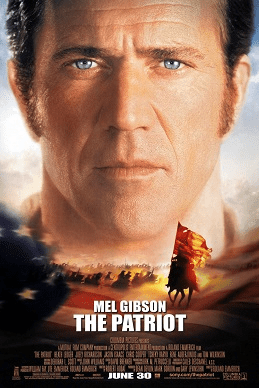
Here’s another plate of historical inaccuracy courtesy of Mel Gibson and the guy who made Independence Day – you know, that movie where aliens attack the world on the 4th of July. The Patriot is the ultimate “America, F*** Yeah!” movie, for better or worse. As with Braveheart five years before it, The Patriot makes the villainous British absolutely monstrous and one-dimensional while their victims (in this case, the United States) are completely innocent and unequivocally good…despite some vague atrocities during the French and Indian War that get swept under the rug. Also like Braveheart, The Patriot follows one man on the “victim” side of the conflict, who just wants to live in peace, but when someone close to him dies, he takes his revenge and sparks a rebellion in the process. And also, it’s a lot of fun.
Benjamin Martin is a widower with seven kids who is called up to Charleston to vote in support of the Continental Army. Martin abstains because he doesn’t want to send others to fight in a conflict he himself will not fight in. The vote passes anyway, and Gabriel, Martin’s eldest son, joins the army despite Benjamin’s protests. Two year later, Charleston is taken over by the British, and Gabriel, now wounded, returns home with rebel dispatches in hand. The Martin family cares for Gabriel as well as other American and British soldiers nearby, but when British Colonel William Tavington arrives, he arrests Gabriel, intending to hang him, and orders the Martin house burned and the American wounded killed. Thomas, another of Benjamin’s sons, tries to free Gabriel and is killed by Tavington for it. Benjamin and his two younger sons ambush the convoy carrying Gabriel and Benjamin brutally kills all but one of the British soldiers so he can go tell Tavington what has happened. Benjamin leaves his children with his sister-in-law, Charlotte, and joins the rebels with Gabriel. Benjamin’s commanding officer, Harry, tasks him with raising a militia intending to use guerrilla warfare to weaken Cornwallis’ army. Benjamin leads his militia with fervor, ambushing British caravans and stealing the supplies, as well as burning bridges Cornwallis intends to use. Cornwallis gives Tavington permission to do whatever it takes to arrest Benjamin. Tavington raids a town that is known to help the militia and gathers the entire town into the church, where he has it barricaded and burned with them inside, including Gabriel’s new bride, Anna. Enraged, Gabriel and some of the other soldiers attack Tavington’s encampment, but they are killed. Benjamin considers deserting the cause, but is reminded of Gabriel’s dedication. He and his militia join the Continental Army at the Battle of Cowpens, where he and Tavington face off. Though injured, Benjamin and the Continental Army are victorious, causing Cornwallis to retreat. Cornwallis is eventually besieged at Yorktown.
So, this movie gets a lot of flack for a supposed anti-British sentiment. Tavington burns buildings left and right and also shoots and kills a child with absolutely zero remorse, so the criticism is fair, but the film is obviously meant to be sheer entertainment. There’s no underlying messages at work here. Tavington is the only completely cold-hearted Brit in the film and he’s not even a real person. Yes, supposedly there is a couple of British officers who were inspiration for the character, just like for Benjamin Martin, but that separation between fiction and reality prevents the film from being overtly anti-British. However, any American-produced movie about the Revolutionary War is going to be in some capacity anti-British, right? If you want accuracy, read a textbook. If you want something fun to watch, you could much worse than Braveheart or The Patriot.
 Destined for Mediocrity