I can only think of two films that are so revered for their thrilling twists that people agree they are the spitting image of a Hitchcock film: Charade and Diabolique (or Les Diaboliques, the true French title). Diabolique actually has the distinction of nearly being made by Hitchcock. The story goes that Henri-Georges Clouzot was given the novel that was the basis for Diabolique (She Who Was No More) by his wife, Vera Clouzot, and was so engrossed in its story that he stayed up one night and read the entire thing. Early the next morning, he called and bought the rights to adapt it. The story also goes that Alfred Hitchcock was denied the rights to the book when he called only a few hours later. Both filmmakers took the comparisons in stride, however, with Clouzot admitting to being an admirer of Hitchcock and took it as a sign of success whenever such a comparison was made, and Hitchcock used Diabolique as a source of inspiration when making Psycho.
Michel runs a boarding school with an iron fist. He is horrible to the students, mocks the frailty of his wife, Christina, due to a heart condition, and both beats his mistress, Nicole, and parade her in front of his wife. Surprisingly, Christina and Nicole develop a close bond over their mutual hatred for Michel. Nicole comes up with a plan to murder Michel and coerces Christina to help her. They get Michel over to Nicole’s apartment, sedate him and drown him in the bathtub. They return his body to the school and throw him in the pool to make it look like an accident. However, the body does not float back to the top. The next day, the pool is drained, and still there is no body. Many strange happenings worsen Christina’s heart condition. First, the suit Michel wore on the day he was drowned is returned from the dry cleaners. Then, a boy who is raking leaves outside the school yard tells Christina that Michel told him to do it as punishment for breaking a window. Finally, a photo is taken of the school and Michel’s ghost appears in one of the windows. Christina’s condition is worsened to the point of being confined to her bed. But even in bed, she hears strange noises all around her.
To go any further with a film description would be to do you a disservice. If you have not seen the film, I implore you to do so and to go in without any more knowledge of the film’s events beforehand. I wish to respect the words that appear over the end credits of the film. Translated, it reads, “Don’t be Diabolical! Do not destroy the interest your friends may have in this movie. Do not tell them what you have seen. Thank you, on their behalf.” Diabolique is actually one of the first films to use this sort of anti-spoiler messaging during the movie – another thing that inspired Hitchcock for an intense marketing campaign for Psycho. If you have any interest in a great thriller (with some elements of horror) with beautifully conceived twists, please watch this movie. Enjoy what has been referred to as the original “twist ending which forces you to reassess everything you thought you had been told earlier in the film.”
Bonus Review: Rope
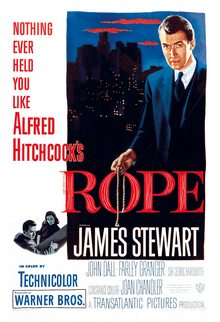
Speaking of Hitchcock, one of his better films that I feel is increasingly underappreciated is Rope. Rope is based on a play, which was inspired by the very real crime committed by Nathan Leopold and Richard Loeb. On May 21, 1924, while Leopold and Loeb were still students at the University of Chicago, they attempted to pull off the perfect crime – kidnap and kill 14-year-old Bobby Franks and send the family and authorities on a complex wild goose chase with an extended ransom arrangement. The two young men – they were 19 and 18 when committing this crime – were inspired by the writings of Friedrich Nietzsche and his concept of some humans being superior to others based solely on intellect, the “Beyond-Man” or “Ubermensch”, and wanted to test themselves. However, a pair of glasses was found at the scene of the crime that were fitted with an unusual hinge, which narrowed the police’s search to just three individuals in the Chicago area…Leopold being one of them. Ubermenschen, these boys were not.
The film was rather experimental for Hitchcock. He intended to film in as few takes as possible and extended scenes to the length of a roll of film (which, at the time, was only about 10 minutes). To make the film look like one continuous shot, the camera movement had to be choreographed extensively and it also had to be given opportunities to cut without the audience noticing. This was accomplished by the camera ending and beginning shots zoomed in on actor’s black suits or behind an overly-shadowed piece of furniture. James Stewart was particularly incensed by the technique and complained that the camera was being given more attention than the actors. Years later, he calmed down a tad on his opinion, but still claimed it was an experiment that just didn’t work.
Brandon and Phillip are two young men who have taken the teachings of their professor, Rupert, over Nietzsche’s theories to heart. They decide to murder one of their schoolmates, David, in their apartment and hide the body in a chest before inviting David’s closest friends and family to a dinner party. They also invite Rupert. At the party, David’s absence is noted and conversation about his whereabouts and the possibility of murder is encouraged by Brandon. Phillip, on the other hand, keeps to himself, drinking heavily. The food is laid out, buffet-style, on the chest containing David’s body. It is mentioned over dinner that Phillip has a knack for strangling chickens, which he vehemently denies. This, along with several other peculiarities over the course of dinner, make Rupert suspicious (he has witnessed Phillip strangling chickens before), and so he questions him. The conversation at the dinner table increasingly turn to David’s absence from the party and when David’s mother calls the apartment (she did not attend due to an illness) to see if David has turned up, David’s father decides to leave. The party quickly peters out, and everyone leaves. Rupert, on his way out, is given the wrong hat. The hat in his hands is monogrammed with David’s initials, further increasing his suspicions. He returns to the apartment and questions Brandon and Phillip again, demanding to look in the chest. Seeing David’s body, Rupert wrestles a gun from Phillip and fires two shots out the apartment window to alert the police.
 Destined for Mediocrity