Studio Ghibli is world cinema’s greatest contribution to animation. Since the rise of foreign animation in the early 2000s, Studio Ghibli has been competition for American animation, specifically Disney, and has been critically revered for more adult thematic material. One of the top animators/filmmakers for the company, Hayao Miyazaki, has basically confirmed this intention. Miyazaki’s own work started off with a younger audience in mind. Movies like Castle in the Sky, My Neighbor Totoro and Kiki’s Delivery Service are all definitely children’s films. However, even they deal with somewhat mature themes (there’s an intentionally ambiguous plot line in My Neighbor Totoro that implies that the two main characters’ mother is dying). But, even Miyazaki’s first original film, Nausicaa of the Valley of the Wind, is considerably more adult than its contemporaries.
Princess Mononoke is similarly more adult in nature. It deals with more adult concepts such as environmentalism, and also plays on the ambiguity of its characters. There are no clear heroes or villains, outside of the main character, Ashitaka. It also deals with distinctly Japanese themes, as the story is formed around a medieval Japan and deals with forest spirits and gods associated with the Shinto religion. Because of this, I certainly wouldn’t recommend the film to anyone under the age of a teenager. However, for the age appropriate, there isn’t a better film to showcase what possibilities animation as film is capable of.
The film begins with a village under attack by a large, squiggly demon. The village’s own Ashitaka successfully kills it before it does too much harm, but before it dies, the demon curses Ashitaka by grabbing his arm. The curse is painful and will eventually kill him, but in the meantime, his arm has superhuman strength. As the demon dies, the curse slowly melts away from its body, revealing that it was a boar god corrupted by a bullet in its skin. Ashitaka is shunned from his village because of his curse, but is told he might could find a cure in the land to the west. Ashitaka meets up with a caravan led by the leader of nearby Iron Town, Lady Eboshi, but is soon interrupted by an attack by a wolf goddess. With the wolf goddess is a young woman named San. In the attack, two men fall of a cliff side, but Ashitaka saves them and has to carry them back to Iron Town. He carries them through the forest and while there, he glimpses the Great Forest Spirit, who has taken the form of a giant deer. Ashitaka and the two men arrive in Iron Town – a city built in the middle of the forest to mine the iron there in order to make weapons. It is also home to outcasts and lepers, as Lady Eboshi deeply cares for the people who cannot help themselves. Eboshi freely admits to shooting the boar god, turning him into a demon, and also lets Ashitaka know that San was raised by wolves and hates humankind.
That very night, San infiltrates Iron Town to kill Eboshi, but Ashitaka intervenes, subduing both of them, and carries San out of the town, though he is shot by one of Iron Town’s citizens. When San wakes up, Ashitaka is in a weakened state and so she sees her chance to kill him, but she witnesses the Great Forest Spirit remove Ashitaka’s bullet and heal him, and so decides to trust Ashitaka. Eboshi decides to find and take the head of the Great Forest Spirit, thinking if she gifts it to the Emperor, he will grant her protection from her enemies. A battle ensues between the wolves, the boars and Eboshi’s fighters. At night, the Great Forest Spirit becomes a giant nightwalker, but mid-transformation, Eboshi decapitates it. They make off with the head, and the body continues to grow and walks around in search of its head. As it does so, its neck oozes blood that kills everything it touches and the forest starts to die. Ashitaka and San take back the head and return it to the Great Forest Spirit, effectively healing the land and Ashitaka’s curse. As all is restored, Eboshi decides to rebuild Iron Town elsewhere and San returns to her forest home.
Bonus Review: The Breadwinner
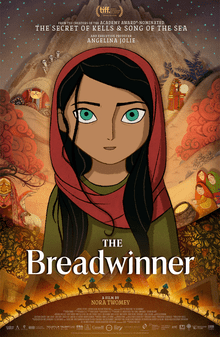
Ireland’s Cartoon Saloon is a steadily growing animation studio known mostly for a trio of Irish-themed films: The Secret of Kells, Song of the Sea, and Wolfwalkers. However, in 2017, they also took on The Breadwinner, a story of a young girl in Afghanistan based on the book of the same name. Much like the acclaimed work from Studio Ghibli, The Breadwinner is a story of children but with very adult themes, particularly the violent nature of the Taliban and the difficulties of womanhood in an Islamic state.
Parvana is an 11-year-old girl in Kabul just as the War on Terror is beginning. She lives with her father, Nurullah, and mother, Fattema, as well as her two sisters and baby brother. One day, Nurullah is arrested because a young Taliban jerk felt slighted by him in the market. With Nurullah arrested, Parvana’s family is unable to provide for themselves since the Taliban forbids women to go outside without a male relative. Parvana and Fattema try to go to the prison to appeal Nurullah’s arrest, but Fattema is severely beaten and threatened to be arrested if she returns out without a male relative. Parvana comforts her baby brother by telling him a story of a boy who seeks out the Elephant King to take back his village’s seeds so they can grow things.
To circumvent the Taliban’s rule, Parvana cuts her hair and wears boy clothes so she can pass for the family’s nephew, Aatish. Her plan works and so is able to provide for her family. She is told that she might be able to bribe a guard to see her father again, so she takes on hard labor jobs in an attempt to earn extra money for a bribe. She also befriends an illiterate man named Razaq, who asks Parvana to read a letter he received claiming his wife was killed by a land mine. Meanwhile, Fattema writes a letter to a relative outside of Kabul, offering her eldest daughter’s hand in marriage in exchange for the family’s protection. When Parvana comes home, Fattema forbids her from going out as a boy anymore as their relatives will be there the next day to pick them up. Parvana demands the chance to see Nurullah to let him know where they’re going. However, while she’s away, Fattema’s cousin arrives early to take them away, and demands they leave Parvana behind since the war is starting and soon there will be no way out of the city. Fattema stands up to her cousin, so the cousin leaves the family on the side of the road. Razaq helps Parvana find her father and bring him out of the prison after she reveals her true identity, and as they escape, Parvana witnesses some of the weaker prisoners being executed. She returns home with her father and the family is reunited.
 Destined for Mediocrity