Erich Maria Remarque was a German man who fought in World War I for the Imperial Army. Like most veterans, he returned to his home shellshocked and completely disgusted with the nature of war. He turned his time in the War into the novel All Quiet on the Western Front – one of the first examples of a veteran writing about conflict. All Quiet on the Western Front was released in 1929, and just four years later, in 1933, Joseph Goebbels, the minister of Nazi propaganda, declared Remarque’s books as unpatriotic and banned them from the country. Remarque took the opportunity to get out of Germany just as World War II was ramping up in earnest. Over the course of his life after coming to America, he continued writing novels set in wartime, much to Germany’s dismay. Remarque’s sister, Elfriede Scholz, remained in Germany with her husband and children and was arrested by the Nazis and accused of undermining morale. However, a comment made by the judge at her trial hints at an ulterior motive for the arrest, saying, “Your brother is unfortunately beyond our reach – you, however, will not escape us.” She was beheaded in December 1943. Remarque was not notified until World War II had ended. Think this little history lesson is too depressing for a film review? Wait until we get to the movie.
Through encouragement at school, several young German men decide to enlist in the army to help the war effort. They are, however, quickly disillusioned to the Great War between their time in bootcamp and their venture to the front lines. The veterans already positioned there are unwelcoming and the constant bombardment rakes against their nerves. When they attempt to gain ground against the French, the casualties are so numerous that they can afford a double-helping of rations at the end of the day. One of the young men, Paul, successfully stabs a French soldier behind enemy lines, but is forced to hide in a shell-hole with his dying enemy. He breaks down and tries to help the man, but when that is unsuccessful, he begs him for forgiveness. Paul is later wounded behind enemy lines and is sent to an infirmary that is notorious for a low survival rate. He makes a speedy recovery, but his fellow soldier, Albert, must have his leg amputated. Paul is allowed to visit home and is taken aback by how ignorant and optimistic everyone is regarding the war effort. He returns to his old schoolroom and is allowed to share his experience so far, but he instead expresses his disillusionment, causing the students to label him a “coward”. Paul is disgusted by everyone’s unabashed excitement about the war and returns to the front lines to be with those who knows what he’s going through. However, upon his return, most of his troop has been replaced with newer and younger recruits. He learns that most of his comrades have died. One of the few who remain, Kat, is killed by an explosion while in Paul’s arms. While hiding behind the sandbags on the frontline, Paul sees a butterfly floating nearby. He reaches out to the butterfly and is shot and killed by an enemy sniper. He falls back and dies, and the butterfly floats mere inches from his hand.
War is somewhat a catch-22 (hmm…I wonder if there’s a book about this topic). Those who instigate don’t fight in it and those who do fight in the war have to be manipulated into doing so (at least in America where, outside of a draft, no one is required to join the cause) because if the army were upfront about the nature of war, no one would volunteer. I’m not so anti-war that I don’t understand the pros to it (overcoming an oppressor, helping someone else overcome their oppressor, maintaining balance), but even more so, I understand and believe that if those in power weren’t so greedy and power-hungry, then less wars would occur and that would certainly be ideal. A lot of times, we are blinded by a sense of patriotism – which is typically encouraged heavily by the government, so I cut the everyman a break on it – that joining the effort is a personal source of pride and glory. However, that same everyman is the one who is forgotten and left out in the cold. If you want proof of how America feels about those who fight for their country, take a look at the state of their veterans programs. All Quiet on the Western Front was dismissed as unpatriotic upon its release, and I can certainly see some folks reading this coming to the same conclusion, but All Quiet on the Western Front is a beautiful film and an important story, because it does not forget the everyman.
Bonus Review: 1917
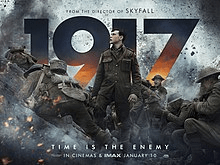
World War I doesn’t get as much attention in film as World War II does. The only reason I can think of for this is the fact that film as a medium was less established at the time of World War I. Also (I guess there’s two reasons), the patriotic spirit within the film industry during World War II meant that movies of a patriotic nature were being churned out like the offspring of rabbits. It’s kind of sad, honestly, because World War II feels much more similar to our modern way of warfare but World War I has a foot in both the modern and the primitive.
British reconnaissance has discovered that the German forces who have seemingly retreated from fighting France are now in a position to ambush the British with artillery. Two corporals, Blake and Schofield, are instructed to travel into dangerous territory to relay the message to the troops that are scheduled to attack the next morning. Blake and Schofield cross no man’s land and get to the now-abandoned German trenches where an explosive boobytrap has been laid. The two survive, though Schofield does get injured, and they continue on to a farmhouse. There, they see a German plane get shot down and it lands near the farmhouse. Blake insists on rescuing the pilot and so they do, and Blake tells Schofield to get the man some water. While Schofield is away, the pilot awakens and stabs Blake. Schofield returns in time to shoot the pilot and comfort Blake as he dies. Schofield makes it to a town that seems abandoned, but he is soon under sniper fire, and the two have a shootout. Schofield kills the sniper, but he is hit by a bullet to the helmet, knocking him unconscious. When he wakes up, it is now night before the morning’s attack. The town is now overrun with German soldiers and so Schofield must now sneak his way out of it, but this is unsuccessful. He kills a German soldier and runs from several others, jumping into a river as the early morning light shines through. The river leads to a waterfall, which Schofield survives falling from, and when he reaches the bank, he is in the midst of the last wave of British soldiers of the scheduled attack. He tries to make his way to the colonel, but the trenches are too crowded, so Schofield goes up to the battlefield and sprints along the trenches as the infantry begins its charge. He makes it to the colonel, giving him the message, and the colonel calls off the attack. Schofield was earlier informed that Blake’s brother would be in this group and so he seeks him to tell him his brother is dead and to give him his dog tag. Schofield is given his permission to write their mother a letter about Blake’s bravery.
Sam Mendes, the director, wanted to write a film about the exploits of his grandfather during the War and so began his work on 1917. And in doing so, he made a film about the dangers that even simply carrying a message can entail. It’s the ultimate wartime Everyman. Mendes also, to give the film a sense of urgency (the mission has to be completed in less than 24 hours), constructed the camera work to appear as if it’s made up of only two shots, the break being when Schofield is knocked unconscious and the screen goes black. This required extensive choreography for the camera to follow the main action and the extras to work around it. The film is impressively shot, and the scene where Schofield runs along the trenches as the infantry comes over the top for their charge will surely be considered an iconic scene of cinema in the near future.
 Destined for Mediocrity