25. Saving Private Ryan

Is Saving Private Ryan the greatest war film of all time? With the slight exception of a less combat-based comedy, absolutely it is. More care and attention to detail was put into this movie than most movies get in general – even more so than most war films (explosion fests, shoot ‘em ups, etc.) get. The opening recreation of D-Day alone is so carefully executed, that it gave veterans who went to screenings PTSD. It also single-handedly changed how combat was filmed for war films and epics. No, seriously. Compare any battle scene filmed after Saving Private Ryan came out in 1998, and see for yourself. The jerky handheld-camera movement, the soldier POV, the choreography – it’s all that’s done anymore. Other details, such as the patches on soldiers’ uniforms and ways they would prepare their rifles, it’s all considered incredibly authentic. Steven Spielberg and Tom Hanks’ love of World War II history is what makes the film such a loving tribute to those who sacrificed everything for their country.

Captain John Miller leads a team of soldiers behind German lines after they storm Omaha Beach to secure a victory as part of the Normandy invasion. The U.S. Department of War receives word that of the four Ryan brothers who enlisted, three have been killed in action, and the one who may be alive is considered missing. Miller and his band of brothers are tasked with finding Ryan and bringing him home so his mother can be spared any more heartache. The group thinks they have found Ryan, but it turns out to be a different Ryan with a similar first and middle name. The group makes their way to a rallying point where a soldier, now nearly deaf, claims to know where Ryan is…Ramelle, a town with a bridge that needs defending. Along the way, they lose some of their soldiers, making the survivors question if their mission is worth it. They do find Ryan in Ramelle, but he refuses to leave his men, believing he has no more right than anyone else to leave. Miller and his men stay and help defend the bridge, but all but two of the original company die in battle with the Germans. As Miller himself dies, he whispers to Ryan “earn this”. Decades later, an elderly Ryan stands at Miller’s grave as he reminisces.

Saving Private Ryan notoriously lost the big prize at the Academy Awards to Shakespeare in Love – a rom-com framed around the writing and performing Romeo and Juliet. I really enjoyed Shakespeare in Love, personally, but it pales in comparison to the writing, camera work, story and lasting impact that Saving Private Ryan has. When we think about all the sacrifices soldiers make – the time and energy to get in shape for combat as well as all they have to carry on a daily basis, the time spent away from family, the mental wrestling with the morality and depravity of what they witness in combat, the physical and mental toll of stressful warfare, and the willingness to die if necessary – it doesn’t seem right to just make action films with tons of explosions and shooting to tell their stories. There should be honor and appreciation behind these stories, and if no other movie does it justice, at least Saving Private Ryan delivers.

Bonus Review: Hacksaw Ridge

In the past, I’ve talked about my deep love for the film, Sergeant York. It’s a wonderful film about a religious man who fights in World War I despite his moral objections. In the film (not sure about the real life York), he originally refuses to fight, but eventually justifies it, saying by killing those running machine guns, he was saving the lives of countless others. Yeah, maybe. But Desmond Doss (the real man and the man Hacksaw Ridge is about) staunchly refuses to fight when in the same position. Instead, his compromise (if you can even call it that) is to be a medic. He will serve his country by taking care of the ones who do fight.

Desmond Doss is drafted to fight in World War II, but his Christian morals prevent him from taking the life of another man. His goal is to become a medic so that he can comply with his country’s demands and stick to his moral code. His seeming self-righteousness makes him several enemies among his fellow soldiers, but he sticks to his beliefs in the face of such adversity and ends up saving those who hated him. He becomes a hero. It’s a little simple and straightforward, and most of the conflict is manufactured, but that doesn’t detract from what makes it great. The movie is a testament to unrelenting faith and a lack of compromise when trials come. It’s also a story of not just a general soldier, but a very specific, very honorable one.

26. Django Unchained

By the time I watched Django Unchained, I was already a fan of Quentin Tarantino. His movies were the very definition of “cool”, and he remains a pillar of influence on college dorm posters the world over. Since Django Unchained was released, I have somewhat cooled on my opinion of Tarantino. I still like his work, and I believe he mostly improves as time goes on, but his obsession with 60s and 70s films, particularly Spaghetti Westerns, Blaxploitation, and Kung Fu films, has perhaps run its course as far as his homage-focused style of filmmaking. Having said that, Django Unchained is arguably the greatest use of all those influences, even when it overdoes it. The movie’s title is a send up Sergio Corbucci’s Django for crying out loud! It gets a lot of side-eyes because it’s a film about slavery that puts slavery in the backseat, but because the slavery isn’t the focus of the film and more of a background, the incredible violence, humor and genre-bending mostly gets a pass.

A German bounty hunter/dentist named Dr. King Schultz (Christoph Waltz) seeks to purchase a slave named Django (Jamie Foxx) because he should recognize the faces of his next big bounty, the Brittle Brothers. The deal is, if Django can point them out to Schultz, then Django is a free man. As they track down the Brittles, Schultz gives Django the opportunity to learn to shoot and read, where he proves to be a natural at both. After they successfully kill the Brittle Brothers, Schultz learns that Django was married to a house slave named Broomhilda (Kerry Washington) before they were sold separately and is determined to reunite them. They discover Broomhilda or “Hildi” is a slave at the plantation of Calvin Candie (Leonardo DiCaprio), and come up with a ruse to get Candie to sell Hildi to Schultz by acting interested in one of Candie’s fighting slaves and adding Hildi to the transaction. The main house servant, Stephen (Samuel L. Jackson), discovers the nature of Django and Hildi’s relationship, and alerts Candie who doesn’t appreciate being lied to. Multiple gunfights ensue and it’s going to require all of Django’s wit to get out of Candie’s plantation with Hildi alive.

Christoph Waltz typically gets most of the praise here for his performance Dr. King Schultz, and rightfully so. He’s quick and funny. His introduction is one of the best 10-minute segments of film ever. Schultz is the most entertaining and bombastic part of the movie, so much so that Will Smith, who was originally offered the role of Django, declined it because it “wasn’t the lead”. I disagree with his takeaway, but there’s merit to it to be sure. Jamie Foxx does a superb job with Django, portraying his change from innocent and unknowing slave to aggressive and sly bounty hunter perfectly. Foxx, who is kind of a chameleon when it comes to his performing, is the best person for the job and he takes the reins with familiarity and assurance. A cavalcade of colorful caricatures make for a surprisingly laugh-out-loud experience. It’s rare that a movie can so easily jump between comedy and surreal violence. But even that violence is comical. At least the violence against the slave owners is. The violence against slaves is brutal and without a wink from the director, which is certainly for the best.

The controversy surrounding the film is two-fold: the onscreen violence is so ridiculous that it is considered by some as a mockery of the real violence that happened in that era, and the constant use of the “N-word”, which can be a valid criticism in some other Tarantino films, but I honestly don’t understand how that can be a criticism of a movie set during the 1800s American South. Nevertheless, I mention these two things because for some viewers, it’s best not to go in blind. Quentin Tarantino is not for everybody. I’m well aware of that, but if you can look past his overindulgences, you can find a charming, action-packed, and surprisingly hilarious send up to Spaghetti Westerns in here. The movie has intensity and swagger, and a multitude of well-defined characters in spades. Django Unchained is one for the ages.

Bonus Review: Once Upon a Time in the West

Sergio Leone decided to retire from making Westerns after his Dollars Trilogy (A Fistful of Dollars, For a Few Dollars More, and The Good, the Bad, and the Ugly), and so he went to work on another epic, Once Upon a Time in America, which would not come to fruition until the mid 80s. In the meantime, he was given a massive budget from Paramount Pictures and the use of Henry Fonda (Leone’s favorite actor whom he had always wanted to work with) if he would tackle another Western. Thus, we got Once Upon a Time in the West. In a rare twist, Fonda was cast as the villain of the story, Frank. Fonda was originally reluctant to play the villain, but was convinced by talking to Eli Wallach, who worked on The Good, the Bad and the Ugly, and a pitch from Leone himself regarding using Fonda’s celebrity against the audience. Charles Bronson plays the closest thing to a good guy, “Harmonica”. Unusual for the Leone films that came before it, Once Upon a Time in the West is slow and sparse with dialogue, building tension slowly until sudden bursts of violence occur. The reasoning for this that Leone gave was that he was not interested in violence, he was instead interested in the setup before such violence happens. An emphasis on the calm before the storm. The film dwells in that lull.

A train arrives in town and a man with a harmonica is cornered by three men. He guns all of them down quickly and walks away. The three men work for Frank, an outlaw working for the railroad tycoon, Morton, and is trying to acquire land owned by Brett McBain. Frank kills McBain and his children at their ranch, and leaves evidence to frame another outlaw called Cheyenne. McBain’s new bride, Jill, who gets off the train, is now the sole heir to the ranch. Morton and Frank cut ties because Morton only wanted Frank to intimidate McBain, but Frank wants the land for himself. Harmonica connects with Jill and Cheyenne and discovers Frank’s connection to Morton. He rescues Frank from being gunned down in an ambush. Frank proceeds to intimidate Jill into giving up the land. Eventually, Frank and Harmonica meet at the ranch (with Cheyenne and Jill inside the house) and proceed to have a standoff. In a flashback, Harmonica is revealed to be the younger brother of a man who Frank had previously hanged. Harmonica was forced as a boy to use his shoulders for his brother to stand on just to live a little while longer. Frank placed a harmonica in his mouth and walked away. Back in the present, Harmonica is the faster draw and guns Frank down. Frank, as he dies, asks for Harmonica’s real identity. Harmonica places the harmonica in Frank’s mouth to remind him, and then Frank dies. Jill begs Harmonica to stay, but Harmonica carries Cheyenne (who has been wounded) away.

Once Upon a Time in the West is an interesting film. It’s considered a masterpiece in its own right, but its scenes are made up of references to other Westerns. Leone asked for help from Dario Argento and Bernardo Bertolucci in writing the script, and the way they went about it was by watching older Westerns together and writing down their favorite scenes. A list of the films Once Upon a Time in the West references includes The Iron Horse, Duel in the Sun, Winchester ‘73, Shane, Johnny Guitar, The Searchers, The Comancheros, The Man Who Shot Liberty Valance, and The Last Sunset (the ending fight between Frank and Harmonica is almost a shot-for-shot replica of the gunfight in this film). The scenes that were referenced mostly replace the meaning in a way to give Once Upon a Time in the West a very ironic feel. Despite the pacing, this movie is exciting and brimming with life.

27. The Sting

The Sting is one of those rare instances in movie-making where everything just clicks together effortlessly: the performances of the two leads, the ragtime score, the attention to detail and passion for the big con, as well as simple but thorough direction, and a decidedly cheeky aesthetic. Director George Roy Hill was an eccentric filmmaker to say the least, but he knew how to give audiences what they wanted, and maybe even some things they didn’t even know they wanted. He reteams with Paul Newman and Robert Redford, who he previously directed in Butch Cassidy and the Sundance Kid, but this time, instead of making a thought-provoking and methodical Western, he throws everything away except the method for a fun, endearing caper. A lot of the movie rests on Newman and Redford’s ability to sell it to you, and they succeed with an air of indifference. No wonder they made such a dynamic duo. The film divides itself into chapters and uses title cards that are painted in the style of the Saturday Evening Post to round out the charm and authenticity to the time period where our story takes place.

Johnny Hooker, along with his partners, Luther and Joe, con a man out of $11,000. Hooker immediately loses his share of the money in a roulette game, and Luther decides to retire. The corrupt police lieutenant, who is on the payroll of crime boss, Doyle Lonnegan (who was the owner though not the carrier of the $11,000), shoots and kills Luther while Johnny narrowly escapes to Chicago. Johnny finds a man Luther recommended to him, Henry Gondorff, and invokes his help in taking down Lonnegan. Henry assembles a team of con artists and together they plan to use “the wire” – a now-defunct con that requires an elaborate setup and significant manpower to create and operate a fake horse-betting operation. It is revealed that Lonnegan is now in Chicago and Henry warns Johnny that if he’s caught, he’s on his own. Henry poses as a bookie named “Shaw” and enters Lonnegan’s high-stakes poker game on board a train, irritating him and cheating him out of $15,000. Johnny plays “Kelly”, Shaw’s disgruntled employee who seeks Lonnegan’s help in taking over Shaw’s operation. The police lieutenant that shot Luther arrives, looking for Johnny, and his pursuit attracts the attention of FBI agent Polk, who wants Johnny captured to lure in Henry, his own target. To prove his worth, Johnny as “Kelly” provides Lonnegan with a 7-to-1 tip on a long shot that pays off. Lonnegan presses “Kelly” for more details as to how he had the 7-to-1 sewn up as well as the his plan to take down “Shaw”. “Kelly” claims to have a man named “Harmon” who works for Western Union who can help by past-posting the bets. Lonnegan agrees to go along with the plan after he is provided with the trifecta of another race, and offers a $500,000 bet to get revenge on “Shaw”.

With movies like this that are so naturally twisty, it’s hard to do the synopsis part, so I’m leaving my summary there, even though there is still so much more to discuss. It’s the sign of a great movie when you can’t see the twists coming but when they’re revealed, they make total sense. The Sting has about five or so such twists. It’s a lot to keep up with, but it’s well worth the time and attention given. What I love about a movie like The Sting is that it requires to sit there and watch it. If you leave it running for a bathroom break or you pull out your phone in the middle of it, you’re going to miss something important. That need for immersion is so rare in films these days, so it’s always exciting when you come across something like that. One final thought on The Sting: I mentioned the score before, but I want to briefly point out the power that movies can have in reviving interest in old or forgotten things. The score, which covers several Scott Joplin tunes, most notably “The Entertainer”, brought Joplin’s name back to public attention. By 1973, Scott Joplin was no longer a well-known figure in musical history. Ragtime wasn’t played anywhere except Jazz piano recitals. But the success of The Sting, and the popularity of that score, is in part why Scott Joplin remains a household name. This is not to take away from Joplin’s own fame or contributions to history, but sometimes people who deserve attention fall through the cracks, and if a movie can help rectify a gross oversight, then more power to it.

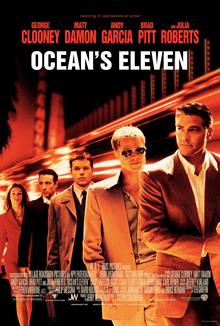
Bonus Review: Ocean’s Eleven

A remake of the 1960s Rat Pack film, Ocean’s 11, here is a film that can sit close beside The Sting. The thing with heists movies that a lot of other films don’t have to worry about is the “coolness” factor. Heists have to be cool, or the movies are boring and the audience doesn’t care. The stakes have to be personal and something above just getting rich, your leading ne’er-do-wells must be charming enough to overcome the fact that they’re thieves, and if you can make it look glamorous while doing it…well, that doesn’t hurt either. The modern day Newman and Redford, George Clooney and Brad Pitt, lead an all-star cast in this fast-paced, snappy, witty good time. They’re helped out by Matt Damon, Bernie Mac, Don Cheadle, Julia Roberts, Elliott Gould, Scott Caan, Casey Affleck, and Carl Reiner, as well as a cool villainous turn from Andy Garcia.

Danny gets out of prison four years after being arrested for his thieving ways. He meets up with his friend, Rusty, and the two of them travel to Las Vegas to meet with Reuben, a wealthy friend of theirs who will hopefully financially back their plan to rob three Vegas casinos: the Bellagio, the Mirage, and the MGM Grand. All three casinos happen to be owned and run by Terry Benedict, Reuben’s rival and Danny’s ex-wife’s new boyfriend. Danny and Rusty recruit their team and explain the heist: the casinos will be holding upwards of $150 million in an underground vault on the night of a well-publicized prize fight. The team survey the casinos to understand how they operate and acquaint themselves with the habits of the staff. They also build a replica of the vault to practice the heist. One of the other con men, Linus, is the one who discovers that Benedict is dating Danny’s ex, Tess, and Rusty confronts him about it, fearing that his personal motives will get in the way of the job. Danny convinces him it won’t, but soon after, he runs into Tess and Benedict, and the three carry on a brief conversation, but alert to Danny’s history, Benedict bans him from the casinos. The next day, the day the heist is to go down, Danny enters the Bellagio and is immediately detained in a room where he is to be beaten by the Bellagio strong man, Bruiser. The rest of the crew begins the heist.

Again, I have to cut it short to avoid spoiling anything. Ocean’s Eleven surpasses all other heist films (including the original) in it’s level of “coolness”. From the lights of Vegas, to the atmosphere of the casinos, to the bossa nova soundtrack, Ocean’s Eleven skyrockets to the top like the Fountains of Bellagio. The script is smart and quick, and the film shines amber like you’re watching it through a glass of cognac. Ocean’s Eleven was surprisingly successful when released in 2001, sandwiched between Harry Potter and the Sorcerer’s Stone and The Lord of the Rings: The Fellowship of the Ring, so much so that it spawned two likewise acclaimed sequels and an all-female lead reboot. Despite its modernity, the film has a lasting and universal appeal, and hopefully we eventually see more movies like this before long.

28. Braveheart

Braveheart is retroactively viewed as one of the worst critically-acclaimed films ever. Much scorn and critical analysis has been given to the historical inaccuracies of the film and the film’s value has slowly deteriorated because of it. Not to mention Mel Gibson’s public issues, which have also contributed to a negative view of the film. I’m gonna say, some of the criticism is warranted, especially for the crimes of emotional manipulation and portraying Edward Longshanks as cartoonishly evil. However, I would argue that if the film is done right, these negativities have little-to-no effect on the finished product and a movie about a historical figure can be enjoyable without being accurate. And in fact, accuracy should have no power to determine whether a movie is good or not. Anyway, back to Braveheart.

The King of England, Edward Longshanks, conquers Scotland and kills many of the nobles under the guise of a meeting to discuss the future of the country. A young William Wallace loses both his father and his brother in battle with the English, and he is taken by his uncle, Argyll, to be raised. Over time, the English reign over Scotland grows significantly more tyrannical. Longshanks marries his effeminate son to the French princess, Isabelle, and grants his lords in Scotland the right to “jus primae noctis”. Wallace returns home and secretly marries his childhood sweetheart, Murron. However, after he saves her from being defiled by an English soldier, she is captured and killed to lure Wallace out. It works, but Wallace is prepared and leads a rebellion, killing the entire English garrison there. While Longshanks is off campaigning through France, Wallace defeats an army at Stirling and sacks York, and also befriends Robert the Bruce (who is after the Scottish kingship). Longshanks returns and sends Isabelle to meet with Wallace and distract him. Instead, she falls in love with him and warns him of Longshanks plans. At Falkirk, Wallace is betrayed by two noblemen, Mornay and Lochlan, as well as Robert the Bruce, and his army is overwhelmed. Robert, however, helps Wallace escape and vows to never be on the wrong side again. William Wallace kills Mornay and Lochlan for their betrayal, but when he is invited to meet with Robert in Edinburgh, he is betrayed and captured. Robert discovers it was his father’s doing and disowns him. Wallace is taken to England, and even though Longshanks is on his deathbed, he still demands Wallace’s torture and execution. Wallace is stretched with rope and disemboweled, but still refuses to beg for mercy despite the magistrate’s promise of a quick death. Instead, Wallace screams for freedom and is beheaded. He dies watching an image of Murron in the crowd. Robert the Bruce is granted the Scottish crown and pleads with his army at Bannockburn to fight with him as they did with Wallace.

The script for Braveheart, which is written by Randall Wallace (no relation), is powerful and intense. Mel Gibson’s directing and acting (always a dangerous combination if you want to avoid accusations of ego) are both superb. Gibson as Wallace is convincing and strong, but not without feeling. As a director, his attention to the action of the battle scenes and his love for the Scottish landscape keep the film exciting and beautiful. The soundtrack from James Horner is epic. The film is based on an equally historically-inaccurate poem, The Actes and Deidis of the Illustre and Vallyeant Campioun Schir William Wallace (The Acts and Deeds of the Illustrious and Valiant Champion Sir William Wallace) – a story so popular that its printing in Scotland was second only to the Bible for hundreds of years following its release. It just goes to show that nothing can get in the way of a good story.

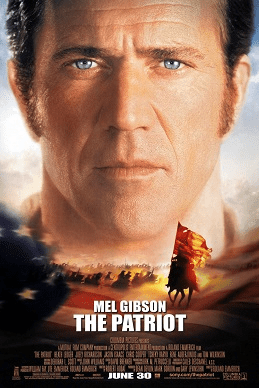
Bonus Review: The Patriot

Here’s another plate of historical inaccuracy courtesy of Mel Gibson and the guy who made Independence Day – you know, that movie where aliens attack the world on the 4th of July. The Patriot is the ultimate “America, F*** Yeah!” movie, for better or worse. As with Braveheart five years before it, The Patriot makes the villainous British absolutely monstrous and one-dimensional while their victims (in this case, the United States) are completely innocent and unequivocally good…despite some vague atrocities during the French and Indian War that get swept under the rug. Also like Braveheart, The Patriot follows one man on the “victim” side of the conflict, who just wants to live in peace, but when someone close to him dies, he takes his revenge and sparks a rebellion in the process. And also, it’s a lot of fun.

Benjamin Martin is a widower with seven kids who is called up to Charleston to vote in support of the Continental Army. Martin abstains because he doesn’t want to send others to fight in a conflict he himself will not fight in. The vote passes anyway, and Gabriel, Martin’s eldest son, joins the army despite Benjamin’s protests. Two year later, Charleston is taken over by the British, and Gabriel, now wounded, returns home with rebel dispatches in hand. The Martin family cares for Gabriel as well as other American and British soldiers nearby, but when British Colonel William Tavington arrives, he arrests Gabriel, intending to hang him, and orders the Martin house burned and the American wounded killed. Thomas, another of Benjamin’s sons, tries to free Gabriel and is killed by Tavington for it. Benjamin and his two younger sons ambush the convoy carrying Gabriel and Benjamin brutally kills all but one of the British soldiers so he can go tell Tavington what has happened. Benjamin leaves his children with his sister-in-law, Charlotte, and joins the rebels with Gabriel. Benjamin’s commanding officer, Harry, tasks him with raising a militia intending to use guerrilla warfare to weaken Cornwallis’ army. Benjamin leads his militia with fervor, ambushing British caravans and stealing the supplies, as well as burning bridges Cornwallis intends to use. Cornwallis gives Tavington permission to do whatever it takes to arrest Benjamin. Tavington raids a town that is known to help the militia and gathers the entire town into the church, where he has it barricaded and burned with them inside, including Gabriel’s new bride, Anna. Enraged, Gabriel and some of the other soldiers attack Tavington’s encampment, but they are killed. Benjamin considers deserting the cause, but is reminded of Gabriel’s dedication. He and his militia join the Continental Army at the Battle of Cowpens, where he and Tavington face off. Though injured, Benjamin and the Continental Army are victorious, causing Cornwallis to retreat. Cornwallis is eventually besieged at Yorktown.

So, this movie gets a lot of flack for a supposed anti-British sentiment. Tavington burns buildings left and right and also shoots and kills a child with absolutely zero remorse, so the criticism is fair, but the film is obviously meant to be sheer entertainment. There’s no underlying messages at work here. Tavington is the only completely cold-hearted Brit in the film and he’s not even a real person. Yes, supposedly there is a couple of British officers who were inspiration for the character, just like for Benjamin Martin, but that separation between fiction and reality prevents the film from being overtly anti-British. However, any American-produced movie about the Revolutionary War is going to be in some capacity anti-British, right? If you want accuracy, read a textbook. If you want something fun to watch, you could much worse than Braveheart or The Patriot.

29. City Lights

Charlie Chaplin’s most well-regarded film was also his biggest headache. He fired an actor who would do a scene that was asked of him. He and his leading lady, Virginia Cherrill, did not get along to the point where Chaplin fired her and then, when he realized he had filmed too much of her to replace her, hired her back at her new demanded rate. His success in previous years had driven Chaplin to such a degree of perfectionism that he filmed more takes than most other filmmakers did at that time. For reference, the final film is made of a little over 8,000 feet of film, but over 314,000 feet of film was shot, which makes a ratio of almost 39 feet per foot of film in the final version. Above all of that, in 1931 when City Lights was released, silent films were already out of favor with general audiences who had since moved on to “talkies”. Chaplin, when he was working on City Lights, believed that “talkies” wouldn’t last and gave them “three years” tops. He even had the opportunity to be on the ground floor of sound films when Eugene Augustin Lauste reached out in 1918, offering Chaplin the chance to make a sound film with him (Lauste was not necessarily the inventor of such technology, but his help in developing the sound-on-film process was vital to the rise of “talkies”). Instead, Chaplin relied on the popularity of his Little Tramp character (which he also understood wouldn’t be able to translate to sound films very well), as well as his own name, to sell the movie. City Lights was not only one of his most financially successful films (and the highest-grossing film of the year), but it is widely considered his best, including by the man himself.

The Tramp walks along the street and comes across a woman selling flowers. He buys one from her and, over the course of their interaction, realizes she is blind. For the Tramp, it’s love at first sight. The door of a chauffeured vehicle shuts as the Tramp leaves, making the blind woman believe he’s an incredibly wealthy man. That night, the Tramp saves a drunken millionaire from drowning. The grateful millionaire takes his new best friend out for a night on the town. The Tramp returns the millionaire home in the morning to sleep it off. The millionaire offers the Tramp some money and the use of his car to get wherever he wants to go, and he uses the money to buy all of the flower girl’s flowers and uses the car to take her home. The Tramp leaves the flower girl and the girl tells her grandmother about her rich and helpful friend. The Tramp returns to the millionaire’s mansion, but the millionaire is now sober and doesn’t remember him, promptly kicking him out. Later, when the millionaire is drunk again, he invites the Tramp to his mansion for a party, but the next morning, a sober millionaire kicks him out again. The Tramp goes to find the flower girl, but she is not at her usual spot, so he goes to her house where he overhears a doctor say she is very sick. The Tramp gets a job as a street sweeper to raise money to help. He takes the girl groceries and reads to her from a newspaper a story about a doctor that can cure blindness. As he leaves, he sees an eviction notice and vows to pay the girl’s rent, but when he returns to work, he is promptly fired for showing up late. A boxer offers to fight him for an easy fight and they can split the prize money, but just before the fight, that boxer is replaced by another and the new boxer has no intention of sharing the money or going easy on the Tramp. The Tramp meets the millionaire again, and the millionaire offers him money for the flower girl’s operation, but after the Tramp leaves, burglars knock the millionaire out and take what money is left. The police think the Tramp is the thief and chase after him, but the Tramp gets the flower girl the money before he is apprehended and thrown in jail. When he gets out some time later, he sees the flower girl now owns a flower shop and she can see. She sees his downtrodden state and offers the Tramp a flower and some money, but when she goes to place the money in his hand, she realizes he is the man who paid for her operation. She smiles at him, and the Tramp smiles back.

City Lights is considered one of the greatest romantic comedies – and one of the greatest films – of all time. The final scene where the two reunite is one of the most lauded shots in cinema history for its humanity and performances. So moving is it that, famously, Albert Einstein was brought to tears at the premiere. Very rarely does a movie seem so genuine and heartfelt and still make us laugh so much. Some of Chaplin’s most famous routines happen in this film, notably the boxing match and a scene with the millionaire at a night club. I don’t know that it’s his funniest movie, but it is for sure Chaplin’s most accessible. It blends the comedy and pathos so beautifully that it is my go-to recommendation for anyone willing to try a silent film.

Bonus Review: The Kid

If you’re willing to take on more of the great Charlie Chaplin, look no further than his feature-film debut. It toes the line of “feature film” since it runs a measly 68 minutes, but it makes excellent use of its time, and gives you enough comedy and emotion to sustain. It also marks an early appearance of the world’s first “child star”, Jackie Coogan. Coogan was hired for The Kid at just seven years old, but already he had impressed Chaplin greatly for his ability to mimic others for the sake of performance, and that ability is used to great effect in building the relationship between the Tramp and the kid.

An orphan child is left by its mother in a car with a note. The car is stolen, but the thief leaves the child in an alley where it’s picked up by the wandering Tramp. When he sees the note, the Tramp decides to keep the child and raise him. Later, the mother returns, having had a change of heart, and is informed the car she placed her baby in has been stolen, prompting her to faint. Five years later, the Tramp and kid have a business together: the kid throws rocks at people’s windows and the Tramp is paid to fix them. At the same time, the mother has become wealthy and charitably gives presents to poor children. Unbeknownst to either of them, the mother and the kid cross paths because of this. Later, the kid gets sick in the presence of the mother, and she calls the doctor. The doctor discovers the boy is not the Tramp’s biological child by way of the note the mother left a long time ago and notifies the authorities. The Tramp and kid escape the cops and remain close to each other’s side. The mother comes back to visit the kid, and the doctor shows her the note. She now realizes the kid is hers. The Tramp and kid stay the night in a flophouse, but the proprietor learns of the reward for the kid and takes him while the Tramp is sleeping. After awaking, the Tramp frantically and fruitlessly searches for the kid. Meanwhile, the kid and his mother are reunited. Later, a cop finds the Tramp and drives him over to a mansion. When the door opens, the kid jumps into the Tramp’s arms and the mother invites him in.

30. The Third Man

Every now and then, you come across a movie, whether it’s on a streaming platform, flipping through the channels on cable, going to a small, local theater, or back years ago, picking up something random at a video rental store. Let me tell you how I first came across The Third Man. I was in college, taking film-related classes at school, and there was a guy named Louis who acted as a librarian of sorts for the film collection at the school. His job mostly consisted of sitting in a chair and keeping tabs on which professors are borrowing which movies at what times. It was thrilling stuff. He had a lot of time on his hands, so he would pop in a movie at his desk when he wasn’t busy and sit there and watch it. And he got paid to do it.

Based on my school/work schedule, I got to most of my classes 20-30 minutes early and have to sit out in the hallway while classes were going on. Louis’ library was just around the corner, but I wouldn’t normally know anything about what he was watching as he would usually have headphones in. However, on this fateful day, his ears were naked, and I heard the strangest tune coming from the library. It sounded like a mix between a guitar and a harp, and it had a nice bounce to it. Later, I would learn that the instrument was called a zither, and the movie he was watching was The Thin Man. I watched maybe 10-15 minutes of the movie with him, so intrigued by the soundtrack I was, and I immediately was enthralled. The visuals of a post-war Vienna, the camera angles and stark lighting, even the narration from Joseph Cotten held my attention.

Upon Louis’ recommendation, I checked out my public library to see if they had a copy, and sure enough, they did. I took a well-used DVD copy of the movie home, and sat through the entire thing. It wasn’t until about the 40-minute mark that I remembered the popcorn I had in the microwave. Anyway, because the disc was rather scratched up, it froze on me just as a little cat walks in front of a doorway where a foot is barely revealed from behind the shadows. If you’ve seen the movie, you know exactly what scene I’m talking about. I had to find a way to finish it. Because I’m a snob, I try to buy Blu-rays when I can instead of DVDs, so I snagged an out-of-print copy on eBay for $130. Watch the movie so you can believe me when I say it was worth it.

Holly Martins (Joseph Cotten), a Western author, travels to Vienna after receiving a job offer from his friend Harry Lime. Only trouble is, once Martins arrives, he learns that Lime is dead. At the funeral, he hears of two men who witnessed Lime’s death – he was run over by a car while crossing the street – who carted his body to the side of the road. Martins seeks out Anna Schmidt (Alida Valli), Lime’s girlfriend, to console her and discuss how neither of them believe the stories they hear of Harry’s death. In fact, as they talk, they realize there are conflicting accounts of the incident and Martins is convinced that there was a third man to help transport the body. In order to find out what really happened to his friend, Martins decides to investigate and find out who could possibly be the third man. The chase sequence in the sewers alone makes the film worth a watch, but there’s much here to be witnessed. Do yourself a favor and watch this movie.

Bonus Review: Double Indemnity

Another Billy Wilder classic. The only other filmmaker I have seen juggle both intense drama and ridiculous comedy is Howard Hawks. It’s not a feat many can do and do well. But what makes Double Indemnity so special is two-fold. One, it is the blueprint by which nearly every other noir goes by: the chiaroscuro effect of light and dark, the Venetian blind look (where the light casts the shadows of window blinds over the characters to make them look like prison bars), the femme fatale, the doomed protagonists, and so on. Every movie in the genre after it can trace something back to Double Indemnity. And two, it had the writing power of Billy Wilder and the two biggest names in pulp fiction of the era: James M. Cain, who wrote the book that the film is based on as well as The Postman Always Rings Twice and Mildred Pierce, and Raymond Chandler, who wrote the novels for the Philip Marlowe detective character as well as the screenplay for Double Indemnity. The crime-story know-how attached to this film has yet to be duplicated in any crime film since.

Walter Neff (Fred MacMurray) is an insurance salesman who meets the wife of one of his clients, Phyllis Dietrichson (Barbara Stanwyck). When she brings up the idea of getting a life insurance policy for her husband without his knowledge, Neff agrees to help her get one, finding himself attracted to Phyllis’ calculating nature. Together, they hatch a plot to get the policy and then killing her husband. If they can make it look like an accident, they can invoke the double indemnity clause, which means double the payout. However, Neff’s boss, Barton Keyes (Edward G. Robinson), is not taken for a fool, and tries to investigate the nature of Mr. Dietrichson’s death and Phyllis’ role in it. As things play out, Walter and Phyllis lose faith and trust in each other, and their relationship deteriorates. All the while, Keyes gets closer and closer to discovering the truth.

31. Silence

In 1989, Martin Scorsese was invited by Akira Kurosawa to come to Japan and play the part of Vincent Van Gogh in his film, Dreams. In his downtime, Scorsese came across a novel called Silence by the Japanese novelist, Shūsaku Endō, and read it. As soon as he returned to the U.S., he obtained the film rights to Silence. Fast forward to 2015 and he is finally able to make good on that purchase and begin work on his film adaptation. 26 years for a passion project is not the longest amount of time a movie has spent in development hell, but it’s up there. Silence is the last installment of a spiritual trilogy of sorts over crises of faith, following The Last Temptation of Christ and Kundun, and funnily enough, it’s the only one that didn’t receive backlash upon release, presumably because the real life figures portrayed in the film are not well known or considered sacred, like Jesus Christ or the Dalai Lama, to get religious groups up in arms.

Two young Jesuit priests, Rodrigues and Garupe, are informed that their mentor, Ferreira, has renounced his faith while acting as a missionary in Japan. Rodrigues and Garupe go to Japan, following a man named Kichijiro, who is trying to make up for renouncing his faith to save his life while the rest of his family died as martyrs. They arrive in Japan and are hidden by a local village because Christians are being killed for their beliefs and anyone hosting them is also put to death. The two priests learn that the shogunate is capturing reported Christians and making them stomp on a fumi-e (a tablet image of the crucified Christ) as a sign of them renouncing their faith, and those who do not are drowned and cremated so they cannot receive a proper Christian burial. Rodrigues and Garupe separate and Kichijiro betrays Rodrigues to the authorities, getting him captured. A man who is called The Inquisitor forces Rodrigues to witness one of these drownings, which involves hanging the Christians on simple crosses in the ocean until the tide comes in. Kichijiro is thrown in prison as well and Rodrigues hears his confession. Rodrigues is taken to meet Ferreira, who is now fully assimilated into Japanese culture, apostate, and believes Christianity does not belong in Japan. Later on, Rodrigues is taken to where five Christians are being tortured. He is informed they have already apostatized, but they will continue to be tortured until Rodrigues also apostatizes. Rodrigues struggles and wonders if it is self-centered to refuse when it will end the suffering of others. He hears a voice in his head, supposedly Jesus, telling him it’s okay to step on the fumi-e and that his purpose was to be trampled on for the sake of others, and so Rodrigues does. Rodrigues is assimilated into Japanese life and is ordered to help Ferreira sort through Danish paraphernalia to look for Christian propaganda. When Rodrigues dies, he is given a Japanese burial and his wife places a crucifix in his hand, implying that he never apostatized in his heart and remained a “Kakure Kirishitan” – a “hidden Christian”.

Silence is named for the supposed silence from God that Rodrigues wrestles with. It’s a very spiritual/psychological movie but the near-three hour runtime won’t do most people any favors. However, if you’re willing to put your brain to work, Silence is so very rewarding. The best-case scenario for most Christians is to die a martyr’s death – never verbally denying the God they claim to love – but as this movie points out, there’s also the potential for a lot of pride in that mentality. So, the film proposes a very interesting thought: Is it okay to deny Christ (even in word only) if it means others will be spared? I don’t have an answer for that, but I don’t believe it’s as cut-and-dry as others might argue. Considering how black and white theology is most of the time, it can be so interesting when there’s a grey area to explore, and that’s what makes the movie so incredible.

Bonus Review: A Hidden Life

Another film by the wonderfully poetic Terrence Malick, A Hidden Life is another true-story war film about a soldier that cannot reconcile his faith and his country’s demand that he fight and kill (if I had a nickel for every one of those I’ve seen, I’d have three nickels, which isn’t much, but it’s weird that it’s happened thrice). The only difference between this film and Hacksaw Ridge – and it is a big difference – is that Franz is Austrian, meaning his country’s authority is Adolf Hitler, and Hitler is much less forgiving of defiance against country than Americans. The film covers a lot of ground, and even though it moves slowly, it earns its three-hour runtime – a trait that it shares with Silence. Also similar to Silence, the film is a meditation on faith under God’s deafening silence and that is a theme that I think should be explored more.

Franz Jagerstatter is a farmer in the Austrian village of St. Radegund. He and his wife, Franziska, live a quiet life raising their three daughters. However, when World War II breaks out, Franz is called for basic training in the German army, spending months away from his family. However, he gets to go home when France surrenders as it’s assumed the war is almost over. However, the war continues and soon Franz and the other men of the village are called to fight. Their first requirement is to swear allegiance to Hitler and the Third Reich. Despite conversations with his neighbors, the mayor and the Bishop of Linz, Franz refuses to do so. Franz understands that his refusal will result in his imprisonment and likely his death, he remains steadfast, finding strength in Franziska and God. Franz is arrested and imprisoned, and waits several months for his trial. He and Franziska write letters to each other, and Franziska and their children deal with the hostility of the rest of the villagers. Eventually, Franziska is allowed to see Franz. They reaffirm their love for one another, and Franz stays committed to his faith in God despite God’s apparent silence in his situation. When Franz goes to trial, he is quickly found guilty and sentenced to death. He is given several more opportunities to pledge his allegiance and is also promised he will not face combat, but still he refuses. The real Franz Jagerstatter was executed by the Third Reich on August 9, 1943.

A Hidden Life, which was released in 2019, was Terrence Malick’s first plot-driven film since 2005. Because of the change in filming style, it was in post-production for over two years, slowly being pieced together in a way Malick liked, that flowed more with what he was used to. Malick, who is known for his poetic way of filming natural beauty, shines in the contemplative nature of this story. The camera moves across the mountainous German landscape and through the empty prison walls as if we are exploring it for ourselves and the movie’s narrative is happening around us. It’s very immersive. That immersion is beneficial, especially with the inward struggle Franz is going through. It allows to feel it with him. It allows us to empathize with his circumstance and pray along with him that his choice is the right one.

32. His Girl Friday

His Girl Friday is a screwball spin on a play, called The Front Page, about a newspaper editor and his star reporter who do everything in their power to get the exclusive scoop on a man who has escaped prison to avoid the gallows. His Girl Friday twists it up slightly by making the reporter a woman, and making the two leads a divorced couple where the reporter is now about to marry someone else. It adds extra stakes for the characters and a whole other layer to the chaos that ensues throughout the film. Cary Grant stars as the editor, Walter Burns, and Rosalind Russell is his star reporter, Hildy Johnson. Ralph Bellamy rounds out the leading cast in another role where he’s the new beau of Cary Grant’s ex (The Awful Truth is the first). The movie is hilarious, sharp-witted and quick. The director, Howard Hawks, encouraged his actors to improvise and be spontaneous in their performances, and he also wanted them to step on each other’s lines in an attempt to be the record holder for fastest film dialogue – a record I believe the film still holds to this day. The dialogue clocks in at 240 words per minute. For comparison, most other movies at the time ran at 90 words per minute, and we talk casually to each other, we average 140 words per minute.

Walter learns that his ex-wife, Hildy, is about to marry an insurance salesman, Bruce. He convinces Hildy to cover one last story: the execution of a bookkeeper named Earl, who is convicted of killing a police officer. She interviews Earl in prison and he claims he shot the officer by accident. Meanwhile, Walter does whatever he can to keep Hildy from leaving and accuses Bruce of stealing a watch, which lands him temporarily in jail. Hildy bails Bruce out of jail and quits Walter’s paper right away, but just then, Earl escapes from prison and she becomes glued to the story. Walter frames Bruce again, and gets him sent back to jail, but instead of bailing him out right away, Hildy prioritizes the story. Earl sneaks into a deserted press room to hide, but Hildy finds him and he is forced to hold her off at gunpoint. At the sound of the other reporters returning to the room, Hildy hides Earl in a rolltop desk. Hildy and Walter are forced to keep police, the other reporters, and Bruce’s mother away so they can get their scoop to varying degrees of success. In the end, Earl is revealed and Hildy and Walter are arrested for assisting his escape. However, the governor issues a reprieve on the execution and Hildy and Walter are released. Hildy realizes that Walter still loves her and, after bailing Bruce out of jail again, Hildy and Walter plan to remarry.

His Girl Friday has practically no soundtrack until the end of the film, though you wouldn’t notice for how fast-paced everything about the movie is. It also is an early example of breaking the fourth wall, which is when characters in a production speak or nod directly to their audience. Cary Grant adlibs some of his lines and at one point claims that Bruce, played by Ralph Bellamy, looks like Ralph Bellamy. He later uses the name Archie Leach (Cary Grant’s legal name) when talking about an off-screen character. His Girl Friday has been remade multiple times and has been referenced by several filmmakers as one of their favorite movies. It’s crept into pop culture in many ways. Particularly, Russell’s Hildy is the inspiration for Lois Lane in the Superman series. It’s a classic that begs to be watched and rewatched and rewatched, if only to actually understand the dialogue.

Bonus Review: Arsenic and Old Lace

Frank Capra was mostly known for his idealistic humanist films such as Mr. Smith Goes to Washington, Mr. Deeds Goes to Town, and It’s A Wonderful Life, but two years before that last one was released, Capra released Arsenic and Old Lace. Because of the serious nature of these films, Arsenic and Old Lace almost seems like an outlier, but Capra was mostly known for his screwball comedies before the late 30s. His career consisted of classics like Platinum Blonde, Mr. Deeds Goes to Town and It Happened One Night before he turned into the king of the patriotically critical. What does make Arsenic and Old Lace stand out somewhat is the horror underlining of the story. Even though it’s a comedy, it is still darker than the majority of Capra’s output.

This screwball comedy takes place on Halloween night, and Mortimer Brewster (Cary Grant) has just been married. He runs home to tell his aunties only to discover that his sweet, old aunties have a dead body in the window seat. In fact, they have been killing sad old men for awhile, trying to help them out of their lonely, depressing lives. From there, the film spirals out of control as Mortimer fends off his brothers, Teddy (who believes he’s the president with the same name) and Jonathan (who looks just like Boris Karloff and is an actual killer), asylum doctors, the police, and his new bride. It’s such a mad-cap night that, by then end of it, even Mortimer walks away a little insane.

Cary Grant plays in screwballs so well, because he plays out-of-his-element so incredibly well. Bringing Up Baby is another example of some of Grant’s best work as a paleontologist who gets caught up with a scatterbrained Katherine Hepburn and her pet leopard, but even that pails compared to Arsenic and Old Lace. It’s a perfect Halloween comedy although it really doesn’t have any references to the holiday outside of the fact that movie takes place during it. And of course, even Arsenic and Old Lace can’t compare to the uproarious action of His Girl Friday and those reporters that will literally do anything for the sake of their story.

33. Alien

After making his first film in 1977, The Duellists, Ridley Scott was given the chance to direct Alien. Given Scott was such a small name in that day and the other directors that passed on the film (Robert Aldrich, Robert Altman, and John Boorman), it’s clear that 20th Century Fox considered Alien to be B-movie schlock instead of the pillar of science fiction it is considered today. In the studio’s defense, this was only two years after the first Star Wars film was released. To this point in history, sci-fi was Flash Gordon, Buck Rogers, and Ed Wood, the schlockiest of schlock, and until that first Star Wars film, there was no precedent for a big, blockbuster sci-fi film. The beauty of Alien is that it crosses genres. It’s not just a sci-fi film like The Incredible Shrinking Man, but it’s also a monster movie, like Jaws or the Universal Horror films of the 1930s. In its defiance of its genres, it elevates itself to a different kind of movie – one that can look incredibly detailed and expensive but also be very simple and cost-effective. The film only has two real set pieces: the alien planet and the spaceship, Nostromo. When you think about it like that, Alien is like 12 Angry Men in a way.

The spaceship, Nostromo, is carrying its crew back home. Aboard the ship are Dallas, Kane, Ripley, Lambert, Ash, Parker and Brett. The ship’s computer, called Mother, awakens the crew after receiving a distress signal from a nearby planet. Dallas, Kane and Lambert explore the planet, finding an alien ship with a dead alien inside. The alien happens to have a huge hole in the middle of its torso. They continue across the planet, and Kane discovers a chamber with hundreds of eggs inside. He touches one of the eggs and out pops an alien creature that latches on to his face. Dallas and Lambert carry Kane back to the Nostromo where Ash lets them inside, despite Ripley’s objections over quarantine regulations. As the ship takes off again, Ash attempts to remove the alien from Kane’s face, but discovers that its blood is incredibly acidic and could kill Kane or destroy their ship if he’s not careful. However, when looking in on Kane later, the crew discovers the alien has detached itself and died, and Kane wakes up, seemingly normal albeit with a bit of memory loss. The crew enjoys a meal together before they return to sleep for the remainder of the trip, and suddenly, an alien creature bursts forth from Kane’s chest and runs away. The crew attempt to find the alien and destroy it before anything worse happens. Using the computer, Ripley discovers that the company they work for has instructed Ash to bring the alien back for research at all costs and considers the rest of the crew as expendable. Before Ash can kill Ripley, Parker bashes Ash’s head with a club, revealing that Ash was actually an android. The remaining crew decide to self-destruct the Nostromo and escape in the escape pod, but the alien picks them off one by one until only Ripley remains, and the alien blocks her path to the escape pod. However, while she is able to get into the pod and ship off just before the Nostromo explodes, its revealed that the alien stowed away on the pod and attacks her. She shoots the alien out of the pod by opening the airlock and returns home.

Alien is an interesting pairing of a 50s B-horror film, such as Creature from the Black Lagoon, and Agatha Christie’s And Then There Were None. Though there’s little mystery to it, the film’s slow loss of crew member after crew member is terrifying, and the relative simplicity of it all makes it feel incredibly fast-paced. Therefore, it gets the heart racing, gives you hardly any time to breathe, and makes you feel like more is happening than what really is. Despite the initial critics, Alien has become a staple of sci-fi cinema and is considered one of the greatest films of all time. A lot of this can be attributed to that simplicity. It also feels more believable than some other sci-fi films. Yes, it involves aliens, and it’s set in the future, but take out the outer space location and replace it with an 1800s logging camp in Minnesota and take out the aliens and replace them with wolves, you’re well on your way to a very grounded and potentially award-worthy period film. All that to say, whether it’s the iconic scene where an alien pops out of Kane’s chest or it’s easily accessible premise, Alien is a classic for good reason.

Bonus Review: Tremors

Now, if Alien is a good sci-fi monster movie, then Tremors is a terrible one, but it’s incredibly entertaining all the same. Roger Ebert, in his review of the film, says he felt “embarrassed” by how much he enjoyed the film, and also pointed out that the success on the film was focusing on the fun, goofy characters that make up the town of Perfection, rather than the creatures that were after them. I have to agree. There are some very entertaining characters in this movie, particularly Val (Kevin Bacon) and Earl (Fred Ward), the two handymen who discover the creatures and help the rest of the small town escape, and Burt (Michael Gross) and Heather (Reba McEntire), a married couple that are well-loaded and well-prepared for the end of the world and would feel right at home as my MAGA next door neighbor. The beauty of Tremors, however, is that it knows what kind of movie it is and it doesn’t try to be anything beyond that. It wears its B-movie status as a badge of honor.

Val and Earl work as handymen in the very isolated, very small town of Perfection, Nevada. They decide one day that they’re tired of the town and their work and make for the next nearest town, Bixby. As they leave, they find a dead body sitting on top of an electrical tower and the severed head of a nearby farmer. Thinking there’s a serial killer on the loose, they turn back to Perfection to warn everyone. They even warn a couple of construction workers on the side of the road as they make their way back, but their warnings go unheeded, and the two construction workers are also killed by something, and that something also causes a rock slide, blocking the exit out of Perfection. Val and Earl try to make a call, but discover that the phone lines are also down, and, just as something grabs ahold of Val’s truck, they hightail it back into town. They alert the town, who only believe them when they see what remains of the creature that grabbed on to Val’s truck, and then attempt to get to Bixby for help via horseback. However, they are waylaid when from the ground explodes a giant worm-like creature. It chases them across the desert, but since it does not have eyes, it run headfirst into a concrete aqueduct, killing itself. Rhonda, a student conducting seismology tests in the area, looks over her results and determines that there are three more of these creatures around and that they hunt by detecting the seismic vibrations coming from above ground. To avoid making any vibrations, the three of them pole vault from boulder to boulder until they can get to Rhonda’s truck and back to Perfection. In town, everyone gets on their rooftops to avoid attracting the worms. Burt and Heather successfully kill one at their bunker by unloading round after round of heavy gunfire into its face. The two remaining worms follow the townspeople as they attempt to escape on a single track loader. However, the worms force them on to some boulders out in the desert. Burt has made some pipe bombs for a rainy day and they use one to successfully kill another worm. When they attempt with the last worm, it has grown smarter and sends the pipe bomb back at them. They duck and cover, but in the process are down to one last bomb. Val decides to run towards a cliff and uses the last pipe bomb to distract the worm into charging through the cliffside and falling to its death hundreds of feet below.

Like Alien, Tremors has created a successful franchise for itself, though the quality of the subsequent films certainly declines with each new movie. Tremors, I think, is also partially responsible for the rise in purposely-bad sci-fi and monster movies, such as Sharknado, Sharktopus, Megaladon, Ghost Shark, Shark Night, Planet of the Sharks, Dinoshark, Dinocroc vs. Supergator, Piranhaconda, Lavalantula and Anonymous Rex (that sure is a lot of shark-related movies). There is such a thing as too much of a good thing, and these franchises surely define what that looks like incredibly well. Alien, Tremors and Sharknado are all basically worthless after the second movie, and I don’t even want to get into some of these other spinoffs and cheap imitations, but for those first few movies, there’s something genuinely enjoyable there, and it makes the existence of the sequels worth it.

34. The Night of the Hunter

The Night of the Hunter has had a rollercoaster of an existence. The film was hated on its original release, and the conversation surrounding it was so abysmal, that it’s director, Charles Laughton (an actor known for his roles in Mutiny on the Bounty and Witness for the Prosecution) never made another film. Since then, the film has been reevaluated significantly, and is now considered one of the greatest films of all time from most critics and filmmakers. It has inspired filmmakers such as Martin Scorsese, the Coen brothers, Spike Lee (if you remember, he references The Night of the Hunter in Do the Right Thing), Guillermo del Toro and Robert Altman. It is overwhelmingly considered a masterpiece and it’s a shame that Laughton never got to experience its success in his lifetime. He only lived seven more years after its release.

Harry Powell (Robert Mitchum) is a traveling preacher who marries lonely widows and then kills them for their fortunes. While in prison, Powell shares a cell with Ben Harper (Peter Graves), who reveals that he was arrested for a big bank robbery and that he left the money with his wife, Willa (Shelley Winters). Powell is released and Ben Harper is sent to hang, so Powell travels to see Willa, wooing her and the entire town with his charm and demonstration of the continuous war between “love” and “hate”. John, Willa’s eldest child, remains skeptical of Powell, and refuses to tell him where the money is when Willa’s not around. Powell becomes increasingly erratic, and so John and his little sister, Pearl, steal away in the middle of the night to escape, but Powell is on their trail, stalking them like, well, a hunter, intimidatingly singing “Leaning on the Everlasting Arms” to make his presence known, and he won’t stop without getting what he wants.

The visuals of the film are striking in their use of shadow and straight edges. It’s very much influenced by the art of German Expressionism, which took the norm and made it rigidly abstract. Think this painting:

The art movement bled into filmmaking during the silent years for backdrops and aesthetic. Most famously in The Cabinet of Dr. Caligari, but also seen in films such as The Golem, Destiny, Nosferatu and Metropolis, German Expressionism even crept into American films, such as the early Universal Horror films like Dracula, thanks to the cinematographers that came from Germany to escape persecution and Nazism. Most noir films reference German Expressionism in their look and use of shadow, and even today, the works of Tim Burton are a return to that look of early Expressionism. The Night of the Hunter, too, uses this art technique to great effect. Below are two images, the first of a shot from The Cabinet of Dr. Caligari, and the second from The Night of the Hunter for comparison.

As a director, Laughton was supportive and open to input from his actors. Being an actor himself, he was better at knowing what they needed for a good performance and was accommodating. He was also significantly worried about his time and budget and refused to cut in between takes, instead directing his actors and if they did not give him what he wanted, he would demand they do it again with the cameras still rolling. This was a method that by 1955 had all but been done away with. It was more a method during the days of silent films. Interestingly enough, Laughton’s goal with The Night of the Hunter was to return to the feel of silent cinema, and bemoaned the more current nature of the film-going audience of relaxing in your seat with popcorn. He wanted to, in his own words, “make people sit up again”.

To add to the aura of silent films, Laughton cast silent film star, Lillian Gish, as Rachel Cooper, an old woman who takes care of orphan children and who takes John and Pearl in as they attempt to escape Harry Powell. Lillian Gish was called “The First Lady of American Cinema” for her work as the strong, beautiful heroines in the films of D.W. Griffith, including The Birth of a Nation (considered the most racist film of all time), Intolerance (Griffith’s attempt to say, “Nuh uh, I’m not racist.”), Broken Blossoms (also called The Yellow Man and the Girl, so you can see how well that “not racist” thing worked out) and Way Down East (this one’s okay). Gish’s role as Rachel Cooper is one of the highlights of the film. Once he discovers where they are, Harry Powell attempts to charm Rachel to get John and Pearl back. However, she is not ensnared by the gleam in his eye and forbids him from coming to get them. In perhaps the greatest scene in the film, Powell stands outside the house and sings “Leaning on the Everlasting Arms”. Rachel, unintimidated, sits on the porch, rifle in her lap, and joins him in a duet.

Bonus Review: Gaslight

After her famous opera-singing aunt is murdered, Paula Alquist (Ingrid Bergman) inherits her estate and follows in her footsteps. She falls in love and quickly marries her accompanist, Gregory Anton (Charles Boyer), and they move into the estate. Soon after, Paula finds a letter addressed to her late aunt from a Sergis Bauer and encounters several strange incidents – there are haunting noises coming from the attic and the gaslights outside of the house seem to dim and brighten. Gregory convinces Paula that it’s all in her imagination and that she’s a kleptomaniac. However, when Inspector Brian Cameron (Joseph Cotten) starts snooping around, he helps Paula discover that, not only is she not crazy, but her husband might be gaslighting her.

Yes, it’s true. This is where that term comes from. If you’re gaslighting someone, you are the Charles Boyer to their Ingrid Bergman. Gaslight is a beautiful piece of London gothic in film that harkens back to the novels of the Bronte sisters and such, as well as sits among its contemporaries of 1940s thrillers that seemingly fall under the same category: Don’t Trust Your Husband! Movies like Rebecca, Suspicion, Shadow of a Doubt, Jane Eyre, Dragonwyck, Notorious and The Spiral Staircase that were all released within six years’ time. It’s interesting the trends you can find in cinema. Bergman gained a lot of attention for her role as Paula, garnering several awards for the film (more for this film than even Casablanca), and it is also the film debut of Angela Lansbury. That’s right, Jessica Fletcher was a maid in her early days before becoming an novelist and amateur detective!