Will Kane (Gary Cooper) is getting married when it’s announced that Frank Miller is on the twelve o’clock train, headed for town. This is a problem for Kane, since Miller is a vicious outlaw and Kane is the town’s marshal, and Kane was the one to put Miller behind bars in the first place. He now sees it as his responsibility to do so again. Miller’s gang, including his younger brother, are waiting for Frank at the train station, and when they arrive in town, it will be a very unfair four-against-one. Kane pleads with the town judge, mayor and all his friends in town to help him take care of the Miller gang, but everyone has one excuse or another, except for a fourteen-year-old boy who Kane rightly sends on his way, despite his appreciation of the boy’s courage. His own bride, Amy Fowler (Grace Kelly), urges him to abandon the town, and when he refuses, she abandons him. Come high noon, it’s an empty street as Kane and the Miller gang close the gap between them. This movie plays out in real-time, which increases the tension drastically. High Noon is mostly famous for a great performance by Gary Cooper and being an allegory of the McCarthy era Hollywood Blacklisting. It’s also responsible for its two biggest detractors, Howard Hawks and John Wayne, to make Rio Bravo – a vastly inferior film, but still considered a Western classic.
High Noon is a very contained movie. The time before Frank Miller arrives is exactly how much time the movie gives you. It plays out in real time. It also stays within the town where Kane is the marshal. The furthest it goes is to the train station at the edge of the town. In fact, it operates more like a play than a film in that regard. High Noon is an early example of what is called a “revisionist Western”. By 1952, Westerns had already been around for nearly 50 years and were a popular genre for the last 30. It became an oversaturated market and developed a formula for its storytelling. Basically, the hero is a loner who moseys into town and helps the town rid itself of some outlaws, or the hero is the law and he successfully recruits help to get rid of the outlaws that just rode into town. Revisionist Westerns turned some of these basic stories on their heads, like when a movie makes the outlaws the good guys. High Noon is a revisionist Western because no one helps Kane defeat Miller’s gang.
Screenwriter, Carl Foreman, was interviewed by the House Un-American Activities Committee (HUAC) while he was writing High Noon, due to his affiliation with the Communist Party over ten years prior. He pleaded his case and was considered “no longer a Communist”, but when HUAC asked him to name others he believed to be Communist, Foreman refused. He was labeled an “uncooperative witness” and eventually was blacklisted. Before he had to flee the country, however, he was pressured by his producer and business partner, Stanley Kramer, the head of Columbia Pictures, Harry Cohn, and John Wayne, who is quoted as saying he would “never regret having helped run Foreman out of this country,” to name names. Foreman steadfastly refused. Despite what everyone around him was telling him, he had to do what he felt was right. Sounds a lot like that Will Kane, doesn’t it?
Bonus Review: The Big Country
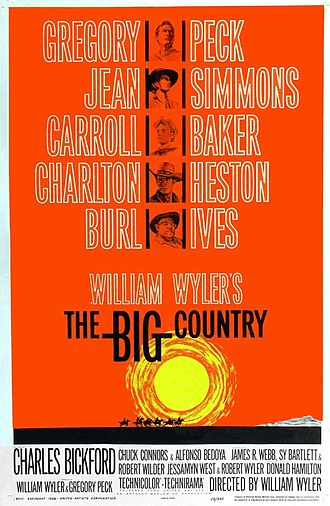
The Big Country is an epic Western centered on a Hatfields and McCoys-style conflict between two families – the Terrills and the Hannasseys – with Peck’s James McKay caught in the middle. It’s not necessarily anything new, but it’s played out so well and the characters are so believable that you just have to enjoy it. It’s also entirely too long. Two hours and forty-five minutes is nothing for William Wyler (he did make The Best Years of Our Lives, Friendly Persuasion and Ben-Hur, after all). However, the majority of his classic films could have benefitted from some more time in an editing booth. Despite its length, The Big Country is a beautifully-shot, enjoyable story of a man who refuses to stand down from his principles, no matter what. It also makes good use of Burl Ives, who otherwise doesn’t fair too well in movies in my opinion, and he’s not stuck singing “A Holly Jolly Christmas” in the background, so that’s nice.
James McKay is a wise man who travels west to join his fiancee, Patricia, at her father’s ranch. Henry Terrill is Patricia’s father, and later, James also meets the family of Terrill’s rival, Rufus Hannassey. Rufus’ son, Buck, drunkenly berates James, and much to Patricia’s surprise and dismay, James simply laughs off his jibes instead of defending himself. James also meets Patricia’s friend, Julie, a local schoolteacher, who explains the feud to him and shares his disdain for it. The next day, Terrill’s foreman tries to get James to ride a very untrained horse called “Old Thunder”, but James declines. He also presents a pair of pistols that once belonged to his father to Terrill as a gift. Terrill learns about Buck’s antics the previous night and rallies a posse together despite James’ protests. However, neither Buck nor Rufus are home when they arrive, so instead, the Terrills terrorize the women and children and shoot holes in the Hannassey water reservoir. While they’re gone, James secretly tames Old Thunder. Later, at a party hosted by Terrill for Patricia’s upcoming wedding, Rufus and his family barge in, armed, and accuse Terrill of what they did at his place previously. James visits Julie because her house sits on the river at the center of the feud. Both families want to use that river to water their livestock, and Julie and her family have allowed both families to do so without exclusivity. James asks to buy the property as a gift for Patricia and, by maintaining Julie’s rule of access for everyone, hopes to end the feud for good. However, when he tells Patricia that he intends to continue to let the Hannasseys use the river, she leaves him. Rufus attempts to lure Terrill into a trap by kidnapping Julie. To calm him, James promises Rufus that his family will still have access to the river, but Buck forces James into a duel. Buck shoots before the signal and misses, allowing James a free shot, but when Buck cowardly hides under a wagon, James lets him live. Instead of being grateful, Buck grabs a rifle to shoot him again, forcing Rufus to shoot and kill his own son. Rufus then meets Terrill in the canyon and they have a similar duel, ending in both of their deaths. With that, the feud is over and James and Julie, now clearly falling in love, ride away.
 Destined for Mediocrity