I don’t know if many people are aware of this, but Good Morning, Vietnam is a biopic of sorts. Robin Williams’ character, Adrian Cronauer, was a real airman who was stationed in Saigon and acted as a DJ for the Armed Forces Radio Service. However, that’s about where the similarities end. Robin Williams is basically Robin Williams, and was given carte blanche to improvise his time in the booth and several of his interactions with fellow military personnel. If you’ve listened to Robin Williams’ stand-up, particularly A Night at the Met, you’ll recognize some of the jokes being recycled in the film. The film is about 85% comedy, but like the best Robin Williams films, has a deep, emotional center that carries it.
It’s 1965 and Adrian Cronauer has just arrived in Saigon. He is picked up by Private Edward Garlick, probably the closest he has to a kindred spirit, and they travel to the base, where it is immediately apparent that Cronauer does not fit in with the rigid expectations of his superiors, Second Lieutenant Hauk and Sergeant Major Dickerson. Cronauer’s fellow DJs and Brigadier General Taylor are his only companions. Cronauer uses his air time to make irreverent jokes, read censored news and play rock ‘n’ roll. He follows a Vietnamese woman named Trinh to her English class. Desperate to talk to her, Cronauer pretends to be the teacher, and teaches the students profanity and slang terms. His attempts to get close to Trinh are inhibited by her brother, Tuan, but he and Tuan end up developing a friendship. The two men go to a local G.I. bar but are harassed by two racist soldiers to the point where a fight breaks out. Cronauer is reprimanded for the incident, but is allowed to continue his broadcast like normal. Days later, Cornauer returns to the bar, when Tuan rushes in and tells him Trinh wants to speak to him right away. Cronauer follows Tuan out of the building moments before it explodes. Cronauer is shaken by the incident and when it is given to him as a censored report to read over the air, he locks himself in the studio and relays the uncensored version. Dickerson suspends him for his actions and lets Hauk take over the broadcast. After a flood of angry letters and phone calls come through complaining about Hauk’s lack of humor and insistence on playing polka music on the air, Cronauer is reinstated. Before he returns to work, he is held up in traffic with Garlick behind a truckload of soldiers, and at Garlick’s insistence, gives an impromptu broadcast and jokes with the soldiers. In an attempt to be rid of Cronauer, Dickerson “allows” him to interview soldiers in the field and sends him out to the front line via a Viet-Cong controlled highway. His jeep hits a mine and he and Garlick are forced to hide from their patrols. Tuan learns what happened to Cronauer and goes to rescue him. Back at the base, it is revealed that Tuan, as part of the Viet-Cong, was responsible for blowing up the bar from earlier, and therefore his friendship with Cronauer is a liability. Cronauer is honorably discharged and leaves Saigon for good. In his absence, Garlick takes over as the fun DJ.
Robin Williams could best be described as “all over the place”. He was manic, and somehow human and not human at the same time. He had a way of disarming you with a joke and then giving you a glimpse inside his heart. It’s “all over the place”, but in the most beautiful way. For instance, in what other movie are you going to get jabs at Ho Chi Minh and an endearing, impromptu game of softball? Good Morning, Vietnam is like most Robin Williams films: rapid-fire humor on the outside, warm sentimentality on the inside. Where some of Williams’ movies go wrong is by leaning into the sentimentality so much that it dives head-first into schmaltz. Think Jack or Toys or Patch Adams (though I have a soft spot in my heart for that one). Good Morning, Vietnam is perfectly balanced, with extra weight on the comedy side over the dramatic side. The slight edge to comedy is what puts it above Dead Poets Society and Good Will Hunting for me; two great Williams films that emphasize the drama over the comedy. Like Mrs. Doubtfire, Good Morning, Vietnam is perfectly shaped for Williams’ talents and fits him like a glove. It’s the pinnacle of what that man was capable of.
Bonus Review: Stalag 17
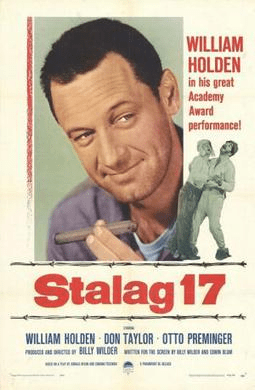
Stalag 17 is another movie about smiling in the face of war. Billy Wilder, who moved to the US in part to avoid the rise of Nazism in Germany, spent the majority of his career avoiding films about the subject of war. The only two films where World War II is a major part of the story – this one and Five Graves to Cairo – were based on plays. I don’t know if that means much, but it’s interesting to me.
Stalag 17 is about a group of men in a German POW camp. Two men, Hoffy and Frank Price set up a plan for two other airmen to escape. However, the two men are shot and killed before they can get out. This causes the men of the camp to grow suspicious of an informant amongst their group. They suspect a man named Sefton who is cynical toward the escape attempts and openly trades with the German officers. Over the course of the film, the prisoners attempt to make camp life easier. Sefton uses his ties to the guards to get parts to make a telescope and a distillery. A new man is added to their barracks named Dunbar, who Sefton knows from officers school as an idiot, and the two are at odds. The men’s radio is confiscated and Dunbar is arrested when the extent of his sabotage to the Germans is revealed. Both instances are blamed on Sefton, still believing him to be the informant, and the men beat him up. Dunbar, though arrested, cannot be tried or convicted without evidence so the Germans use the informant to try and get the details of how he made the bomb he used for evidence. Sefton witnesses Price speaking to the officers in German and suspects him of being the informant. When it’s decided that Dunbar needs to be rescued and helped in escaping, Price volunteers. Sefton accuses Price of being the informant, explaining the system he used to communicate with the officers. The men are convinced and they restrain Price and Sefton agrees to help Dunbar escape. The men throw Price out of the barracks with cans tied to his legs to stir up noise. All of the spotlights land on him, giving Dunbar and Sefton the chance to escape.
This movie is surprisingly optimistic for Billy Wilder. Even though William Holden as Sefton is as cynical as can be, we still root for him, and he still wins the day. Compare that to the tragic ending of The Great Escape and you’ll wonder whose movie you’re actually watching. While most of these POW movies end tragically, we still enjoy them because it’s about the determination and perseverance of the characters and even though things end badly, we still appreciate that they tried. Stalag 17 pretty much flips that. Sefton survives and escapes, yes, but he’s no hero. It’s no feat of endurance to make it to the end. He’s just opportunistic. It’s a great twist on the war movie modus operandi and William Holden sells it.
 Destined for Mediocrity