Give a Charlie Chaplin film sound and you’ll discover he has quite a lot to say. The Great Dictator was released in 1940, just over a year before America entered World War II, while the extent of the horrors of the concentration camps were still unknown to most of the world. Chaplin even said that if he had known what was really going on in the camps, he could not have made the film. Considering there is an eternal debate going on whether there are some things off limits to comedy or if everything is fair game, Chaplin’s statement is an interesting idea – the idea that in truly horrific subjects there is a line that, when crossed, kills comedy. However, I would argue there are no bad joke topics, only bad punchlines. Because of this, I believe my hindsight knowledge of Nazi Germany only makes me enjoy The Great Dictator more. If we can laugh in the face of tragedy, then the tragedy is conquerable.
Charlie Chaplin acknowledges the similarities between the Hitler mustache and his Tramp character’s own with this film. He plays dual roles – an unnamed Jewish barber, who is basically just the Tramp, and Adenoid Hynkel, the Phooey of Tomainia, a parody of the Fuhrer, Adolph Hitler. The film begins in World War I, where the Jewish barber is a soldier in the Tomainian army. He saves the life of Commander Schultz, but their plane crashes, and Schultz is notified of Tomainia’s surrender and the Jewish barber is carted off to the hospital. Twenty years later, the Jewish barber returns to his old profession, but suffers from amnesia. He falls in love with his neighbor, Hannah, but their time together is cut short by stormtroopers arriving and arresting the barber. They intend to kill him for resisting, but Schultz, who has been promoted to dictator Adenoid Hynkel’s number two, recognizes the barber and has the stormtroopers let him go. Hynkel is currently trying to finance his growing military through a Jewish banker named Epstein (oof, how timely), but Epstein refuses to lend him the money. In his anger, Hynkel demands a purge of the Jews. Schultz argues against this and is sent to a concentration camp. He briefly escapes and hides in the barber’s place, but both are captured and sent to the same camp. Meanwhile, Hannah and her family escape to the nearby country of Osterlich.
Benzino Napaloni, the dictator of Bacteria, visits Hynkel and they argue over which of them gets to invade Osterlich. The argument becomes a food fight, but eventually the two come to an agreement and sign a treaty declaring the invasion. This means that Hannah and her family are now trapped between a rock and a hard place. Schultz and the barber escape the camp by dressing up in the uniforms of officers, and they break for Osterlich. They witness a victory procession of the Tomainian army and are waiting for a speech from Hynkel. However, Hynkel is out duck hunting in civilian clothes and mistaken for the barber, so he is captured and thrown in the camp. Schultz convinces the barber to get up and make a speech, impersonating Hynkel. Up until this point, the barber has been completely silent, much like the Tramp has always been. The speech acts as the first time the character has ever spoken in a film. On the podium, he gives an impassioned speech, claiming he has had a change of heart and encourages all those listening to show love and kindness to their fellow man. Hannah recognizes that it’s actually the barber speaking and encourages her family to listen.
Reportedly, Chaplin was inspired to make The Great Dictator after he and another film director, Rene Clair, viewed Leni Riefenstahl’s propaganda film, Triumph of the Will, together. It is said that Clair was deeply horrified by the film, but Chaplin laughed throughout the film. He even went back and watched it several more times in order to get Hitler’s mannerisms and vocal inflection down for Hynkel (who sounds like Hitler, but he’s definitely not speaking German). The Great Dictator is a precursor to other great War spoofs such as To Be or Not to Be and Dr. Strangelove and a companion to other timely World War II comedy, such as the Donald Duck cartoon “Der Fuhrer’s Face” which borrows the song of the same name from Spike Jones, and the Three Stooges’ You Nazty Spy! While the message in The Great Dictator is inspiring and beautifully presented (that ending speech is consistently considered the greatest speech in film history), ultimately, it’s the gags that make it a joy to watch. Whether it’s Hynkel’s gibberish acting as German or his dance around the room with the globe of all he intends to conquer, there are just as many jokes in The Great Dictator as the entirety of Chaplin’s catalogue.
Bonus Review: Duck Soup
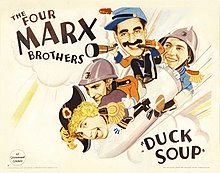
I understand the Marx Brothers are not for everybody. I know many people who consider that madcap, relentless joke barrage to be overwhelming and annoying, but for me, they’re hilarious and I appreciate the variety in their work through each brother’s individual sense of humor. Duck Soup, at the time of its release, was not as well-liked as Horse Feathers and Monkey Business, and it wasn’t receiving similar returns at the Box Office, though that can likely be chalked up to its release in 1933, right in the middle of the Great Depression. However, the years have been extremely kind to the film (except for a few outdated jokes and references) and it is now considered their best work. Rightfully so, in my opinion, though Horse Feathers and A Night at the Opera sure come close.
Rufus T. Firefly is appointed leader of the struggling country of Freedonia, thanks to an ultimatum by the country’s greatest benefactor, the widow Mrs. Teasdale. The ambassador of the neighboring country, Sylvania, named Trentino, sends his spies Chicolini and Pinky to Freedonia, hoping to find something on Firefly that will encourage Freedonia to revolt against him. Chicolini and Pinky fail to find anything, and so Chicolini takes up selling peanuts from a cart outside Firefly’s office. Firefly impulsively makes Chicolini his Secretary of War. Soon after, Firefly’s second-in-command, Bob Roland, speaks with him over his suspicions of Trentino’s plot. He argues that Firefly can rile the man up with insults in hopes that Trentino will slap him, inciting his removal as ambassador. Firefly agrees, but when he tries to get at Trentino, he instead riles himself up and ends up slapping him instead. Trentino discovers from another spy named Vera Marcal that Mrs. Teasdale is in possession of Freedonia’s plans of war, and so he decides to send Vera, Chicolini and Pinky to steal them. Firefly catches Chicolini in the act, and puts him on trial. During said trial, war breaks out between Freedonia and Sylvania. From here, the film descends into anarchy. Everyone at the trial is so excited by the idea of war that they break out into song. Then a battle breaks out between the two countries in the courtroom. The film ends with Firefly, Chicolini, Pinky and Roland pelting Trentino with tomatoes. Mrs. Teasdale begins to sing the Freedonia national anthem (probably the 100th time the song has been heard in the film) and so the men turn the tomatoes on her.
Duck Soup contains some of the Marx Brothers’ most famous gags. In particular, the mirror scene, where Harpo imitates Groucho to make him believe he is looking in a mirror, which has been referenced and parodied in films and television since the movie was released. The ending sequence is so incredibly bonkers and sheer anarchy that you can’t help but laugh. If you’re looking for a lighthearted war spoof, both Duck Soup and The Great Dictator are excellent options, but Duck Soup is a tad bit lighter, if that’s your preference.
 Destined for Mediocrity