When you’re as prolific a writer as Stephen King, they can’t all be winners (re: these reviews), but The Green Mile is one of his best, and the film version is honestly better. Despite being over three hours, it’s tighter and flows smoother than the book, which could have benefitted from an editor (like a lot of King’s books). Also different from other King novels, The Green Mile isn’t really a horror story. It has some horror elements and a very supernatural premise, but comparatively, it’s much more grounded than what you’d expect.
Paul Edgecomb (Tom Hanks) is the supervisor over the correctional officers at Cold Mountain Penitentiary: Brutal, Dean, Harry and Percy. Most of them are easy to work with, except for Percy, who takes sadistic pleasure in torturing the inmates and flaunts his connections as the state governor’s nephew to avoid punishment. He takes particular pleasure in breaking the fingers of one of the inmates, Del, and killing his pet mouse, Mr. Jingles. The new inmate, John Coffey (Michael Clarke Duncan), arrives and, despite being a towering black man, he has the meekest personality that Paul has ever come across. He’s a gentle giant who has a healing touch, and he shares that gift with Paul, by clearing up a bladder infection, and with Del by reviving Mr. Jingles. When John cures the warden’s wife from a brain tumor, Paul understands the impartiality of John’s gift. Once John has touched someone, he takes on their pain and has to find a way to release it or he will die. John releases the the energy of the brain tumor into Percy, which makes Percy walk up to the cell of the newest inmate, “Wild Bill” Wharton, and shoot him. John, who is in prison for allegedly raping and killing two little girls, touches Paul and shows him in a vision that Wharton committed the crime he is accused of. Paul, knowing the truth about John, offers to let him go free and suffer the consequences, but John admits that, as scared of being executed as he is, death would be a relief from the cruel world.
Michael Clarke Duncan portrays John Coffey with duality – a man so physically overwhelming and yet so timid that he’s afraid of the dark. He seems like such a natural that you can easily forget that this is only like his second movie where he doesn’t play a bouncer or bodyguard, which he had hands-on experience with. In fact, he was the bodyguard for Notorious B.I.G., though a friend was working in his place on the night Biggie was shot. Duncan quit being a bodyguard soon after the incident. He then had a string of great movie performances, including this one, and then sort of got regulated to direct-to-video and TV movies. I’m not sure why, since he was so clearly great, but my assumption is typecasting. Michael Clarke Duncan died in 2012. He was only 54.
Bonus Review: Big Fish
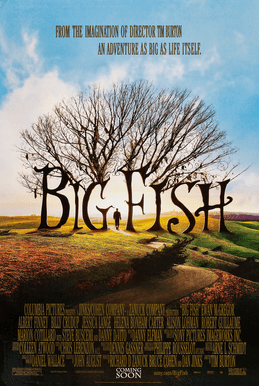
Big Fish is the story of an estranged father and son who attempt to reconcile on the father’s deathbed. Will’s father, Edward, has a gift for storytelling, possibly with some embellishments. The fantastical nature of Edward’s stories convinces Will that they’re lies and so he decides he doesn’t want to raise his family around his father. However, just a matter of years after Will’s marriage, Edward develops cancer and slowly withers away. Will and his wife, Josephine, take care of Edward in his home in Alabama where he tells Josephine the stories Will has heard his entire life. Over the course of his life, Edward has supposedly come across and befriended witches, giants, ringmasters who are secretly werewolves, poets, and Siamese twins. He was a circus performer and fought in Korea. Quite a colorful life. Will decides to investigate his father’s claims and learns there may be more truth to them than he believed. Upon his return, Will learns his father has had a stroke and is in the hospital. Edward, who now cannot tell his stories, asks Will to tell him the story of how he will die. Will spins a yarn of their escape from the hospital to a lake where all of Edward’s friends are waiting. There, Will helps his dad into the water where he turns into a giant catfish. Satisfied, Edward dies peacefully. At his funeral, Will meets many of the characters from Edward’s stories and is surprised that they were only slightly embellished.
The father-son relationship is the core of Big Fish, but there are some other major themes at play too. It acts as an analysis of how we process death (which is why I paired it with The Green Mile), and also argues for the joy in storytelling – and that love for storytelling is certainly the key. Visually, it’s Tim Burton’s least-Tim-Burton-y movie, but at it’s heart, it’s probably his most genuine. Edward’s stories could each be their own Burton film, honestly, and that’s why the movie works so well. It’s a feel good movie with some meat on it, and is therefore, one of if not my most highly recommended Tim Burton movie.
 Destined for Mediocrity